
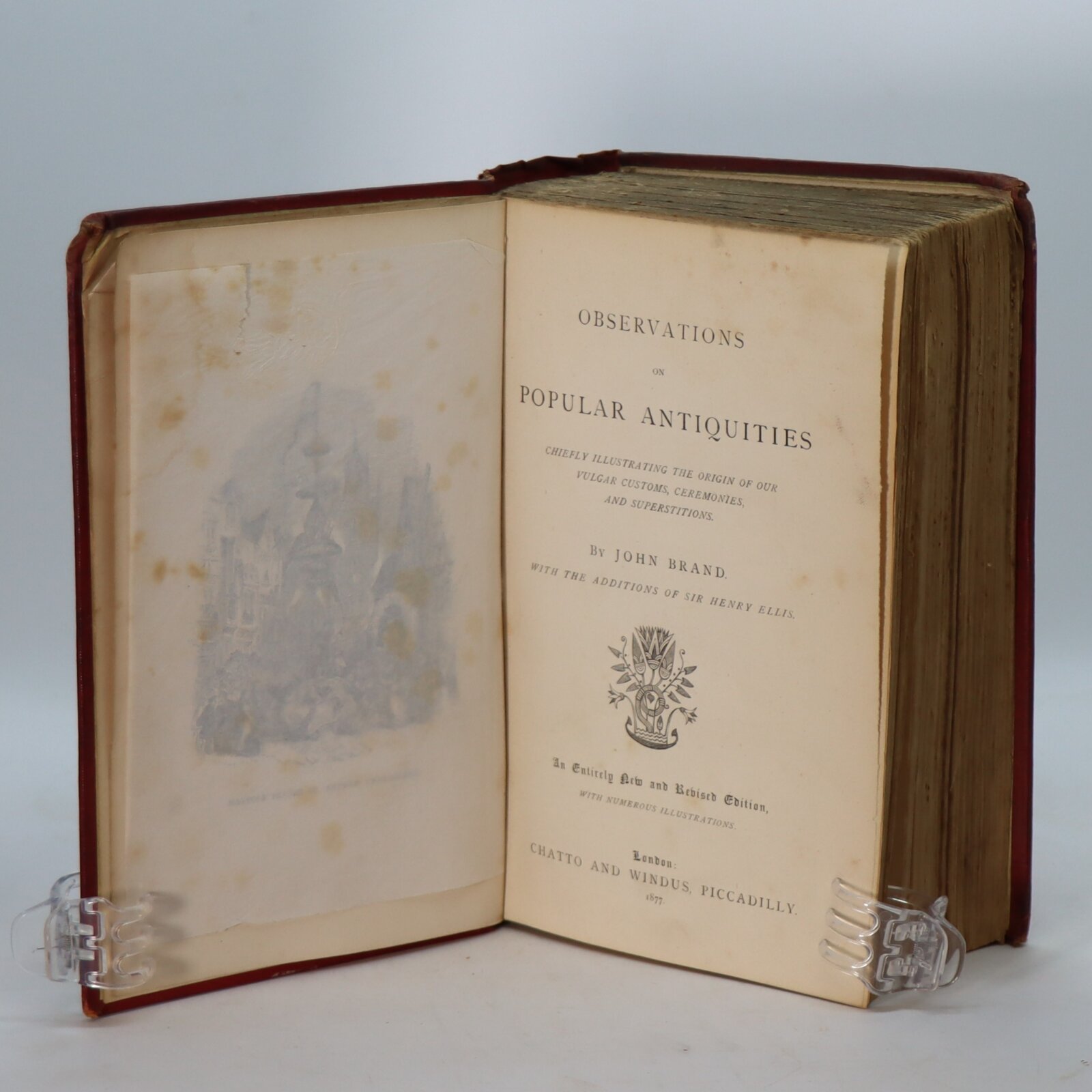
Brand's Observations on Popular Antiquities.
By John Brand
Printed: 1877
Publisher: Chatto & Windus. London
| Dimensions | 15 × 20 × 6 cm |
|---|---|
| Language |
Language: English
Size (cminches): 15 x 20 x 6
Condition: Fine (See explanation of ratings)
SORRY, THIS ITEM HAS SOLD


Item information
Description
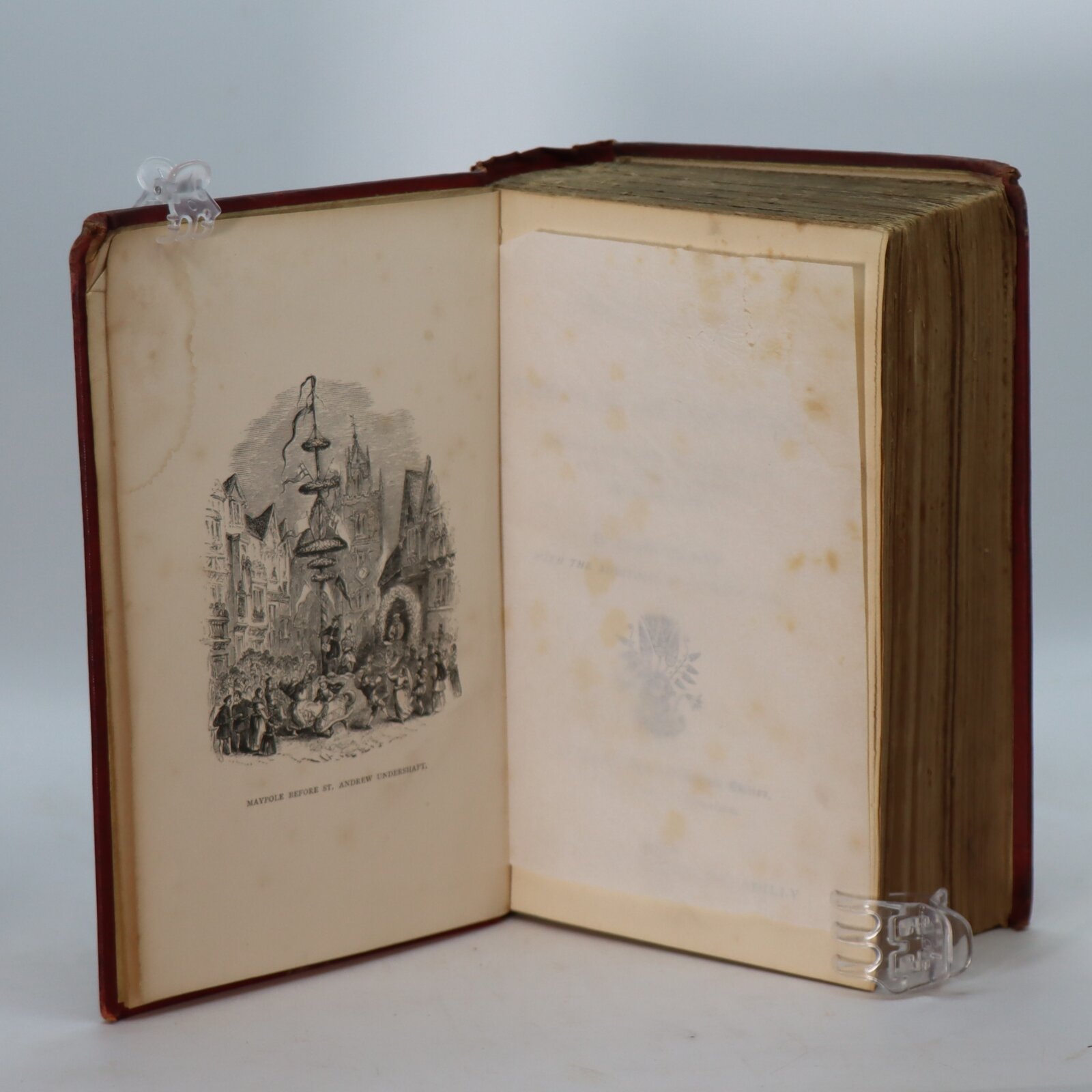
Red cloth binding with gilt embossed bear baiting scene and black decoration on the front boards. Gilt title and scene on the spine.
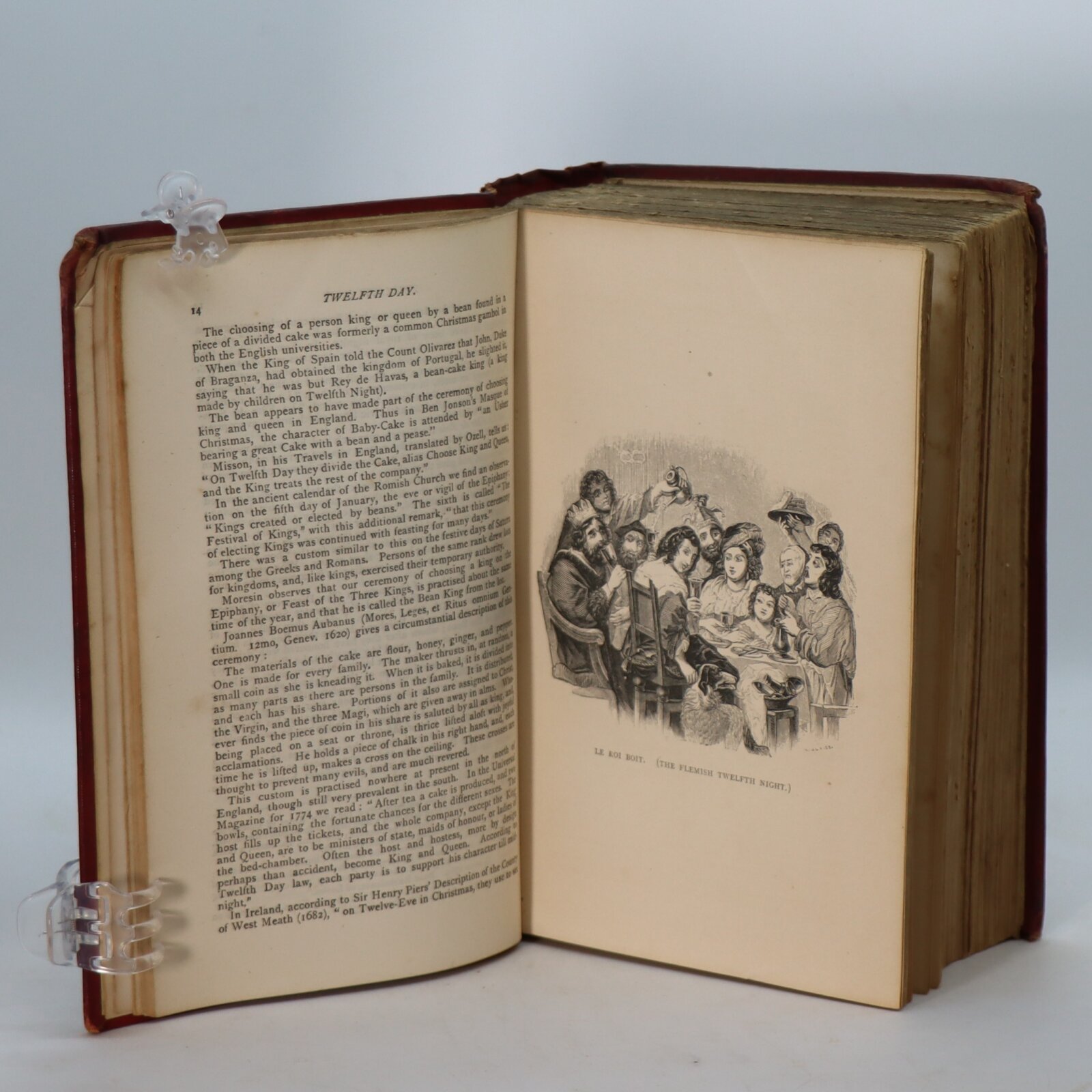
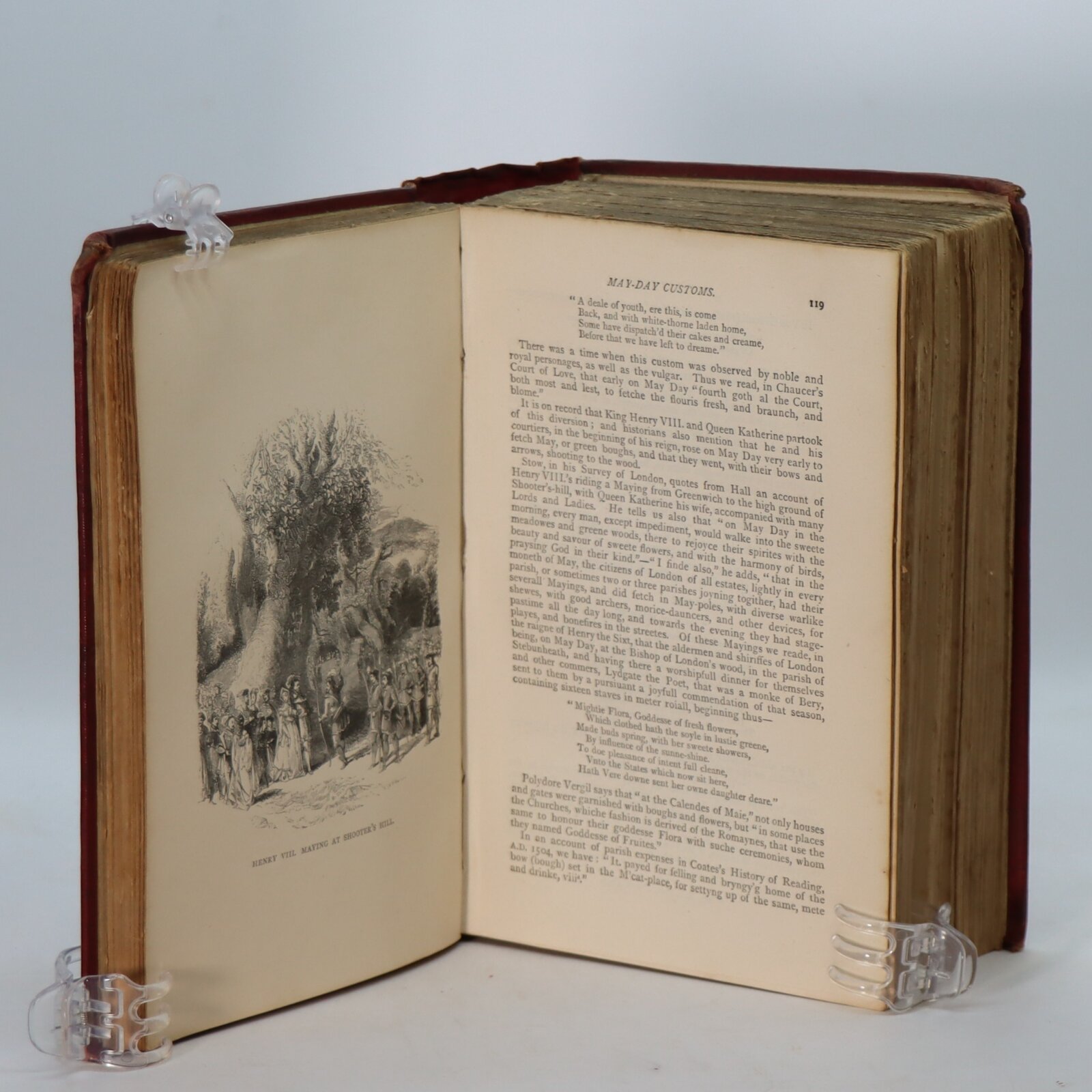
F.B.A. provides an in-depth photographic presentation of this item to stimulate your feel and touch. More traditional book descriptions are immediately available.
An extremely well kept book
John Brand (19 August 1744 – 11 September 1806) was an English antiquarian and Church of England clergyman. He was author of Observations on Popular Antiquities: including the whole of Mr Bourne’s “Antiquitates Vulgares,” with addenda to every chapter of that work.
Brand wrote Observations on the popular antiquities of Great Britain: Including the Whole of Mr. Bourne’s Antiquitates Vulgares (1777), generally referred to as Popular Antiquities. (The incorporated work was the Popular Antiquities of Henry Bourne, published 1725, with Brand’s own extensive annotations). Material from it was afterwards broadly incorporated into William Hone’s Every Day Book, Year Book, etc., and in Chambers’ Book of Days, which had wide popular circulation. The Popular Antiquities were further revised and enlarged by Sir Henry Ellis. The expression “popular antiquities” was overtaken in the 19th century by “folklore”. The book was again reworked as an alphabetical dictionary in Faiths and folklore ; a dictionary of national beliefs, superstitions and popular customs, (1905) by William Carew Hazlitt.
Sir Henry Ellis KH FRS FSA (29 November 1777 – 15 January 1869) was an English librarian and antiquarian, for a long period principal librarian at the British Museum.
In 1798 Ellis published at the age of twenty-one his History of St. Leonard’s, Shoreditch, and Liberty of Norton Folgate. As an antiquarian, his contributions to Archaeologia were numerous. In 1813 he edited John Brand’s Popular Antiquities, a work going back to Henry Bourne. For Rees’s Cyclopædia, Ellis contributed articles on Antiquities and other subjects, but the topics are not known.
Henry Bourne (c.1694 – 16 February 1733) was an English historian, who is remembered for his Antiquitates Vulgares (1725), a pioneering work in the field of folklore studies, and for his substantial history of his home town of Newcastle upon Tyne (1736).
Bourne was born in Newcastle, the son of Thomas Bourne, a tailor, in about 1694: he was baptised on 16 December 1694. His father originally had him apprenticed as a glazier; but he showed such promise that he was sent to the Royal Free Grammar School in Newcastle, where he flourished, eventually winning a scholarship to Cambridge under the tutelage of The Reverend Mr. Thomas Atherton, a fellow Novocastrian.
He was appointed curate at All Hallows Church in Newcastle in 1724 and held the position until his death in 1733.
In 1725 Bourne published his most acclaimed work, Antiquitates Vulgares, or, Antiquities of the Common People. This provided a record of various folk customs and ceremonies in England, although its more pragmatic aim was to identify those customs that might be encouraged, and those that should be abolished or regulated.
His huge and very complete history of Newcastle was not quite finished upon his death in Newcastle on 16 February 1733. It was published posthumously in 1736 under the title The History of Newcastle upon Tyne, or the Ancient and Present State of that Town.
Rees’s Cyclopædia, in full The Cyclopædia; or, Universal Dictionary of Arts, Sciences, and Literature was an important 19th-century British encyclopaedia edited by Rev. Abraham Rees (1743–1825), a Presbyterian minister and scholar who had edited previous editions of Chambers’s Cyclopædia.
Want to know more about this item?
We are happy to answer any questions you may have about this item. In addition, it is also possible to request more photographs if there is something specific you want illustrated.
Ask a question
Related products



Share this Page with a friend
