
Beaumont & Fletcher. 14 Volumes.
By Henry Weber
Printed: 1812
Publisher: F C & J Rivington. Edinburgh
| Dimensions | 15 × 22 × 3.5 cm |
|---|---|
| Language |
Language: English
Size (cminches): 15 x 22 x 3.5
Condition: Fine (See explanation of ratings)
THIS ITEM WILL BE AVAILABLE SOON
SORRY, THIS ITEM HAS SOLD


Item information
Description
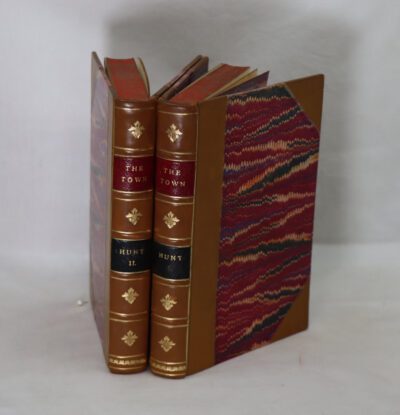
Full tan calf. Brown and tan title plates with gilt lettering. Dimensions are for one volume.
FIRST EDITION of a compilation by Henry William Weber (1783–1818) who was an English editor of plays and romances and literary assistant of Sir Walter Scott.
Weber was born in 1783, allegedly in St. Petersburg, and is said to have been the son of a Westphalian who married an Englishwoman. He was sent with his mother to Edinburgh “by some of the London booksellers in a half-starved state.” Sir Walter Scott employed him from August 1804 as his amanuensis and secured for him profitable work in literature. Weber was described as affectionate but imbued with Jacobin principles by Scott. (Scott, Journal, 1890, i. 149). After Christmas 1813 a fit of madness seized Weber at dusk, at the close of a day’s work in the same room with his employer. He produced a pair of pistols and challenged Scott to mortal combat. A parley ensued, and Weber dined with the Scotts; next day he was put under restraint. His friends, with some assistance from Scott, supported him, “a hopeless lunatic,” in an asylum at York. There he died in June 1818.
Beaumont and Fletcher were the English dramatists Francis Beaumont and John Fletcher, who collaborated in their writing during the reign of James I (1603–25).
They became known as a team early in their association, so much so that their joined names were applied to the total canon of Fletcher, including his solo works and the plays he composed with various other collaborators including Philip Massinger and Nathan Field.
The first Beaumont and Fletcher folio of 1647 contained 35 plays; 53 plays were included in the second folio in 1679. Other works bring the total plays in the canon to about 55. While scholars and critics will probably never render a unanimous verdict on the authorship of all these plays—especially given the difficulties of some of the individual cases—contemporary scholarship has arrived at a corpus of about 12 to 15 plays that are the work of both men.
The plays generally recognised as Beaumont/Fletcher collaborations:
- The Woman Hater, comedy (1606; printed 1607)
- Cupid’s Revenge,tragedy (c. 1607–12; printed 1615)
- Philaster, or Love Lies a-Bleeding, tragicomedy (c. 1609; printed 1629)
- The Maid’s Tragedy, tragedy (c. 1609; printed 1619)
- A King and No King, tragicomedy (1611; printed 1619)
- The Captain, comedy (c. 1609–12; printed 1647)
- The Scornful Lady, comedy (c. 1613; printed 1616)
- Love’s Pilgrimage, tragicomedy (c. 1615–16; 1647)
- The Noble Gentleman, comedy (licensed 3 February 1626; printed 1647).
Beaumont/Fletcher plays, later revised by Massinger:
- Thierry and Theodoret, tragedy (c. 1607?; printed 1621)
- The Coxcomb, comedy (1608–10; printed 1647)
- Beggars’ Bush, comedy (c. 1612–13?; revised 1622?; printed 1647)
- Love’s Cure, comedy (c. 1612–13?; revised 1625?; printed 1647).
Due to Fletcher’s distinctive pattern of contractional forms and linguistic preferences (‘em for them, ye for you, etc.), his hand can be fairly readily distinguished from Beaumont’s in their collaborative works. In A King and No King, Beaumont wrote Acts I, II, and III in their entirety, plus scene IV,iv and V,ii and iv, while Fletcher wrote only the first three scenes in Act IV (IV,i-iii) and the first and third scenes of Act V (V,i and iii). The play is more Beaumont’s than it is Fletcher’s. Beaumont also dominates in The Maid’s Tragedy, The Noble Gentleman, Philaster, and The Woman Hater. In contrast, The Captain, The Coxcomb, Cupid’s Revenge, Beggars’ Bush, and The Scornful Lady contain more of Fletcher’s work than Beaumont’s. The cases of Thierry and Theodoret and Love’s Cure are somewhat confused by Massinger’s revision; but in these plays too, Fletcher appears the dominant partner.
Critics and scholars debate other plays. Fletcher clearly wrote the last two quarters of Four Plays in One, another play in his canon—and he clearly didn’t write the first two sections. Many scholars attribute the play’s first half to Nathan Field—though some prefer Beaumont. Given the limits of the existing evidence, some of these questions may be unresolvable with currently available techniques.
Francis Beaumont (1584 – 6 March 1616) was a dramatist in the English Renaissance theatre, most famous for his collaborations with John Fletcher.
Beaumont was the son of Sir Francis Beaumont of Grace Dieu, near Thringstone in Leicestershire, a justice of the common pleas. His mother was Anne, the daughter of Sir George Pierrepont (d. 1564), of Holme Pierrepont, and his wife Winnifred Twaits. Beaumont was born at the family seat and was educated at Broadgates Hall (now Pembroke College, Oxford) at age thirteen. Following the death of his father in 1598, he left university without a degree and followed in his father’s footsteps by entering the Inner Temple in London in 1600.
Accounts suggest that Beaumont did not work long as a lawyer. He became a student of poet and playwright Ben Jonson; he was also acquainted with Michael Drayton and other poets and dramatists, and decided that was where his passion lay. His first work, Salmacis and Hermaphroditus, appeared in 1602. The 1911 edition of the Encyclopædia Britannica describes the work as “not on the whole discreditable to a lad of eighteen, fresh from the popular love-poems of Marlowe and Shakespeare, which it naturally exceeds in long-winded and fantastic diffusion of episodes and conceits.” In 1605, Beaumont wrote commendatory verses to Jonson’s Volpone.
Beaumont’s collaboration with Fletcher may have begun as early as 1605. They had both hit an obstacle early in their dramatic careers with notable failures; Beaumont’s The Knight of the Burning Pestle, first performed by the Children of the Blackfriars in 1607, was rejected by an audience who, the publisher’s epistle to the 1613 quarto claims, failed to note “the privie mark of irony about it;” that is, they took Beaumont’s satire of old-fashioned drama as an old-fashioned drama. The play received a lukewarm reception. The following year, Fletcher’s Faithful Shepherdess failed on the same stage. In 1609, however, the two collaborated on Philaster, which was performed by the King’s Men at the Globe Theatre and at Blackfriars. The play was a popular success, not only launching the careers of the two playwrights but also sparking a new taste for tragicomedy. According to a mid-century anecdote related by John Aubrey, they lived in the same house on the Bankside in Southwark, “sharing everything in the closest intimacy.” About 1613 Beaumont married Ursula Isley, daughter and co-heiress of Henry Isley of Sundridge in Kent, by whom he had two daughters; Elizabeth and Frances (a posthumous child). He had a stroke between February and October 1613, after which he wrote no more plays, but was able to write an elegy for Lady Penelope Clifton, who died 26 October 1613. Beaumont died in 1616 and was buried in Westminster Abbey. Although today Beaumont is remembered as a dramatist, during his lifetime he was also celebrated as a poet.
It was once written of Beaumont and Fletcher that “in their joint plays their talents are so…completely merged into one, that the hand of Beaumont cannot clearly be distinguished from that of Fletcher.” Yet this romantic notion did not stand up to critical examination.
In the seventeenth century, Sir Aston Cockayne, a friend of Fletcher’s, specified that there were many plays in the 1647 Beaumont and Fletcher folio that contained nothing of Beaumont’s work, but rather featured the writing of Philip Massinger. Nineteenth- and twentieth-century critics like E.H.C. Oliphant subjected the plays to a self-consciously literary, and often subjective and impressionistic, reading – but nonetheless began to differentiate the hands of the collaborators. This study was carried much farther, and onto a more objective footing, by twentieth-century scholars, especially Cyrus Hoy. Short of absolute certainty, a critical consensus has evolved on many plays in the canon of Fletcher and his collaborators; in regard to Beaumont, the schema below is among the least controversial that has been drawn.
By Beaumont alone:
- The Knight of the Burning Pestle, comedy (performed 1607; printed 1613)
- The Masque of the Inner Temple and Gray’s Inn, masque (performed 20 February 1613; printed 1613?)
With Fletcher:
- The Woman Hater, comedy (1606; 1607)
- Cupid’s Revenge, tragedy (c. 1607–12; 1615)
- Philaster, or Love Lies a-Bleeding, tragicomedy (c. 1609; 1620)
- The Maid’s Tragedy, tragedy (c. 1609; 1619)
- A King and No King, tragicomedy (1611; 1619)
- The Captain, comedy (c. 1609–12; 1647)
- The Scornful Lady, comedy (c. 1613; 1616)
- Love’s Pilgrimage, tragicomedy (c. 1615–16; 1647)
- The Noble Gentleman, comedy (licensed 3 February 1626; 1647)
Beaumont/Fletcher plays, later revised by Massinger:
- Thierry and Theodoret, tragedy (c. 1607?; 1621)
- The Coxcomb, comedy (c. 1608–10; 1647)
- Beggars’ Bush, comedy (c. 1612–13?; revised 1622?; 1647)
- Love’s Cure, comedy (c. 1612–13?; revised 1625?; 1647)
Because of Fletcher’s highly distinctive and personal pattern of linguistic preferences and contractional forms (ye for you, ‘em for them, etc.), his hand can be distinguished fairly easily from Beaumont’s in their collaborations. In A King and No King, for example, Beaumont wrote all of Acts I, II, and III, plus scenes IV. iv and V. ii & iv; Fletcher wrote only the first three scenes in Act IV (IV, i–iii) and the first and third scenes in Act V (V, i & iii) – so that the play is more Beaumont’s than Fletcher’s. The same is true of The Woman Hater, The Maid’s Tragedy, The Noble Gentleman, and Philaster. On the other hand, Cupid’s Revenge, The Coxcomb, The Scornful Lady, Beggar’s Bush, and The Captain are more Fletcher’s than Beaumont’s. In Love’s Cure and Thierry and Theodoret, the influence of Massinger’s revision complicates matters; but in those plays too, Fletcher appears to be the majority contributor, Beaumont the minority.
John Fletcher (1579–1625) was a Jacobean playwright. Following William Shakespeare as house playwright for the King’s Men, he was among the most prolific and influential dramatists of his day; during his lifetime and in the early Restoration, his fame rivalled Shakespeare’s. He collaborated on writing plays with Francis Beaumont, and also with Shakespeare on two plays.
Though his reputation has declined since, Fletcher remains an important transitional figure between the Elizabethan popular tradition and the popular drama of the Restoration.
Fletcher was born in December 1579 (baptised 20 December) in Rye, Sussex, and died of the plague in August 1625 (buried 29 August in St. Saviour’s, Southwark). His father Richard Fletcher was an ambitious and successful cleric who was in turn Dean of Peterborough, Bishop of Bristol, Bishop of Worcester and Bishop of London (shortly before his death), as well as chaplain to Queen Elizabeth. As Dean of Peterborough, Richard Fletcher, at the execution of Mary, Queen of Scots, at Fotheringay Castle, “knelt down on the scaffold steps and started to pray out loud and at length, in a prolonged and rhetorical style as though determined to force his way into the pages of history”. He cried out at her death, “So perish all the Queen’s enemies!”
Richard Fletcher died shortly after falling out of favour with the Queen, over a marriage she had advised against. He appears to have been partly rehabilitated before his death in 1596 but he died substantially in debt. The upbringing of John Fletcher and his seven siblings was entrusted to his paternal uncle Giles Fletcher, a poet and minor official. His uncle’s connexions ceased to be a benefit and may even have become a liability after the rebellion of Robert Devereux, the Earl of Essex, who had been his patron. Fletcher appears to have entered Corpus Christi College, Cambridge, in 1591, at the age of eleven. It is not certain that he took a degree but evidence suggests that he was preparing for a career in the church. Little is known about his time at college but he evidently followed the path previously trodden by the University wits before him, from Cambridge to the burgeoning commercial theatre of London.
Collaborations with Beaumont
In 1606, he began to appear as a playwright for the Children of the Queen’s Revels, then performing at the Blackfriars Theatre. Commendatory verses by Richard Brome in the Beaumont and Fletcher 1647 folio place Fletcher in the company of Ben Jonson; a comment of Jonson’s to Drummond corroborates this claim, although it is not known when this friendship began. At the beginning of his career, his most important association was with Francis Beaumont. The two wrote together for close on a decade, first for the children and then for the King’s Men. According to an anecdote transmitted or invented by John Aubrey, they also lived together (in Bankside), sharing clothes and having “one wench in the house between them”. This domestic arrangement, if it existed, was ended by Beaumont’s marriage in 1613 and their dramatic partnership ended after Beaumont fell ill, probably of a stroke, the same year.
Successor to Shakespeare
By this time, Fletcher had moved into a closer association with the King’s Men. He collaborated with Shakespeare on Henry VIII, The Two Noble Kinsmen and the lost Cardenio, which is probably (according to some modern scholars) the basis for Lewis Theobald’s play Double Falsehood. A play he wrote singly around this time, The Woman’s Prize or the Tamer Tamed, is a sequel to The Taming of the Shrew. In 1616, after Shakespeare’s death, Fletcher appears to have entered into an exclusive arrangement with the King’s Men similar to Shakespeare’s. Fletcher wrote only for that company between the death of Shakespeare and his death nine years later. He never lost his habit of collaboration, working with Nathan Field and later with Philip Massinger, who succeeded him as house playwright for the King’s Men. His popularity continued throughout his life; during the winter of 1621, three of his plays were performed at court. He died in 1625, apparently of the plague. He seems to have been buried in what is now Southwark Cathedral, although the precise location is not known; there is a reference by Aston Cockayne to a common grave for Fletcher and Massinger (also buried in Southwark). What is more certain is that two simple adjacent stones in the floor of the Choir of Southwark Cathedral, one marked ‘Edmond Shakespeare 1607’ the other ‘John Fletcher 1625’ refer to Shakespeare’s younger brother and the playwright. His mastery is most notable in two dramatic types, tragicomedy and comedy of manners.
Fletcher’s early career was marked by one significant failure, of The Faithful Shepherdess, his adaptation of Giovanni Battista Guarini’s Il Pastor Fido, which was performed by the Blackfriars Children in 1608. In the preface to the printed edition of his play, Fletcher explained the failure as due to his audience’s faulty expectations. They expected a pastoral tragicomedy to feature dances, comedy and murder, with the shepherds presented in conventional stereotypes—as Fletcher put it, wearing “gray cloaks, with curtailed dogs in strings”. Fletcher’s preface in defence of his play is best known for its pithy definition of tragicomedy: “A tragicomedy is not so called in respect of mirth and killing, but in respect it wants [i.e., lacks] deaths, which is enough to make it no tragedy; yet brings some near it, which is enough to make it no comedy”. A comedy, he went on to say, must be “a representation of familiar people” and the preface is critical of drama that features characters whose action violates nature.
Fletcher appears to have been developing a new style faster than audiences could comprehend. By 1609, however, he had found his voice. With Beaumont, he wrote Philaster, which became a hit for the King’s Men and began a profitable connexion between Fletcher and that company. Philaster appears also to have initiated a vogue for tragicomedy; Fletcher’s influence has been credited with inspiring some features of Shakespeare’s late romances (Kirsch, 288–90) and his influence on the tragicomic work of other playwrights is even more marked. By the middle of the 1610s, Fletcher’s plays had achieved a popularity that rivalled Shakespeare’s and cemented the pre-eminence of the King’s Men in Jacobean London. After Beaumont’s retirement and early death in 1616, Fletcher continued working, singly and in collaboration, until his death in 1625. By that time, he had produced or had been credited with, close to fifty plays. This body of work remained a big part of the King’s Men’s repertory until the closing of the theatres in 1642.
During the Commonwealth, many of the playwright’s best-known scenes were kept alive as drolls, the brief performances devised to satisfy the taste for plays while the theatres were suppressed. At the re-opening of the theatres in 1660, the plays in the Fletcher canon, in original form or revised, were by far the most common fare on the English stage. The most frequently revived plays suggest the developing taste for comedies of manners. Among the tragedies, The Maid’s Tragedy and especially, Rollo Duke of Normandy held the stage. Four tragicomedies (A King and No King, The Humorous Lieutenant, Philaster and The Island Princess) were popular, perhaps in part for their similarity to and foreshadowing of heroic drama. Four comedies (Rule a Wife And Have a Wife, The Chances, Beggars’ Bush and especially The Scornful Lady) were also popular. Fletcher’s plays, relative to those of Shakespeare and to new productions, declined. By around 1710, Shakespeare’s plays were more frequently performed and the rest of the century saw a steady erosion in performance of Fletcher’s plays. By 1784, Thomas Davies asserted that only Rule a Wife and The Chances were still on stage. A generation later, Alexander Dyce mentioned only The Chances. Since then Fletcher has increasingly become a subject only for occasional revivals and for specialists. Fletcher and his collaborators have been the subject of important bibliographic and critical studies but the plays have been revived only infrequently.
PLAYS
Because Fletcher collaborated regularly and widely, attempts to separate Fletcher’s work from this collaborative fabric have experienced difficulties in attribution. Fletcher collaborated most often with Beaumont and Massinger but also with Nathan Field, Shakespeare and others. Some of his early collaborations with Beaumont were later revised by Massinger, adding another layer of complexity to the collaborative texture of the works. According to scholars such as Hoy, Fletcher used distinctive mannerisms that Hoy argued identify his presence. According to Hoy’s figures, he frequently uses ye instead of you at rates sometimes approaching 50 per cent. He employs ‘em for them, along with a set of other preferences in contractions. He adds a sixth stressed syllable to a standard pentameter verse line—most often sir but also too or still or next. Various other habits and preferences may reveal his hand. The detection of this pattern, a Fletcherian textual profile, has persuaded some researchers that they have penetrated the Fletcher canon with what they consider success—and has in turn encouraged the use of similar techniques in the study of literature. Scholars such as Jeffrey Masten and Gordon McMullan, have pointed out limitations of logic and method in Hoy’s and others’ attempts to distinguish playwrights on the basis of style and linguistic preferences.
Bibliography has attempted to establish the writers of each play. Attempts to determine the exact “shares” of each writer. in particular plays continues, based on patterns of textual and linguistic preferences, style and idiosyncrasies of spelling.
The list that follows gives a tentative verdict on the writing of the plays in Fletcher’s canon, with likeliest composition dates, dates of first publication and dates of licensing by the Master of the Revels, where available.
Solo Plays
- The Faithful Shepherdess, pastoral (written 1608–09; printed 1609?)
- Valentinian, tragedy (1610–14; 1647)
- Monsieur Thomas, comedy (c. 1610–16; 1639)
- The Woman’s Prize, or The Tamer Tamed, comedy (c. 1611; 1647)
- Bonduca, tragedy (1611–14; 1647)
- The Chances, comedy (c. 1613–25; 1647)
- Wit Without Money ,comedy (c. 1614; 1639)
- The Mad Lover, tragicomedy (acted 5 January 1617; 1647)
- The Loyal Subject, tragicomedy (licensed 16 November 1618; revised 1633?; 1647)
- The Humorous Lieutenant, tragicomedy (c. 1619; 1647)
- Women Pleased, tragicomedy (c. 1619–23; 1647)
- The Island Princess, tragicomedy (c. 1620; 1647)
- The Wild Goose Chase, comedy (c. 1621; 1652)
- The Pilgrim, comedy (c. 1621; 1647)
- A Wife for a Month, tragicomedy (licensed 27 May 1624; 1647)
- Rule a Wife and Have a Wife, comedy (licensed 19 October 1624; 1640)
Collaborations
With Francis Beaumont:
- The Woman Hater, comedy (1606; 1607)
- Cupid’s Revenge, tragedy (c. 1607–12; 1615)
- Philaster, or Love Lies a-Bleeding, tragicomedy (c. 1609; 1620)
- The Maid’s Tragedy, Tragedy (c. 1609; 1619)
- A King and No King, tragicomedy (1611; 1619)
- The Captain, comedy (c. 1609–12; 1647)
- The Scornful Lady, comedy (c. 1613; 1616)
- Love’s Pilgrimage, tragicomedy (c. 1615–16; 1647)
- The Noble Gentleman, comedy (c. 1613?; licensed 3 February 1626; 1647)
With Beaumont and Massinger:
- Thierry and Theodoret, tragedy (c. 1607; 1621)
- The Coxcomb, comedy (c. 1608–10; 1647)
- Beggars’ Bush, comedy (c. 1612–13; revised 1622?; 1647)
- Love’s Cure, comedy (c. 1612–13; revised 1625?; 1647)
With Shakespeare:
- Henry VIII, history (c. 1613; 1623)
- The Two Noble Kinsmen, tragicomedy (c. 1613; 1634)
- Cardenio, tragicomedy? (c. 1613)
Nathan Field (also spelled Feild occasionally; 17 October 1587 – 1620) was an English dramatist. He was also an actor. Field, as a member of the Children of the Queen’s Revels, Field acted in the innovative drama staged at Blackfriars in the first years of the 17th century. Cast lists associate him with Ben Jonson’s Cynthia’s Revels (1600) and The Poetaster (1601); a 1641 quarto associated him with George Chapman’s Bussy D’Ambois.
Later in the decade, he performed in Epicoene and, perhaps, played Humphrey in Francis Beaumont’s The Knight of the Burning Pestle. During the same years, he wrote commendatory verses for Jonson’s Volpone and Catiline, and for John Fletcher’s The Faithful Shepherdess.
Field was presumably also among those of the children’s company briefly imprisoned for the official displeasure occasioned by Eastward Hoe and John Day’s The Isle of Gulls; the latter imprisonment was in Bridewell Prison.
Field stayed with a children’s company until 1613, his twenty-sixth year. He appears to be the only one of the boy actors of 1600 to remain with the Blackfriars troupe when, in 1609, Philip Rosseter and Robert Keysar assumed control of the company. In this company, he performed in the theatre in Whitefriars and, frequently, at court, in plays such as Beaumont and Fletcher’s The Coxcomb. From the latter years of this period come the first of his plays: A Woman is a Weathercock and The Honest Man’s Fortune (the latter with Fletcher and Philip Massinger).
In 1613, Rosseter combined his company with the Lady Elizabeth’s Men, managed by Philip Henslowe. Performing at the Swan Theatre and Hope Theatre, Field acted in Thomas Middleton’s A Chaste Maid in Cheapside and Jonson’s Bartholomew Fair. For the latter play, in which he may have performed as Cokes or Littlewit, he received payment for the company after a performance at court. These years witnessed some degree of tumult; Henslowe’s business practices resulted in his actors’ drawing up certain “articles of grievance” against him, and Rosseter’s attempt to build a new private theatre (Porter’s Hall) in Blackfriars was blocked by the city and Privy Council. This period ended when Henslowe died, Rosseter abandoned his plans, and Lady Elizabeth’s Men briefly merged and then separated from Prince Charles’s Men, thereafter, touring in the country. For Field, the period had a presumably more satisfactory end: by late 1616, he had joined the King’s Men.
With the King’s Men, Field seems to have performed as Voltore in Volpone and as Face in The Alchemist. It is not clear what other parts he played; an epigram, produced by John Payne Collier, that associated the actor with the role of Othello is an apparent forgery. Edmond Malone supposed that Field played women’s roles with the company; O. J. Campbell, however, suggests that he played young second leads. Of course he acted in a number of Fletcher’s plays, as well as Shakespeare’s; presumably he also acted in his own Amends for Ladies (printed 1618, though probably written earlier), and in The Fatal Dowry, which he wrote with Philip Massinger. Field died sometime between May 1619 and August 1620.
Scholars and critics have argued for authorial contributions from Field in a number of plays of his era, most commonly in Four Plays in One, The Honest Man’s Fortune, The Queen of Corinth and The Knight of Malta, four dramas in the canon of Fletcher and his collaborators.
Field had a contemporary reputation as a ladies’ man; gossip reported by William Trumbull charges him with a child of the Countess of Argyll. A portrait believed to be of Field can be seen at Dulwich Picture Gallery in London, UK, in which he is depicted as a melancholy figure with hand on heart. It has been said that this painting may be one of the first depictions of an actor “in character”. The portrait artist is unknown, but some believe that it was painted by William Larkin.
William Shakespeare (26 April 1564 – 23 April 1616) was an English playwright, poet, and actor, widely regarded as the greatest writer in the English language and the world’s greatest dramatist. He is often called England’s national poet and the “Bard of Avon” (or simply “the Bard”). His extant works, including collaborations, consist of some 39 plays, 154 sonnets, three long narrative poems, and a few other verses, some of uncertain authorship. His plays have been translated into every major living language and are performed more often than those of any other playwright. They also continue to be studied and reinterpreted.
Shakespeare was born and raised in Stratford-upon-Avon, Warwickshire. At the age of 18, he married Anne Hathaway, with whom he had three children: Susanna and twins Hamnet and Judith. Sometime between 1585 and 1592, he began a successful career in London as an actor, writer, and part-owner of a playing company called the Lord Chamberlain’s Men, later known as the King’s Men. At age 49 (around 1613), he appears to have retired to Stratford, where he died three years later. Few records of Shakespeare’s private life survive; this has stimulated considerable speculation about such matters as his physical appearance, his sexuality, his religious beliefs, and whether the works attributed to him were written by others.
Shakespeare produced most of his known works between 1589 and 1613. His early plays were primarily comedies and histories and are regarded as some of the best work produced in these genres. He then wrote mainly tragedies until 1608, among them Hamlet, Romeo and Juliet, Othello, King Lear, and Macbeth, all considered to be among the finest works in the English language. In the last phase of his life, he wrote tragicomedies (also known as romances) and collaborated with other playwrights.
Many of Shakespeare’s plays were published in editions of varying quality and accuracy in his lifetime. However, in 1623, two fellow actors and friends of Shakespeare’s, John Heminges and Henry Condell, published a more definitive text known as the First Folio, a posthumous collected edition of Shakespeare’s dramatic works that included all but two of his plays. Its Preface was a prescient poem by Ben Jonson that hailed Shakespeare with the now famous epithet: “not of an age, but for all time”.
Want to know more about this item?
We are happy to answer any questions you may have about this item. In addition, it is also possible to request more photographs if there is something specific you want illustrated.
Ask a question
Related products



Share this Page with a friend
