
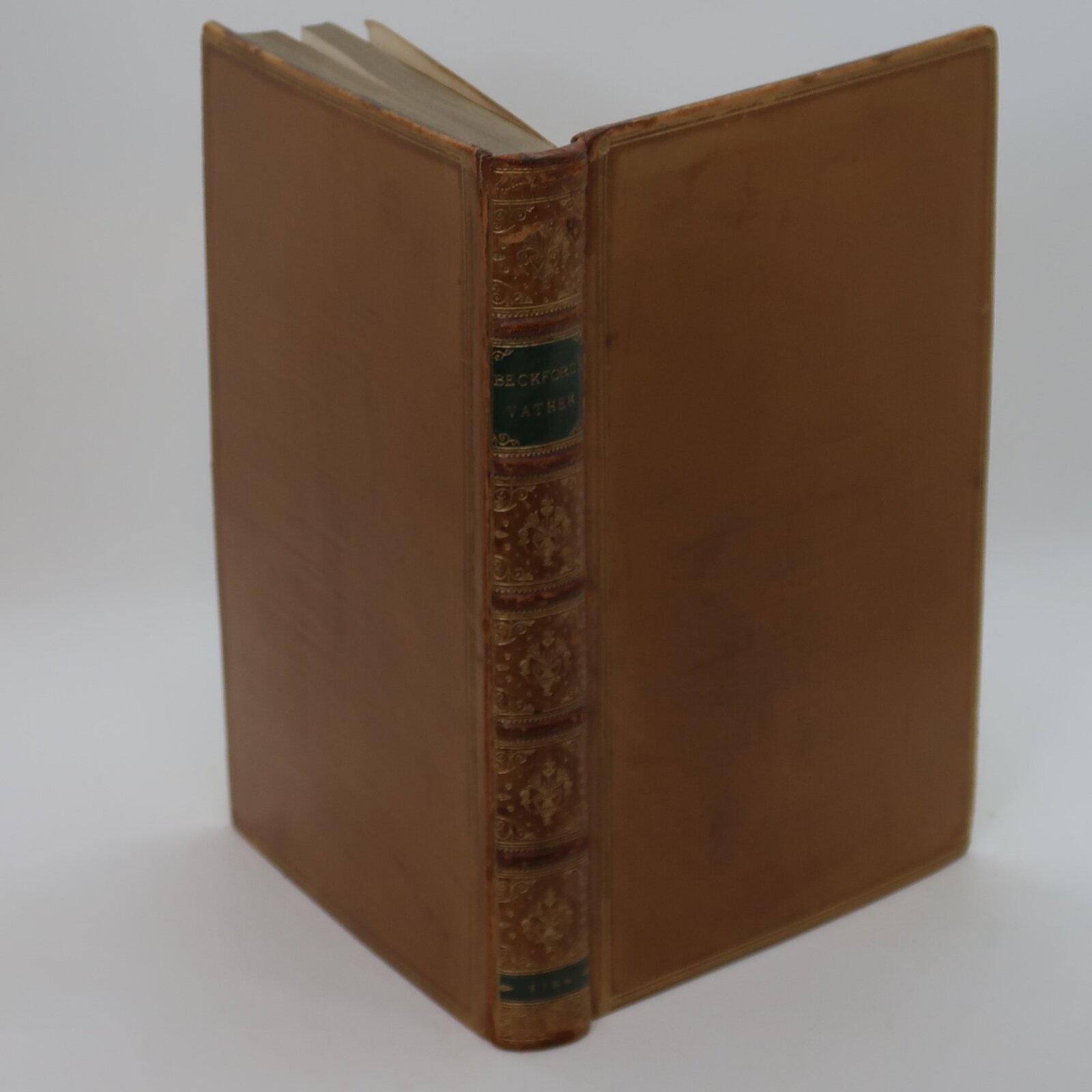
Beckford's Vathek.
By William Beckford
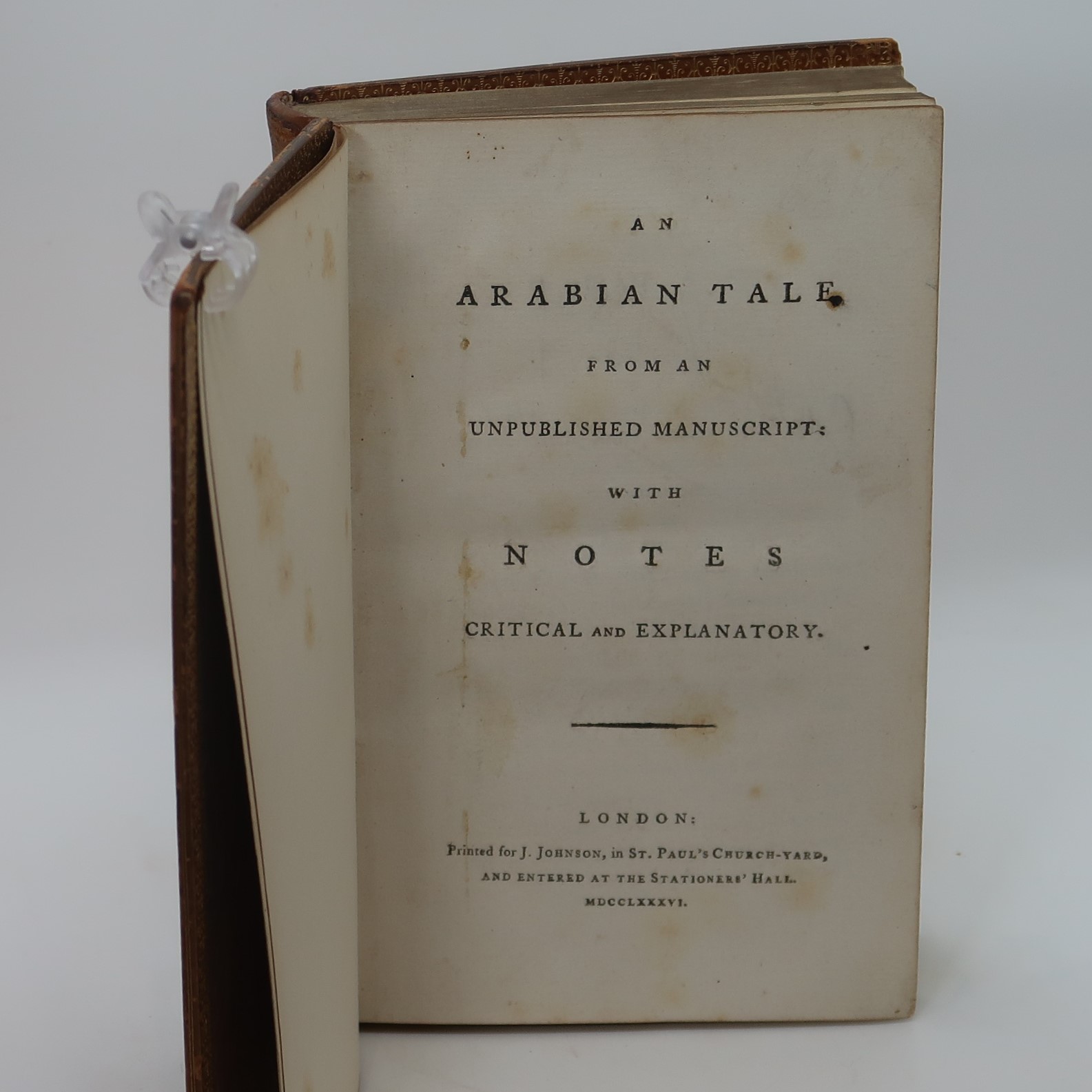
Printed: 1786
Publisher: J. Johnston. London
Edition: first edition
| Dimensions | 13 × 19 × 2.5 cm |
|---|---|
| Language |
Language: English
Size (cminches): 13 x 19 x 2.5
Condition: Fine (See explanation of ratings)
THIS ITEM WILL BE AVAILABLE SOON
SORRY, THIS ITEM HAS SOLD
Item information
Description
AN ORIGINAL GOTHIC NOVEL
William Beckford’s Vathekis a story with elaborate imagery, sardonic humour and an unforgettable gallery of grotesques – which describes a journey to the halls of Eblis, or Hell, in the pursuit of knowledge.
Vathek (alternatively titled Vathek, an Arabian Tale or The History of the Caliph Vathek) is a Gothic novel written by William Beckford. It was composed in French beginning in 1782, and then translated into English by Reverend Samuel Henley in which form it was first published in 1786 without Beckford’s name as An Arabian Tale, From an Unpublished Manuscript, claiming to be translated directly from Arabic. The first French edition, titled simply as Vathek, was published in December 1786 (post-dated 1787). In the twentieth century some editions include The Episodes of Vathek (Vathek et ses episodes), three related tales intended by Beckford to be so incorporated but omitted from the original edition and published separately long after his death.
PLOT INTRODUCTION
Vathek capitalised on the eighteenth- (and early nineteenth-) century obsession with all things Oriental (see Orientalism), which was inspired by Antoine Gulland’s translation of The Arabian Nights (itself retranslated, into English, in 1708). Beckford was also influenced by similar works from the French writer Voltaire. His originality lay in combining the popular Oriental elements with the Gothic stylings of Horace Walpole’s The Castle of Otranto (1764). The result stands alongside Walpole’s novel and Mary Shelley’s Frankenstein (1818) in the first rank of early Gothic fiction.
The novel chronicles the fall from power of the Caliph Vathek, who renounces Islam and engages with his mother, Carathis, in a series of licentious and deplorable activities designed to gain him supernatural powers. At the end of the novel, instead of attaining these powers, Vathek descends into a hell ruled by the fallen angel Eblis where he is doomed to wander endlessly and speechlessly.
Vathek, the ninth caliph of the Abassides, ascended to the throne at an early age. He is a majestic figure, terrible in anger (one glance of his flashing eye can make “the wretch on whom it was fixed instantly [fall] backwards and sometimes [expire]”), and addicted to the pleasures of the flesh. He is intensely thirsty for knowledge and often invites scholars to converse with him. If he fails to convince the scholar of his points of view, he attempts a bribe; if this does not work, he sends the scholar to prison. To better study astronomy, he builds an observation tower with 11,000 steps.
A hideous stranger arrives in town, claiming to be a merchant from India selling precious goods. Vathek buys glowing swords with letters on them from the merchant, and invites the merchant to dinner. When the merchant does not respond to Vathek’s questions, Vathek looks at him with his “evil eye”, but this has no effect, so Vathek imprisons him. The next day, he discovers that the merchant has escaped and his prison guards are dead. The people begin to call Vathek crazy. His Greek mother, Carathis, tells him that the merchant was “the one talked about in the prophecy”, and Vathek admits that he should have treated the stranger kindly.
Vathek wants to decipher the messages on his new sabres, offers a reward to anyone who can help him, and punishes those who fail. After several scholars fail, one elderly man succeeds: the swords say “We were made where everything is well made; we are the least of the wonders of a place where all is wonderful and deserving, the sight of the first potentate on earth”. But the next morning, the message has changed: the sword now says “Woe to the rash mortal who seeks to know that of which he should remain ignorant, and to undertake that which surpasses his power”. The old man flees before Vathek can punish him. However, Vathek realises that the writing on the swords really did change.
Vathek then develops an insatiable thirst and often goes to a place near a high mountain to drink from one of four fountains there, kneeling at the edge of the fountain to drink. One day he hears a voice telling him to “not assimilate [him]self to a dog”. It was the voice of the merchant who had sold him the swords, a mysterious man whom Vathek calls “Giaour“, an Ottoman term used for non-believers. The Giaour cures his thirst with a potion and the two men return to Samarah. Vathek returns to immersing himself in the pleasures of the flesh, and begins to fear that the Giaour, who is now popular at Court, will seduce one of his wives. Vathek makes a fool of himself trying to out-drink the Giaour, and to out-eat him; when he sits upon the throne to administer justice, he does so haphazardly. His prime vizier rescues him from disgrace by whispering that Carathis had read a message in the stars foretelling a great evil to befall Vathek and his vizier Morakanabad; the vizier informs Vathek that Carathis advises him to ask the Giaour about the drugs he used in the potion, lest that be a poison. When Vathek confronts him, the Giaour only laughs, so Vathek gets angry and kicks him. The Giaour is transformed into a ball and Vathek compels everyone in the palace to kick it, even the resistant Carathis and Morakanabad. Then Vathek has the whole town kick the ball-shaped merchant into a remote valley. Vathek stays in the area and eventually hears Giaour’s voice telling him that if he will worship the Giaour and the jinns of the earth, and renounce the teachings of Islam, he will bring Vathek to “the palace of the subterrain fire” where Soliman Ben Daoud controls the talismans that rule over the world.
Vathek agrees, and proceeds with the ritual that the Giaour demands to sacrifice fifty of the city’s children. In return, Vathek will receive a key of great power. Vathek holds a “competition” among the children of the nobles of Samarah, declaring that the winners will receive “endless favours”. As the children approach Vathek for the competition, he throws them inside an ebony portal to be sacrificed. Once this is finished, the Giaour makes the portal disappear. The Samaran citizens see Vathek alone and accuse him of having sacrificed their children to the Giaour, and form a mob to kill Vathek. Carathis pleads with Morakanabad to help save Vathek’s life; the vizier complies, and calms the crowd down.
Vathek wonders when his reward will come, and Carathis says that he must fulfil his end of the pact and sacrifice to the jinn of the earth. Carathis helps him prepare the sacrifice: she and her son climb to the top of the tower and mix oils to create an explosion of light. The people, presuming that the tower is on fire, rush up the stairs to save Vathek from being burnt to death. Instead, Carathis sacrifices them to the jinn. Carathis performs another ritual and learns that for Vathek to claim his reward, he must go to Istakhar.
Vathek goes away with his wives and servants, leaving the city in the care of Morakanabad and Carathis. A week after he leaves, his caravan is attacked by carnivorous animals. The soldiers panic and accidentally set the area on fire; Vathek and his wives must flee. Still, they continue on their way. They reach steep mountains where the Islamic dwarfs dwell. They invite Vathek to rest with them, possibly in the hopes of converting him back to Islam. Vathek sees a message his mother left for him: “Beware of old doctors and their puny messengers of but one cubit high: distrust their pious frauds; and, instead of eating their melons, impale on a spit the bearers of them. Should thou be so fool as to visit them, the portal to the subterranean place will shut in thy face” . Vathek becomes angry and claims that he has followed the Giaour’s instructions long enough. He stays with the dwarfs, meets their Emir, named Fakreddin, and the Emir’s beautiful daughter Nouronihar.
Vathek wants to marry her, but she is already promised to her effeminate cousin Gulchenrouz, whom she loves and who loves her back. Vathek thinks she should be with a “real” man and arranges for Bababalouk to kidnap Gulchenrouz. The Emir, finding of the attempted seduction, asks Vathek to kill him, as he has seen “the prophet’s vice-regent violate the laws of hospitality.” But Nouronihar prevents Vathek from killing her father and Gulchenrouz escapes. The Emir and his servants then meet and they develop a plan to safeguard Nouronihar and Gulchenrouz, by drugging them and placing them in a hidden valley by a lake where Vathek cannot find them. The plan succeeds temporarily—the two are drugged, brought to the valley, and convinced on their awakening that they have died and are in purgatory. Nouronihar, however, grows curious about her surroundings and ascends to find out what lies beyond the valley. There she meets Vathek, who is mourning for her supposed death. Both realise that her “death” has been a sham. Vathek then orders Nouronihar to marry him, she abandons Gulchenrouz, and the Emir abandons hope.
Meanwhile, in Samarah, Carathis can discover no news of her son from reading the stars. Vathek’s favourite wife, the sultana Dilara, writes to Carathis, informing her that her son has broken the condition of the Giaour’s contract, by accepting Fakreddin’s hospitality on the way to Istakhar. She asks him to drown Nouronihar, but Vathek refuses, because he intends to make her his queen. Carathis then decides to sacrifice Gulchenrouz, but before she can catch him, Gulchenrouz jumps into the arms of a Genie who protects him. That night, Carathis hears that Motavakel, Vathek’s brother, is planning to lead a revolt against Morakanabad. Carathis tells Vathek that he has distinguished himself by breaking the laws of hospitality by ‘seducing’ the emir’s daughter after sharing his bread, and that if he can commit one more crime along the way he shall enter Soliman’s gates triumphant.
Vathek continues on his journey, reaches Rocnabad, and degrades and humiliates its citizens for his own pleasure.
A Genie asks Mohammed for permission to try to save Vathek from his eternal damnation. He takes the form of a saintly shepherd who plays the flute to make men realise their sins. The shepherd asks Vathek if he is done sinning, warns Vathek about Eblis, ruler of Hell, and asks Vathek to return home, destroy his tower, disown Carathis, and preach Islam. He has until a set moment to decide yes or no. Vathek’s pride wins out, and he tells the shepherd that he will continue on his quest for power, and values Nouronihar more than life itself or God’s mercy. The moment is past, and the shepherd screams and vanishes. Vathek’s servants desert him; Nouronihar becomes immensely prideful.
Finally, Vathek reaches Istakhar, where he finds more swords with writing on them, which says “Thou hast violated the conditions of my parchment, and deserve to be sent back, but in favour to thy companion, and as the meed for what thou hast done to obtain it, Eblis permitted that the portal of this place will receive thee” . The Giaour opens the gates with a golden key, and Vathek and Nouronihar step through into a place of gold where Genies of both sexes dance lasciviously. The Giaour leads them to Eblis, who tells them that they may enjoy whatever his empire holds. Vathek asks to be taken to the talismans that govern the world. There, Soliman tells Vathek that he had once been a great king but was seduced by a Jinn and received the power to make everyone in the world do his bidding. But because of this, Soliman is destined to suffer in hell for a finite but vast period—until the waterfall he is sitting beside, stops. This eventual end to his punishment is due to his piety in the earlier part of his reign. The other inmates must suffer the fire in their hearts for all eternity. Vathek asks the Giaour to release him, saying he will relinquish all he was offered, but the Giaour refuses. He tells Vathek to enjoy his omnipotence while it lasts, for in a few days he will be tormented.
Vathek and Nouronihar become increasingly discontented with the palace of flames. Vathek orders an ifrit to fetch Carathis from the castle. While the ifrit is bringing Carathis, Vathek meets some people who are, like him, awaiting the execution of their own sentences of eternal suffering. Three relate to Vathek how they got to Eblis’ domain. When Carathis arrives, he warns her of what happens to those who enter Eblis’ domain, but Carathis takes the talismans of earthly power from Soliman regardless. She gathers the Jinns and tries to overthrow one of the Solimans, but Eblis decrees “It is time.” Carathis, Vathek, Nouronihar, and the other denizens of hell lose “the most precious gift granted by heaven – HOPE” (119). They begin to feel eternal remorse for their crimes, their hearts burning with literal eternal fire.
William Thomas Beckford (1 October 1760 – 2 May 1844) was an English novelist; an art collector and patron of works of decorative art, a critic, travel writer, plantation owner and sometime politician, reputed at one stage to be the richest commoner in England. The son of William Beckford and Maria Hamilton, daughter of the Hon. George Hamilton, he served as a Member of Parliament for Wells in 1784–1790 and Hindon in 1790–1795 and 1806–1820. He is remembered as author of the Gothic novel Vathek (1786), builder of the lost Fonthill Abbey in Wiltshire and of Lansdown Tower (“Beckford’s Tower”) in Bath, and above all for his art collection.
Beckford was born on 1 October 1760 in the family’s London home at 22 Soho Square. At the age of ten, he inherited a fortune from his father William Beckford, who had been twice a Lord Mayor of London, consisting of £1 million in cash, an estate at Fonthill in Wiltshire (including the Palladian mansion, Fonthill Splendens), and several sugar plantations in Jamaica. Among the wealth the young Beckford inherited from his father were about 3,000 black slaves.
This fortune allowed him to indulge his interest in art and architecture, as well as writing. He was briefly trained in music by Wolfgang Amadeus Mozart, but his drawing master, Alexander Cozens, was a greater influence, and Beckford continued to correspond with him for some years until they fell out.
On 5 May 1783 Beckford married Lady Margaret Gordon, a daughter of the fourth Earl of Aboyne. However, he was bisexual and after 1784 chose self-exile from British society when his letters to William Courtenay, later 9th Earl of Devon, were intercepted by the boy’s uncle, who advertised the affair in the newspapers. Courtenay was just ten years old on first meeting Beckford, who was eight years older. Beckford was discovered (according to a house guest at the time) to be “whipping Courtenay in some posture or another” after finding a letter penned by Courtenay to another lover. Although Beckford was never punished for child molestation, fornication, or attempted buggery, he subsequently chose self-exile to the continent in the company of his long-suffering wife (who died in childbirth aged 24).
For many years Beckford was believed to have conducted a simultaneous affair with his cousin Peter’s wife Louisa Pitt (c. 1755–1791).
Having studied under Sir William Chambers and Cozens, Beckford journeyed in Italy in 1782 and promptly wrote a book about his travels: Dreams, Waking Thoughts and Incidents (1783). Shortly after this came his best-known work, the Gothic novel Vathek (1786), written originally in French; he boasted that it took a single sitting of three days and two nights, though there is reason to believe that this was a flight of his imagination.
His other principal writings were Memoirs of Extraordinary Painters (1780), a satirical work; and Letters from Italy with Sketches of Spain and Portugal (1834), full of brilliant descriptions of scenes and manners. In 1793 he visited Portugal, where he settled for a while.
Beckford’s fame, however, rests as much upon his eccentric extravagances as a builder and collector as upon his literary efforts. In undertaking his buildings, he managed to dissipate his fortune, which was estimated by his contemporaries to give him an income of £100,000 a year. The loss of one of his Jamaican sugar plantations to James Beckford Wildman was particularly costly. Only £80,000 of his capital remained at his death.
Want to know more about this item?
We are happy to answer any questions you may have about this item. In addition, it is also possible to request more photographs if there is something specific you want illustrated.
Ask a question
Related products



Share this Page with a friend
