
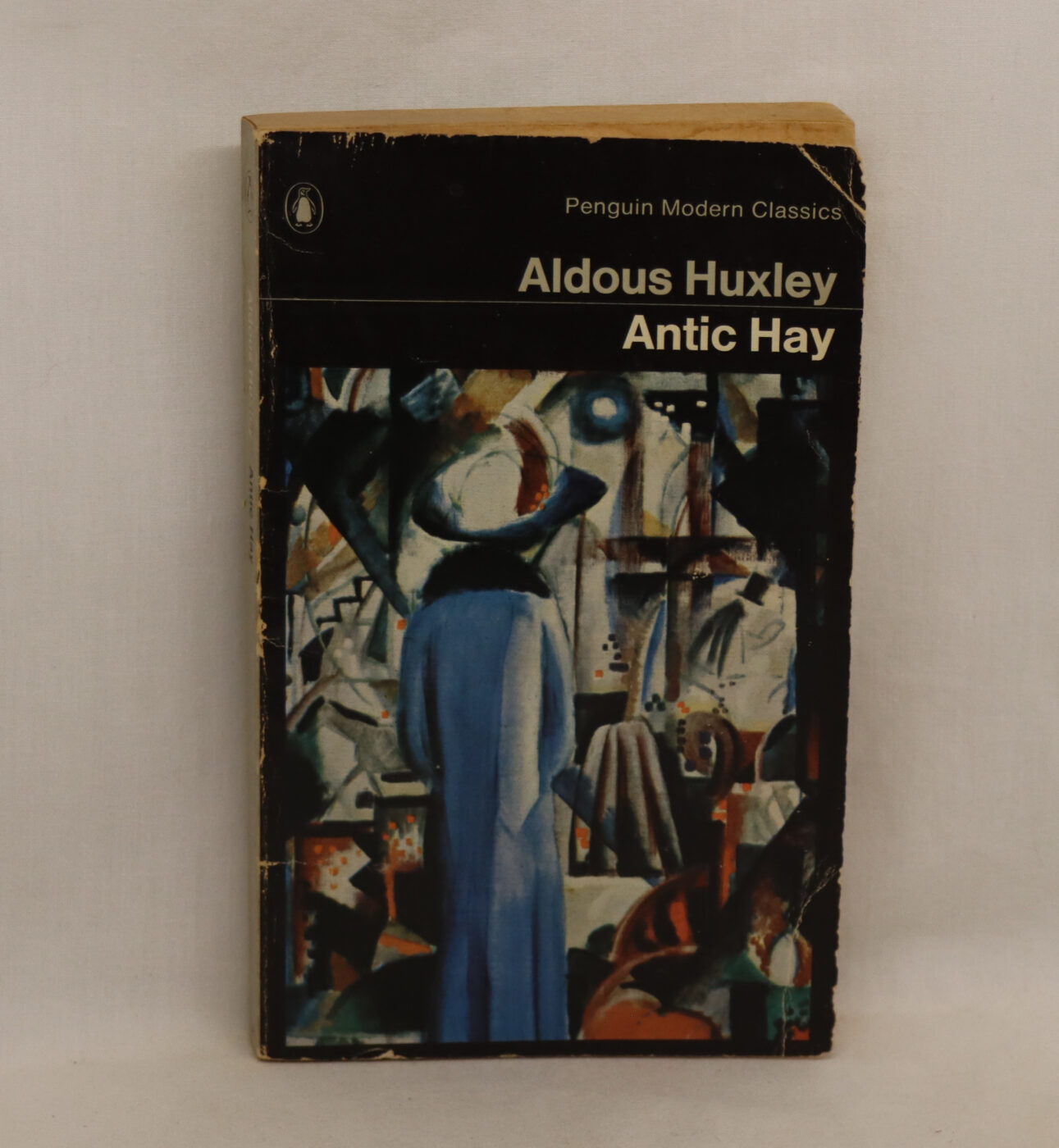
Antic Hay.
By Aldous Huxley
Printed: 1969
Publisher: Penguin Books. London
| Dimensions | 11 × 18 × 1 cm |
|---|---|
| Language |
Language: English
Size (cminches): 11 x 18 x 1
Condition: Fair (See explanation of ratings)
£6.00
Buy Now
Your items
Item information
Description
Paperback. Grey cover with black title.
We provide an in-depth photographic presentation of this item to stimulate your feeling and touch. More traditional book descriptions are immediately available
- A £2 reduction when collected from FBA shop
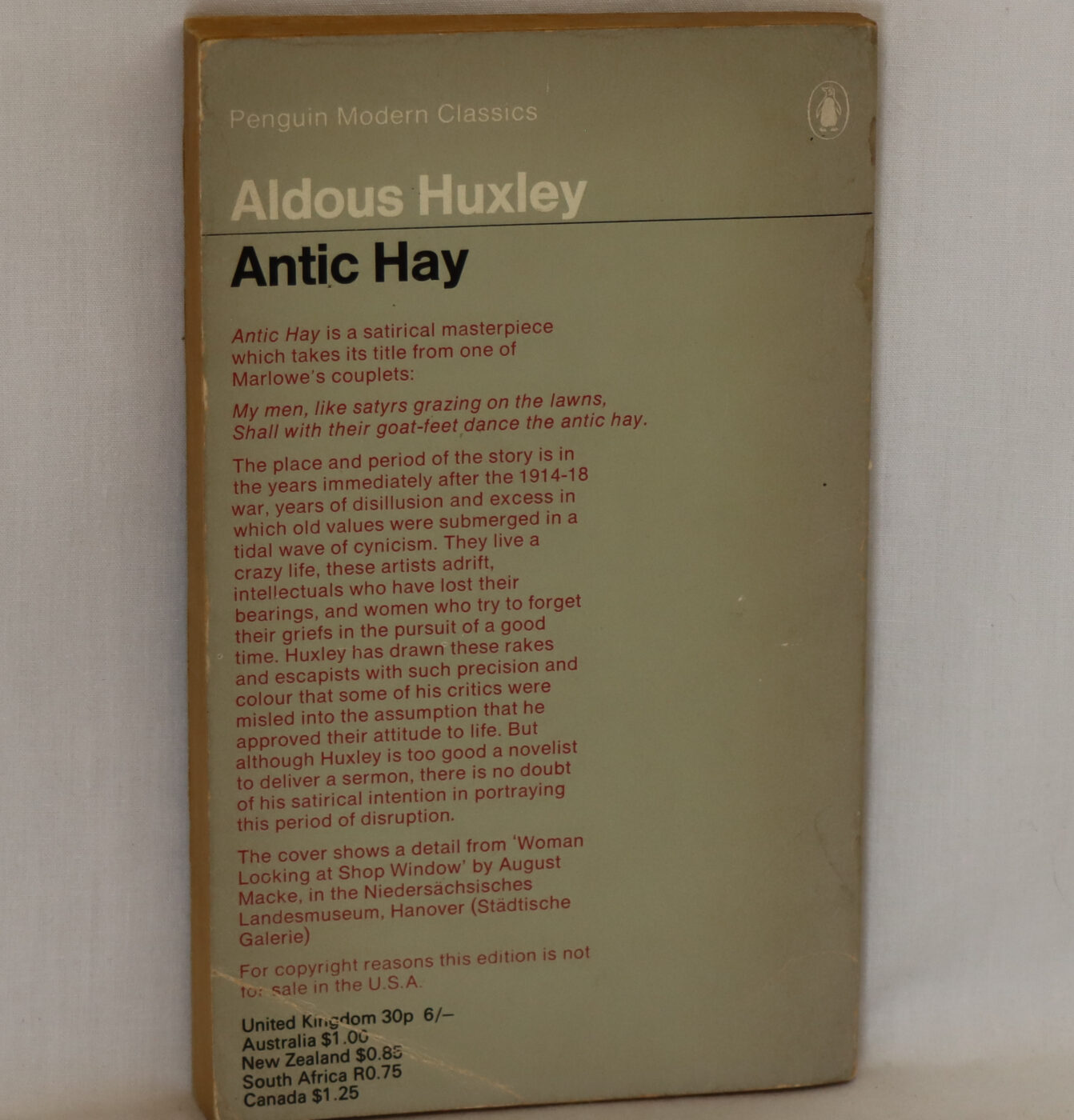
When inspiration leads Theodore Gumbril to design a type of pneumatic trouser cushion to ease the discomfort of sedentary life, he decides the time has come to give up teaching and seek his fortune in the metropolis. He soon finds himself caught up in the hedonistic world of his friends Mercaptan, Lypiatt and the thoroughly civilised Myra Viveash, and his burning ambitions begin to lose their urgency. . . Wickedly funny and deliciously barbed, Antic Hay epitomises the glittering neuroticism of the twenties.
Review
-
- Few present-day writers would dare to be so heroically encyclopaedic, such ardent gleaners of gossip and table talk as well as of the profounder reveries of literature, history, science and religion ― Spectator
- The great uniting principles that swept mankind along in their current have lost their force, and Huxley’s intellectuals find themselves in a maelstrom formed by the new forces of the time. For them, life has become boring, futile, full of ennui. So we get the ‘Antic Hay’, the dance of profane love, but with the wood-wild strains of Pan broken up into the hesitating rhythms demanded by the fever of modern life. Huxley has a fine sensibility and his wit and fresh vision lend Antic Hay a crystalline quality ― Guardian
About the Author: Aldous Huxley was born on 26 July 1894 near Godalming, Surrey. He began writing poetry and short stories in his early 20s, but it was his first novel, Crome Yellow (1921), which established his literary reputation. This was swiftly followed by Antic Hay (1923), Those Barren Leaves (1925) and Point Counter Point (1928) – bright, brilliant satires in which Huxley wittily but ruthlessly passed judgement on the shortcomings of contemporary society. For most of the 1920s Huxley lived in Italy and an account of his experiences there can be found in Along the Road (1925). The great novels of ideas, including his most famous work Brave New World (published in 1932, this warned against the dehumanising aspects of scientific and material ‘progress’) and the pacifist novel Eyeless in Gaza (1936) were accompanied by a series of wise and brilliant essays, collected in volume form under titles such as Music at Night (1931) and Ends and Means (1937). In 1937, at the height of his fame, Huxley left Europe to live in California, working for a time as a screenwriter in Hollywood. As the West braced itself for war, Huxley came increasingly to believe that the key to solving the world’s problems lay in changing the individual through mystical enlightenment. The exploration of the inner life through mysticism and hallucinogenic drugs was to dominate his work for the rest of his life. His beliefs found expression in both fiction (Time Must Have a Stop,1944, and Island, 1962) and non-fiction (The Perennial Philosophy, 1945; Grey Eminence, 1941; and the account of his first mescaline experience, The Doors of Perception, 1954). Huxley died in California on 22 November 1963.
NOTE: This is an original book from the library gathered by the famous Cambridge Don, computer scientist, food and wine connoisseur, Jack Arnold LANG. Note: Jack founded the Michelin Guide ‘Midsummer House’- Cambridge’s paramount restaurant. This dining experience is hidden amongst the grassy pastures and grazing cattle of Midsummer Common and perched on the banks of the River Cam.
In 2008, Jack was one of the co-founders of the Raspberry Pi Foundation, alongside other members of the Department, and acted as the Foundation’s Chair. The project’s original goals were modest: to build and distribute low-cost computers for prospective applicants to our Computer Science degree. Initially the project was a “success disaster”, as Jack would say, as demand far outstripped the low-scale manufacturing plans. Ultimately the Raspberry Pi became the UK’s most successful computer with more than 60 million sold to date. Jack was drawn to the educational possibilities of the Raspberry Pi, its potential uses in emerging economies and the way it could support self-directed learning.
Want to know more about this item?
We are happy to answer any questions you may have about this item. In addition, it is also possible to request more photographs if there is something specific you want illustrated.
Ask a question
Related products


Share this Page with a friend
