
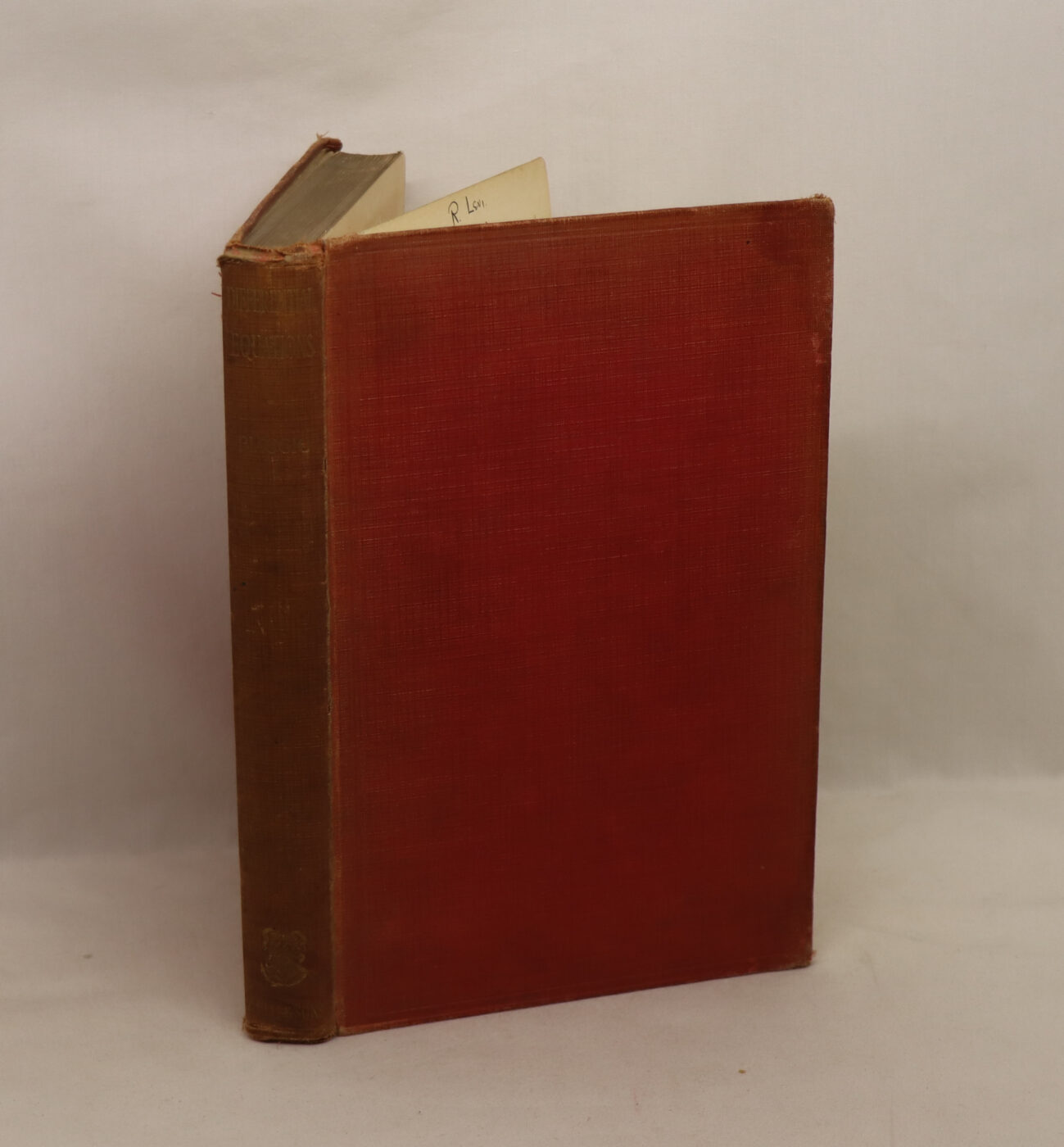
An Elementary Treatise on Differential Equations.
By H T H Piaggio
Printed: 1925
Publisher: G Bell & Sons. London
| Dimensions | 15 × 22 × 2 cm |
|---|---|
| Language |
Language: English
Size (cminches): 15 x 22 x 2
Condition: Good (See explanation of ratings)
£112.00
Buy Now
Your items


Item information
Description
Red cloth binding with gilt title on the spine.
We provide an in-depth photographic presentation of this item to stimulate your feeling and touch. More traditional book descriptions are immediately available
- Note: This book carries a £5.00 discount to those that subscribe to the F.B.A. mailing list
For conditions, please view our photographs. A rare original book from the library gathered by the famous Cambridge Don, computer scientist, food and wine connoisseur, Jack Arnold LANG. A true snapshot in time.
This formative and quality book was purchased by Jack’s father who later became famous for his involvement in ‘heavy water’ and ‘The Manhattan Project’.
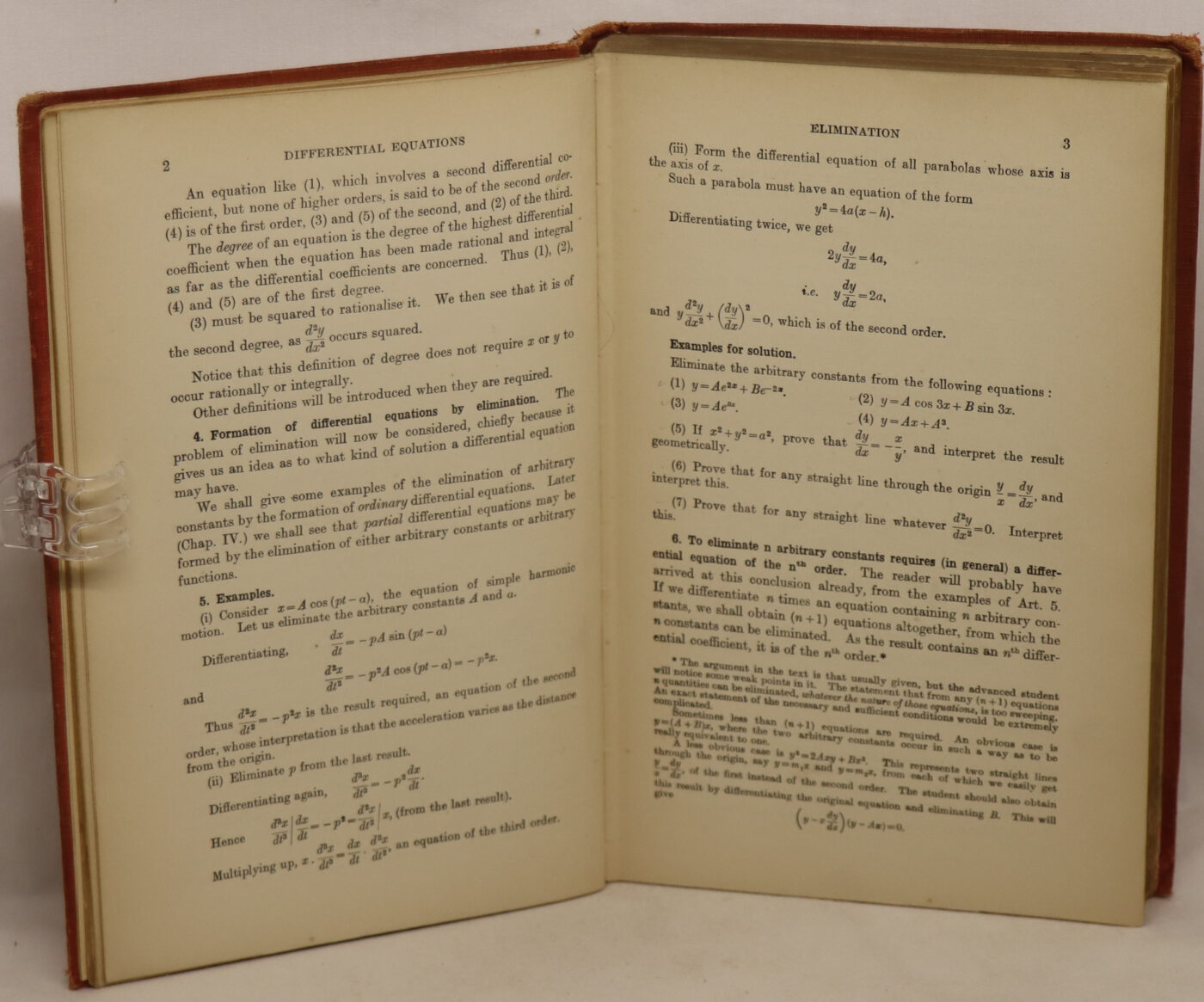
AN ELEMENTARY TREATISE ON DIFFERENTIAL EQUATIONS AND THEIR APPLICATIONS BY H. T. H. PIAGGIO, M. A., D. Sc. PROFESSOR OF MATHEMATICS, UNIVERSITY COLLEGE, NOTTINGHAM SENIOR SCHOLAR OF ST. JOHNS COLLEGE, CAMBRIDGE LONDON G. BELL AND SONS, LTD, 1949 First published May 1920. Reprinted 1921, 1924, 1925, 1926 Revised and Enlarged Edition 1922 reprinted 1929, 1931, 1933, 1937, 19 59, 1940,1911, 1942, 1943, 1944, 1945, 1946, 1949. PREFACE THE Theory of Differential Equations, said Sophus Lie, is the most important branch of modern mathematics. The subject may be considered to occupy a central position from which different lines of development extend in many directions. If we travel along the purely analytical path, we are soon led to discuss Infinite Series, Existence Theorems and the Theory of Functions. Another leads us to the Differential Geometry of Curves and Surfaces. Between the two lies the path first discovered by Lie, leading to continuous groups of transformation and their geometrical interpretation. Diverging in another direction, we are led to the study of mechanical and electrical vibrations of all kinds and the important phenomenon of resonance. Certain partial differential equations form the starting point for the study of the conduction of heat, the transmission of electric waves, and many other branches of physics. Physical Chemistry, with its law of mass-action, is largely concerned with certain differential equations. The object of this book is to give an account of the central parts of the subject in as simple a form as possible, suitable for those with no previous knowledge of it, and yet at the same time to point out the different directions in which it may be developed. The greater part of the text and the examples in the body of it will be found very easy. The only previous knowledge assumed is that of the elements of the differential and integral calculus and a little coordinate geometry. The miscellaneous examples at the end of the various chapters are slightly harder. They contain several theorems of minor importance, with hints that should be sufficient to enable the student to solve them. They also contain geometrical and physical applications, but great care has been taken to state the questions in such a way that no knowledge of physics is required. For instance, one question asks for a solution of a certain partial VI PREFACE differential equation in terms of certain constants and variables. This may be regarded as a piece of pure mathematics, but it is immediately followed by a note pointing out that the work refers to a well-known experiment in heat, and giving the physical meaning of the constants and variables concerned. Finally, at the end of the book is given a set of 115 examples of much greater difficulty, most of which are taken from university examination papers. I have to thank the Universities of London, Sheffield and Wales, and the Syndics of the Cambridge University Press for their kind per mission in allowing me to use these. The book covers the course in differential equations required for the London B. Sc. Honours or Schedule A of the Cambridge Mathematical Tripos, Part II., and also includes some of the work required for the London M. Sc. or Schedule B of the Mathematical Tripos. An appendix gives suggestions for further reading. The number of examples, both worked and unworked, is very large, and the answers to the unworked ones are given at the end of the book. A few special points may be mentioned. The graphical method in Chapter I. based on the MS. kindly lent me by Dr. Brodetsky of a paper he read before the Mathematical Association, and on a somewhat similar paper by Prof. Takeo Wada that has not appeared before in any text-book. The chapter dealing with numerical integration deals with the subject rather more fully than usual…
Want to know more about this item?
We are happy to answer any questions you may have about this item. In addition, it is also possible to request more photographs if there is something specific you want illustrated.
Ask a question
Related products



Share this Page with a friend
