
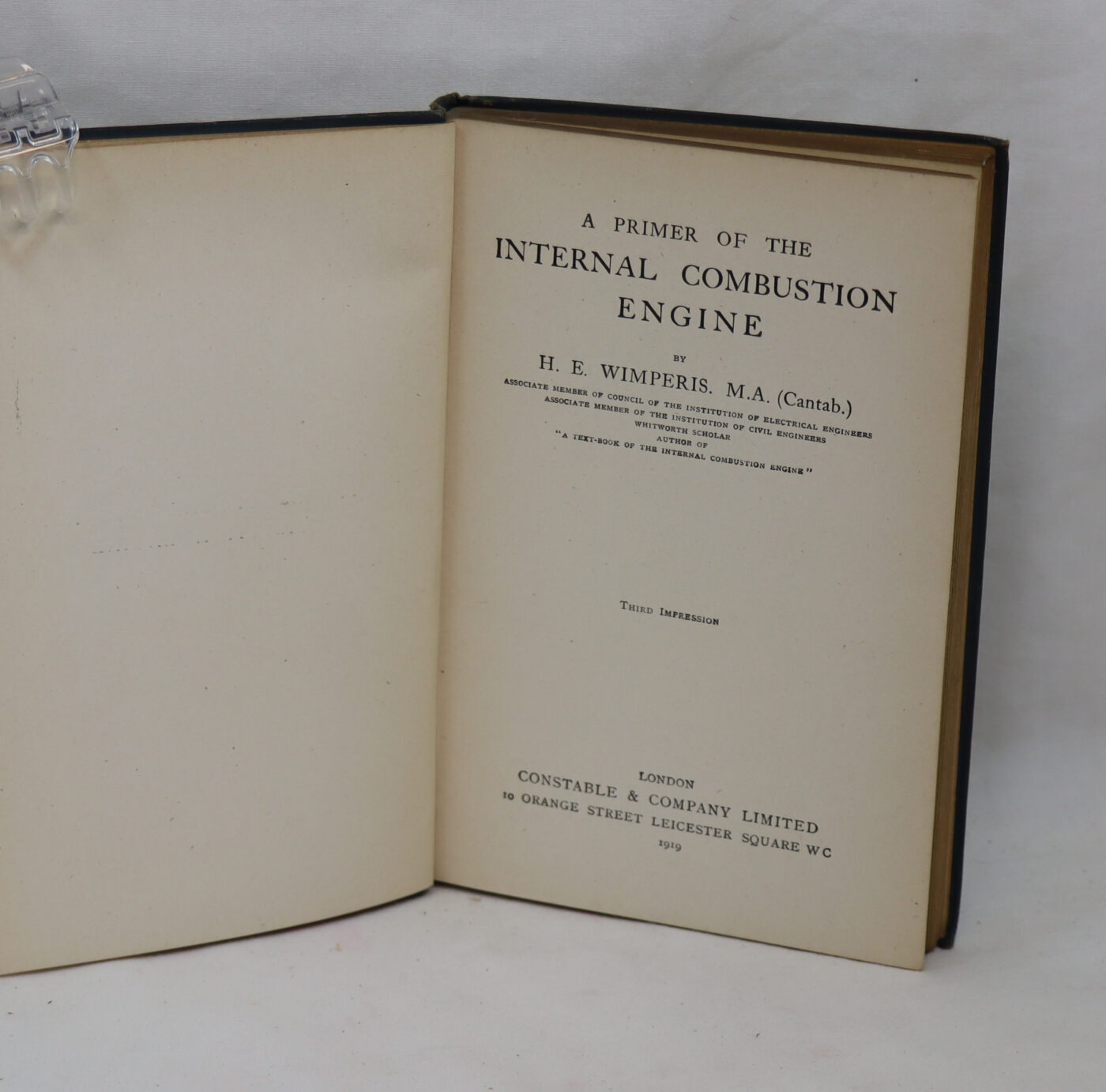
A Primer of the Internal Combustion Engine.
By H E Wimperis
Printed: 1919
Publisher: Constable & Co. London
| Dimensions | 13 × 19 × 1.5 cm |
|---|---|
| Language |
Language: English
Size (cminches): 13 x 19 x 1.5
Condition: Good (See explanation of ratings)
£44.00
Buy Now
Your items

Item information
Description
Navy cloth binding with black title on the spine.
We provide an in-depth photographic presentation of this item to stimulate your feeling and touch. More traditional book descriptions are immediately available.
- Note: This book carries a £5.00 discount to those that subscribe to the F.B.A. mailing list
This is a historic book well sought after by motor enthusiasts. Hardcover. Condition: Very Good with no dust jacket. 143 pages. “(This) is intended to be an introduction to the author’s Text-book of The Internal Combustion Engine first published by Messrs. Constable & Co. in 1908.”
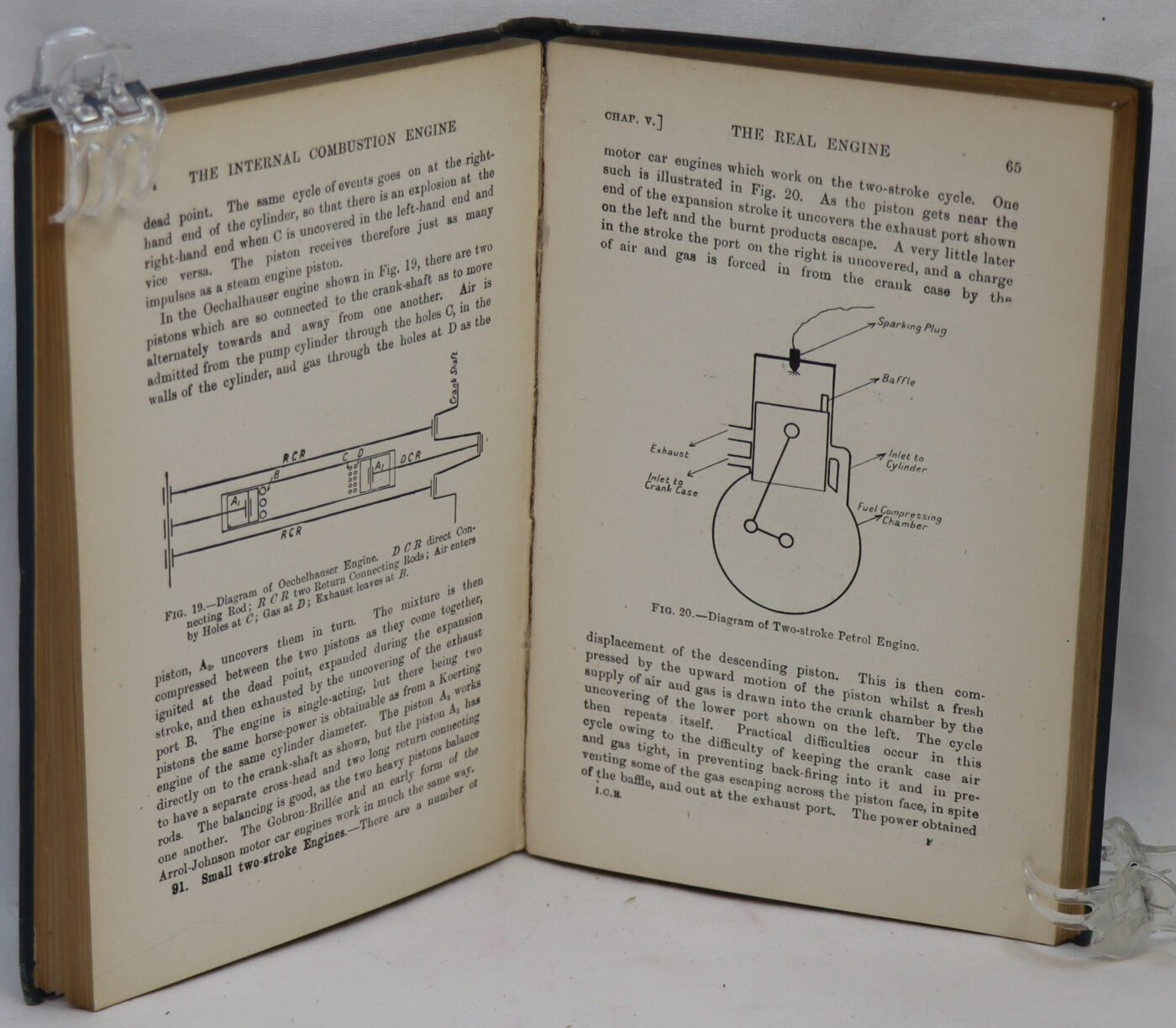
Excerpt: …last three are of various types, and they will be best dealt with in a later chapter. 89. A Typical Otto Cycle Engine.–A typical Otto cycle gas engine is shown in section in Fig. 17. Gas and air enter through the casting G, and pass the inlet valve A (operated by cam arrangements not shown in the figure). As the gas and air enter, the piston C moves along the cylinder, being drawn by the connecting rod D attached to the crank-shaft E. After the gases have been allowed to fill the cylinder they are compressed on the return stroke of the piston, are ignited on the inner dead-centre, expand doing work, and on the exhaust stroke the exhaust valve B opens to allow tliem to escape into the silencer. The cylinder is kept sufficiently cool, to enable it to be lubricated, by means of a circulation of water in the jacket space F. 90. Large two-stroke Engines.–There are two well-known Fig. 18.–Diagram of Koerting Engine. Bj and 7/2 Inlet Valves; C Exhaust Valve. designs of large two-stroke engines, both German in origin, viz., the Koerting and the Oechelhauser. The former is made doubleacting and the latter single-acting. In the Koerting Engine, illustrated diagrammatically in Fig. 18, the piston A is made unusually long, and by alternately covering and uncovering the exhaust post C is itself a part of the valve gear. The mixture of gas and air is admitted alternately at Bj and B.2 from the pump cylinder. If there has just been an explosion at the left-hand end of the cylinder, the piston will move to the right, and the gases will expand, doing work. By the time the piston has got to the end of the stroke, it will have uncovered the exhaust port C, and the burnt gases will rush away. At this point the inlet valve Bj is opened, and fresh air and gas are pumped
NOTE: This is an original book from the library gathered by the famous Cambridge Don, computer scientist, food and wine connoisseur, Jack Arnold LANG. Note: Jack founded the Michelin Guide ‘Midsummer House’- Cambridge’s paramount restaurant. This dining experience is hidden amongst the grassy pastures and grazing cattle of Midsummer Common and perched on the banks of the River Cam.
In 2008, Jack was one of the co-founders of the Raspberry Pi Foundation, alongside other members of the Department, and acted as the Foundation’s Chair. The project’s original goals were modest: to build and distribute low-cost computers for prospective applicants to our Computer Science degree. Initially the project was a “success disaster”, as Jack would say, as demand far outstripped the low-scale manufacturing plans. Ultimately the Raspberry Pi became the UK’s most successful computer with more than 60 million sold to date. Jack was drawn to the educational possibilities of the Raspberry Pi, its potential uses in emerging economies and the way it could support self-directed learning.
Want to know more about this item?
We are happy to answer any questions you may have about this item. In addition, it is also possible to request more photographs if there is something specific you want illustrated.
Ask a question



Share this Page with a friend
