
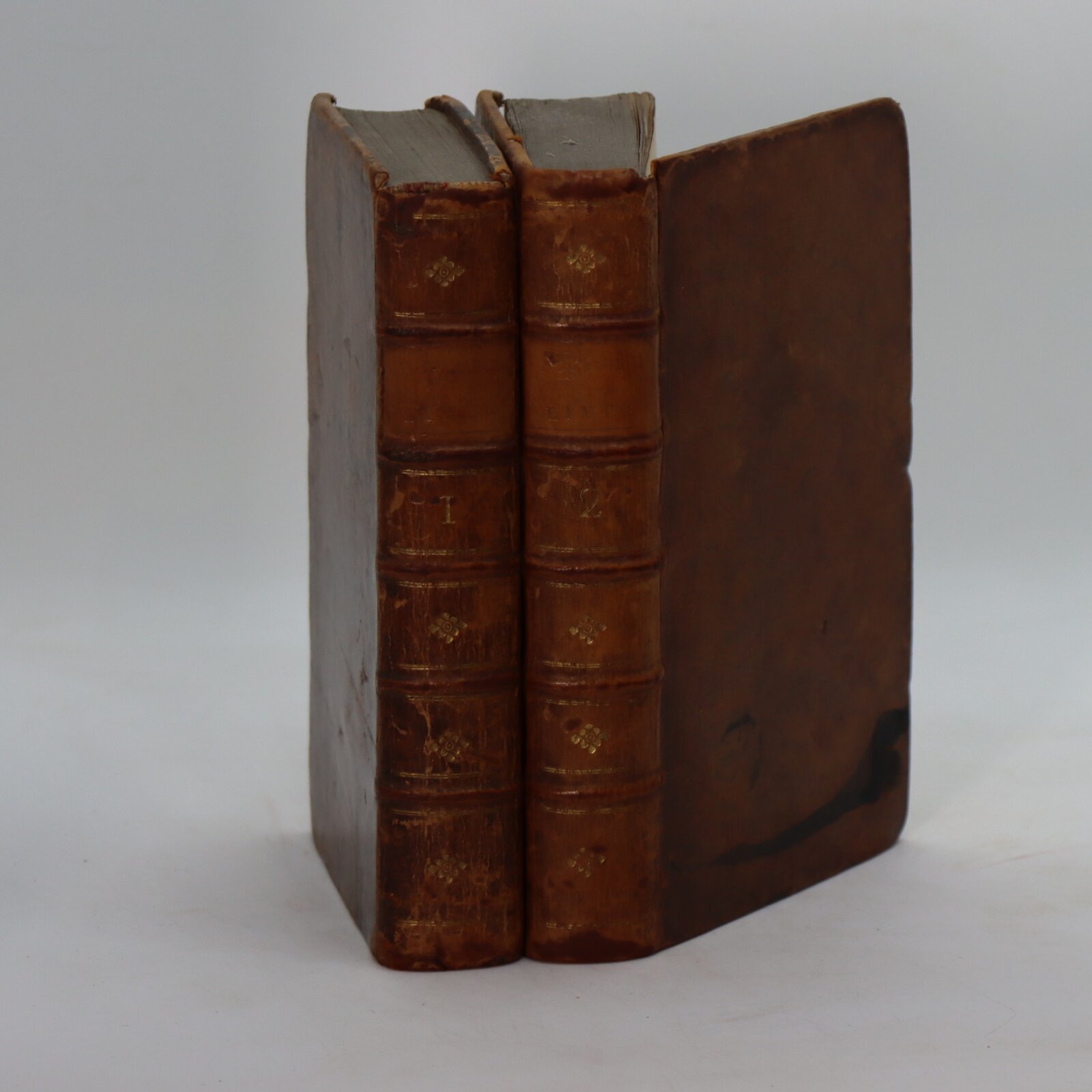
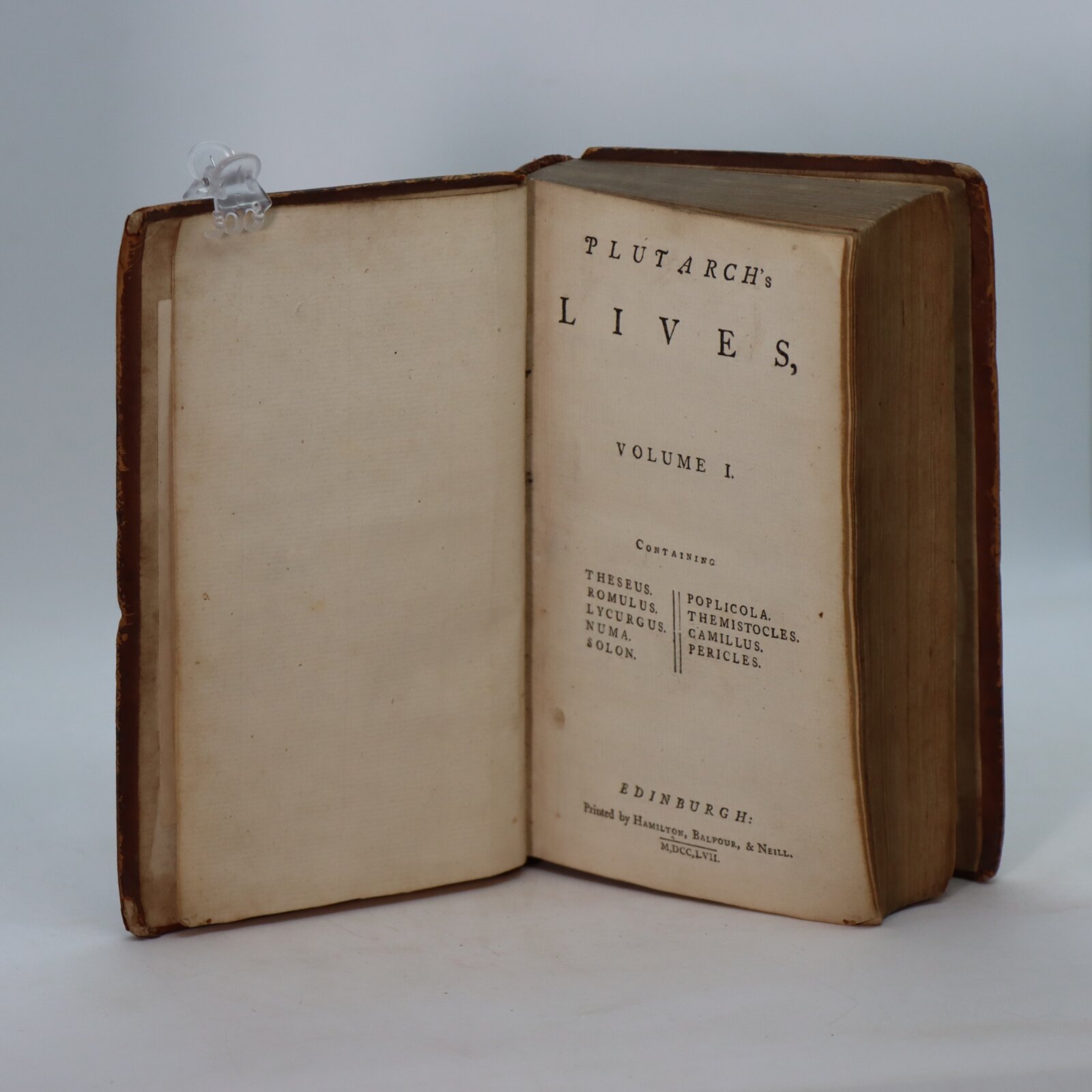
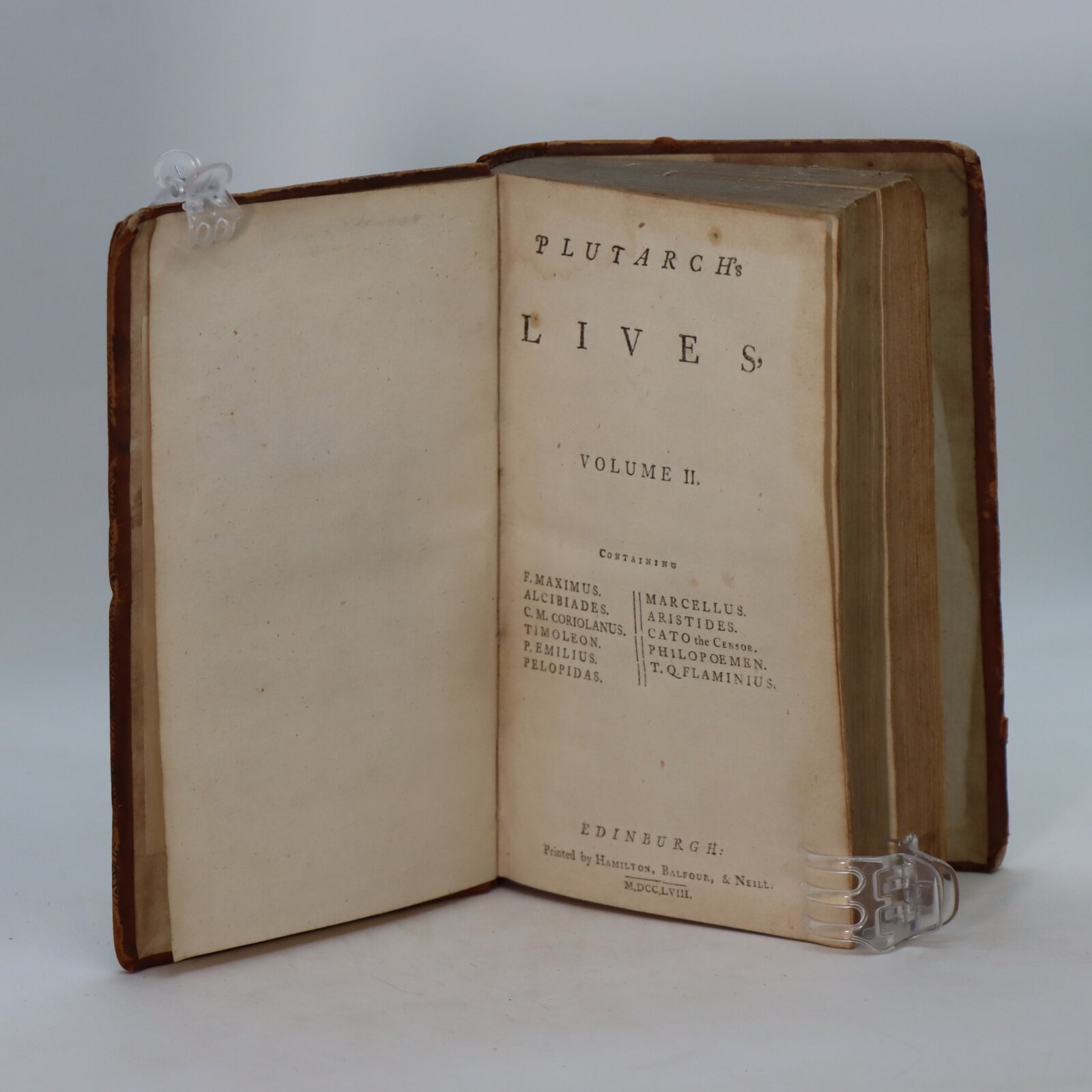
Plutarch's Lives. Volumes I & II.
Printed: 1757
Publisher: Hamilton Balfour & Neill. Ediburgh
| Dimensions | 11 × 17 × 3.5 cm |
|---|---|
| Language |
Language: English
Size (cminches): 11 x 17 x 3.5
Condition: Very good (See explanation of ratings)
THIS ITEM WILL BE AVAILABLE SOON
SORRY, THIS ITEM HAS SOLD
Item information
Description
Tan leather binding. Raised banding, gilt emblem and volume number on the spine. Title plate missing on both volumes. Dimensions are for one volume.
It is the intent of F.B.A. to provide an in-depth photographic presentation of this book offered so to almost stimulate your feel and touch on the book. If requested, more traditional book descriptions are immediately available.
A very good early edition loving kept
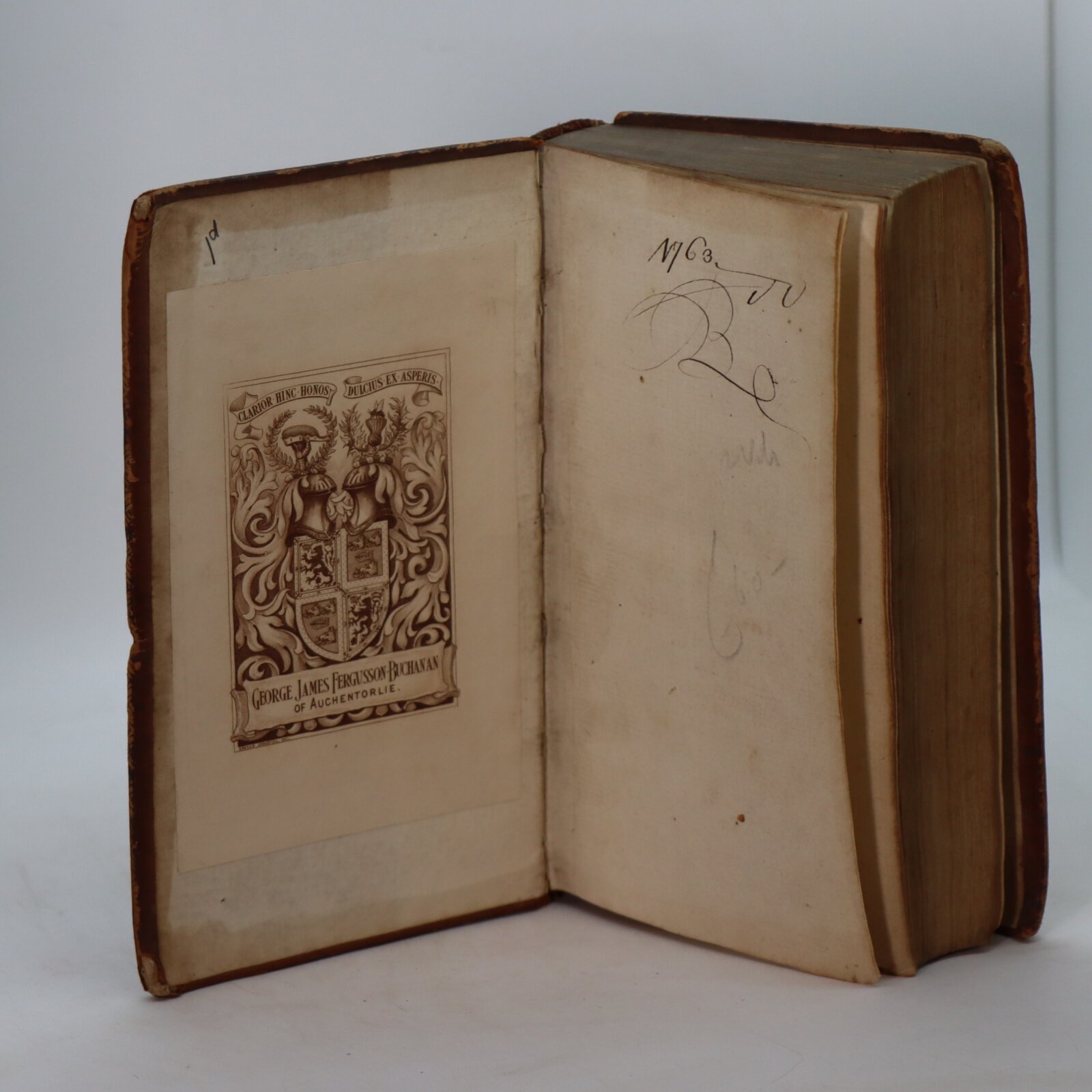
This book (famed for having twice travelled the world) was once cherished property of George James Ferguson-Buchanan (formerly George James Ferguson (1862-1928) ) of Auchentorlie; Justice of the Peace for Co. Dumbarton, was late; Major and Hon. Lt. Col. of the 3rd Battalion of the Scots Fusiliers, formerly A.D.C. to the Governor of Bombay, Major Army Reserve, served in the Royal Scots Fusiliers in South Africa, and Member of the Royal Company of Archers.
Plutarch AD 46 – after AD 119) was a Greek Middle Platonist philosopher, historian, biographer, essayist, and priest at the Temple of Apollo in Delphi. He is known primarily for his Parallel Lives, a series of biographies of illustrious Greeks and Romans, and Moralia, a collection of essays and speeches. Upon becoming a Roman citizen, he was named Lucius Mestrius Plutarchus
Plutarch was born to a prominent family in the small town of Chaeronea, about 30 kilometres (19 mi) east of Delphi, in the Greek region of Boeotia. His family was wealthy. The name of Plutarch’s father has not been preserved but based on the common Greek custom of repeating a name in alternate generations, it was probably Nikarchus (Nίκαρχoς). The name of Plutarch’s grandfather was Lamprias, as he attested in Moralia and in his Life of Antony.
His brothers, Timon and Lamprias, are frequently mentioned in his essays and dialogues, which speak of Timon in particular in the most affectionate terms. Rualdus, in his 1624 work Life of Plutarchus, recovered the name of Plutarch’s wife, Timoxena, from internal evidence afforded by his writings. A letter is still extant, addressed by Plutarch to his wife, bidding her not to grieve too much at the death of their two-year-old daughter, who was named Timoxena after her mother. He hinted at a belief in reincarnation in that letter of consolation.
The exact number of his sons is not certain, although two of them, Autobulus and the second Plutarch, are often mentioned. Plutarch’s treatise De animae procreatione in Timaeo is dedicated to them, and the marriage of his son Autobulus is the occasion of one of the dinner parties recorded in the “Table Talk”. Another person, Soklarus, is spoken of in terms which seem to imply that he was Plutarch’s son, but this is nowhere definitely stated. His treatise on marriage questions, addressed to Eurydice and Pollianus, seems to speak of the former as having recently lived in his house, but without any clear evidence on whether she was his daughter or not.
Plutarch was the uncle of Sextus of Chaeronea, who was one of the teachers of Marcus Aurelius, and who may have been the same person as the philosopher Sextus Empiricus.
Plutarch studied mathematics and philosophy in Athens under Ammonius from 66 to 67.
Plutarch was a vegetarian, though how long and how strictly he adhered to this diet is unclear. He wrote about the ethics of meat-eating in two discourses in Moralia.
At some point, Plutarch received Roman citizenship. As evidenced by his new name, Lucius Mestrius Plutarchus, his sponsor for citizenship was Lucius Mestrius Florus, a Roman of consular status whom Plutarch also used as a historical source for his Life of Otho.
He lived most of his life at Chaeronea and was initiated into the mysteries of the Greek god Apollo. For many years Plutarch served as one of the two priests at the Temple of Apollo at Delphi, the site of the famous Delphic Oracle, twenty miles from his home. He probably took part in the Eleusinian Mysteries. By his writings and lectures Plutarch became a celebrity in the Roman Empire, yet he continued to reside where he was born, and actively participated in local affairs, even serving as mayor. At his country estate, guests from all over the empire congregated for serious conversation, presided over by Plutarch in his marble chair. Many of these dialogues were recorded and published, and the 78 essays and other works which have survived are now known collectively as the Moralia.
Condition notes
title plates missing
Want to know more about this item?
We are happy to answer any questions you may have about this item. In addition, it is also possible to request more photographs if there is something specific you want illustrated.
Ask a question
Related products



Share this Page with a friend
