
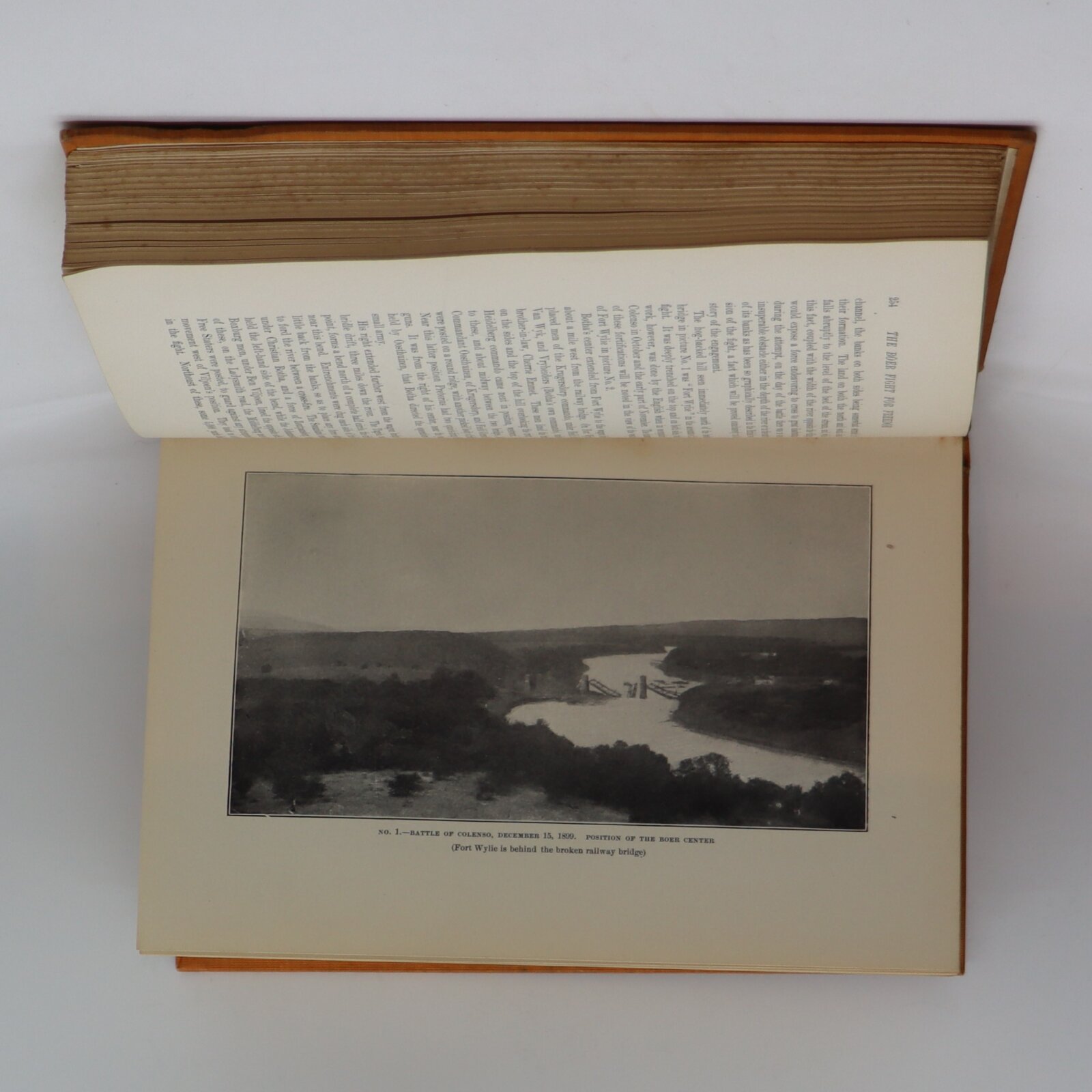
The Boer Fight for Freedom. Davitt.
By Michael Davitt
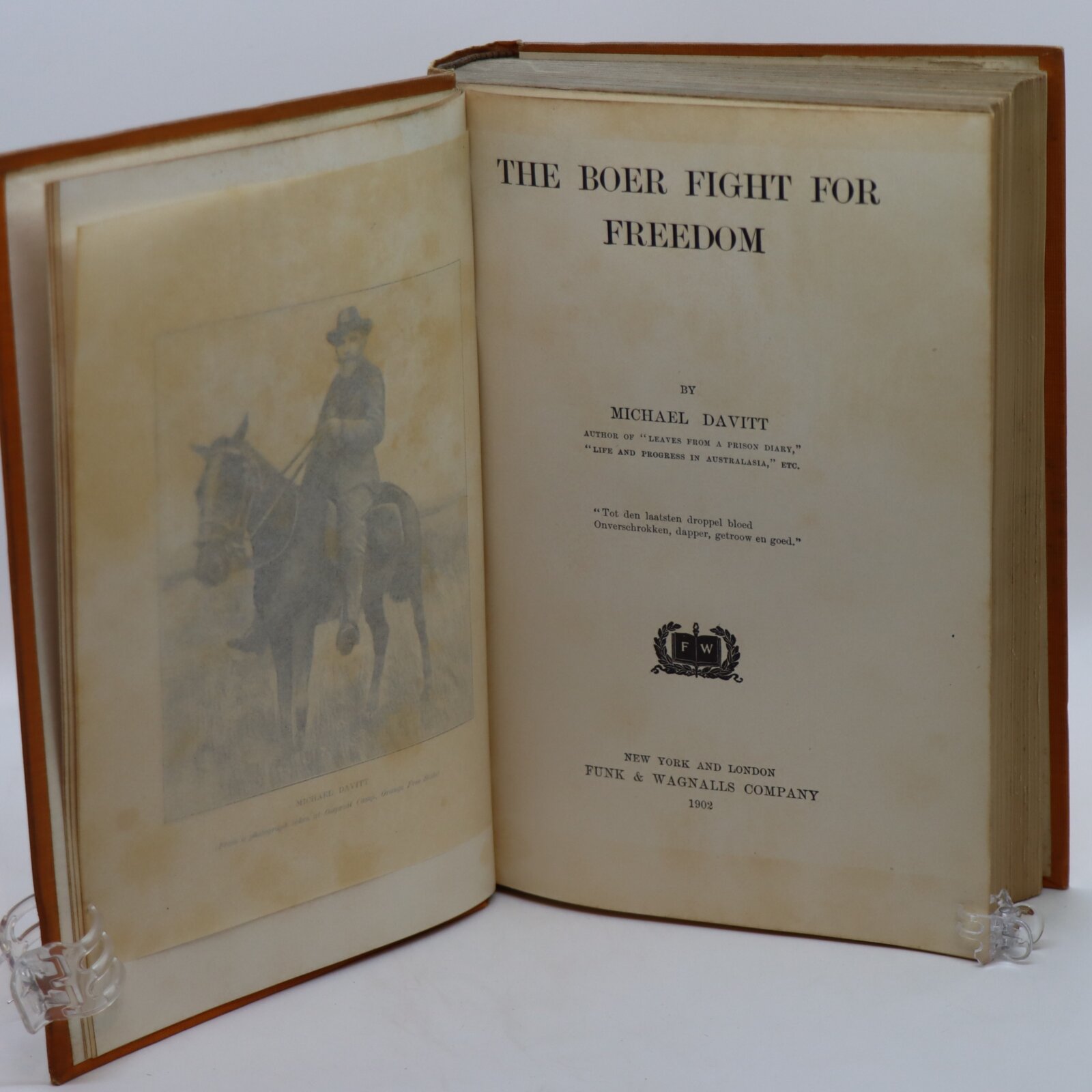
Printed: 1902
Publisher: Funk & Wagnall. London
Edition: first edition
| Dimensions | 16 × 23 × 5 cm |
|---|---|
| Language |
Language: English
Size (cminches): 16 x 23 x 5
Condition: Fine (See explanation of ratings)
THIS ITEM WILL BE AVAILABLE SOON
SORRY, THIS ITEM HAS SOLD
Item information
Description
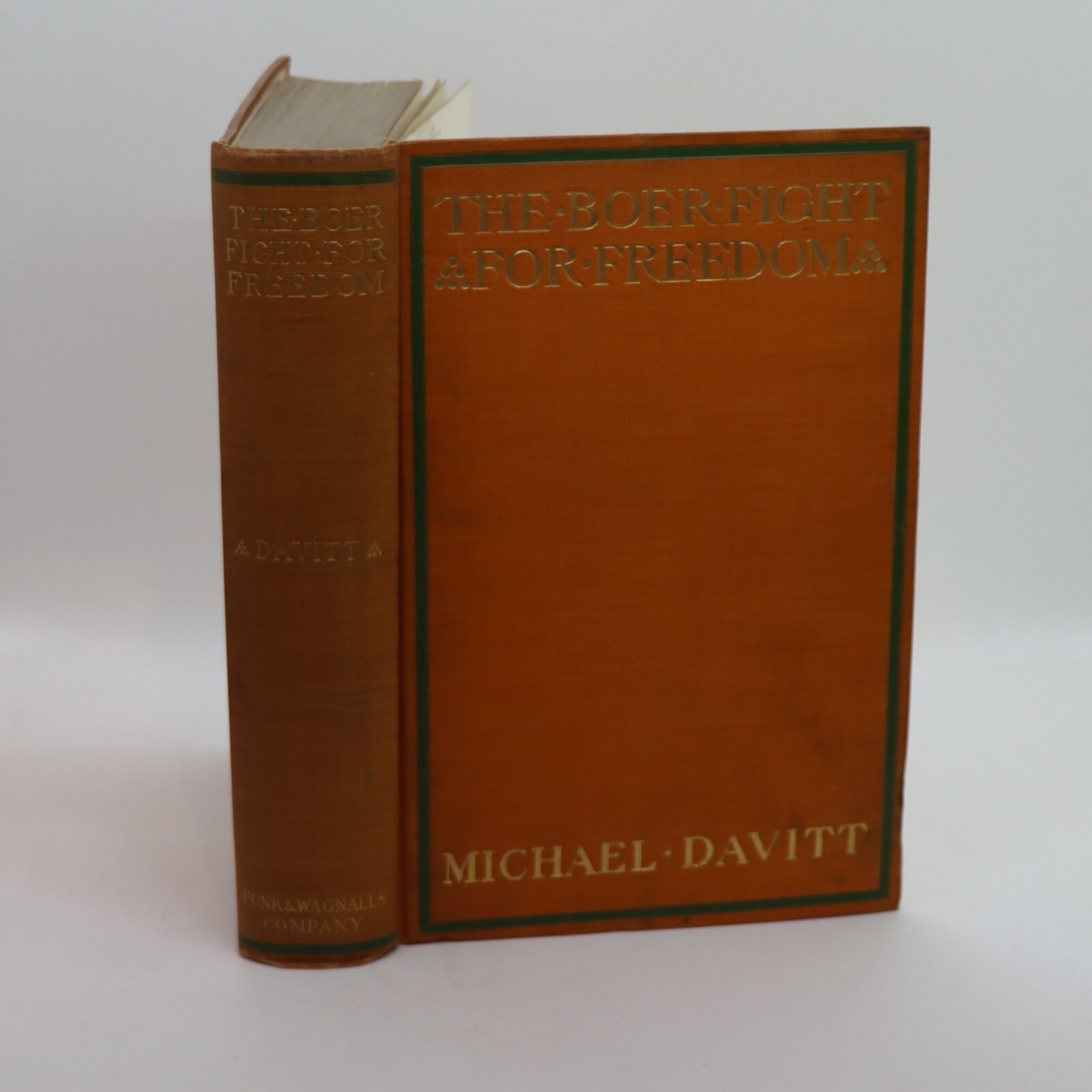
Orange cloth binding, Green edging Gilt Lettering.
First Edition – A very good copy
The two Boer Wars (1880-1902) pitched British colonial forces against the Dutch Boer settlers in the region of Africa today known as South Africa. The conflict concerned the discovery of gold in the region which threatened to destabilize British control with Germany stalking in the wings; conditions were worsened with Dutch abusive treatment of immigrant gold miners. The British stepped in to regain control and the ensuing warfare took the lives of over 40,000 men, women and children.
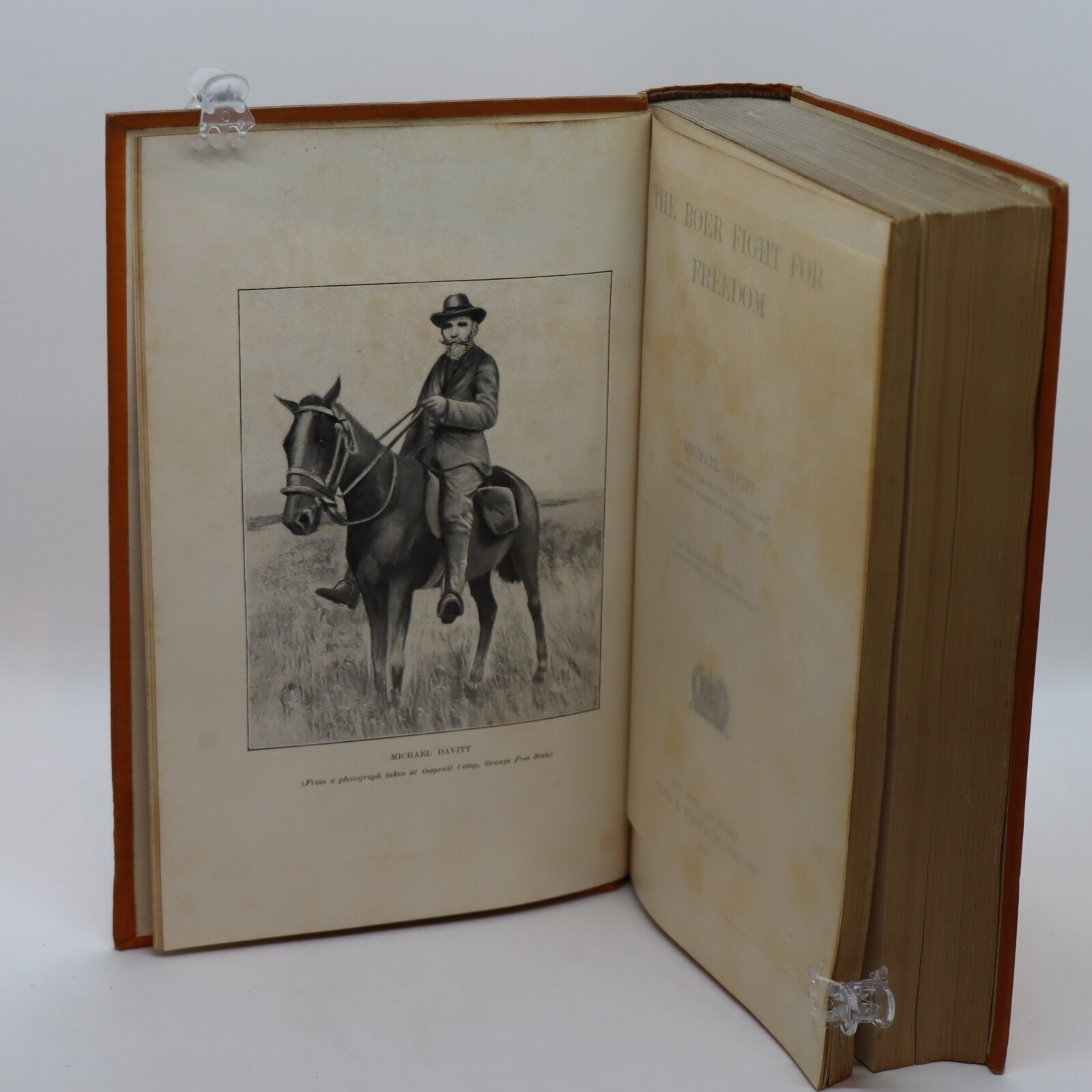
Following a speech in which Davitt denounced the Second Boer War and the fact Ireland had to pay £10 million to the war effort despite opposing it, Davitt left the Commons for good on 26 October 1899 in protest of “the greatest infamy of the nineteenth century”. Obtaining commissions from William Randolph Hearst’s New York American and the Irish paper Freeman’s Journal, he travelled to South Africa to report on the war and lend support to the Boer cause. On 26 March 1900, he arrived in Pretoria and spent the next three months touring and visiting Irish units in the Boer army. Following the last session of the Volksraad, Davitt left the country as Lord Roberts’ army advanced. The fact that the Boers were a “small nation of courageous fighters” facing off against the British Empire impressed Davitt. Nevertheless, of all his writings, The Boer Fight for Freedom (1902) has aged the least well; despite Davitt’s concern for other indigenous peoples, he accepted the Boer narrative that Black Africans were “savages”.
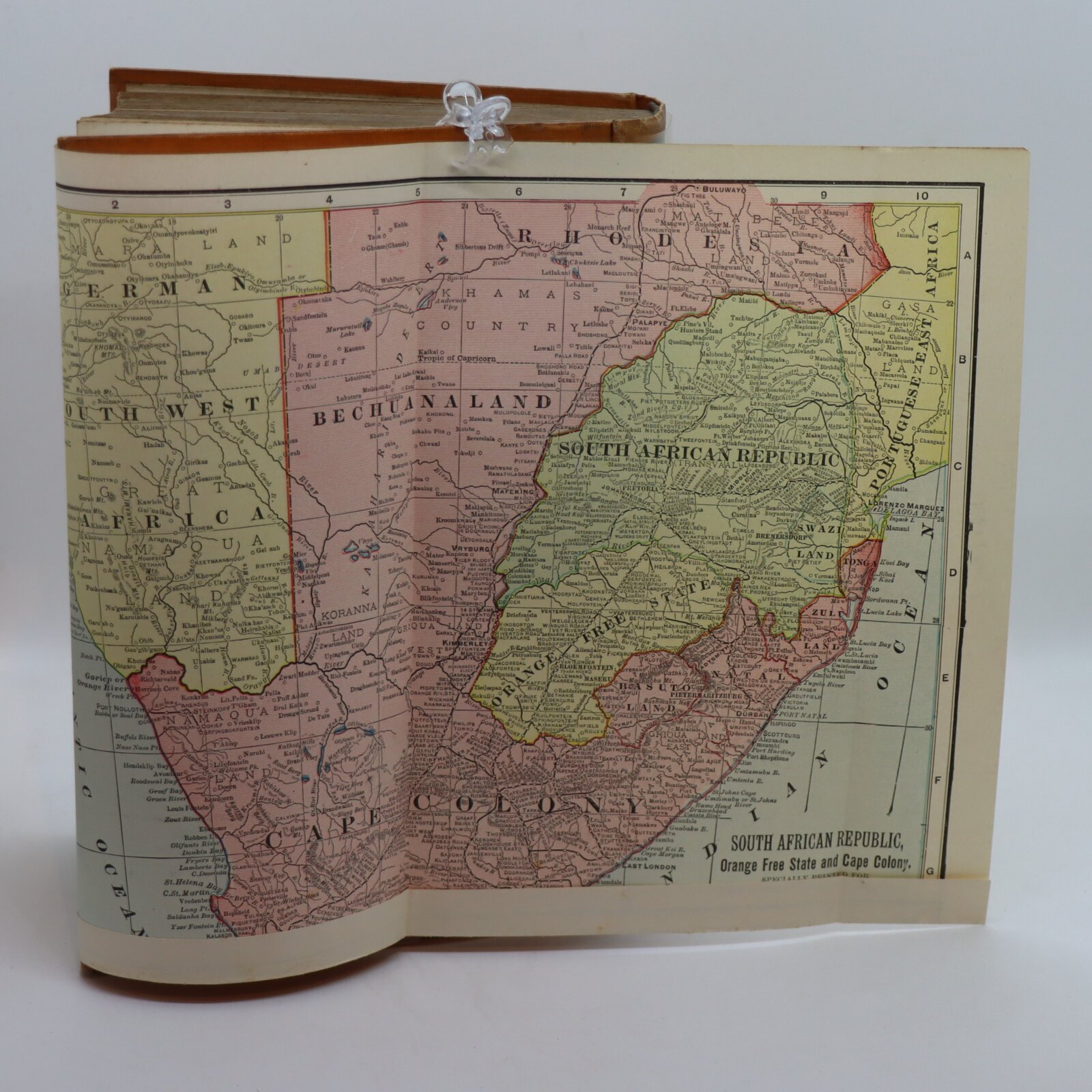
The Second Boer War (also known as the Boer War, the Anglo-Boer War, or the South African War), was a conflict fought between the British Empire and the two Boer Republics (the South African Republic and the Orange Free State) over the Empire’s influence in Southern Africa from 1899 to 1902. Triggered by the discovery of diamond and gold deposits in the Boer republics, the Boers launched successful attacks against British outposts in the opening stages of the war before being pushed back by imperial reinforcements. Though the British swiftly occupied the Boer republics, numerous Boers refused to accept defeat and engaged in guerrilla warfare. Eventually, British scorched earth policies brought the remaining Boer guerrillas to the negotiating table, ending the war.
The conflict broke out in 1899 when Boer irregulars and militia attacked colonial settlements in nearby British colonies. In 1900, they placed Ladysmith, Kimberley, and Mafeking under siege, and won a string of victories at Colenso, Magersfontein and Stormberg. In response to these developments, increased number of British Army soldiers were brought to Southern Africa, and mounted largely unsuccessful attacks against the Boers. However, British military fortunes changed when their commanding officer, General Redvers Buller was replaced by Lord Roberts and Lord Kitchener, who relieved the three besieged cities and invaded the two Boer Republics in late 1900 at the head of a 400,000-strong expeditionary force. The Boers, aware they were unable to resist such a large force, chose to refrain from fighting pitched battles, allowing the British to occupy both republics.
Boer politicians, including President of the South African Republic Paul Kruger either fled the region or went into hiding; the British Empire officially annexed the two republics in 1900. In Britain, the Conservative ministry led by Lord Salisbury attempted to capitalize on British military successes by calling an early general election, which was dubbed by contemporary observers as a “khaki election”. However, numerous Boer fighters took to the hills and launched a guerrilla campaign against the British occupational forces, becoming known as bittereinders. Led by prominent generals such as Louis Botha, Jan Smuts, Christiaan de Wet, and Koos de la Rey, Boer guerrillas launched a campaign of hit-and-run attacks and ambushes against the British, which would continue for two years.
The Boer guerrilla campaign proved difficult for the British to defeat, due in part to British unfamiliarity with guerrilla tactics and extensive support for the guerrillas among the civilian population in the Boer Republics. In response to continued failures to defeat the Boer guerrillas, British high command ordered several scorched earth policies to be implemented as part of a large scale and multi-pronged counter insurgency campaign; a complex network of nets, blockhouses, strongpoints and barbed wire fences was constructed, virtually partitioning the occupied republics. British troops were ordered to destroy farms and slaughter livestock to deny them to Boer guerrillas, and thousands of Boer civilians (mostly women and children) were forcibly interned in concentration camps, where 26,000 died of various causes, mostly disease and starvation. Black Africans were also interned in concentration camps as well to prevent them from supplying the Boers; 20,000 died in the camps as well, largely due to the same causes as their Boer counterparts.
In addition to these scorched earth policies, British mounted infantry units were deployed to track down and engage individual Boer guerillas units; by this stage of the war, all battles being fought were small-scale skirmishes. Few combatants on other side were killed in action, with most casualties coming via disease. Despite the British efforts to defeat the Boer guerillas, they continued to refuse to surrender. This led Lord Kitchener to offer generous terms of surrender to remaining Boer leaders in an effort to bring an end to the conflict. Eager to ensure their fellow Boers were released from the concentration camps, the majority of Boer commanders accepted the British terms in the Treaty of Vereeniging, formally surrendering in May 1902. The former republics were transformed into the British colonies of the Transvaal and Orange River, and in 1910 were merged with the Natal and Cape Colonies to form the Union of South Africa, a self-governing dominion within the British Empire.
British military efforts were aided significantly by local forces from the Cape Colony, the Natal Colony, Rhodesia, as well as volunteers from the British Empire worldwide, particularly Australia, Canada, India and New Zealand. Later in the war, Black African recruits contributed increasingly to the British war effort. International public opinion was generally sympathetic to the Boers and hostile to the British. Even within the empire, there existed significant opposition to the war. As a result, the Boer cause attracted thousands of volunteers from neutral countries all over the world, including parts of the British Empire such as Ireland. Many consider the Boer War as marking the beginning of the questioning of the British Empire’s level of power and prosperity; this is due to the war’s surprisingly long duration and the unforeseen, discouraging losses suffered by the British fighting the “cobbled-together army” of Boers.
Michael Davitt (25 March 1846 – 30 May 1906) was an Irish republican activist for a variety of causes, especially Home Rule and land reform. Following an eviction when he was four years old, Davitt’s family emigrated to England. He began his career as an organiser of the Irish Republican Brotherhood, which resisted British rule in Ireland with violence. Convicted of treason felony for arms trafficking in 1870, he served seven years in prison. Upon his release, Davitt pioneered the New Departure strategy of cooperation between the physical-force and constitutional wings of Irish nationalism on the issue of land reform. With Charles Stewart Parnell, he co-founded the Irish National Land League in 1879, in which capacity he enjoyed the peak of his influence before being jailed again in 1881.
Davitt travelled widely, giving lectures around the world, supported himself through journalism, and served as Member of Parliament (MP) for the Irish Parliamentary Party (IPP) during the 1890s. When the party split over Parnell’s divorce, Davitt joined the anti-Parnellite Irish National Federation. His Georgist views on the land question put him on the left wing of Irish nationalism, and he was a vociferous advocate of alliance between the Radical faction of the Liberal Party and the IPP.
Want to know more about this item?
We are happy to answer any questions you may have about this item. In addition, it is also possible to request more photographs if there is something specific you want illustrated.
Ask a question
Related products



Share this Page with a friend
