
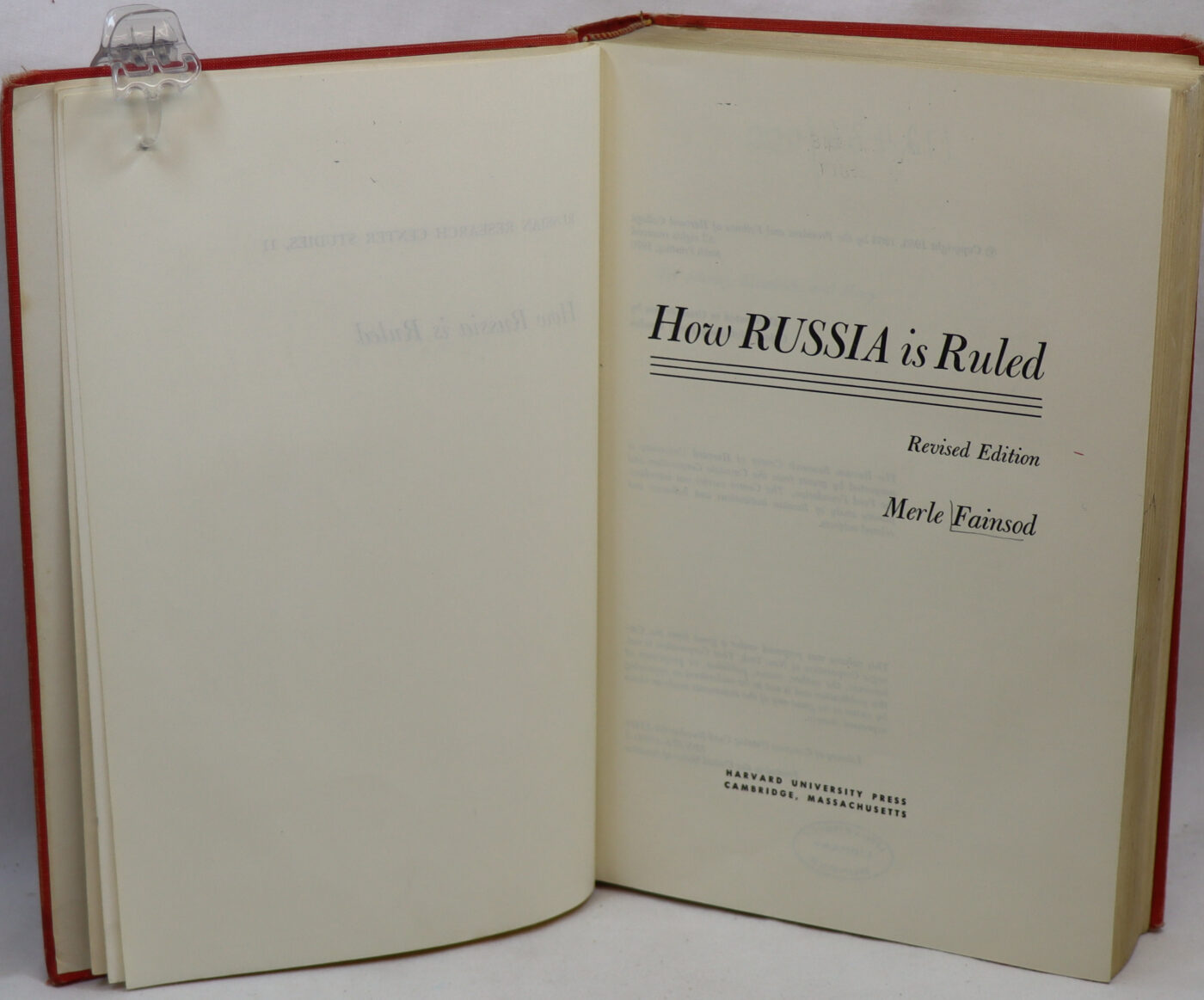
How Russia is Ruled.
By Merle Faisod
ISBN: 9780674189171
Printed: 1970
Publisher: Harvard University Press. Cambridge, Massachusetts
| Dimensions | 16 × 24 × 4 cm |
|---|---|
| Language |
Language: English
Size (cminches): 16 x 24 x 4
Condition: Fair (See explanation of ratings)
£21.00
Buy Now

Item information
Description
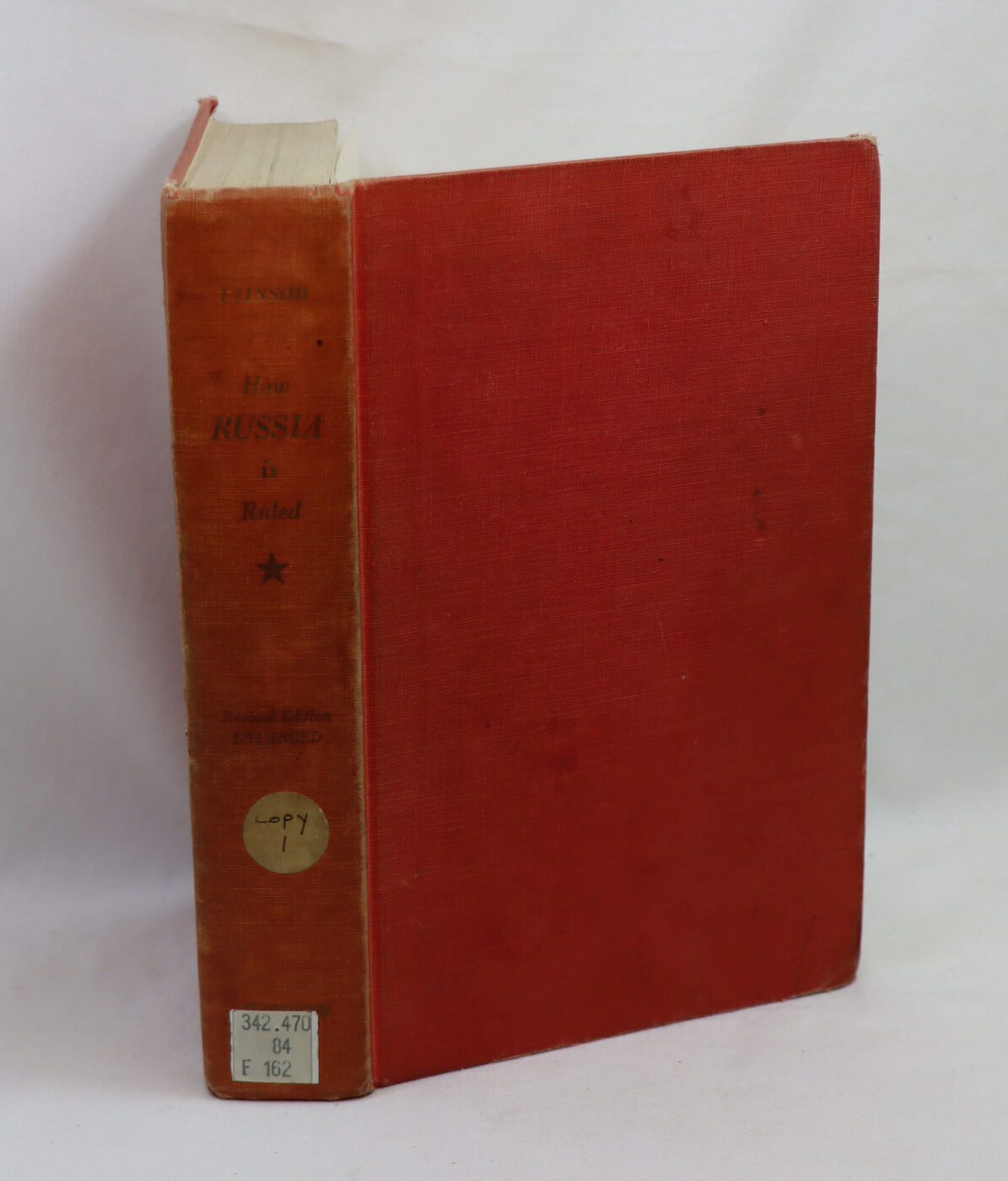
Blue cloth binding with black title on the spine.
We provide an in-depth photographic presentation of this item to stimulate your feeling and touch. More traditional book descriptions are immediately available.
- Note: This book carries a £5.00 discount to those that subscribe to the F.B.A. mailing list
Please view our photographs. “How Russia is Ruled” by Merle Fainsod is a seminal political science text that defined the field of Soviet studies for decades. Originally published in 1953, the ISBN provided (9780674189171) corresponds specifically to the authoritative Revised Edition published by Harvard University Press. This book is highly valued by historians and collectors interested in Cold War-era political analysis and the structural mechanics of the Soviet totalitarian state.
Market Value & Condition Insights
This copy is in Fair condition, so its valuation and interest depends heavily on its physical completeness:
- Estimated Market Value: Copies of the Revised Edition in “Good” to “Very Good” hardcover condition generally retail between £15.00 and £22.00 ($20.00 – $30.00 USD) on used book platforms like AbeBooks. A copy in “Fair” condition typically shifts closer to £10.00 to £15.00.
- Condition Considerations: For a political science text of this era, a “Fair” grading usually implies noticeable shelf wear, a faded or bumped spine, or internal student markings (such as underlining or marginalia) which are common for this specific text.
Book Specifications & Context
- The Author: Merle Fainsod was a preeminent Harvard professor and director of the Russian Research Center. This book remains his most famous academic contribution.
- Core Subject: The text provides a rigorous, historical analysis of the Bolshevik Revolution and the subsequent rise of the totalitarian apparatus. It focuses heavily on how the Leninist and Stalinist party machinery maintained strict top-down control over public administration, the secret police, industry, and the military.
Core Analytical Framework
How Russia Is Ruled analyzes the evolution and operation of the Soviet political system. Fainsod uses a historical-institutional approach to explain how a minor revolutionary faction transformed into a highly centralized, totalitarian state apparatus. The text is structured into four primary analytical parts:
- Part One: Historical Foundations: Traces the transformation of the Tsarist autocracy into a Bolshevik dictatorship, analyzing the roles of Vladimir Lenin and Joseph Stalin in centralizing institutional authority.
- Part One: The Role of the Communist Party: Examines the internal party dynamics, shifting demographics, structural hierarchy, and the mechanisms used to enforce ideological conformity.
- Part Three: Instruments of Rule: Investigates the enforcement organs of the Soviet state, specifically the constitutional framework, the administrative bureaucracy, the secret police, and the military.
- Part Four: Political Dynamics & Conclusions: Synthesizes the interplay between industry, agriculture, and civic life under the command economy, offering an evaluation of the system’s structural strengths, vulnerabilities, and future trajectories.
Chapter-by-Chapter Analytical Breakdown
Part One: The Historical Foundations of Autocracy
Chapter 1: The Heritage of the Past
Fainsod establishes that Soviet totalitarianism did not emerge in a vacuum; it inherited deep structural patterns from Tsarist autocracy. He identifies key continuities: the historical absence of institutional checks on executive power, a deeply ingrained bureaucratic culture, and a long-standing reliance on state-directed modernization. The chapter illustrates how the Russian empire’s historical vulnerability to foreign invasion reinforced a systemic prioritization of state security over individual civil liberties.
Chapter 2: The Logic of Revolution
This chapter analyzes the societal collapse of 1917 and the strategic maneuvers that enabled the Bolsheviks to seize power. Fainsod evaluates the structural breakdown of the Provisional Government, the tactical exploitability of widespread peasant and worker grievances, and the organizational doctrine of the Bolshevik party. He highlights how the chaotic environment of the Civil War necessitated the early development of repressive, centralized administrative structures.
Chapter 3: The Growth of the Party Apparatus (1917-1953)
Fainsod tracks the institutional shift of power away from democratic soviets (councils) directly into the internal organs of the Communist Party. The chapter documents the historical transition from Lenin’s collective leadership model to Stalin’s highly personalized dictatorship. Fainsod traces how early ad-hoc revolutionary bodies hardened into permanent administrative offices like the Secretariat and the Orgburo, transforming the party from an open political forum into a closed, disciplined command hierarchy.
Part Two: The Role of the Communist Party
Chapter 4: The Composition and Social Structure of the Party
This section analyzes the changing demographics of the party membership over time. Fainsod details how the party shifted from its original core of radical, urban intellectuals and industrial laborers into a specialized elite dominated by technical managers, state bureaucrats, and military officers. This evolution tracks the transformation of the party from a revolutionary vanguard into a careerist ruling class.
Chapter 5: Party Organization: The Democratic Centralist Facade
Fainsod deconstructs the official organizational concept of “democratic centralism”—the doctrine that party decisions are debated democratically but must be executed with absolute unity. Through rigorous structural analysis, he demonstrates how the democratic element served as a facade. Power flowed entirely downward from the Politburo and Secretariat, rather than upward from the local party cells, rendering congresses and elections purely performative endorsements of central decrees.
Chapter 6: Party Leadership: The High Command
An investigation into the inner workings of the Politburo, Secretariat, and Central Committee. Fainsod details the institutional mechanics of factional politics, ideological purges, and the methods used to isolate and eliminate political dissent. The chapter explains how patronage networks operated within the high command, where loyalty to senior leaders dictated political survival and institutional advancement.
Part Three: Instruments of Rule
Chapter 7: The Constitutional Framework and the Soviet System
This chapter contrasts the highly democratic language of the 1936 Soviet Constitution with the operational realities of Soviet governance. Fainsod explains how constitutional guarantees of free speech, assembly, and judicial independence were systematically neutralized by provisions requiring all rights to be exercised solely in alignment with the goals of the socialist state.
Chapter 8: The Bureaucracy and National Administration
Fainsod explores the massive administrative expansion required to run a total command economy. He analyzes the friction between the professional state bureaucracy (the ministries) and the overseeing party apparatus. The chapter highlights how overlapping jurisdictions and mutual surveillance mechanisms were intentionally built into the administration to prevent any single bureaucratic entity from developing an independent base of power.
Chapter 9: Terror and Secret Police
Fainsod presents terror not as a temporary aberration of the Stalinist era, but as an essential, institutional pillar of totalitarian control. He charts the evolution of the state security organs from the Cheka through the OGPU and NKVD. The chapter dissects the operational methodology of the secret police, detailing how systemic surveillance, arbitrary arrests, forced labor systems (the Gulag), and manufactured social paranoia were utilized to prevent the formation of organised opposition.
Chapter 10: The Armed Forces
An examination of civil-military relations within the totalitarian state. Fainsod explains how the party maintained control over a massive military establishment through the system of political commissars (later zampolits) embedded within command units. This dual-command structure ensured that military efficiency was constantly counterbalanced by political surveillance, mitigating the historical threat of a military coup.
Part Four: Political Dynamics and Conclusions
Chapter 11: The Control of Public Opinion and Communications
This chapter outlines the complete state monopoly over media, literature, education, and the arts. Fainsod analyzes the operational methods of Glavlit (the central censorship organ) and the Agitprop department. He demonstrates how the state went beyond suppressing critical ideas to actively manufacturing an all-encompassing ideological environment designed to remold individual psychology into the idealized “Soviet Man.”
Chapter 12: Management in the Command Economy
Fainsod analyzes the structural pressures faced by factory managers and collective farm directors operating under rigid state planning (Gosplan). The chapter highlights how unrealistic production quotas drove widespread institutional corruption, falsified statistics, and reliance on informal black-market networks (blat) to secure raw materials—revealing the structural inefficiencies of centralized economic planning.
Chapter 13: The Problem of Succession and Future Outlook
Written before the complete dissolution of the USSR, this concluding chapter evaluates the systemic vulnerabilities of a regime lacking institutionalized, peaceful mechanisms for transferring power. Fainsod weighs the durability of the Soviet administrative machinery against growing internal contradictions, detailing the long-term strain of economic inefficiency, social stratification, and the constant threat of succession crises.
Condition notes
ex library
Want to know more about this item?
We are happy to answer any questions you may have about this item. In addition, it is also possible to request more photographs if there is something specific you want illustrated.
Ask a question
Related products



Share this Page with a friend
