
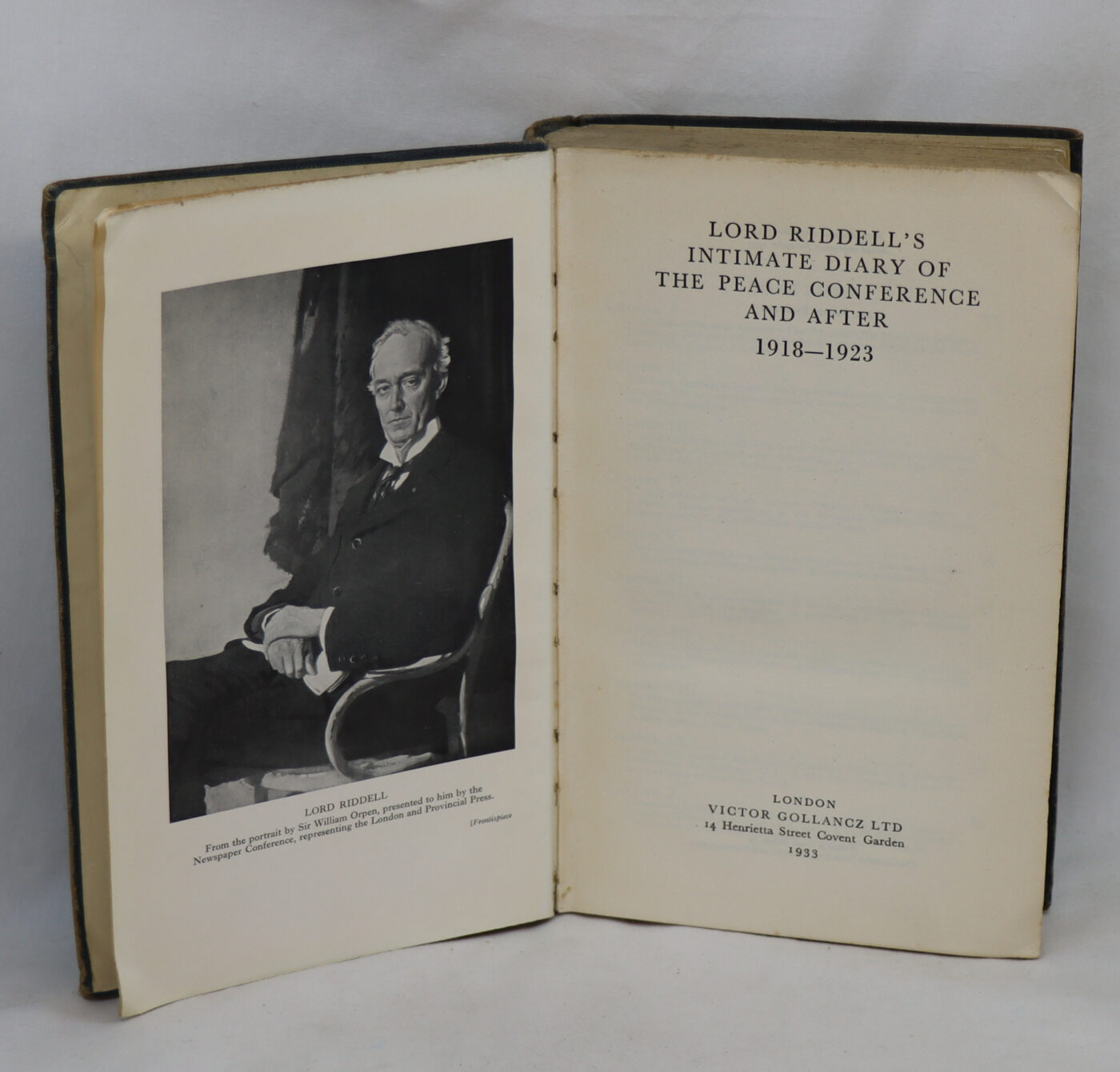
Lord Riddell's Intimate Diary of the Peace Conference and Thereafter. 1918-1923.
By Lord Riddell
Printed: 1933
Publisher: Victor Gollancz. London
| Dimensions | 15 × 22 × 4 cm |
|---|---|
| Language |
Language: English
Size (cminches): 15 x 22 x 4
Condition: Fair (See explanation of ratings)
£28.00
Buy Now

Item information
Description
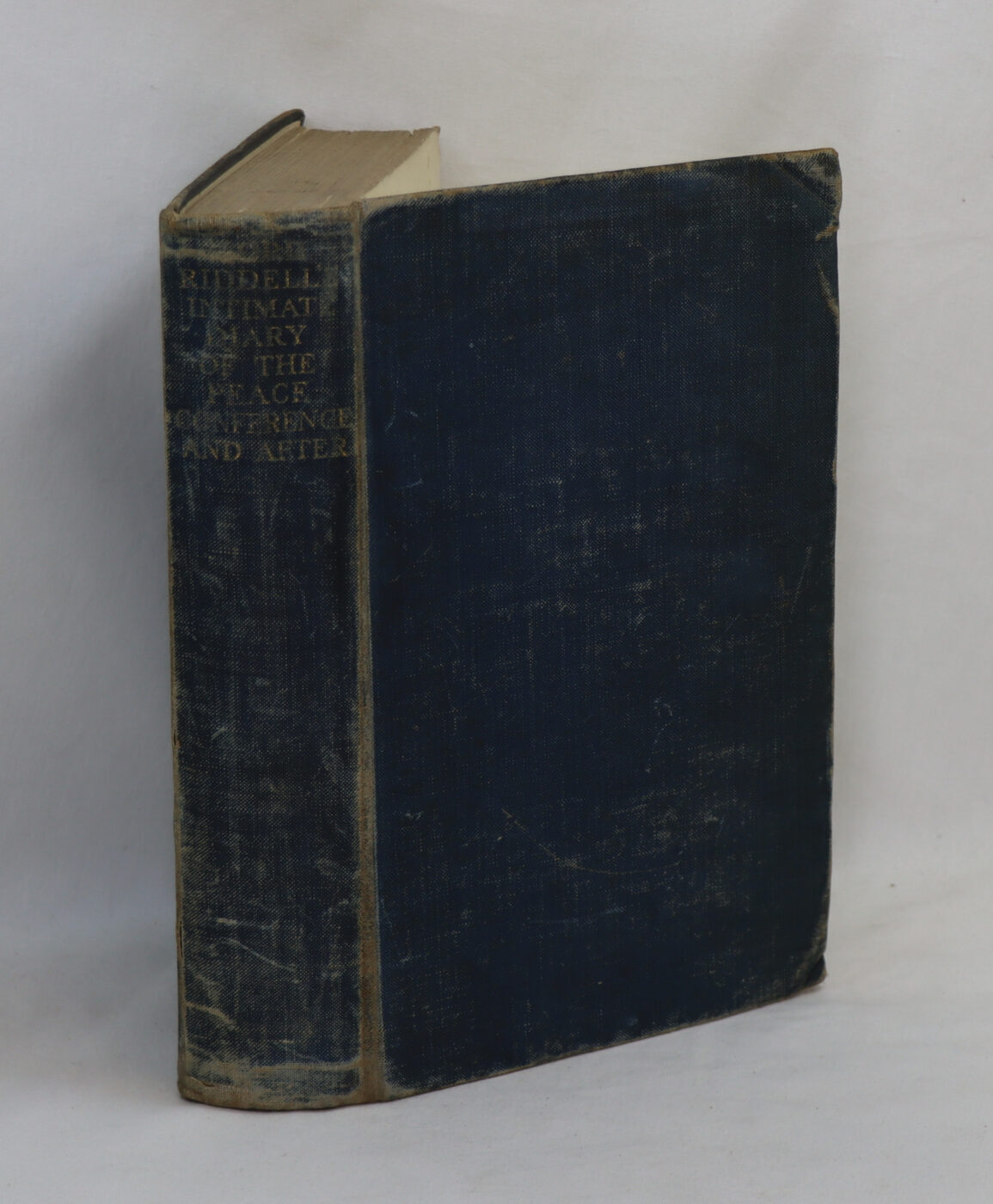
Blue cloth binding with gilt title on the spine.
We provide an in-depth photographic presentation of this item to stimulate your feeling and touch. More traditional book descriptions are immediately available.
- Note: This book carries a £5.00 discount to those that subscribe to the F.B.A. mailing list
Please view our photographs. This is a 1933 first edition copy of Lord Riddell’s Intimate Diary of the Peace Conference and Thereafter (1918–1923). George Riddell, a prominent British newspaper tycoon, served as the official press representative for the British delegation at the Paris Peace Conference, making this book a critical primary historical source.
Market Value & Scarcity
- Estimated Value: In Fair condition, copies of this specific Victor Gollancz printing typically trade between £25 and £35 on antiquarian and used book marketplaces like AbeBooks and World of Books.
- Condition Impact: A “Fair” grading implies the book has complete text but shows significant wear, such as a faded spine, fraying cloth corners, or minor foxing on the page edges. If it retains its original dust jacket (highly rare for 1933 Gollancz editions), the value can increase significantly.
Historical Significance
- The Content: The diary provides an unvarnished, behind-the-scenes look at the negotiations of the Treaty of Versailles and the shifting dynamics between major geopolitical players like David Lloyd George, Woodrow Wilson, and Georges Clemenceau.
- The Publisher: Victor Gollancz was renowned in the 1930s for publishing politically significant non-fiction and left-leaning literature, making this standard cloth-bound trade edition a staple of interwar.
Lord Riddell’s Intimate Diary of the Peace Conference and After (1918–1923) is a highly regarded primary historical resource. Spanning 435 to 436 pages across 12 chapters, the text includes a frontispiece portrait of Lord Riddell alongside 7 additional black-and-white plates.
Because George Riddell was David Lloyd George’s closest press confidant and the official representative for the British press barons, his diary functions as a fly-on-the-wall perspective of the monumental shift from global war to fragile peace.
Core Historical Content
- The Paris Peace Conference & Versailles (1919): The heart of the book details the informal conversations and shifting dynamics of the “Big Four”—David Lloyd George, Woodrow Wilson, Georges Clemenceau, and Vittorio Emanuele Orlando. Riddell captures their personal anxieties, arguments over German war guilt (Clause 231), and the chaotic drafting of the Treaty of Versailles.
- The Birth of the League of Nations: Riddell logs firsthand observations on the ideological friction between American idealism (Wilson’s vision for global cooperation) and European realism regarding the formation of the League of Nations.
- Post-War Global Conferences (1920–1922): The “Thereafter” or “After” portion follows major post-Versailles geopolitical meetings, including the San Remo Conference, the London Conferences, and the Washington Naval Conference (1921–1922), detailing how the Allies handled the collapsing Ottoman Empire and global disarmament.
- The Fall of Lloyd George (1922): The diary traces the disintegration of the British wartime coalition government, the Chanak Crisis, and the eventual political downfall of Lloyd George, which coincided with a permanent personal rift between Lloyd George and Riddell.
Editorial Discretion & “Censorship”
- Omitted Data: When Victor Gollancz published this edition in 1933, Riddell deliberately omitted highly sensitive political secrets, personal scandals, and certain disparaging remarks about living figures like Winston Churchill to avoid legal and political fallout.
- The British Museum Restriction: To preserve the unedited truth, Riddell deposited his complete, unexpurgated raw journals with the British Museum in 1935 with strict instructions that they remain sealed from public view for 50 years. They were finally opened and published in full by historian John M. McEwen in 1986.
Want to know more about this item?
We are happy to answer any questions you may have about this item. In addition, it is also possible to request more photographs if there is something specific you want illustrated.
Ask a question

Share this Page with a friend
