
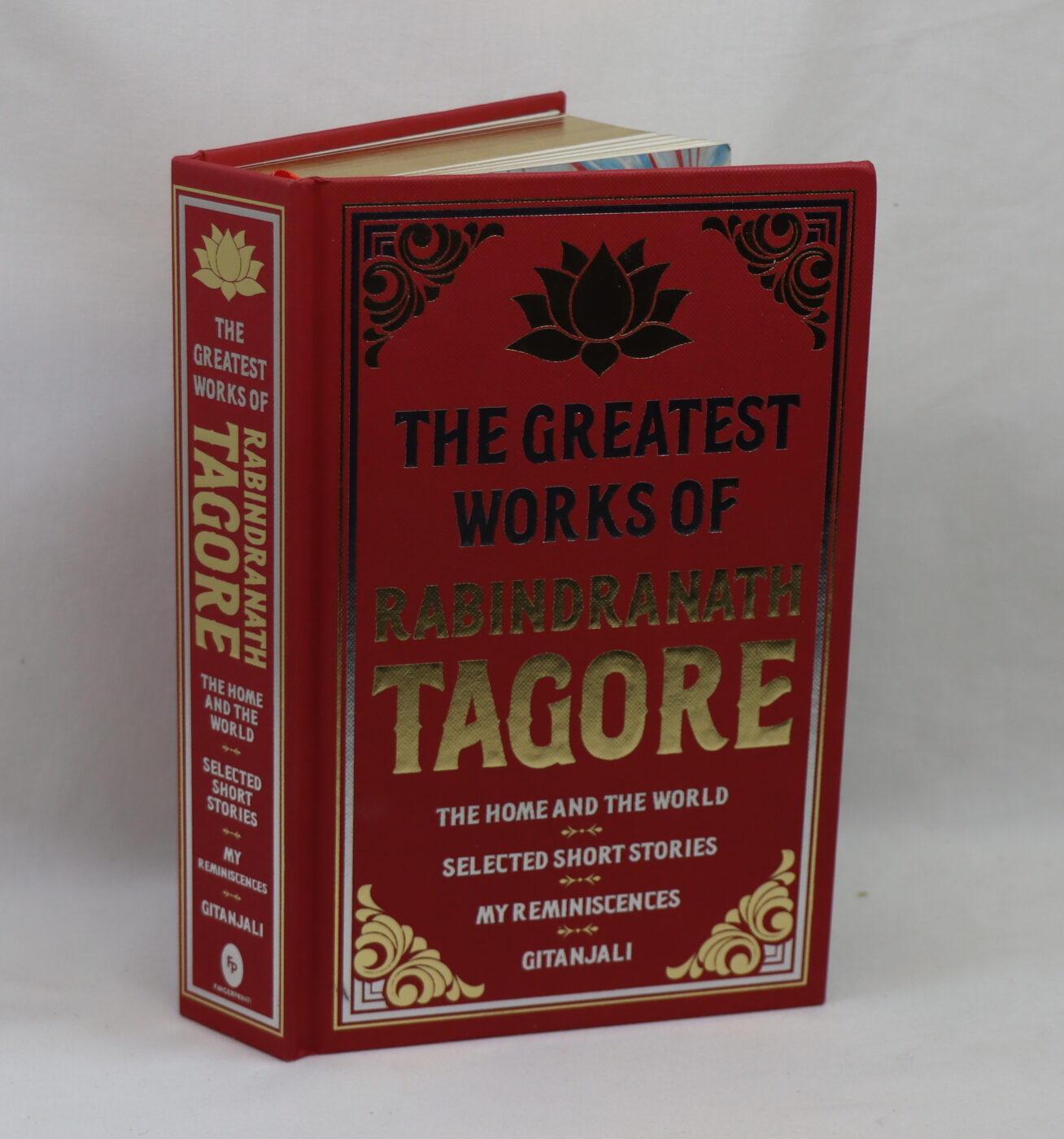
The Greatest Works of Rabindranath Tagore.
By Rabindranath Tagore
ISBN: 9788172247287
Printed: 2024
Publisher: Fingerprint Classics.
| Dimensions | 13 × 22 × 4 cm |
|---|
Language: Not stated
Size (cminches): 13 x 22 x 4
Condition: As new (See explanation of ratings)
£19.00
Buy Now

Item information
Description
Red cloth binding with gilt title on the spine and the front board.
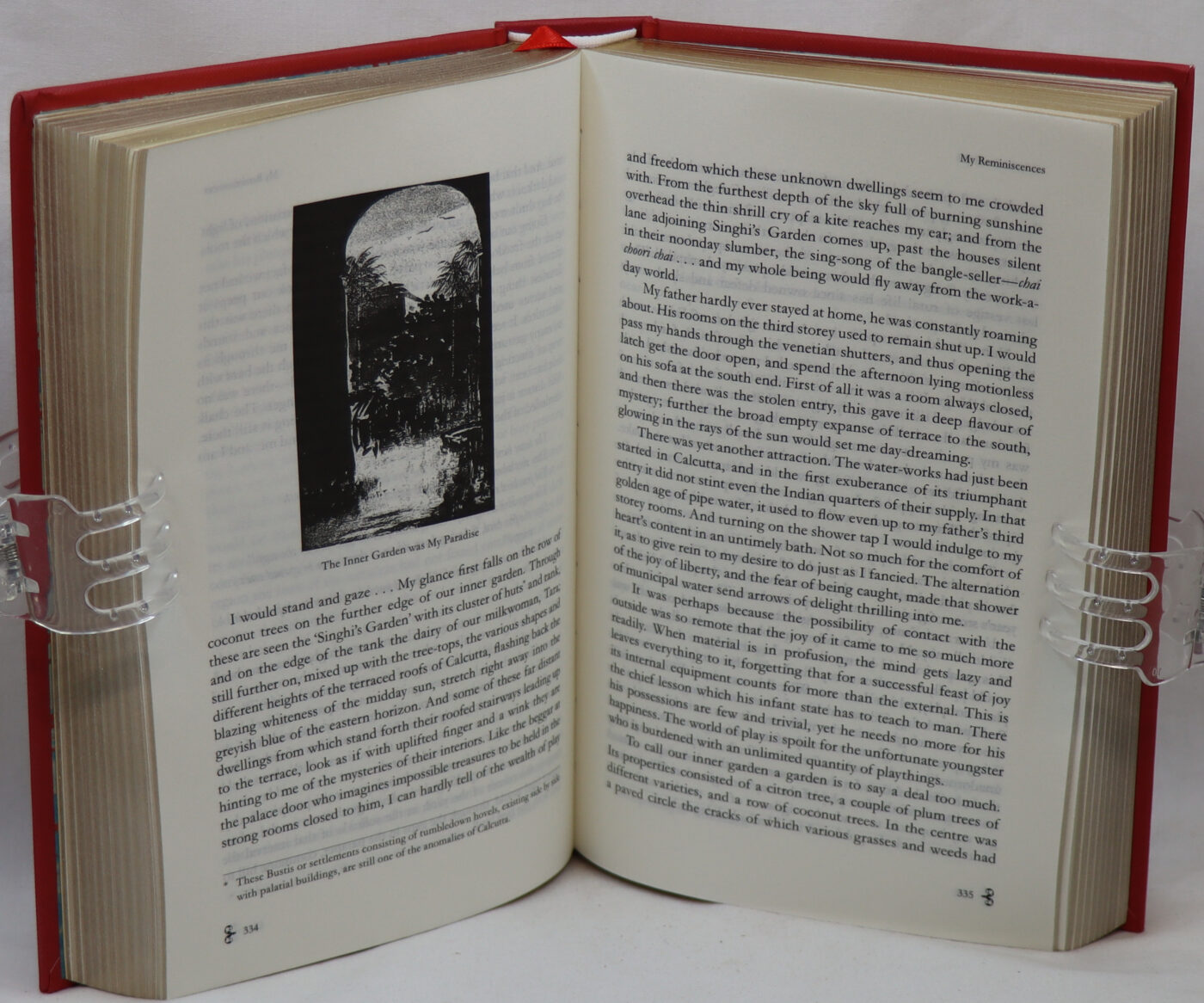
We provide an in-depth photographic presentation of this item to stimulate your feeling and touch. More traditional book descriptions are immediately available.
- Note: This book carries a £5.00 discount to those that subscribe to the F.B.A. mailing list
A lovely book: One of the leading figures of Bengali literature, Rabindranath Tagore was born on May 7, 1861. He was brought up in a literary, intellectual, and social household, and began writing at an early age. The bibliography of his writing contains more than two hundred works and around two thousand two hundred songs. From poetic dramas, social plays, short stories, philosophical and critical essays, and travelogues to letters, memoirs, lyrics, drawings, and paintings, Tagore’s life was marked by uninterrupted literary and artistic creations. Many of Tagore’s stories and novels have been adapted for film and television. His works continue to be translated into many languages worldwide.
Rabindranath Tagore FRAS (Bengali: 7 May 1861 – 7 August 1941), was a Bengali poet, author, playwright, musician, composer, philosopher, social reformer, painter, and one of the foremost figures of the Bengal Renaissance. In 1913, Tagore became the first Asian to win a Nobel Prize in any category, and also the first lyricist and non-European to win the Nobel Prize in Literature. A significant moulder of culture within Bengal and the Indian subcontinent, he wrote and composed the national anthems of India and Bangladesh.
He reshaped Bengali literature and music as well as Indian art with Contextual Modernism in the late 19th and early 20th centuries. He was the author of the “profoundly sensitive, fresh and beautiful” poetry of Gitanjali. Tagore’s poetic songs were viewed as spiritual and mercurial; his elegant prose and magical poetry were widely popular in the Indian subcontinent. He was a fellow of the Royal Asiatic Society. Referred to as “the Bard of Bengal”, Tagore was known by the sobriquets Gurudeb, Kobiguru, and Bishwokobi.
A Bengali Brahmin from Calcutta with ancestral gentry roots in Jessore and Bardhaman districts, Tagore wrote poetry as an eight-year-old. At the age of sixteen, he released his first substantial poems under the pseudonym Bhānusiṃha (“Sun Lion”), which were seized upon by literary authorities as long-lost classics. By 1877 he graduated to his first short stories and dramas, published under his real name. As a humanist, universalist, internationalist, and ardent critic of nationalism, he denounced the British Raj and advocated independence from Britain. As an exponent of the Bengal Renaissance, he advanced a vast canon that comprised paintings, sketches and doodles, hundreds of texts, and some two thousand songs; his legacy also endures in his founding of Visva-Bharati University.
Tagore modernised Bengali art by spurning rigid classical forms and resisting linguistic strictures. His novels, stories, songs, dance dramas, and essays spoke to topics political and personal. Gitanjali (Song Offerings), Gora (Fair-Faced), and Ghare-Baire (The Home and the World) are his best-known works. His poetry, short stories, and novels were both praised and criticised for their lyricism, colloquial tone, naturalism, and philosophical introspection. His compositions were chosen by two nations as national anthems: India’s “Jana Gana Mana” and Bangladesh’s “Amar Sonar Bangla”. The Sri Lankan national anthem was also inspired by his work. His song “Banglar Mati Banglar Jol” has been adopted as the state anthem of West Bengal.
Want to know more about this item?
We are happy to answer any questions you may have about this item. In addition, it is also possible to request more photographs if there is something specific you want illustrated.
Ask a question
Related products


Share this Page with a friend
