
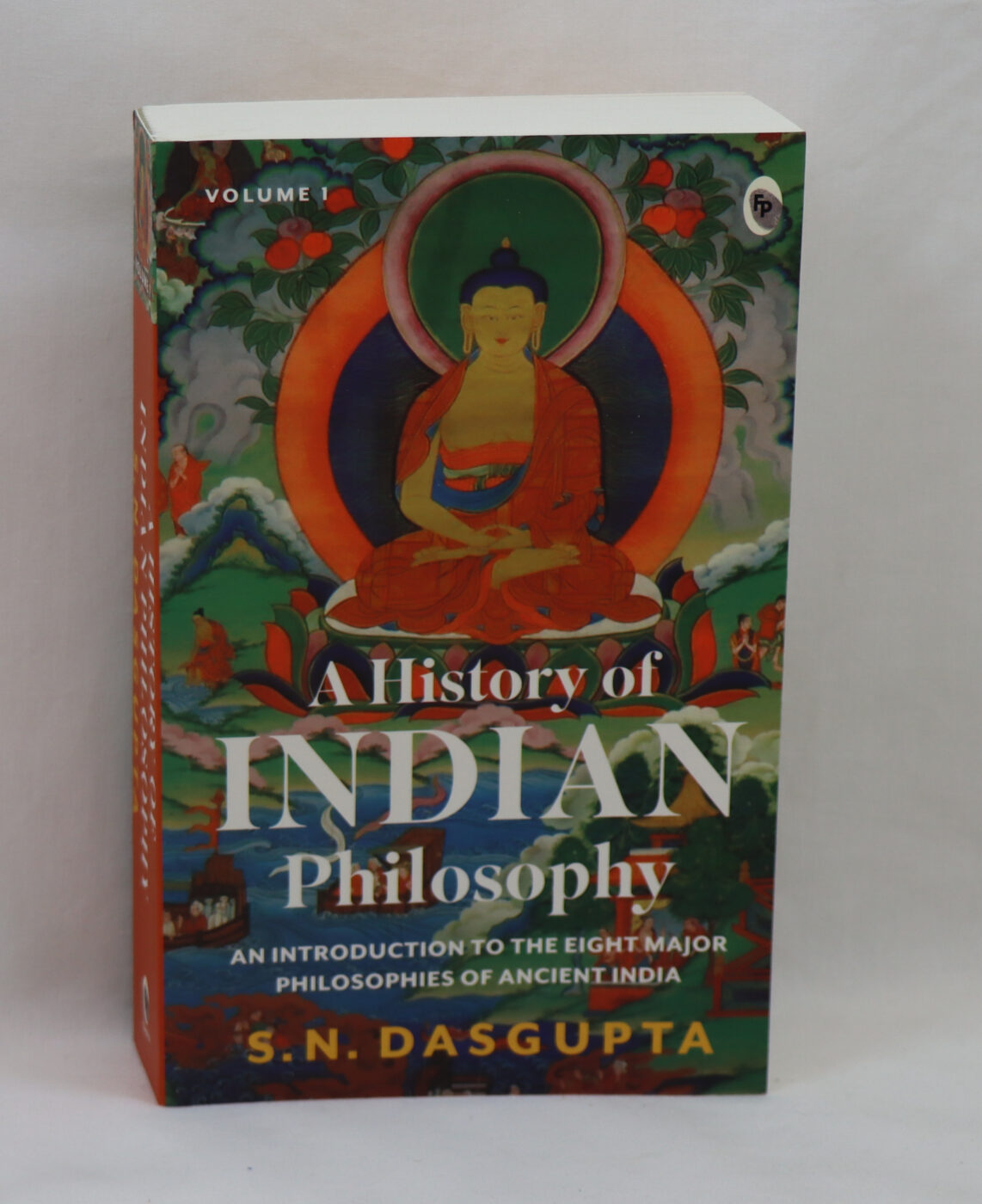
A History of Indian Philosophy.
By S N Dasgupta
ISBN: 9789358567274
Printed: 2025
Publisher: Fingerprint Classics.
| Dimensions | 14 × 21 × 4 cm |
|---|---|
| Language |
Language: English
Size (cminches): 14 x 21 x 4
Condition: As new (See explanation of ratings)
£25.00
Buy Now


Item information
Description
Paperback. Orange cover with white title.
We provide an in-depth photographic presentation of this item to stimulate your feeling and touch. More traditional book descriptions are immediately available.
- Note: This book carries a £5.00 discount to those that subscribe to the F.B.A. mailing list
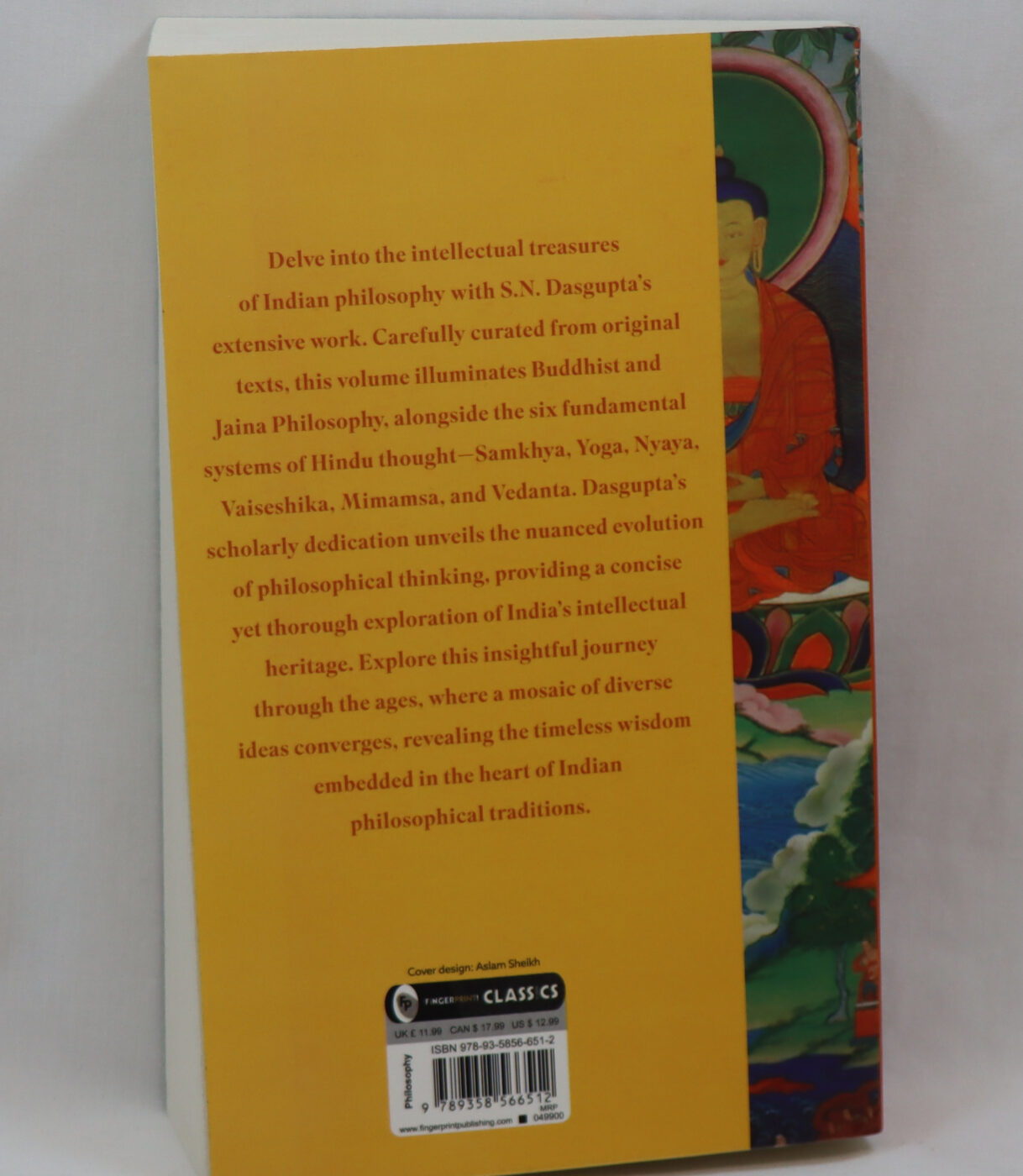
Immerse yourself in the intellectual richness of Indian philosophical traditions with this scholarly masterpiece that unveils the development of philosophical thought in India from the Vedic period to the early centuries of the Common Era. This insightful book presents a panoramic view of diverse philosophical schools, including Nyaya, Vaisheshika, Samkhya, Yoga, and others, and offers invaluable insights into their key tenets and contributions. Extensive research and lucid writing make this volume an essential reference for students, scholars, and enthusiasts of Indian philosophy worldwide. A captivating journey through the philosophical heritage of India!
- A comprehensive exploration of the evolution of Indian philosophical thought.
- Highlights the philosophical systems, thinkers, and their ideas that have shaped Indian culture and spirituality.
- An extensive overview of the diverse schools of Indian philosophy and their principles.
- A perfect value addition for any library.
Reviews:
- Surendranath Dasgupta (18 October 1887 – 18 December 1952) was an Indian scholar of Sanskrit and Indian philosophy.
- Surendranath Dasgupta was born to a Vaidya family in Kushtia, Bengal (now in Bangladesh), on Sunday, 18 October 1885, corresponding to Dashami Shukla (i.e., the tenth day) of the month of Āśvin and coinciding with the festivals of Dussehra and Durga Visarjan.His ancestral home was in the village Goila in Barisal District. He studied at Ripon College in Calcutta and graduated with honours in Sanskrit. Later, in 1908, he received his master’s degree from Sanskrit College, Calcutta. He got a second master’s degree in Western philosophy in 1910 from the University of Calcutta. Prof. Dasgupta married Himani Devi, the younger sister of Himanshu Rai, India’s pioneer film director and founder of the Bombay Talkies movie studios. They had six children together: three daughters, Maitreyi Devi (Sen) (1914-1989), Chitrita Devi (Gupta) (1919- 2006) – both of whom became famous writers – and Sumitra Majumdar; and three sons, Subhayu Dasgupta, Sugata Dasgupta and Prof. Subhachari Dasgupta, who also left behind works valuable to nation-building. Sumitra Majumdar, the youngest and last surviving child, died in Goa in September 2008. One of his granddaughters (daughter of Chitrita Devi) Prof. Lali Chatterjee, is a noted astro physicist based in the United States. Dasgupta earned the Griffith Prize in 1916 and his doctorate in Indian philosophy in 1920. Maharaja Sir Manindra Chandra Nandy now urged him to go to Europe to study European philosophy at its sources, and generously bore all the expenses of his research tour (1920–22). Dasgupta went to England and distinguished himself at Cambridge as a research student in philosophy under Dr. J. M. E. McTaggart. During this time the Cambridge University Press published the first volume of the History of Indian Philosophy (1921). He was also appointed lecturer at Cambridge and nominated to represent Cambridge University at the International Congress of Philosophy in Paris. His participation in the debates of the Aristotelian Society, London, the leading philosophical society of England, and of the Moral Science Club, Cambridge, earned for him the reputation of being an almost invincible controversialist. Great teachers of philosophy like Ward and McTaggart, under whom he studied, looked upon him not as their pupil but as their colleague. He received his Cambridge doctorate for an elaborate thesis on contemporary European philosophy. The impressions that he had made by his speeches and in the debates at the Paris Congress secured for him an invitation to the International Congress at Naples in 1924, where he was sent as a representative of the Bengal Education Department and of the University of Calcutta; later on, he was sent on deputation by the Government of Bengal to the International Congress at Harvard in 1926. In that connection he delivered the Harris Foundation lectures at Chicago, besides a series of lectures at about a dozen other universities of the United States and at Vienna, where he was presented with an illuminated address and a bronze bust of himself. He was invited in 1925 to the second centenary of the Academy of Science, Leningrad, but he could not attend for lack of Government sanction. In 1935, 1936 and 1939 he was invited as visiting professor to Rome, Milan, Breslau, Königsberg, Berlin, Bonn, Cologne, Zurich, Paris, Warsaw and England.
Professor Surendranath Dasgupta (1885–1952) was a distinguished Indian philosopher and historian of philosophy. He was a prominent figure in the realm of Indian philosophical studies. Prof. Dasgupta’s scholarship played a pivotal role in introducing Indian philosophy to a global audience. His insightful writings and meticulous research continue to be highly regarded in academia, shaping the understanding of Indian philosophical thought.
Want to know more about this item?
We are happy to answer any questions you may have about this item. In addition, it is also possible to request more photographs if there is something specific you want illustrated.
Ask a question
Related products

Share this Page with a friend
