
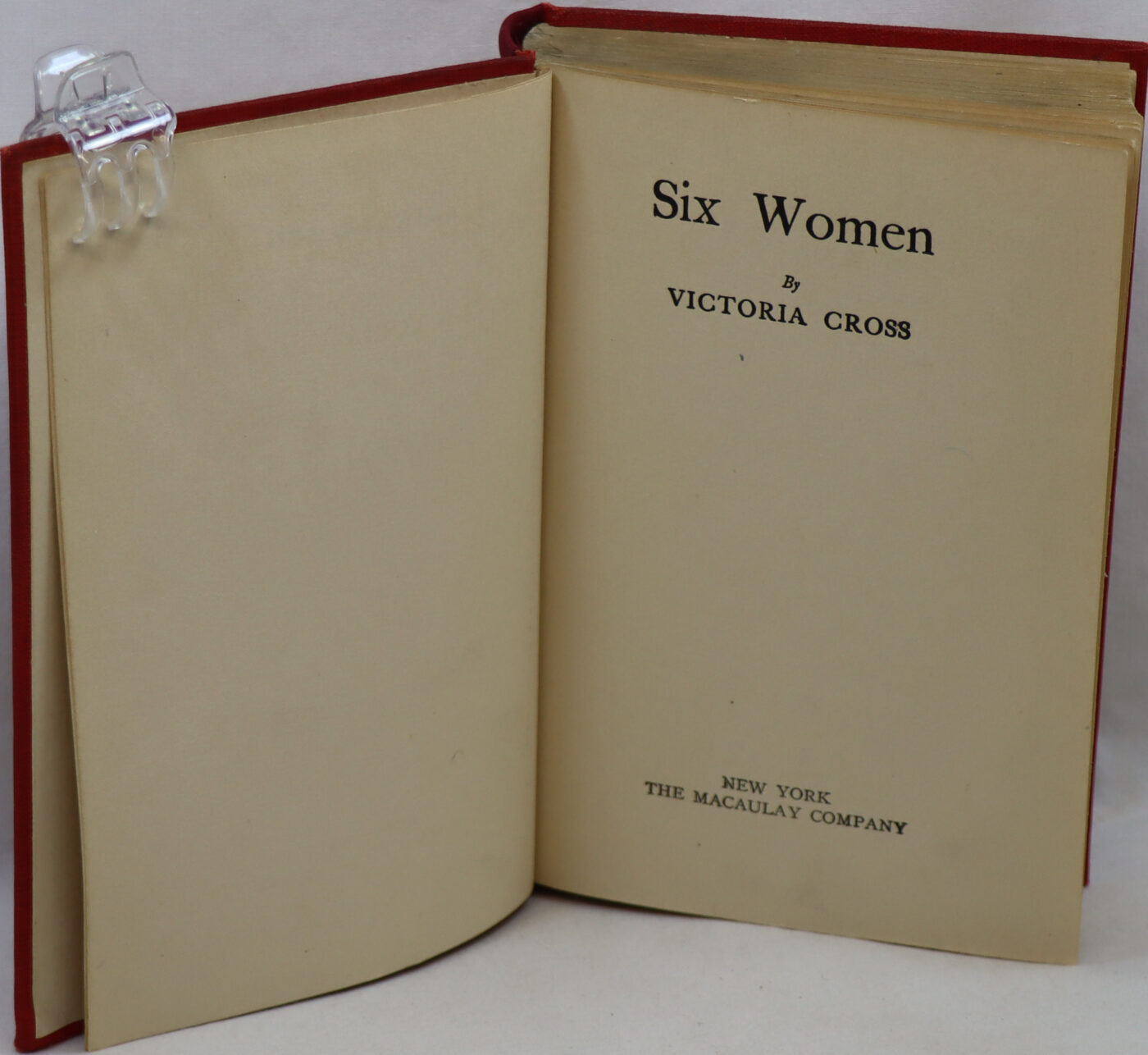
Six Women.
By Victoria Cross
Printed: Circa 1920
Publisher: The Macaulay Co. New York
| Dimensions | 14 × 19 × 4 cm |
|---|---|
| Language |
Language: English
Size (cminches): 14 x 19 x 4
Condition: Good (See explanation of ratings)
£92.00
Buy Now

Item information
Description
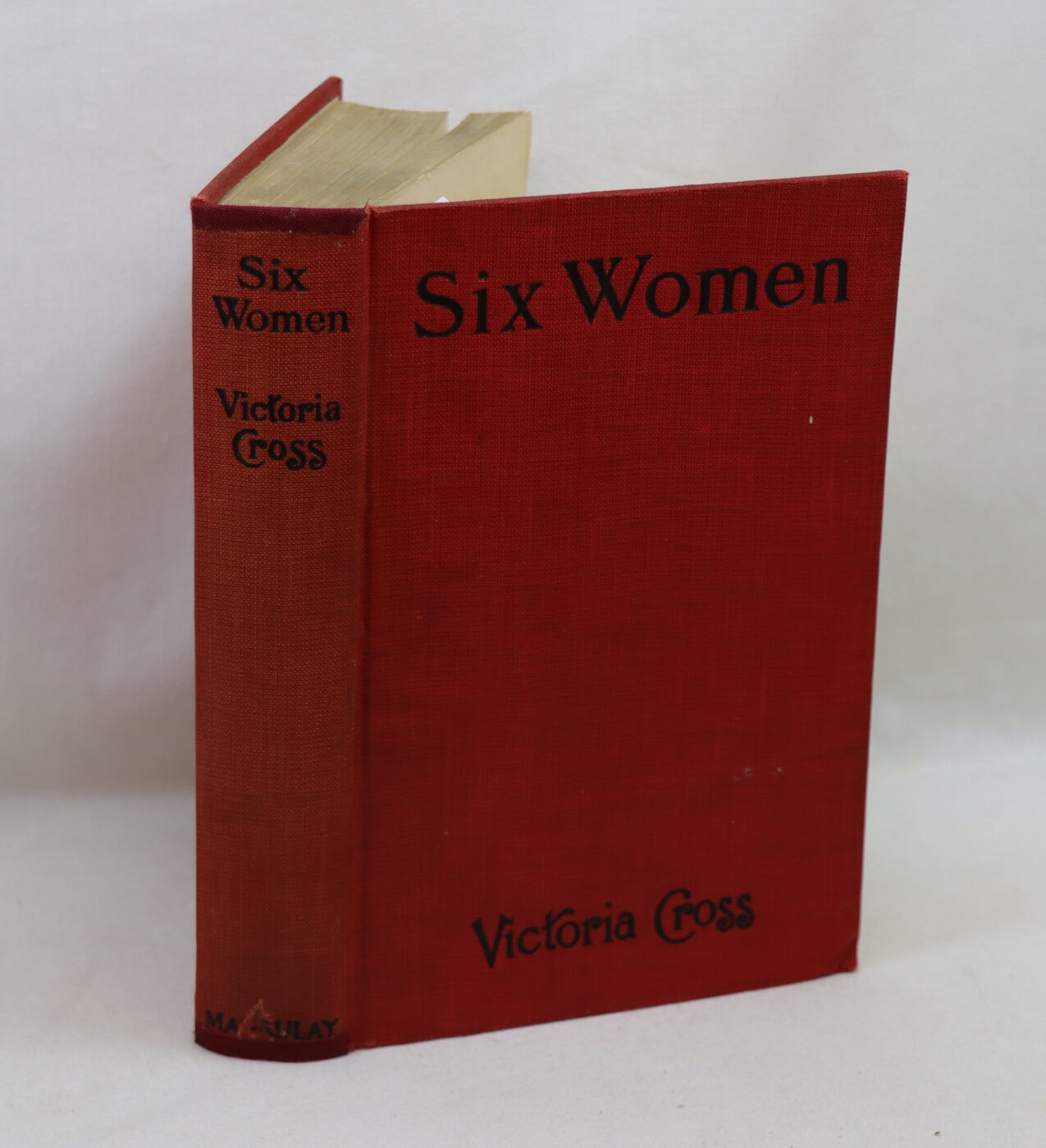
Red cloth binding with a black title on the spine and front board.
We provide an in-depth photographic presentation of this item to stimulate your feeling and touch. More traditional book descriptions are immediately available.
- Note: This book carries a £5.00 discount to those that subscribe to the F.B.A. mailing list
A scarce collector’s (first?) edition from Frost Book’s large Victoria Cross collection. These books are historical and cultural gems.
Annie Sophie Cory (Victoria Cross) comes from a literary family encouraged by her father who also propelled Kipling to international fame!
Six Women reads as exotic romance more than racy which is how these stories would have been originally perceived. The subject of these 6 short stories is love, unrequited, un-returned, punished and achieved. As a group they can be undervalued as early romance stories. The settings are usually the Far East. Each story has a small cast, the loving couple and the people who by rejecting the fact of love cause the conflicts that become the narrative drive. At its worst, these are short stories for overly romantic girls. At their best Miss Cross is an adept story teller. Recommend and not just for the usual Romance Novel crowd.
Victoria Cross is one of several pen names used by Annie Sophie Cory. She was the daughter of a British Army Colonel stationed in the Punjab city of Lahore, Pakistan. Growing up at the end of the British Raj she would have had firsthand experience with people of many races, religions and colors. Her short stories may heighten the romance of these cultures, but they tend to ring true or at least consistent with the cultures as portrayed in the 1001 Nights. Likely her use of the pen name is a direct reference to the Victoria Cross, the highest medal that can be awarded in the British Military Service.
This sequence begins with a lonely senior British Civil Servant who finds passionate love from a too young local woman. Her love is more likely the result of her training to be subservient towards her husband/master, the fact that he treats her better than any other example known to her and he moves her from the edges of survival into a princely if isolated home. Most of this is repugnant to a 21st century reader, but if read in historic context we can dream that all is well.
By the end of the third story I was convinced that Cross was a political writer. Strict adherence to the customs and ways of the late Victorian era always end in personal tragedy. Loss of life, of love or both happen as men refuse to speak of love before achieving financial security or having too much privilege misunderstand their ability to flaunt local cultural norms.. Later stories will cycle through movie variations on the theme of love. Non-white lovers also suffer from their cultural norms or gain success by tricking their way away.
The best and most ambiguous story replays the classic tale of the Harem girl who loves one not her master. This one ends with a very clever twist.
Many modern readers will have difficulty with Six Women. They are of a time when women became sexually active at the direction of older men and at an age we would not continence. This is one of the many problems a modern reader may experience. If you can read them in context they can still be frustrating. Women are too often too compliant and usually have no sense of their own power over themselves. Still I enjoyed the writing. There is something of a modern 1001 Nights type atmosphere that helped me to enjoy a world before the feminist movement.
NOTE: This is an original book from the library gathered by the famous Cambridge Don, computer scientist, food and wine connoisseur, Jack Arnold LANG. Note: Jack founded the Michelin Guide ‘Midsummer House’- Cambridge’s paramount restaurant. This dining experience is hidden amongst the grassy pastures and grazing cattle of Midsummer Common and perched on the banks of the River Cam.
In 2008, Jack was one of the co-founders of the Raspberry Pi Foundation, alongside other members of the Department, and acted as the Foundation’s Chair. The project’s original goals were modest: to build and distribute low-cost computers for prospective applicants to our Computer Science degree. Initially the project was a “success disaster”, as Jack would say, as demand far outstripped the low-scale manufacturing plans. Ultimately the Raspberry Pi became the UK’s most successful computer with more than 60 million sold to date. Jack was drawn to the educational possibilities of the Raspberry Pi, its potential uses in emerging economies and the way it could support self-directed learning.
Condition notes
Had repair
Want to know more about this item?
We are happy to answer any questions you may have about this item. In addition, it is also possible to request more photographs if there is something specific you want illustrated.
Ask a question
Related products
Share this Page with a friend
