
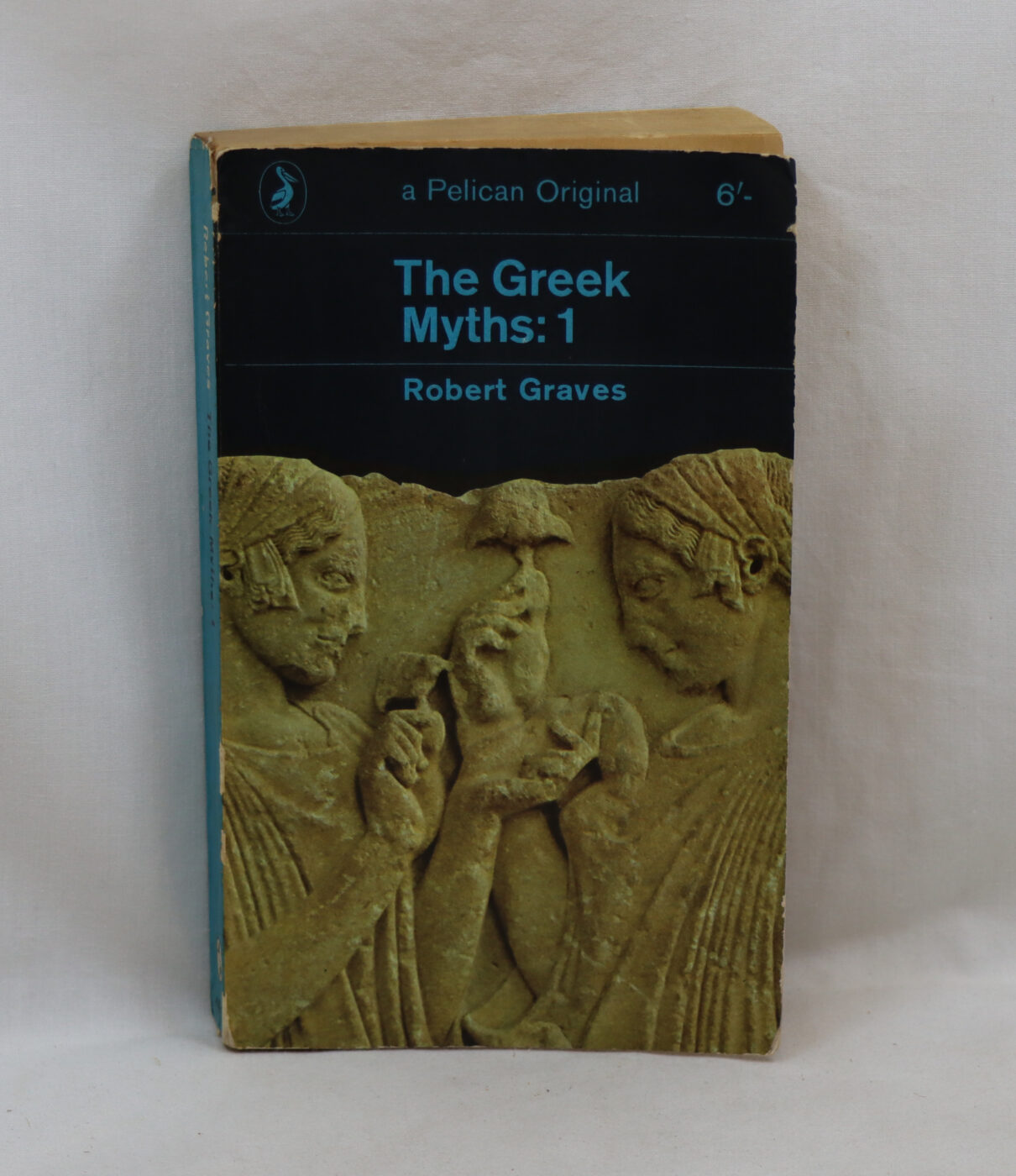
The Greek Myths : 1.
By Robert Graves
Printed: 1964
Publisher: Penguin Books. London
| Dimensions | 11 × 18 × 2 cm |
|---|---|
| Language |
Language: English
Size (cminches): 11 x 18 x 2
Condition: Fair (See explanation of ratings)
£6.00
Buy Now
Item information
Description
Paperback. Blue cover with black title.
We provide an in-depth photographic presentation of this item to stimulate your feeling and touch. More traditional book descriptions are immediately available
- A £2 reduction when collected from FBA shop
Please view the photographs for more details.
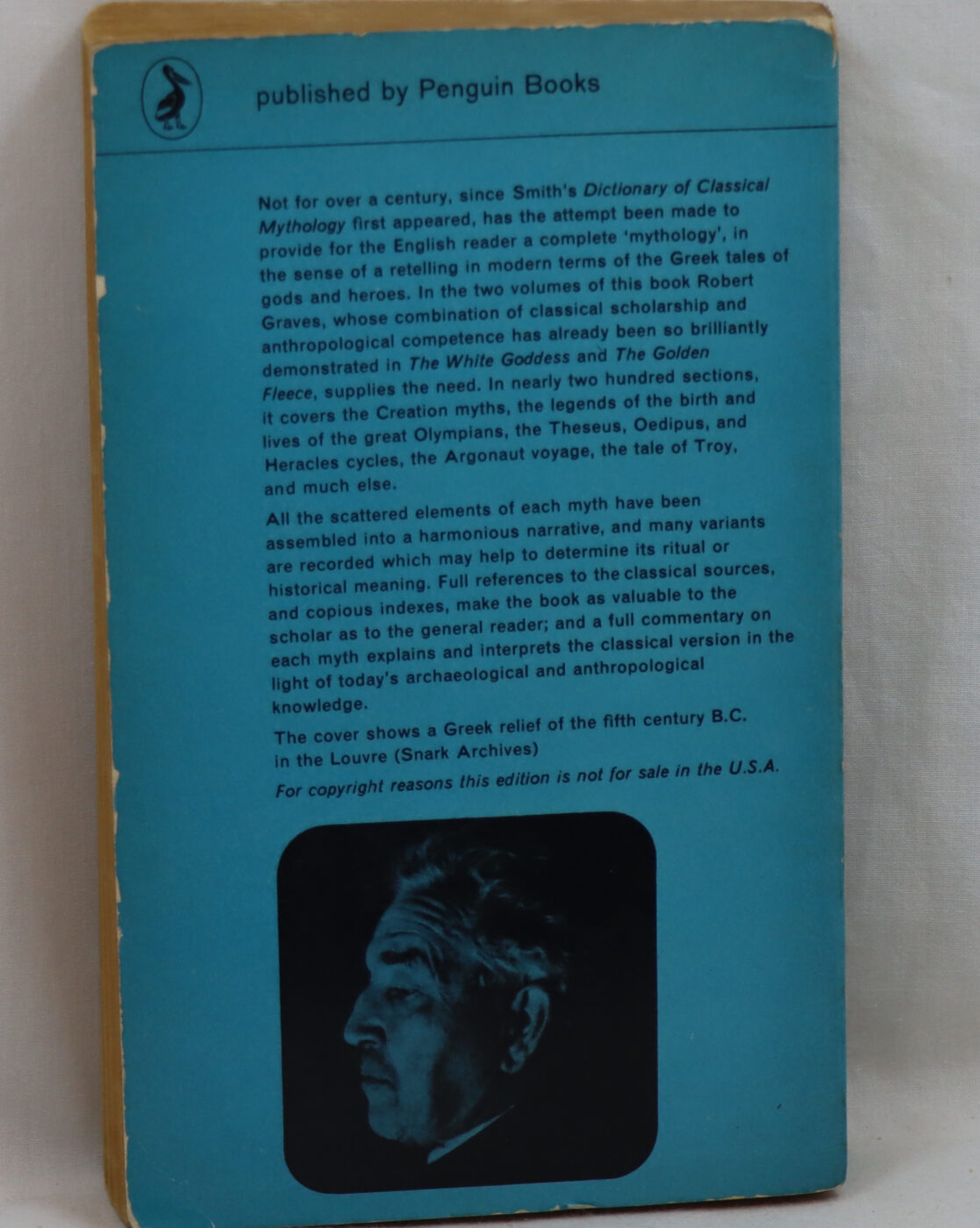
Endymion, Pelops, Daedalus, Pygmalion – what are the stories behind these and the hundreds of other familiar names from Greek mythology – names that recur throughout the history of European culture?
In a two-volume work that has become a classic reference book for both the serious scholar and the casual inquirer, Robert Graves retells the adventures of the important gods and heroes worshipped by the ancient Greeks.
Drawing on an enormous range of sources, he has brought together all the elements of every myth in simple narrative form, supplying detailed cross-references and indexes. Each entry has a full commentary which examines problems of interpretation in both historical and anthropological terms, and in the light of contemporary research.
Review: Useful as a reference book to look up summaries of the various Greek mythical stories and suggested interpretations but not as fascinating or provocative as The White Goddess. The presentation comprises a brief summary of each mythical story. Variants of the characters names are offered and attributed to regions and historical regions. Conjectural origins of the myth are offered, usually as the supplanting or evolution of a local cult following conquest by rival tribes, or migration and merger of communities. The presentation is somewhat bare bones and thus somewhat dry, making this more of a reference book than a retelling of the stories for modern readers. Thus some of the archetype magic is lost. The current editions contain some revisions by the author of his original theories concerning the myths.
Robert Graves was born in 1895 in Wimbledon. He went from school to the First World War, where he became a captain in the Royal Welch Fusiliers and was seriously wounded at the Battle of the Somme. He wrote his autobiography, Goodbye to All That, in 1929, and it was soon established as a modern classic. He died on 7 December 1985 in Majorca, his home since 1929.
NOTE: This is an original book from the library gathered by the famous Cambridge Don, computer scientist, food and wine connoisseur, Jack Arnold LANG. Note: Jack founded the Michelin Guide ‘Midsummer House’- Cambridge’s paramount restaurant. This dining experience is hidden amongst the grassy pastures and grazing cattle of Midsummer Common and perched on the banks of the River Cam.
In 2008, Jack was one of the co-founders of the Raspberry Pi Foundation, alongside other members of the Department, and acted as the Foundation’s Chair. The project’s original goals were modest: to build and distribute low-cost computers for prospective applicants to our Computer Science degree. Initially the project was a “success disaster”, as Jack would say, as demand far outstripped the low-scale manufacturing plans. Ultimately the Raspberry Pi became the UK’s most successful computer with more than 60 million sold to date. Jack was drawn to the educational possibilities of the Raspberry Pi, its potential uses in emerging economies and the way it could support self-directed learning.
Want to know more about this item?
We are happy to answer any questions you may have about this item. In addition, it is also possible to request more photographs if there is something specific you want illustrated.
Ask a question
Related products


Share this Page with a friend
