
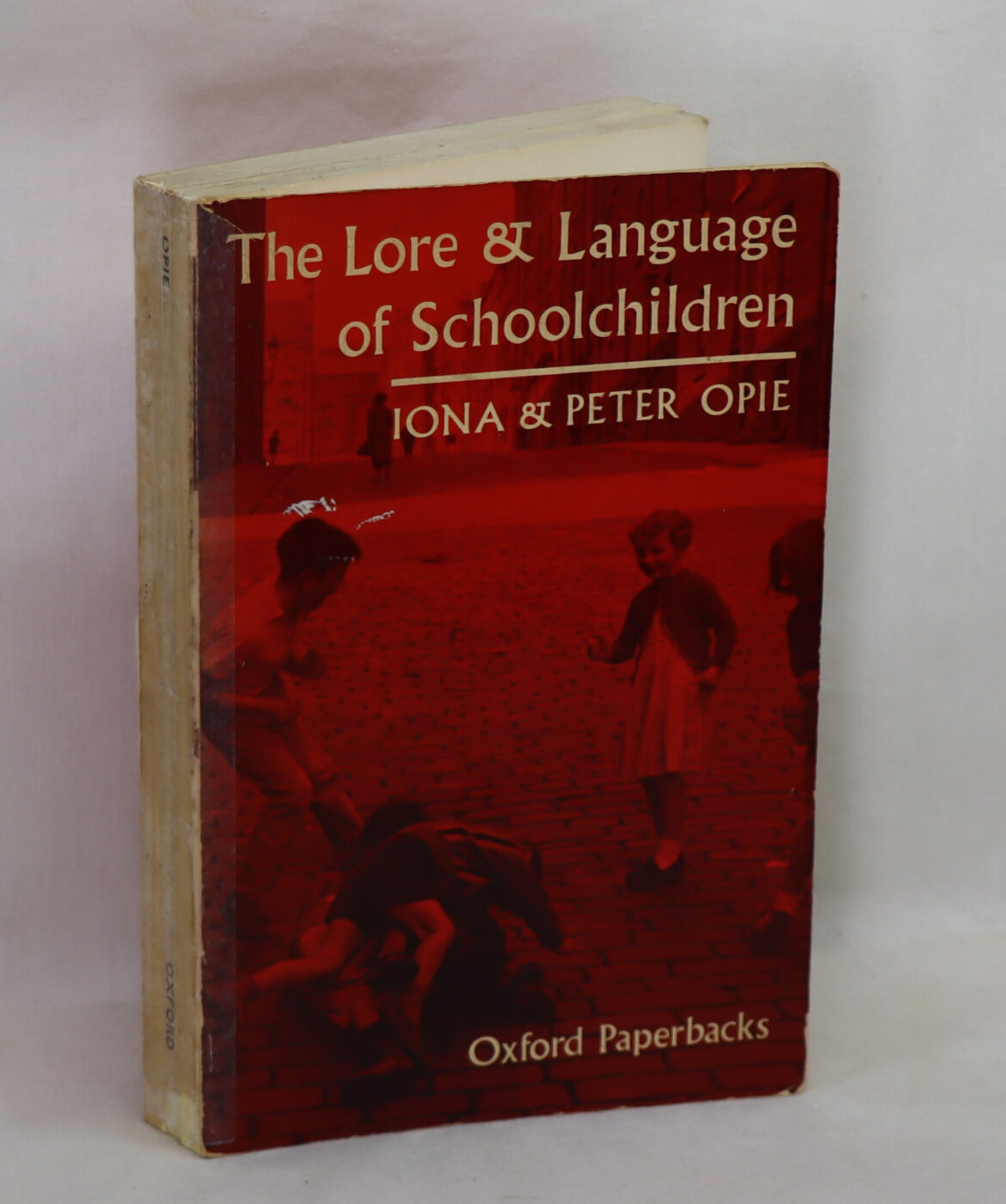
The Lore & Language of Schoolchildren.
By Iona & Peter Opie
Printed: 1967
Publisher: Oxford University Press.
| Dimensions | 13 × 20 × 2 cm |
|---|---|
| Language |
Language: English
Size (cminches): 13 x 20 x 2
Condition: Fair (See explanation of ratings)
£24.00
Buy Now

Item information
Description
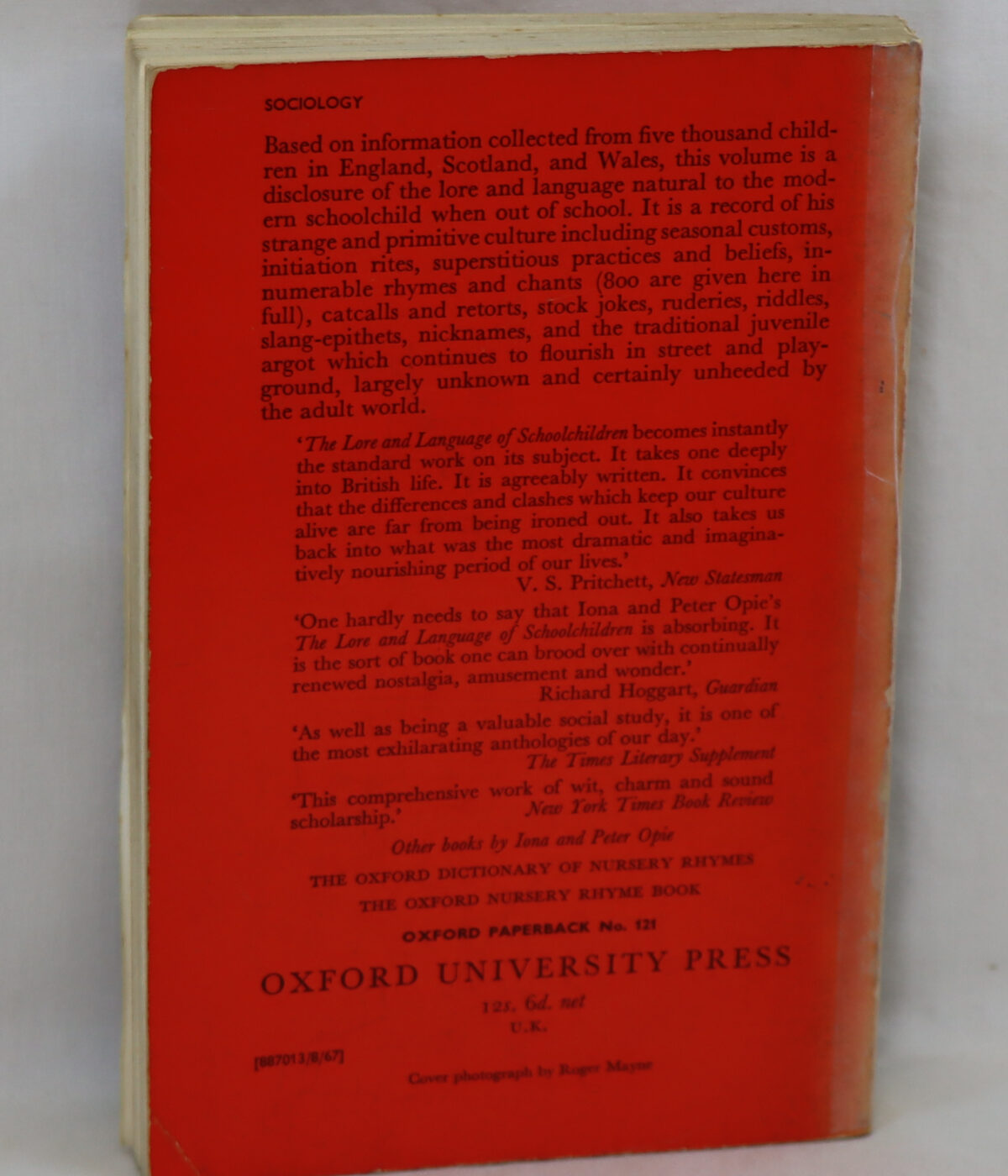
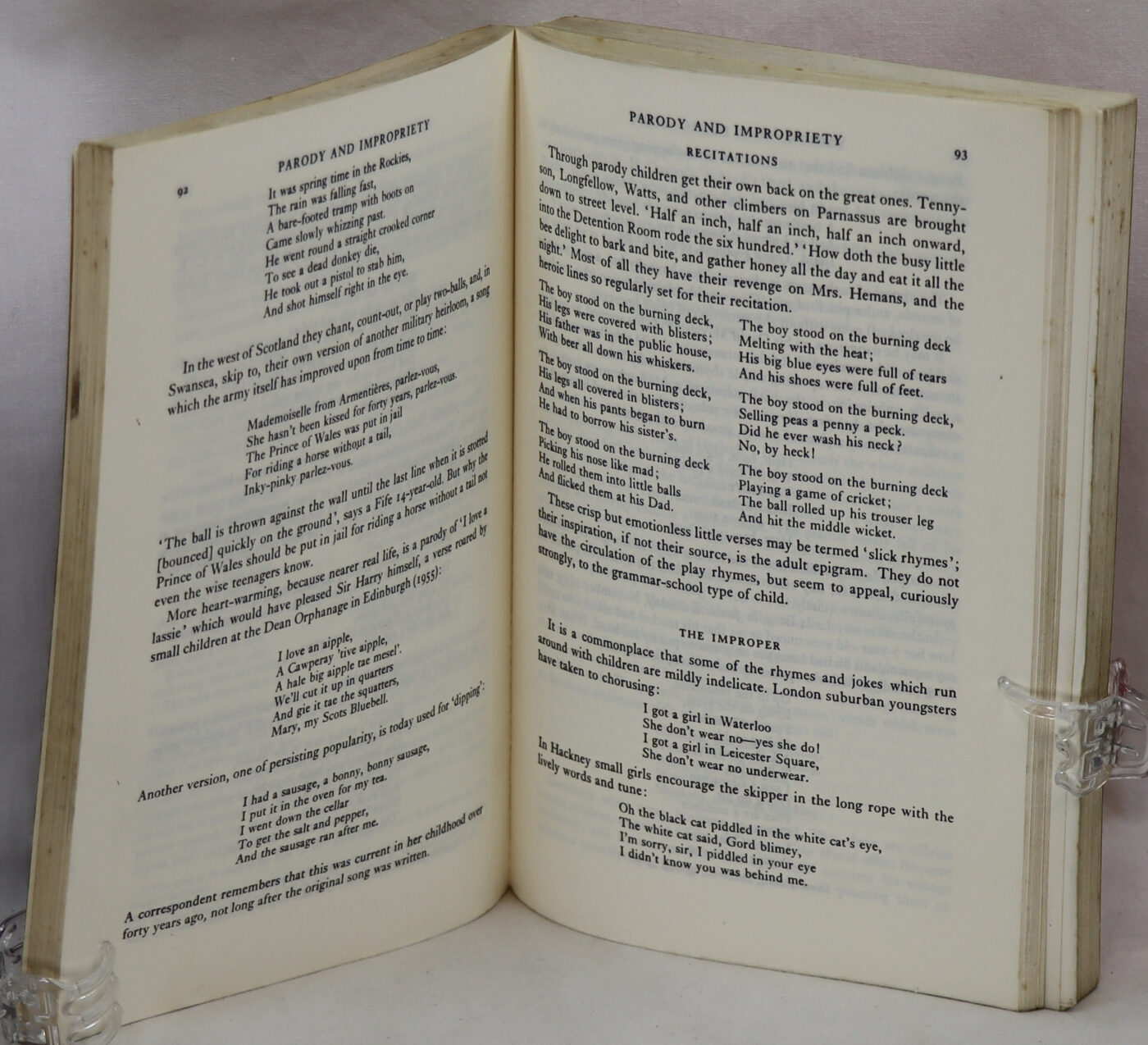
Paperback. Red cover with white title. Slack pages.
We provide an in-depth photographic presentation of this item to stimulate your feeling and touch. More traditional book descriptions are immediately available
- Note: This book carries a £5.00 discount to those that subscribe to the F.B.A. mailing list
First published in 1959, Iona and Peter Opie’s The Lore and Language of Schoolchildren is a pathbreaking work of scholarship that is also a splendid and enduring work of literature. Going outside the nursery, with its assortment of parent-approved entertainments, to observe and investigate the day-to-day creative intelligence and activities of children, the Opies bring to life the rites and rhymes, jokes and jeers, laws, games, and secret spells of what has been called “the greatest of savage tribes, and the only one which shows no signs of dying out.”
Review: This book deserves a more thorough review than I’m going to give it, and it’s worth far more than that I paid for it. Much of the language described in this book has been lost since it was published, truce terms, counting out rhymes, most of the customs of mischief night too – it remains in parts throughout the UK but fragmentary. While the passing of these things is perhaps inevitable, some of the knowledge recorded had survived hundreds or thousands of years before global homogenisation, for which our language and traditions are impoverished. There are bits of this book which won’t be mourned – the long section on catholic and protestant rivalry, anti-semitic calls and so on – note that the authors were academics and have simply recorded whatever they were able to discover, there is no prejudice intended.
I’d advise anyone with an interest in language, play, social history, etc. to read this book and disseminate the customs therein (well, perhaps don’t send your children out to put the neighbour’s gate in a pond). For a semi-academic work it’s entirely readable, and recitable.
“The Opies, professors of literature and essentially folklorists, did something path-breaking: they observed children and took their play seriously…The Lore and Language of Schoolchildren reminds us that children are their own beings who create and navigate complicated social worlds, and the way they do so is worthy of respect and understanding.” –Hilary Levey Friedman, Brain, Child Magazine
Iona (born 1923) and Peter Opie (1918-1982) began their research together in 1944. Fifteen years later, they published The Lore and Language of Schoolchildren and took their places as, to quote The Guardian, “the supreme archivists of the folklore movement.” Since that time, they have jointly published The Oxford Dictionary of Nursery Rhymes, The Classic Fairy Tales, and Children’s Game in Street and Playground. Since Peter Opie’s death in 1982, Iona Opie has carried on with their work under his name as well as her own.
Marina Warner is a writer of fiction, criticism, and history. Her award-winning studies of mythology and fairy tales include Alone of All Her Sex: The Myth and the Cult of the Virgin Mary, From the Beast to the Blonde, and No Go the Bogeyman. In 2006 she published Phantasmagoria: Spirit Visions, Metaphors, and Media, a study of ghosts, phantasms, and technology. Her most recent work of fiction is the novel The Leto Bundle. A Fellow of the British Academy, she is also Professor of Literature, Film, and Theatre Studies at the University of Essex.
NOTE: This is an original book from the library gathered by the famous Cambridge Don, computer scientist, food and wine connoisseur, Jack Arnold LANG. Note: Jack founded the Michelin Guide ‘Midsummer House’- Cambridge’s paramount restaurant. This dining experience is hidden amongst the grassy pastures and grazing cattle of Midsummer Common and perched on the banks of the River Cam.
In 2008, Jack was one of the co-founders of the Raspberry Pi Foundation, alongside other members of the Department, and acted as the Foundation’s Chair. The project’s original goals were modest: to build and distribute low-cost computers for prospective applicants to our Computer Science degree. Initially the project was a “success disaster”, as Jack would say, as demand far outstripped the low-scale manufacturing plans. Ultimately the Raspberry Pi became the UK’s most successful computer with more than 60 million sold to date. Jack was drawn to the educational possibilities of the Raspberry Pi, its potential uses in emerging economies and the way it could support self-directed learning.
Condition notes
Spine slack
Want to know more about this item?
We are happy to answer any questions you may have about this item. In addition, it is also possible to request more photographs if there is something specific you want illustrated.
Ask a question
Related products


Share this Page with a friend
