
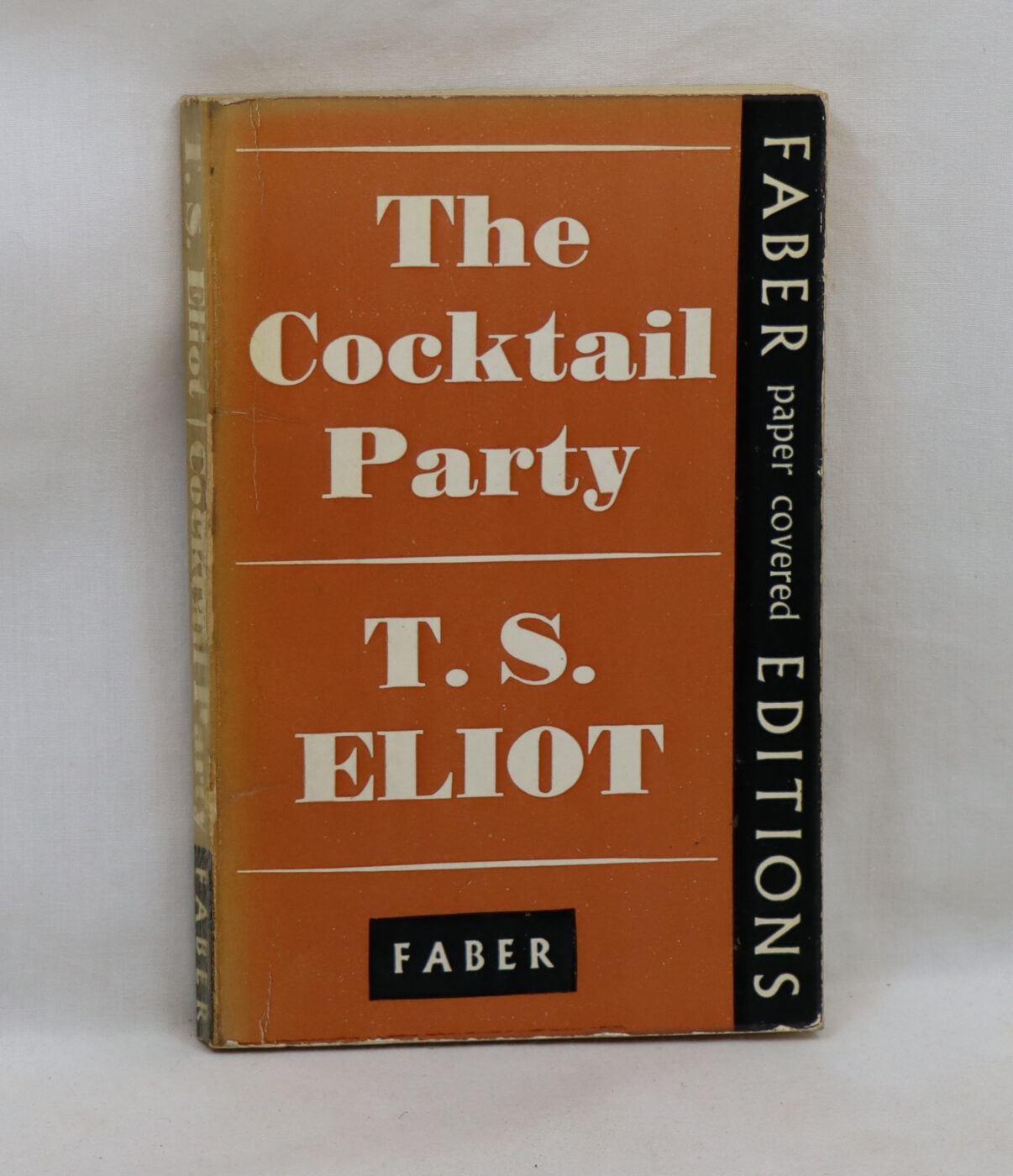
The Cocktail Party.
By T.S. Eliot
Printed: Circa 1960
Publisher: Faber & Faber. London
| Dimensions | 11 × 18 × 1 cm |
|---|---|
| Language |
Language: English
Size (cminches): 11 x 18 x 1
Condition: Fair (See explanation of ratings)
£8.00
Buy Now
Item information
Description
Paperback. Beige cover with black title.
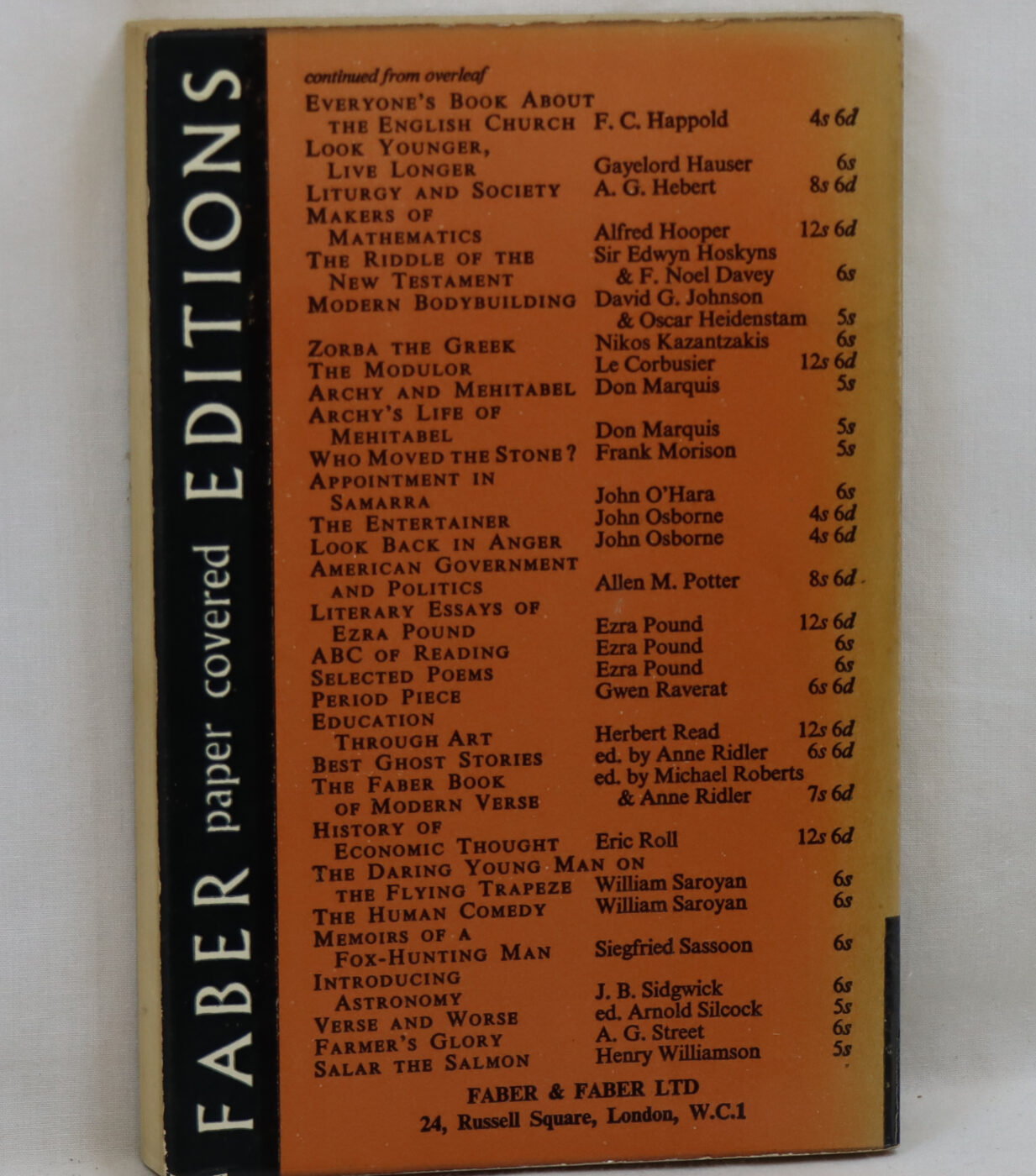
Please view the photographs.
The Cocktail Party is a verse drama in three acts by T. S. Eliot written in 1948 and performed in 1949 at the Edinburgh Festival. It was published in 1950. It was the most popular of Eliot’s seven plays in his lifetime, although his 1935 play, Murder in the Cathedral, is better remembered today. It focuses on a troubled married couple who, through the intervention of a mysterious stranger, settle their problems and move on with their lives. The Cocktail Party was written while Eliot was a visiting scholar at the Institute for Advanced Study in Princeton, New Jersey. In 1950 it had successful runs in London and New York theaters (the Broadway production received the 1950 Tony Award for Best Play). The play starts out seeming to be a light satire of the traditional British drawing room comedy. As it progresses, it becomes a darker philosophical/psychological treatment of human relations. Like many of Eliot’s works, this uses absurdist elements to expose the isolation of the human condition. In another recurring theme of Eliot’s plays, the Christian martyrdom of the mistress character is seen as a sacrifice that permits the predominantly secular life of the community to continue. The morality play is based on Euripides’ play Alcestis. In 1951, in the first Theodore Spencer Memorial Lecture at Harvard University Eliot criticised his own plays in the second half of the lecture, explicitly Murder in the Cathedral, The Family Reunion, and The Cocktail Party. The lecture was published as “Poetry and Drama” and later included in Eliot’s 1957 collection On Poetry and Poets.
A £3 reduction when collected from the FBA shop. An original book from the library gathered by the famous Cambridge Don, computer scientist, food and wine connoisseur, Jack Arnold LANG. In 2008, Jack was one of the co-founders of the Raspberry Pi Foundation, alongside other members of the Department, and acted as the Foundation’s Chair. The project’s original goals were modest: to build and distribute low-cost computers for prospective applicants to our Computer Science degree. Initially the project was a “success disaster”, as Jack would say, as demand far outstripped the low-scale manufacturing plans. Ultimately the Raspberry Pi became the UK’s most successful computer with more than 60 million sold to date. Jack was drawn to the educational possibilities of the Raspberry Pi, its potential uses in emerging economies and the way it could support self-directed learning.
Want to know more about this item?
We are happy to answer any questions you may have about this item. In addition, it is also possible to request more photographs if there is something specific you want illustrated.
Ask a question
Related products
Share this Page with a friend
