
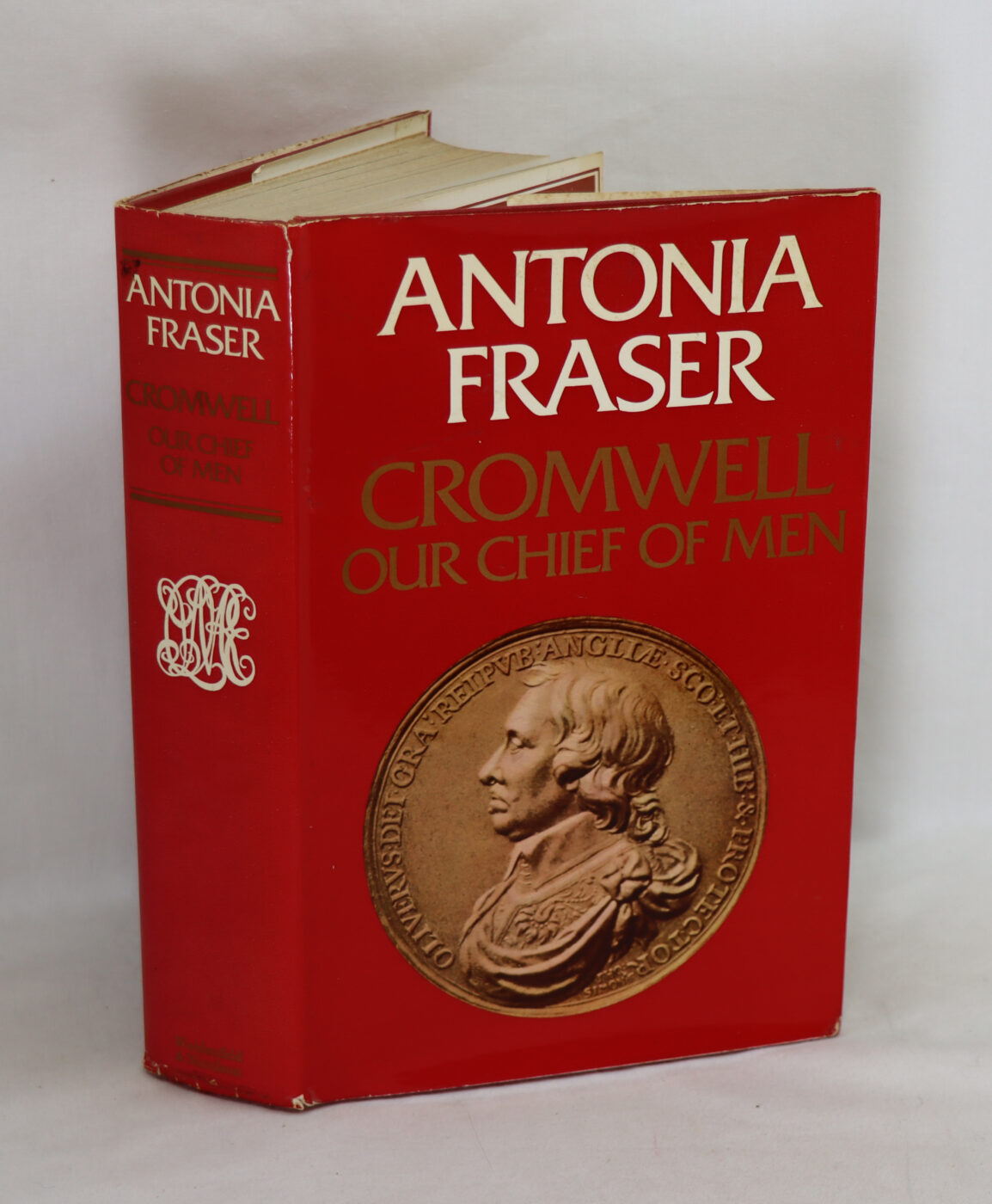
Cromwell. Our Chief of Men.
By Antonia Fraser
ISBN: 9780297818151
Printed: 1974
Publisher: Weidenfeld & Nicholson. London
| Dimensions | 17 × 24 × 5 cm |
|---|---|
| Language |
Language: English
Size (cminches): 17 x 24 x 5
Condition: Very good (See explanation of ratings)
£24.00
Buy Now


Item information
Description
In the original dust jacket. Red cloth binding with gilt title on the spine.
We provide an in-depth photographic presentation of this item to stimulate your feeling and touch. More traditional book descriptions are immediately available
- Note: This book carries a £5.00 discount to those that subscribe to the F.B.A. mailing list
For conditions, please view our photographs. An original book from the library gathered by the famous Cambridge Don, computer scientist, food and wine connoisseur, Jack Arnold LANG.
Once the property of Jack’s mother.
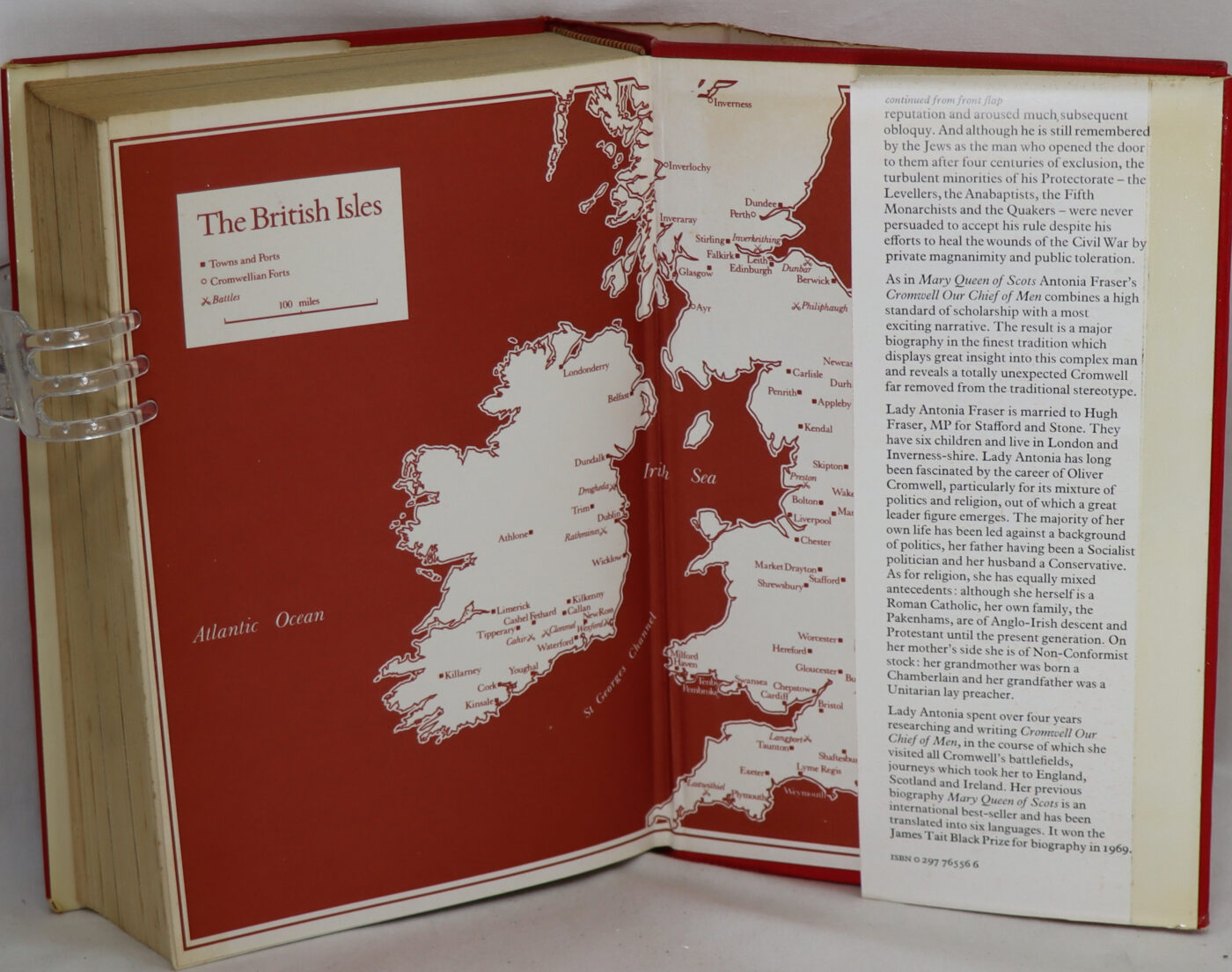
The central purpose of this book is the recreation of Cromwell’s life and character, freed from the distortions of myth and Royalist propaganda. Of Cromwell’s fitness for high office, the book leaves no doubt – under his rule English prestige abroad rose to a level unequalled since Elizabeth I.
Cromwell, Our Chief of Men by Antonia Fraser is a biography of Oliver Cromwell. The title is from a poem praising Cromwell by John Milton, perhaps the most famous and accomplished poet of the English Commonwealth. Fraser’s goal is to “rescue” Oliver Cromwell and rehabilitate his reputation as a statesman and leader, while not glossing over his obvious faults. (Published in the U.S.A. as Cromwell: The Lord Protector). From Fraser’s point of view, one of Cromwell’s main flaws was his tendency to lose his temper in the heat of battle and this character flaw explains the Massacre at Drogheda (1649) and much of his conduct fighting the Irish during the English Civil War. His other main character’s fault was to see events as the result of “providence” which led him into self-justification of his sometimes harsh decisions. The decision to kill Charles I happened (according to Cromwell) because it was willed by God. Cromwell saw himself as the instrument of his creator and often delayed making decisions because he was looking for “signs from God” to confirm his decisions. Cromwell’s character strengths were his decisiveness as a political leader and effectiveness as a war leader. Also Fraser greatly admires Cromwell’s ability to rise from modest origins to the pinnacle of political power in England. He understood people and how to gain their loyalty and respect. Fraser counts him as one of the greatest leaders history has produced. Fraser succeeded in “humanising” Cromwell and the book received much critical acclaim when it was published. It succeeded in exploding the myth of Cromwell as a scheming power hungry hypocrite and presented the man as a complex person, a man who changed the course of history but also as a man of his age, not a tyrant, but a person who struggled with his conscience and truly lived according to his beliefs.
Lady Antonia Margaret Caroline Fraser (née Pakenham; born 27 August 1932) is a British author of history, novels, biographies and detective fiction. She is the widow of the 2005 Nobel Laureate in Literature, Harold Pinter, and prior to his death in 2008 was also known as Lady Antonia Pinter. Fraser’s first major work was Mary, Queen of Scots (1969), published by Weidenfeld & Nicolson, which was followed by several other biographies, including Cromwell, Our Chief of Men (1973). Fraser acknowledges she is “less interested in ideas than in ‘the people who led nations’ and so on. I don’t think I could ever have written a history of political thought or anything like that. I’d have to come at it another way.” Fraser’s study, The Warrior Queens (1989), is an account of military royal women since the days of Boadicea and Cleopatra. In 1992, a year after Alison Weir’s book The Six Wives of Henry VIII, she published a book with the same title. She chronicled the life and times of Charles II in a well-reviewed 1979 eponymous biography. The book was cited as an influence on the 2003 BBC/A&E mini-series Charles II: The Power & the Passion, in a featurette on the DVD, by Rufus Sewell, who played the title character. Fraser served as editor for many monarchical biographies, including those featured in the Kings and Queens of England and Royal History of England series, and in 1996 she also published a book entitled The Gunpowder Plot: Terror and Faith in 1605, which won both the St. Louis Literary Award and the Crime Writers’ Association (CWA) Non-Fiction Gold Dagger. Her book Marie Antoinette: The Journey (2001), was adapted for the film Marie Antoinette (2006), directed by Sofia Coppola, with Kirsten Dunst in the title role, and Love and Louis XIV: The Women in the Life of the Sun King (2006).She contemplated a biography of Queen Elizabeth I, but shelved the idea as this subject has already been extensively covered. Fraser won the Wolfson History Award in 1984 for The Weaker Vessel, a study of women’s lives in 17th-century England
Want to know more about this item?
We are happy to answer any questions you may have about this item. In addition, it is also possible to request more photographs if there is something specific you want illustrated.
Ask a question
Share this Page with a friend
