
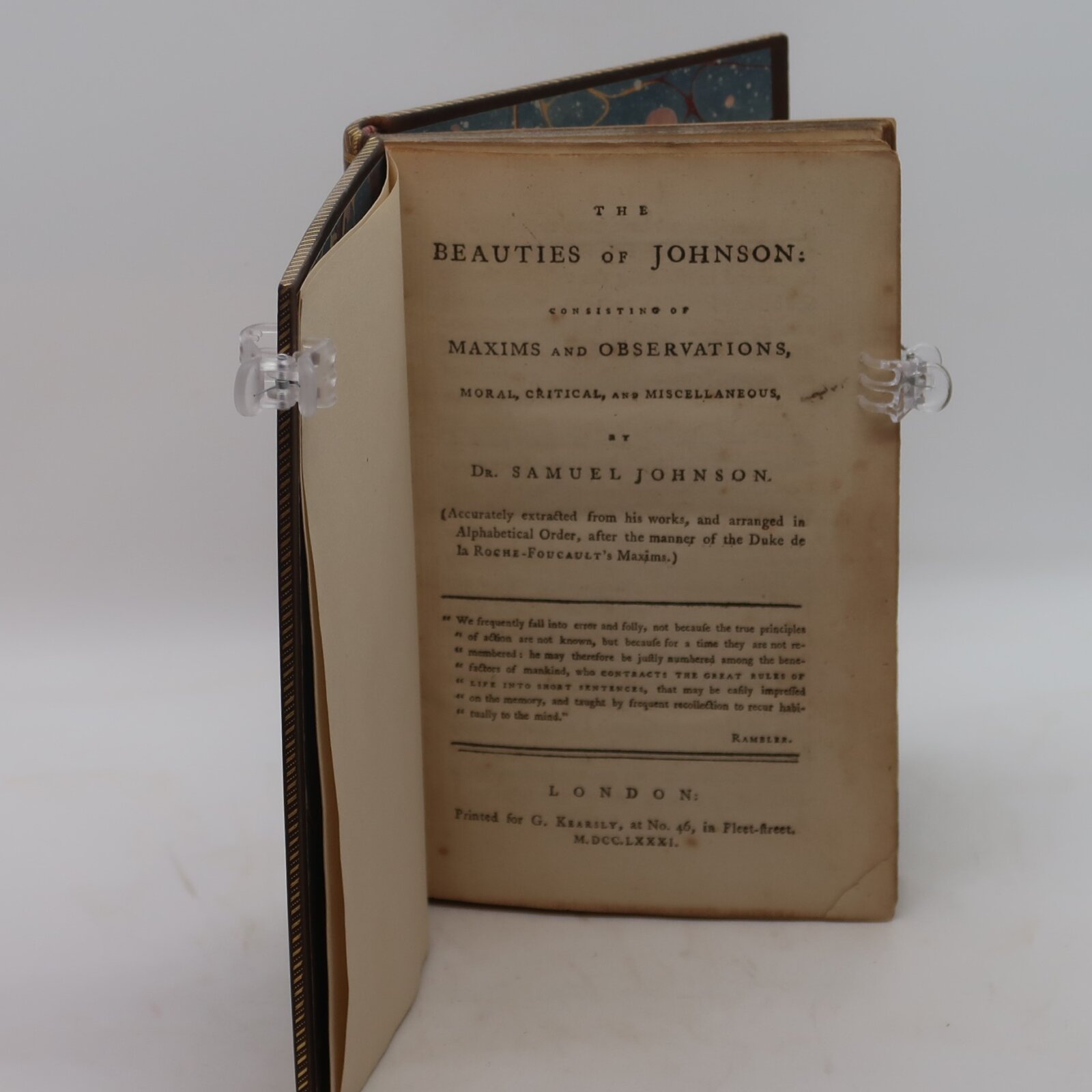
The Beauties of Johnson.
By Dr Samuel Johnson
Printed: 1781
Publisher: G Kearsly. Fleet Street
| Dimensions | 13 × 18 × 2.5 cm |
|---|---|
| Language |
Language: English
Size (cminches): 13 x 18 x 2.5
Condition: Fine (See explanation of ratings)
THIS ITEM WILL BE AVAILABLE SOON
SORRY, THIS ITEM HAS SOLD
Item information
Description
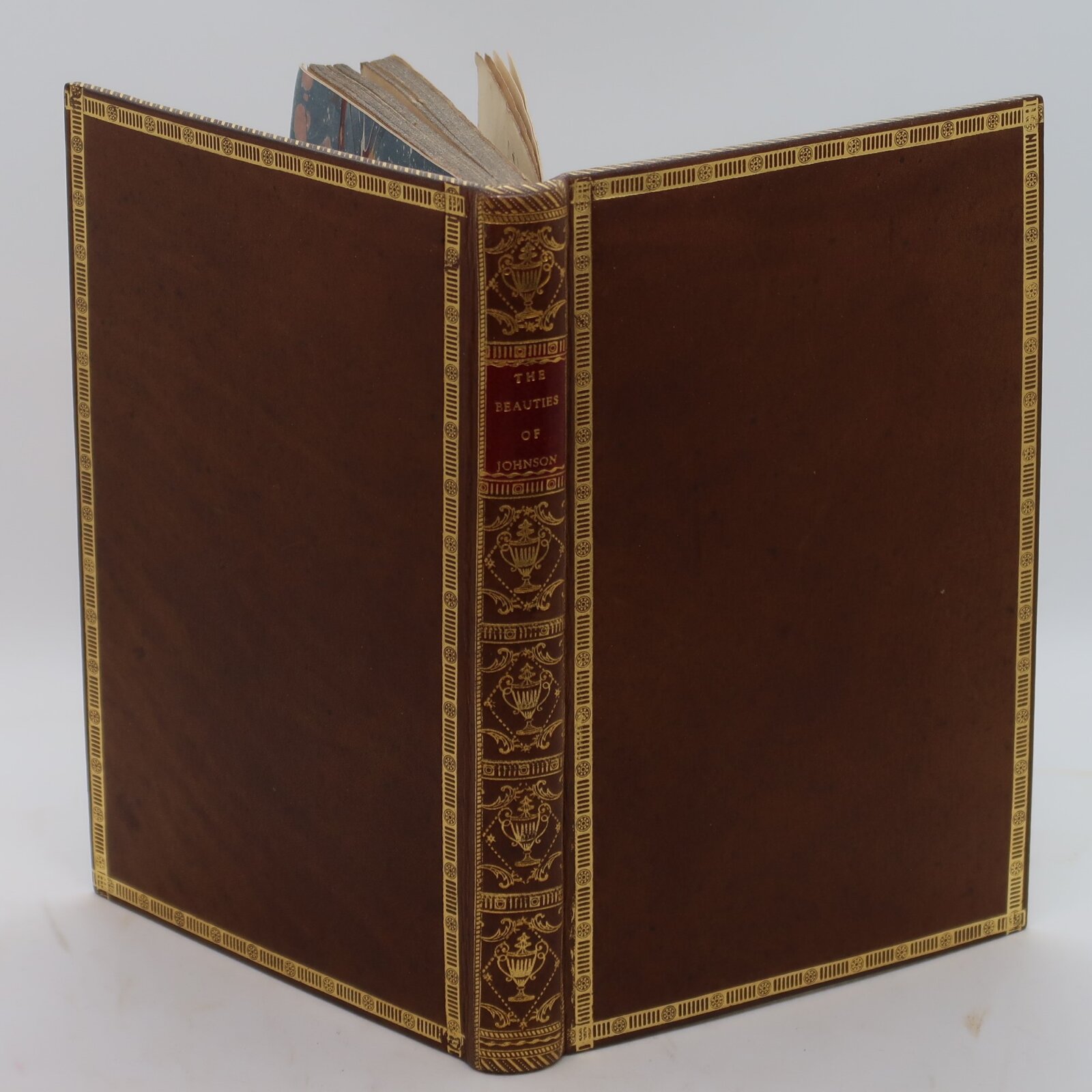
Tan full calf binding with red title plate, gilt lettering and decoration on the spine. Gilt ribbon edging on both boards. Really handsome binding.
The beauties of Samuel Johnson, consisting of maxims and observations, moral, critical, and miscellaneous to which are now added, biographical anecdotes of the doctor, selected from the works of Mrs. Piozzi; his life, recently published by Boswell, and other authentic testimonies, also his will, and the sermon he wrote for the late Doctor Dodd
Samuel Johnson (18 September 1709 – 13 December 1784), often called Dr Johnson, was an English writer who made lasting contributions as a poet, playwright, essayist, moralist, critic, biographer, editor and lexicographer. He was a devout Anglican, and a committed Tory. The Oxford Dictionary of National Biography calls him “arguably the most distinguished man of letters in English history”. James Boswell’s Life of Samuel Johnson was selected by Walter Jackson Bate as “the most famous single work of biographical art in the whole of literature”.
Born in Lichfield, Staffordshire, he attended Pembroke College, Oxford until lack of funds forced him to leave. After work as a teacher, he moved to London and began writing for The Gentleman’s Magazine. Early works include Life of Mr Richard Savage, the poems London and The Vanity of Human Wishes and the play Irene. After nine years’ effort, Johnson’s A Dictionary of the English Language appeared in 1755 with far-reaching effects on Modern English, acclaimed as “one of the greatest single achievements of scholarship”. Until the arrival of the Oxford English Dictionary 150 years later, Johnson’s was pre-eminent. Later work included essays, an annotated The Plays of William Shakespeare and The History of Rasselas, Prince of Abissinia. In 1763 he befriended James Boswell, with whom he travelled to Scotland, as Johnson described in A Journey to the Western Islands of Scotland. Near the end of his life came a massive, influential Lives of the Most Eminent English Poets of 17th and 18th centuries.
Tall and robust, his gestures and tics disconcerted some on meeting him. Boswell’s Life along with other biographies, documented Johnson’s behaviour in a detail that allows a posthumous diagnosis of Tourette syndrome, a condition then undefined. After several illnesses, he died on the evening of 13 December 1784 and was buried in Westminster Abbey. Thereafter he was increasingly seen to have had a lasting effect on literary criticism and even claimed to be the one truly great critic of English literature.
More than a century after his death, literary critics such as G. Birkbeck Hill and T. S. Eliot came to regard Johnson as a serious critic. They began to study Johnson’s works with an increasing focus on the critical analysis found in his edition of Shakespeare and Lives of the Poets. Yvor Winters claimed that “A great critic is the rarest of all literary geniuses; perhaps the only critic in English who deserves that epithet is Samuel Johnson”. F. R. Leavis agreed and, on Johnson’s criticism, said, “When we read him, we know, beyond question, that we have here a powerful and distinguished mind operating at first hand upon literature. This, we can say with emphatic conviction, really is criticism”. Edmund Wilson claimed that “The Lives of the Poets and the prefaces and commentary on Shakespeare are among the most brilliant and the most acute documents in the whole range of English criticism”.
The critic Harold Bloom placed Johnson’s work firmly within the Western canon, describing him as “unmatched by any critic in any nation before or after him … Bate in the finest insight on Johnson I know, emphasised that no other writer is so obsessed by the realisation that the mind is an activity, one that will turn to destructiveness of the self or of others unless it is directed to labour.” It is no wonder that his philosophical insistence that the language within literature must be examined became a prevailing mode of literary theory during the mid-20th century.
Want to know more about this item?
We are happy to answer any questions you may have about this item. In addition, it is also possible to request more photographs if there is something specific you want illustrated.
Ask a question
Related products



Share this Page with a friend
