
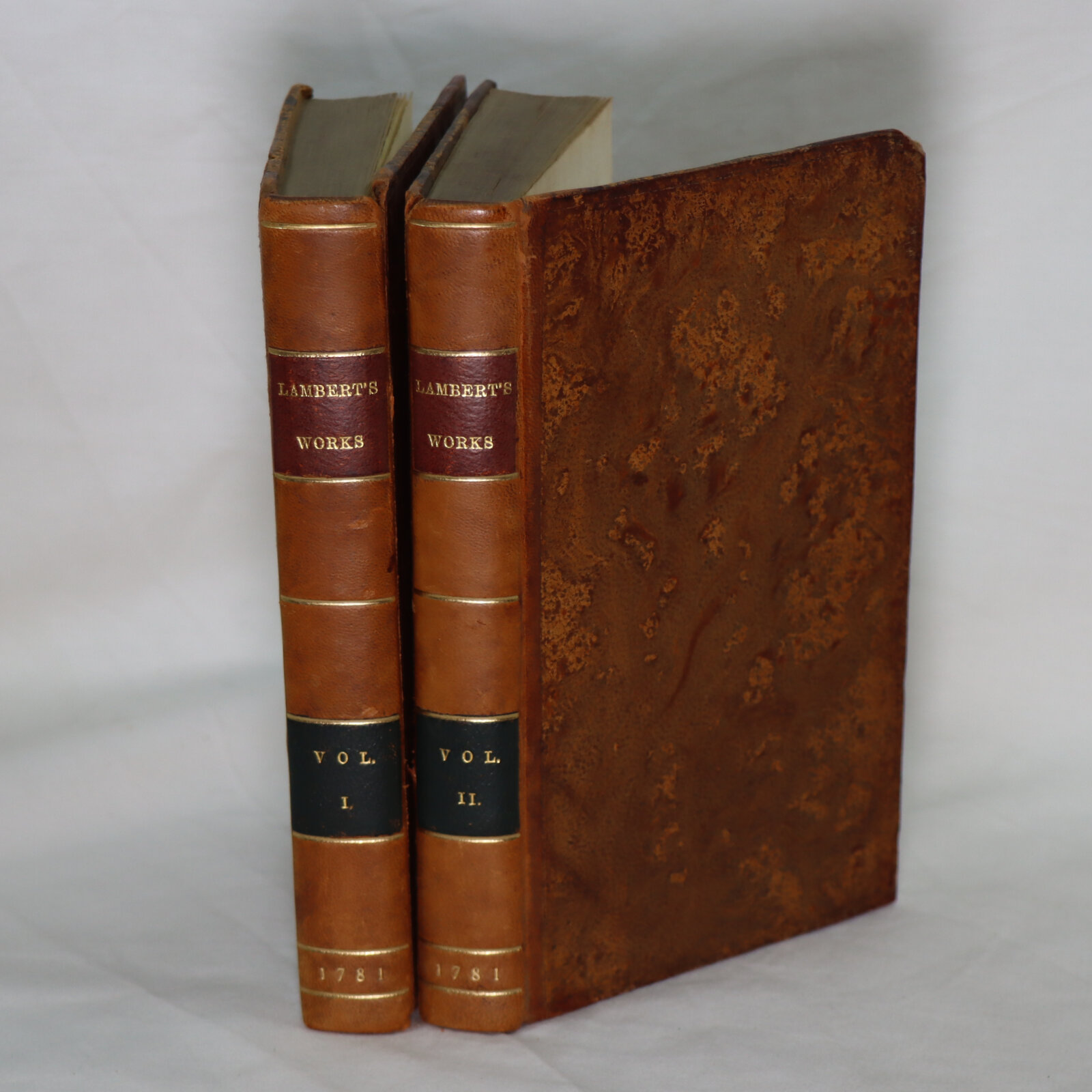
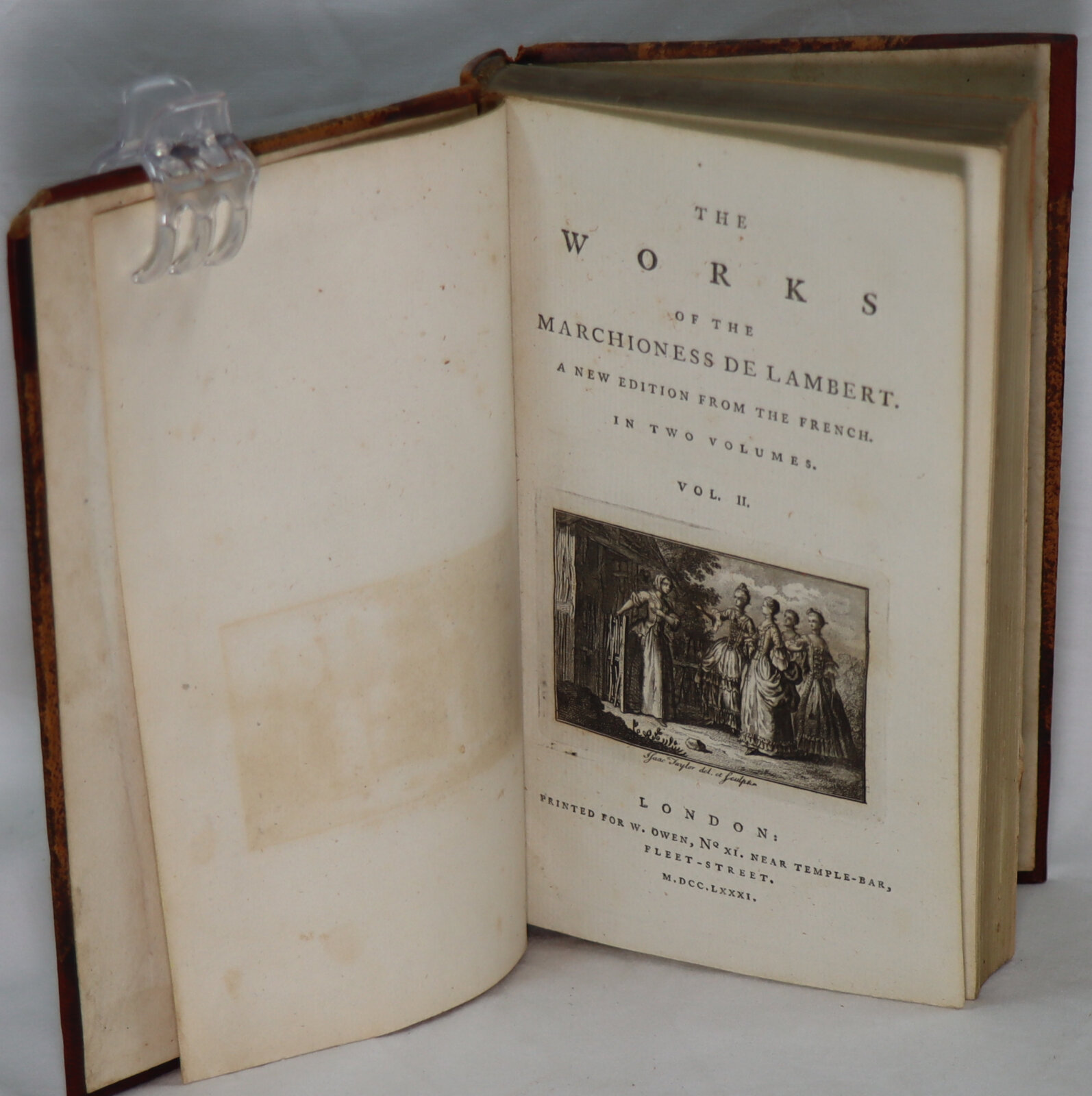
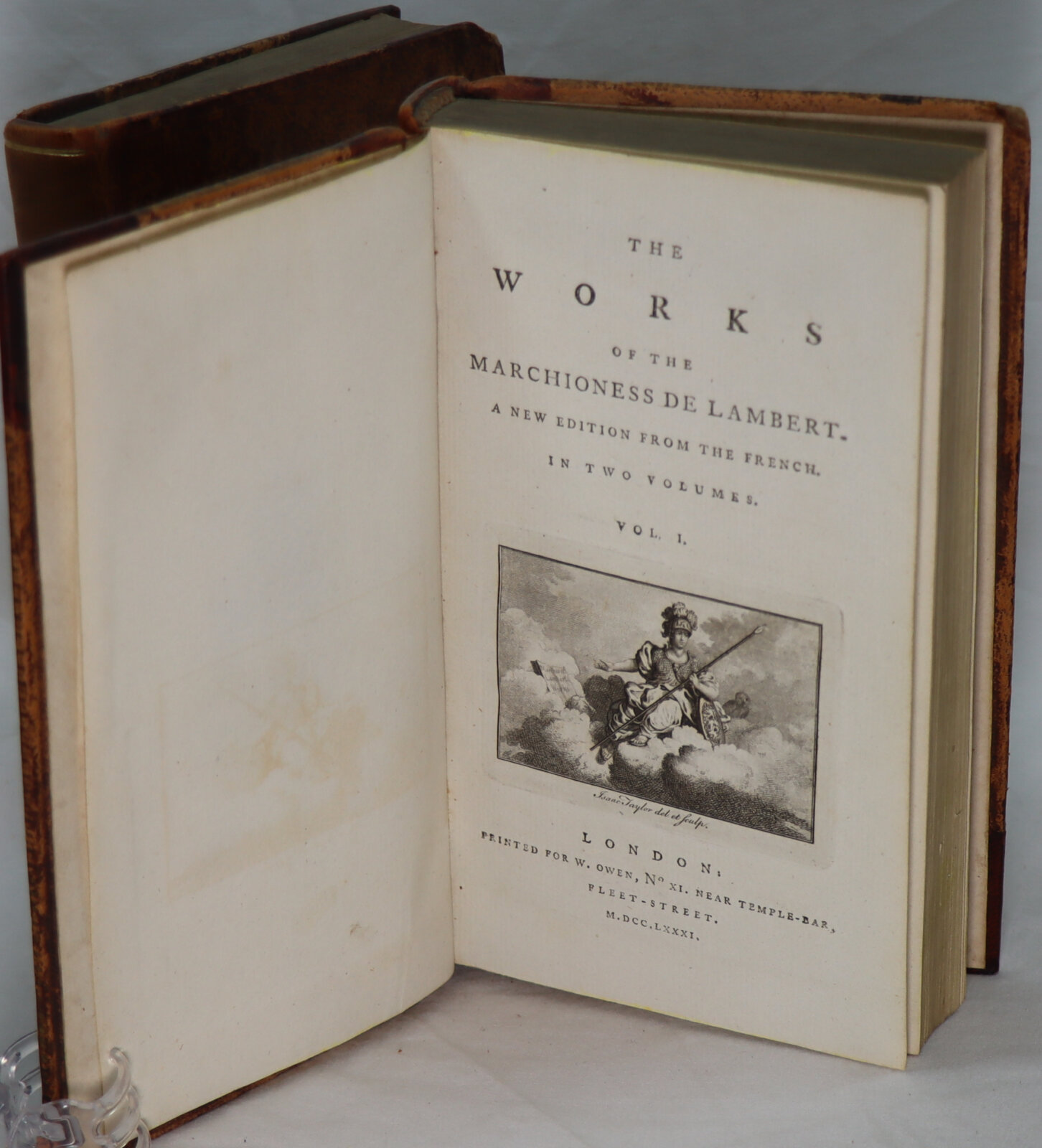
Lambert's Works. Volumes I & II.
By The Marchioness de Lambert
Printed: 1781
Publisher: W Owen. London
| Dimensions | 12 × 18 × 3 cm |
|---|---|
| Language |
Language: English
Size (cminches): 12 x 18 x 3
Condition: Very good (See explanation of ratings)
FREE shipping
SORRY, THIS ITEM HAS SOLD

Item information
Description
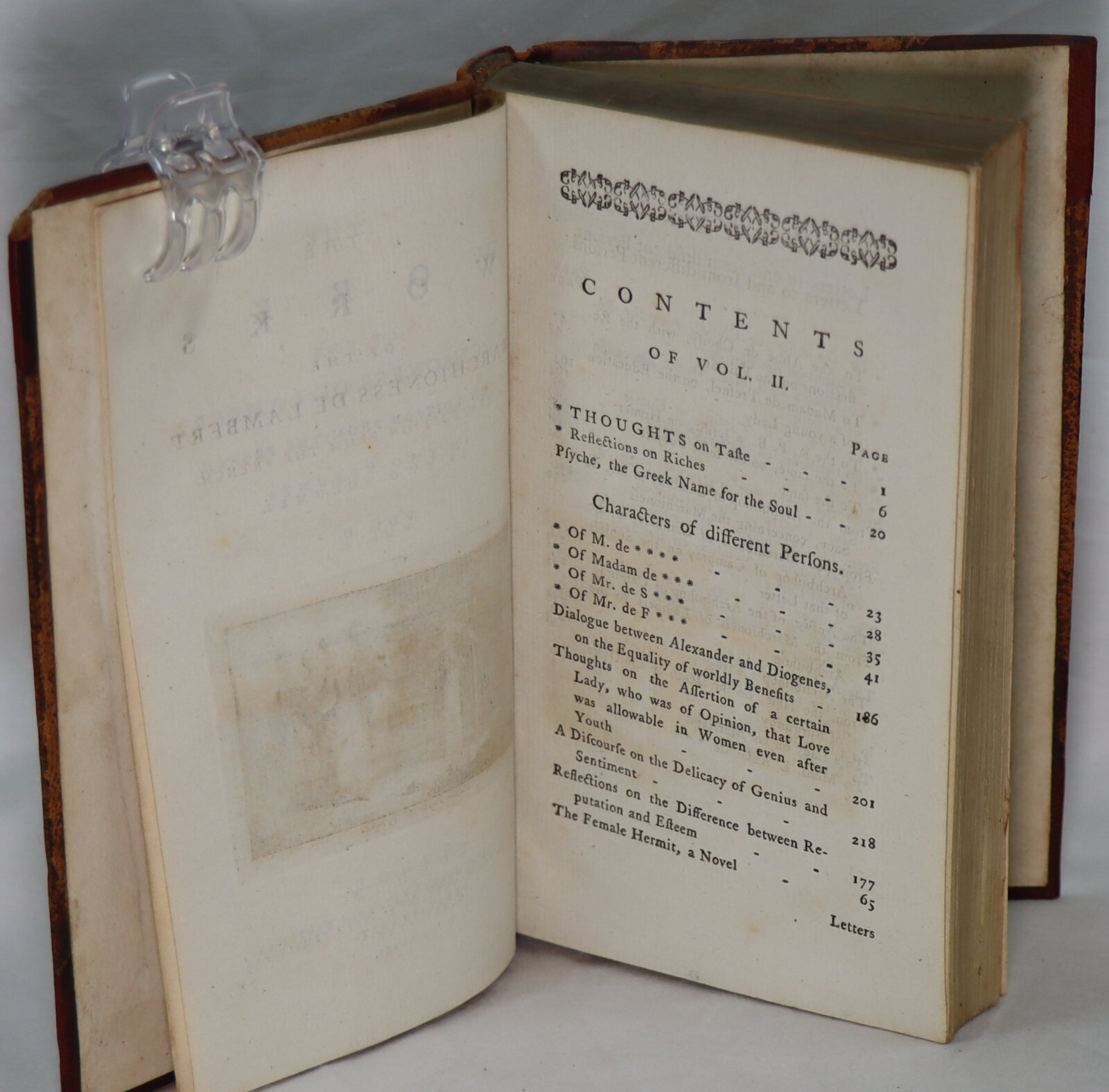
Tan mottled calf binding with brown and black title plates, gilt banding and title on the spine. Dimensions are for one volume .
-
F.B.A. provides an in-depth photographic presentation of this item to stimulate your feeling and touch. More traditional book descriptions are immediately available.
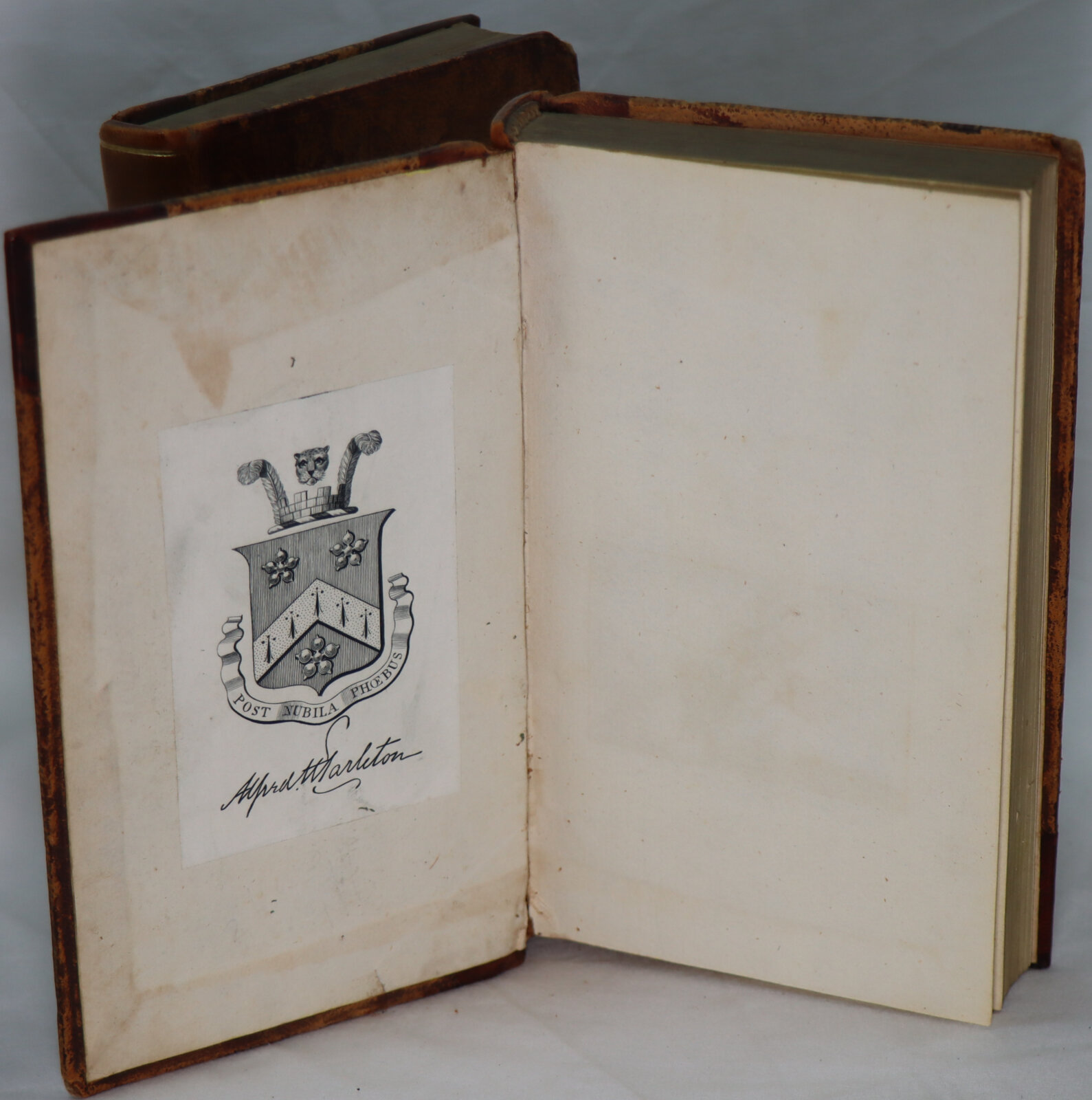
Two fine volumes of historic importance are these revised copies uniquely published 1781 in English in London. The books remain well preserved and attractive on the shelf. They display a pleasing and unique age patina and are in nice antiquarian condition, the age flaws easy to overlook or forgive. Please review photos for more detail and our best attempt to convey how these antique items survive.
Was Madame de Lambert an early if not first feminist? Debatable also if Lambert had any influence on the The French Revolution which was a period of political and societal change in France that began with the Estates General of 1789, and ended with the coup of 18 Brumaire in November 1799 and the formation of the French Consulate. Many of its ideas are considered fundamental principles of liberal democracy, while its values and institutions remain central to modern French political discourse.
These works demonstrate how in the early Enlightenment salonnière madame de Lambert advanced a novel feminist intellectual synthesis favoring women’s taste and cognition, which hybridized Cartesian (specifically Malebranchian) and honnête thought. Disputing recent interpretations of Enlightenment salonnières that emphasize the constraints of honnêteté on their thought, and those that see Lambert’s feminism as misguided in emphasizing gendered sensibility, Lambert’s approach is as best serving her needs as an aristocratic woman within elite salon society, and show through contextualized analysis how she deployed honnêteté towards feminist ends. Additionally, the analysis of Malebranche’s, Poulain de la Barre’s, and Lambert’s arguments about the female mind’s gendered embodiment illustrates that misrepresenting Cartesianism as necessarily liberatory for women, by reducing it to a rigid substance dualism, erases from view its more complex implications for gender politics in the late seventeenth and early eighteenth centuries, especially in the honnête environment of the salons.

Anne-Thérèse de Marguenat de Courcelles (1647 – 12 July 1733), who on her marriage became Madame de Lambert, Marquise de Saint-Bris, and is generally known as the Marquise de Lambert, was a French writer and salonnière.
During the Régence, when the court of the Duchesse du Maine, at the Château de Sceaux, was amusing itself with frivolities, and when that of the Duc d’Orléans, at the Palais-Royal, was devoting itself to debauchery, the salon of the Marquise de Lambert passed for the temple of propriety and good taste, in a reaction against the cynicism and vulgarity of the time. For the cultivated people of the time, it was a true honor to be admitted to the celebrated “Tuesdays”, where the dignity and high class of the “Great Century” were still in the air.
The only daughter of Étienne de Marguenat, Seigneur de Courcelles, and his wife, Monique Passart, Anne-Thérèse de Marguenat de Courcelles was born and died in Paris. She lost her father, an officer of the fiscal court of Paris, in 1650, when she was just three years old. She was raised by her mother, who was distinguished by the lightness of her habits, and by her mother’s second husband, the literary dilettante François Le Coigneux de Bachaumont, who instilled in her a love of literature. At a young age, writes her friend Bernard Le Bouyer de Fontenelle, “she often stole away from the pleasures of youth to read alone, and she began, of her own accord, to write extracts of what struck her the most. It was either subtle reflections on the human heart, or ingenious turns of phrase, but most often reflections.”
On 22 February 1666, she married Henri de Lambert, marquis de Saint-Bris, a distinguished officer who was to become a lieutenant-general and the governor of Luxembourg. Their union was very happy and they had two children: a son, Henri-François (1677–1754), and a daughter, Marie-Thérèse (1679 ]-1731), who became Comtesse de Saint-Aulaire by her marriage. The Marquise de Lambert was widowed in 1686 and raised her two young children while carrying on lengthy and troublesome lawsuits against her husband’s family to save her children’s property.
In 1698, she rented the north-west half of the hôtel de Nevers, located on the rue de Richelieu near the current site of the Bibliothèque nationale. Starting in 1710, in her beautiful drawing room decorated by Robert de Cotte, she launched her famous literary salon. According to her friend the Abbé de La Rivière, “She fell victim to a colic of cultivation and wit, an illness which stuck her suddenly and which remained incurable until her death.” She received visitors twice a week: literary people on Tuesdays and high society on Wednesdays, without, however, seeking to establish an impenetrable barrier between the two worlds; on the contrary, she liked to interest the well-born in literature and to introduce writers to the advantages of frequenting society, and regular visitors could pass without constraint from one day to the other.
The Tuesdays began about one o’clock in the afternoon. After a very fine dinner, “academic conferences” on a philosophical or literary theme took place. Political and religious discussions were absolutely prohibited. Every guest was required to give a personal opinion or to read some excerpts from their latest work; on the morning of the gathering, says the Abbé de La Rivière, “the guests prepared wit for the afternoon.” The lady of the house directed what her critics called “wit’s business office”. She encouraged writers to the highest moral tone and contributed to orienting the movement of ideas toward new literary forms: from her salon originated Antoine Houdar de la Motte’s attacks on the three unities, on versification, and on Homer, whom Madame de Lambert thought dull; which did not prevent her from receiving such partisans of the Classical writers as Anne Dacier, Father d’Olivet, or Valincour.
The Marquise de Lambert was not socially conservative. She championed Montesquieu’s satirical Persian Letters and succeeded in obtaining the author’s election to the Académie française. She was one of the first society women to open her door to actors such as Adrienne Lecouvreur or Michel Baron.
Fontenelle and Houdar de la Motte were the great men of her celebrated salon, where one could also encounter Marie-Catherine d’Aulnoy, the poet Catherine Bernard, the Abbé de Bragelonne, Father Buffier, the Abbé de Choisy, Madame Dacier, the mathematician Dortous de Mairan, Fénelon, Hénault, Marivaux, the Abbé Mongault, Montesquieu, the lawyer Louis de Sacy (one of the Marquise’s favorites), the Marquis de Sainte-Aulaire, Baronne Staal, Madame de Tencin who received the Marquise’s guests at her death in 1733, or the Abbé Terrasson.
The Marquise de Lambert’s salon was known as the antechamber of the Académie française. According to the Marquis d’Argenson, “she had brought about the election of half the members of the Academy.”
Madame de Lambert, says Fontenelle, “was not only ardent to serve her friends, without waiting for their request, nor the humiliating exposition of their need; but a good deed to be done, even for someone she had no connection with, always interested her intensely, and the circumstances had to be especially contrary, for her not to succumb. Some bad outcomes of her generosity had not reformed her, and she always remained equally ready to risk doing good.
Madame de Lambert was particularly interested in questions of education. She wrote Advice from a mother to her son (1726) and Advice from a mother to her daughter (1728) which are full of nobility and a great elevation of thought, and whose debt to the maxims of Fénelon she recognized: “I found the precepts which I gave to my son in Telemachus and the counsels to my daughter in L’Éducation des filles.”
Her “Reflections on Women” were not intended to be printed, and when they were published from copies intended for friends of the author, she was greatly upset and believed herself dishonored. She bought up a large part of the edition to destroy it, which did not prevent several clandestine reprintings and even a translation into English. This text finely evokes the paradoxes of the feminine condition:
I have examined whether women could be better employed : I have found respectable authors who have thought that they had qualities which might carry them to great things, such as imagination, feeling, taste : gifts which they have received from Nature. I have reflected on each of these qualities. Since feeling dominates them, and leads them naturally towards love, I have sought whether they could be saved from the disadvantages of that passion, by separating pleasure from what is called vice. I have therefore imagined a metaphysics of love : let her practice it who can.
Without rejecting the attractions of femininity, the author revolts against the emptiness of women’s education, reproaching Molière with ‘”having attached to learning the shame which was the lot of vice.” It is inner emptiness, she believes, which leads to moral corruption : enhanced education is therefore a bulwark against vice.
She also wrote essays on Friendship and on Old Age, as well as depictions of the guests at her salon and pieces to be read at these gatherings.
She had a true talent for crafting maxims with a new and original turn : “It is often well thought,” writes the nineteenth-century critic Charles Augustin Sainte-Beuve, “but it is even better said.” Sometimes erring by an excess of refinement, she often shows energy and concision. Her writings are remarkable, according to Fontenelle, “for the tone of amiable virtue that reigns throughout,” and, according to Louis Simon Auger, “for the purity of the style and the morality, the elevation of the sentiments, the fineness of the observations and the ideas.”
The Marquise de Lambert was not very devout, even if she condemned irreligion as in bad taste; “Mme de Lambert’s religion,” notes Sainte-Beuve, “is more of an elevated intellectual form than an interior and habitual spring flowing from the heart, or than a positive revelation.” In this way, she was a forerunner of the Enlightenment and its philosophical ideas.
A prominent salonnière in the France of Louis XIV and the Regency, Madame de Lambert authored numerous essays dealing with philosophical issues. Her most famous works, twin sets of instructions to her son and daughter, analyze the virtues to be cultivated by each gender in the aristocracy. Men pursue glory while women focus on humility. During the literary querelle de la femme, Lambert defends the dignity of women against misogynist stereotypes advanced by opponents of gender equality. In her political writings, she criticizes the vices typical of the hierarchical society of the period, especially the unequal distribution of material goods. The era’s distortion of friendship and mistreatment of the elderly also received critical scrutiny. Her religious philosophy leans toward the God of deism: a Supreme Being who should be honored for the works of creation but whose attributes do not transcend the categories of human reason. Several works in aesthetics treat the subjective problem of taste and sensibility. Throughout her writings, Lambert manifests her allegiance to a Cartesian understanding of the nature of philosophical analysis. The French Enlightenment recognized the philosophical value of her works, most of which were published posthumously. Fontenelle, Montesquieu, and Voltaire are the most prominent of the Enlightenment thinkers who lauded the philosophical acumen of Lambert.
Condition notes
Rebacked
Want to know more about this item?
We are happy to answer any questions you may have about this item. In addition, it is also possible to request more photographs if there is something specific you want illustrated.
Ask a question
Related products



Share this Page with a friend
