
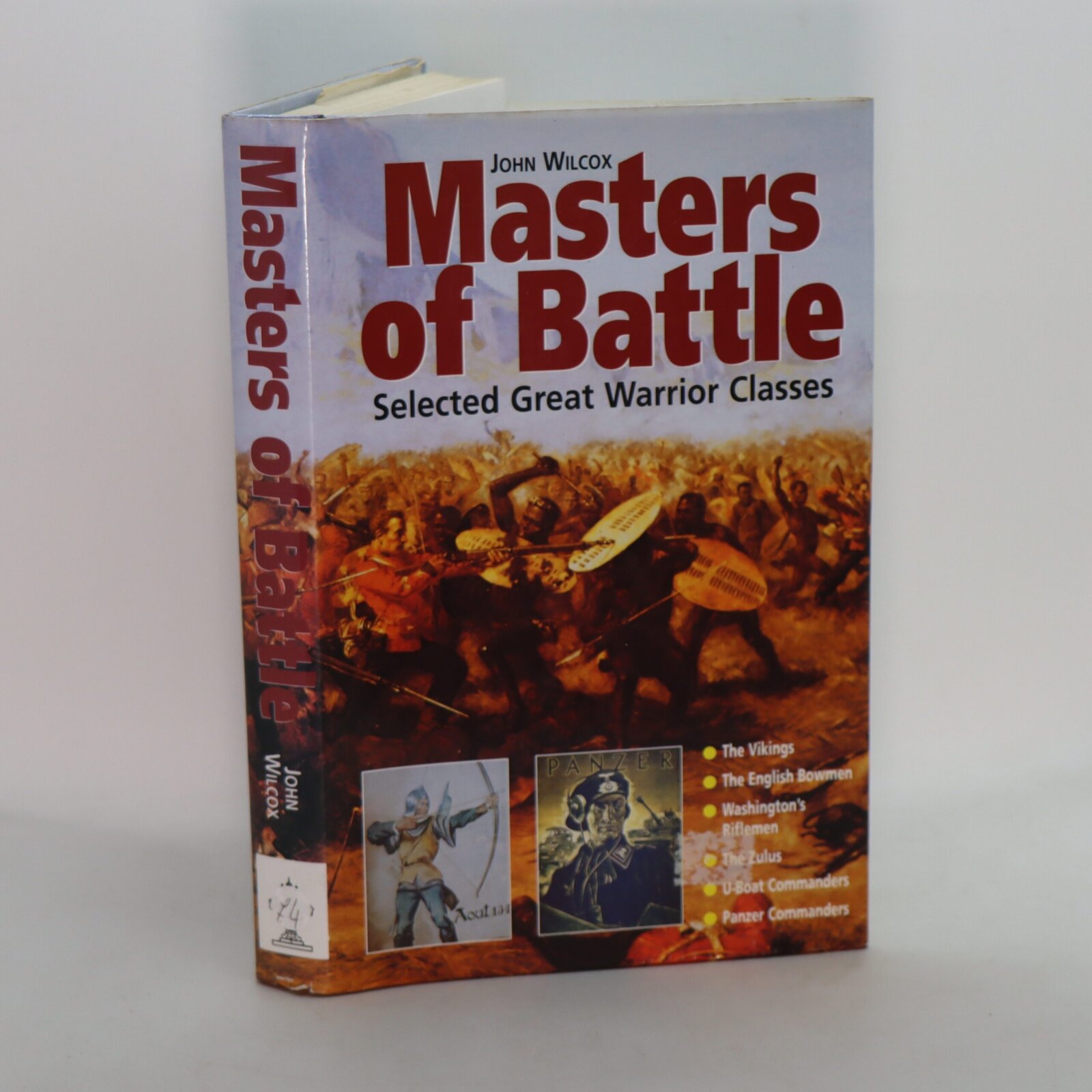
Masters of Battle.
By John Wilcox
ISBN: 9781860198298
Printed: 1999
Publisher: Brockhamton Press. London
| Dimensions | 16 × 24 × 3 cm |
|---|---|
| Language |
Language: English
Size (cminches): 16 x 24 x 3
Condition: Fine (See explanation of ratings)
£21.00
Buy Now


Item information
Description
In the original dustsheet. Binding the same as the dustsheet.
F.B.A. provides an in-depth photographic presentation of this item to stimulate your feeling and touch. More traditional book descriptions are immediately available.
This is a great reference book, one that should be absorbed by all students of War.
Review: This is a fascinating book of unexpected wonders, that carries the subtitle ‘Selected Great Warrior Classes’. The author – John Wilcox – developed the concept for this book from an idea for a television series. It is a poignant subject, as Wilcox himself is descended from a prominent British military family, (with members holding a Victoria Cross, a Military Medal and a Distinguished Conduct Medal), indeed, it is to this older generation of his family that Wilcox dedicates this book.
The hardback (1999) edition contains 224 numbered pages and as well as an Acknowledgement and Introduction section, is divided into six chapters:
1) The Marines – The Vikings of the North.
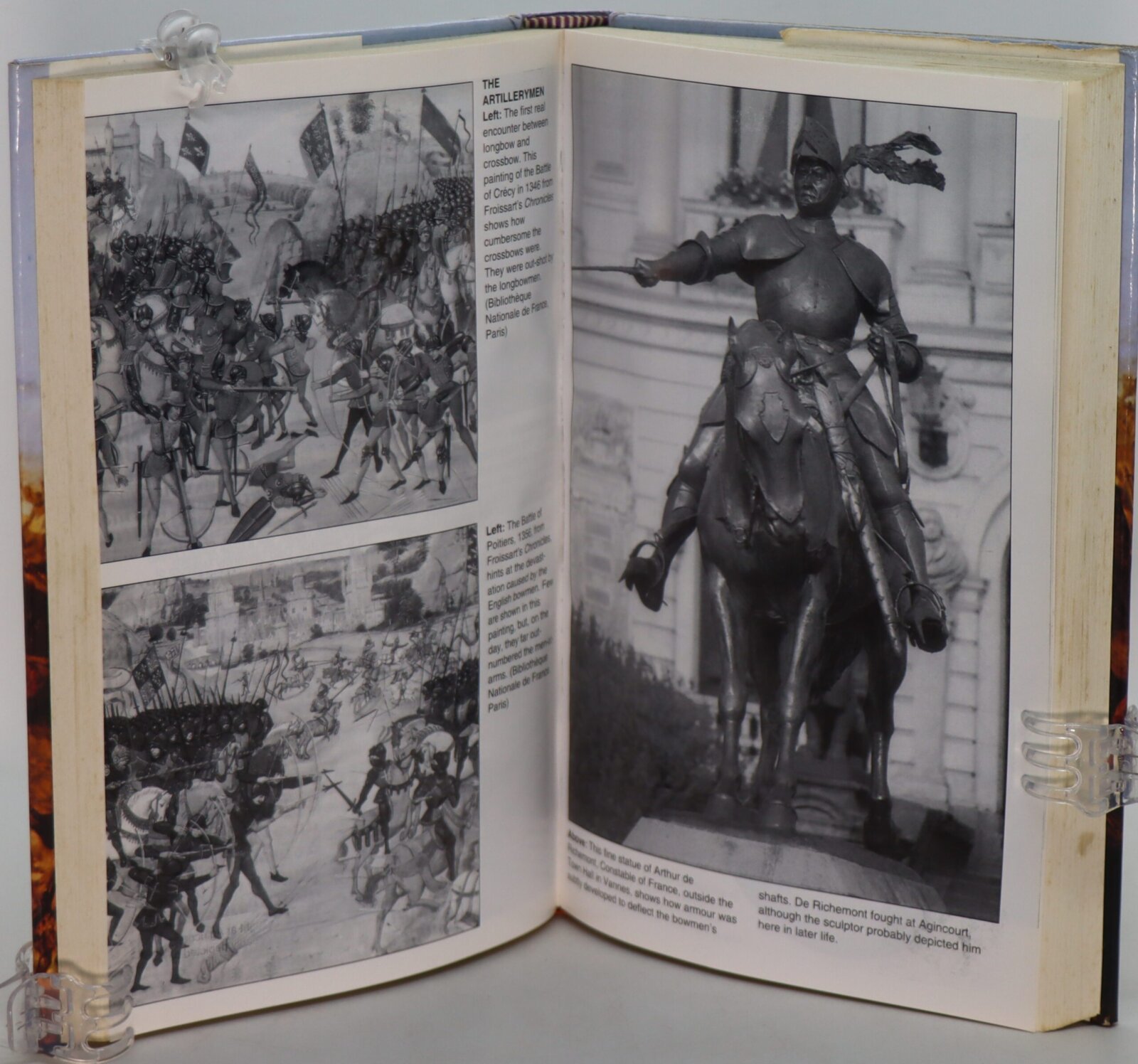
2) The Artillerymen – The Longbowmen of England.
3) The Skirmishers – The Riflemen of Saratoga.
4) The Spearmen – The Zulus of Isandlwana.
5) The Privateers – The Kaiser’s U-boat Captains.
6) The Armoured Ones – Hitler’s Panzer Commanders.
Each section is easy to read and is logically constructed. The subject matter is far from simple, but Wilcox manages to convey a mixture of military exactitude, with a sound narrative history, so that each of the six warrior subjects is presented within a three-dimensional historical context. For instance, we learn that in the year 997 AD, a written legal code, intended for use in Danelaw – the area of England controlled by the Vikings, stipulated that local twelve men (thanes), had the right to impartially judge, whilst under oath, offenders before the law. According to Wilcox’ research, this is the first written example of such a convention. In 1013 AD, the Viking king Cnut came to thrown of a united England. He submitted to baptism, and it was he who declared Christianity to be the state religion of England, and that it was a legal duty to support the Church.
Elsewhere in the book, other research suggests that the English and Welsh longbows were more efficient than most early muskets or rifles, and certainly more versatile than the crossbow, and that it was not until the introduction of the Martini-Henry breech-loading rifle of the 1870’s, that the longbow was finally superseded on all fronts. This is not a bad achievement for a weapon that made English and Welsh armies feared in Europe during the 14th and 15th centuries.
Then there are the innovations, such as the rifled musket used during the American War of Independence, that although of a far greater accuracy in combat, were slower to re-load. Time between shots was sacrificed for the quality of the shot at hand. Rifling, having developed in Germany, involved the cutting of a spiral pattern along the inside of an otherwise smooth inner barrel surface. A musket, with its smooth barrel, although firing a projectile, cannot guarantee any degree of accuracy over distance, per single shot. This is why a great number of muskets were employed in massed infantry ranks, that had to close with an enemy, to ensure any chance of hitting the intended targets. The rifle, by way of contrast, could be fired with a devastating accuracy, with each valuable shot fatally striking its target from a distance. The rifling made the projectile (or bullet) spin as it left the barrel, thus ensuring a greater stability in flight. At the Battle of Saratoga (1777), American Skirmishers, recruited from the wild western frontiers, inflicted casualties on the traditionally trained British army, which marched into battle shoulder to shoulder, across open ground. This is typical of a formal European army of the day. The Skirmishers, making use of cover, and firing from long distance, were safe from the effects of returned musket fire, used their rifled muskets to cut down the opposing force.
The Zulu warriors of the Anglo-Zulu War (1879) are included for their magnificent victory over a British armed force in 1879, at Isandlwana. Armed with short stabbing spears and cowhide shields, these brave men of Southern Africa, took on and defeated a modern military force armed with canon, rocket launchers and breech-loading rifles. Their discipline in the face of modern firepower enabled their traditional battle tactics to prevail.
The final two chapters are dedicated to two German forces – the U-boats of WWI, and the Panzer Tanks of WWII. The U-boats sank an astonishing amount of British and allied shipping during WWI, whilst the Panzers of WWII served as the spearhead to every German military success in that war. The U-boat was still very new at the outbreak of WWI. Other countries possessed submarines at this time, but it was the Germans that first devised an effective and systematic use of them, literally cutting down an enemy’s navy from below the waves. Wilcox description of the German U-boat effectiveness is truly terrifying. In WWII, many countries possessed tanks (armoured, motorised vehicles), but it was the German military thinkers that devised a way of using them, so as to render trench warfare (such as that experienced in WWI), virtually redundant. This is an excellent book, worthy of study.
Condition notes
small stains on pastedown
Want to know more about this item?
We are happy to answer any questions you may have about this item. In addition, it is also possible to request more photographs if there is something specific you want illustrated.
Ask a question
Related products

Share this Page with a friend
