
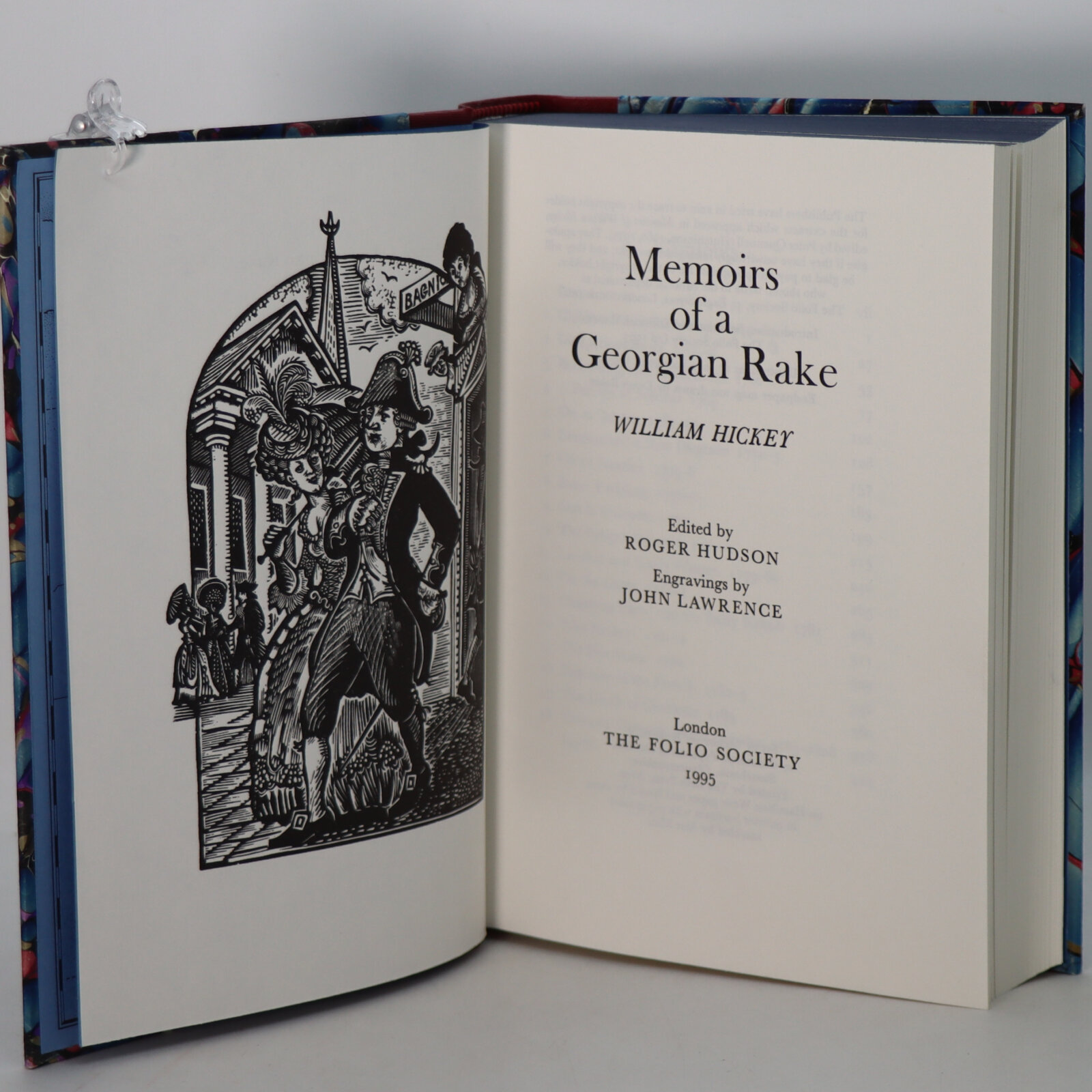
Memoirs of a Georgian Rake.
By William Hickey
ISBN: 9781258949976
Printed: 1995
Publisher: THe Folio Society. London
| Dimensions | 15 × 21 × 4 cm |
|---|---|
| Language |
Language: English
Size (cminches): 15 x 21 x 4
Condition: Fine (See explanation of ratings)
£23.00
Buy Now

Item information
Description
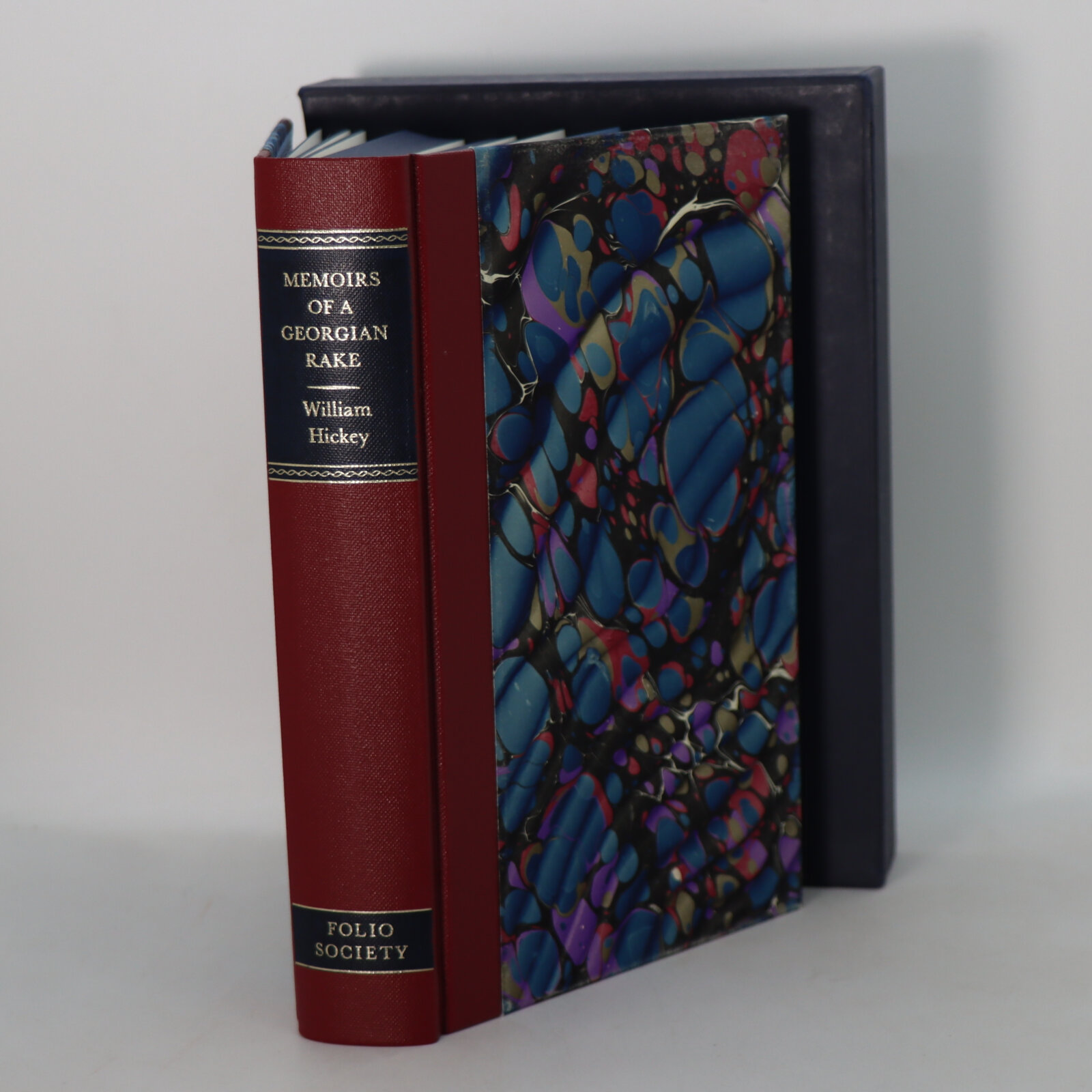
In a fitted box. Maroon cloth spine with black title plate and gilt lettering. Blue marbled boards.
F.B.A. provides an in-depth photographic presentation of this item to stimulate your feeling and touch. More traditional book descriptions are immediately availabie
Endorsed by F.B.A. – F.B.A. is endorsing a range of collectable lovingly used books
A most clean edition worthy of a good library – looks new!
Excellent binding, print etc as expected from the Folio Society. But heavily edited and reduced content from the original which I had read years ago. From that point of view a bit disappointing.
This is a joyous and extraordinary memoir of a man who lived a joyous and extraordinary life. William Hickey was from a middle-class Irish family (his father was friends with Edmund Burke and was a sometime member of The Club), and he grew up and trained as a lawyer in London in the 1760s and ’70s, before sailing off to try and make his fortune in India. It’s a life that offers an amazing window on places and personalities of the period that are untouched by contemporary novelists.
William Hickey (30 June 1749 – 31 May 1830) was an English lawyer, but is best known for his vast Memoirs, composed in 1808–10 and published between 1913 and 1925, which in their manuscript form cover seven hundred and forty closely written pages. Described by Peter Quennell as “One of the most remarkable books of its kind ever published in the English Language”, Hickey’s Memoirs give an extraordinarily vivid picture of life in late 18th-century London, Calcutta, Madras and Jamaica which stands comparison with the best of his near-contemporary James Boswell.
Hickey was born in St. Albans Street, Pall Mall, Westminster, England, on 30 June 1749, the seventh son of Joseph Hickey, a successful Irish solicitor, and Mary Boulton, from a Yorkshire gentry family. He began his education at Westminster School but was removed “in high disgrace” in December 1763 after neglecting his studies, frequenting public houses and leading, in his own words, a life of “idleness and dissipation”. Instead, he was sent to a private school at Streatham in Surrey, where he was able to study Arithmetic, Writing, French, Drawing and Dancing in addition to the Classical Studies which had failed to engage him at Westminster. In January 1766 he left school and began his legal training, but he continued to lead an extremely debauched existence.
He refers in his memoirs to many of his youthful sexual experiences, beginning with a girl called Nanny Harris, a servant of his father’s. He had many indiscretions in London, where he lived well beyond his means.
Eventually he embezzled £500 from the accounts in his father’s office, and when this was discovered, it was resolved to send the prodigal to India to see if he could make good. Accordingly, Hickey embarked on the ship Plassey, a fast Indiaman, at Dungeness on 4 January 1769.
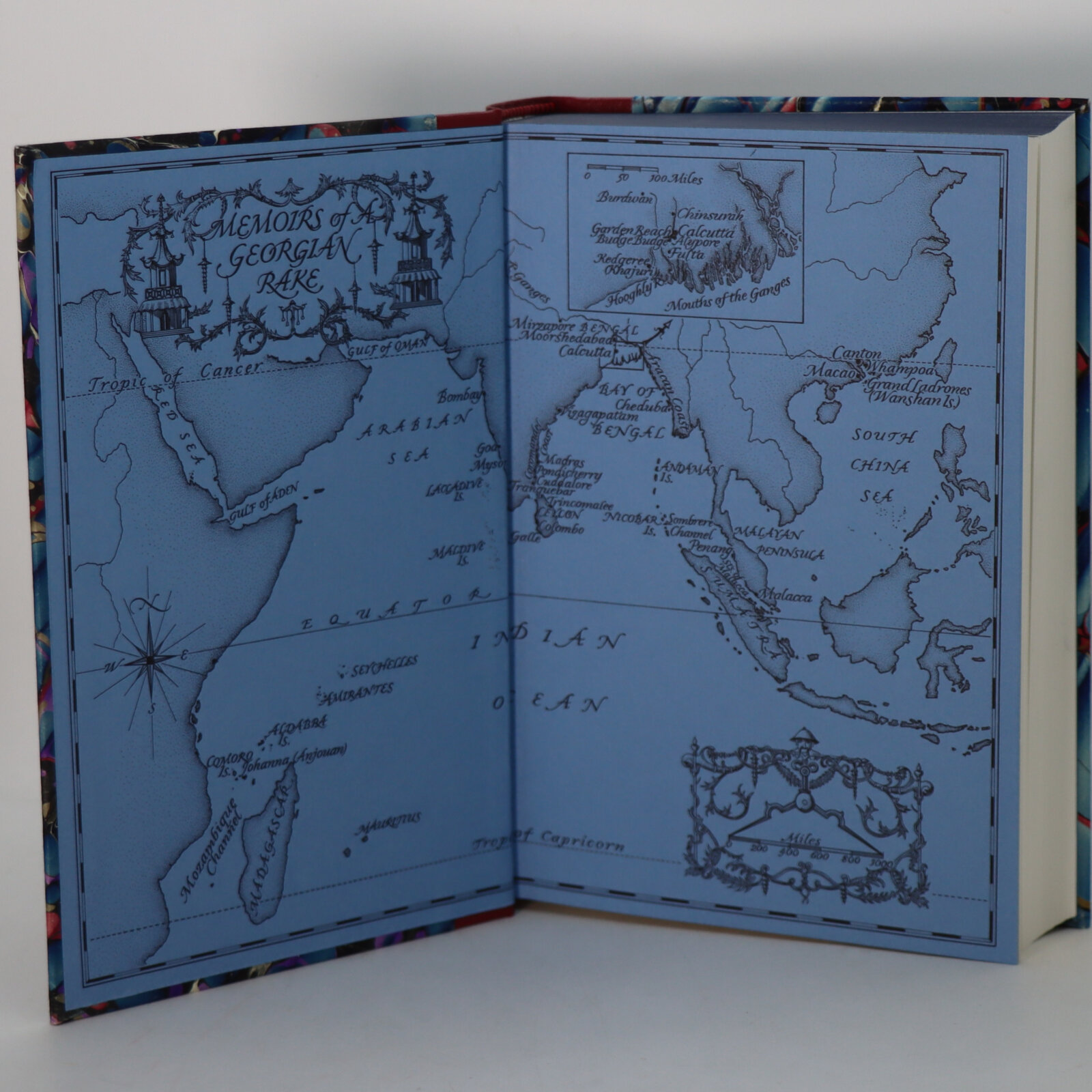
Upon arriving in India, Hickey was expected to join the British East India Company army as an officer cadet, but he was put off the prospect when he learned that the pay was “too contemptible to afford the common necessaries of life”. He got back on the Plassey to return to England. The ship travelled on first to China, of which he gives an account in his memoirs. His father was less than pleased at his return. After Hickey reverted to his old ways, his father sent him to Jamaica to take up as a lawyer, with a warning that if he failed, he could expect no further help—indeed, his father would no longer even receive him. Once in Jamaica he found that, because of limits imposed on the numbers of attorneys allowed to practice, he would not be able to make a living as a lawyer there. He returned to England, “with considerable regret”, leaving about five months after his arrival, on 17 April 1776, arriving back on 14 June.
Through his various connections, including Edmund Burke, he arranged to be accepted as a lawyer in Bengal, a feat which restored his father’s goodwill towards him. He departed for Bengal from Portsmouth on 1 May 1777 and called in, on route, at Cape Town. On 12 November 1777 Hickey, aged 28, was “entered on the Roll” as “Solicitor, Attorney, and Proctor of the Supreme Court” in Bengal. He prospered in those roles. In April 1779 he set out to return to England, charged by the English inhabitants of Calcutta to deliver, at their expense, a petition to Parliament in England that they should be entitled to trial by jury. After a difficult journey travelling via Cape Town and Holland he arrived back in England, at the port of Harwich, on 28 June 1780.
In October he first met and later took up with a demi-mondaine named Charlotte Barry, who was then aged 18 and with whom he fell in love. He offered to marry her; she refused marriage but agreed to live with him as his partner. The couple then travelled together to India when Hickey was 32 in 1783. Charlotte did not survive long, dying the year after they arrived. Hickey established himself in the legal profession, managing to obtain a series of lucrative posts, including Under-Sheriff and Clerk to the Chief Justice. Some while after Charlotte’s death he took an Indian mistress, Jemdanee, who was locally considered to be his wife. She bore him a son in 1796, but died in childbirth. The couple’s son died a few months after her. Hickey retired to the Buckinghamshire town of Beaconsfield in late 1808, having left India after becoming ill. He brought with him “a pair of elderly unmarried sisters, his favourite Indian servant Munnoo and a large parti-coloured English dog.” The dullness of what he called a “trifling” place “with a very limited society”, encouraged him to occupy his mind by writing his memoirs, which eventually extended to over 700 pages of handwritten text taking his life up to 1810, at which point he stopped.
The details of his life after 1810 are sketchy, but he seems to have moved to London with his sisters, Sarah, and Ann, who died in 1824 and 1826 respectively. He died in 1830.
Want to know more about this item?
We are happy to answer any questions you may have about this item. In addition, it is also possible to request more photographs if there is something specific you want illustrated.
Ask a question
Share this Page with a friend
