
Under Wolfe's Flag.
By Rowland Walker
Printed: Circa 1910
Publisher: S W Patridge & Co. London
Edition: Second impression
| Dimensions | 14 × 19 × 4 cm |
|---|---|
| Language |
Language: English
Size (cminches): 14 x 19 x 4
Condition: Very good (See explanation of ratings)
£15.00
Buy Now


Item information
Description
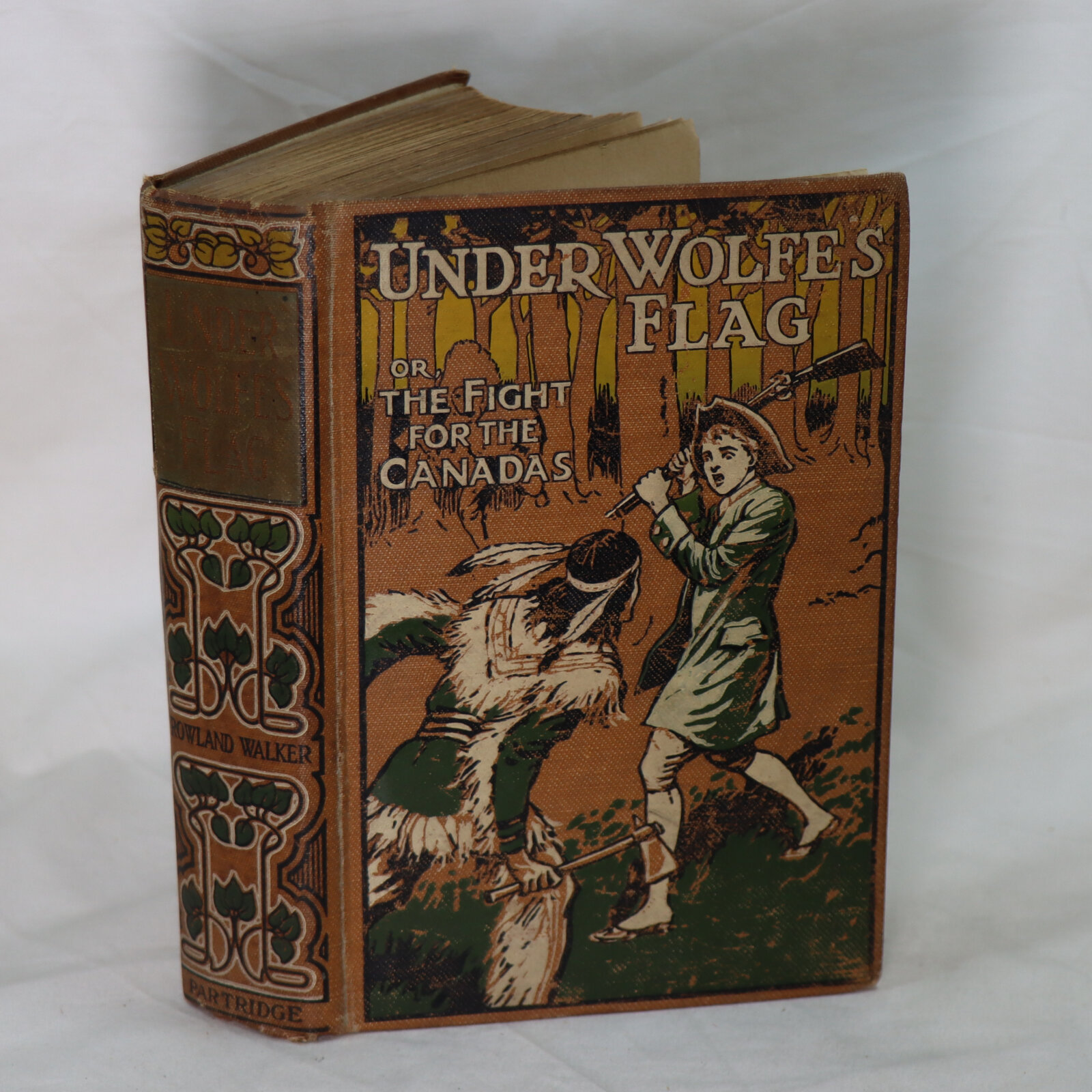
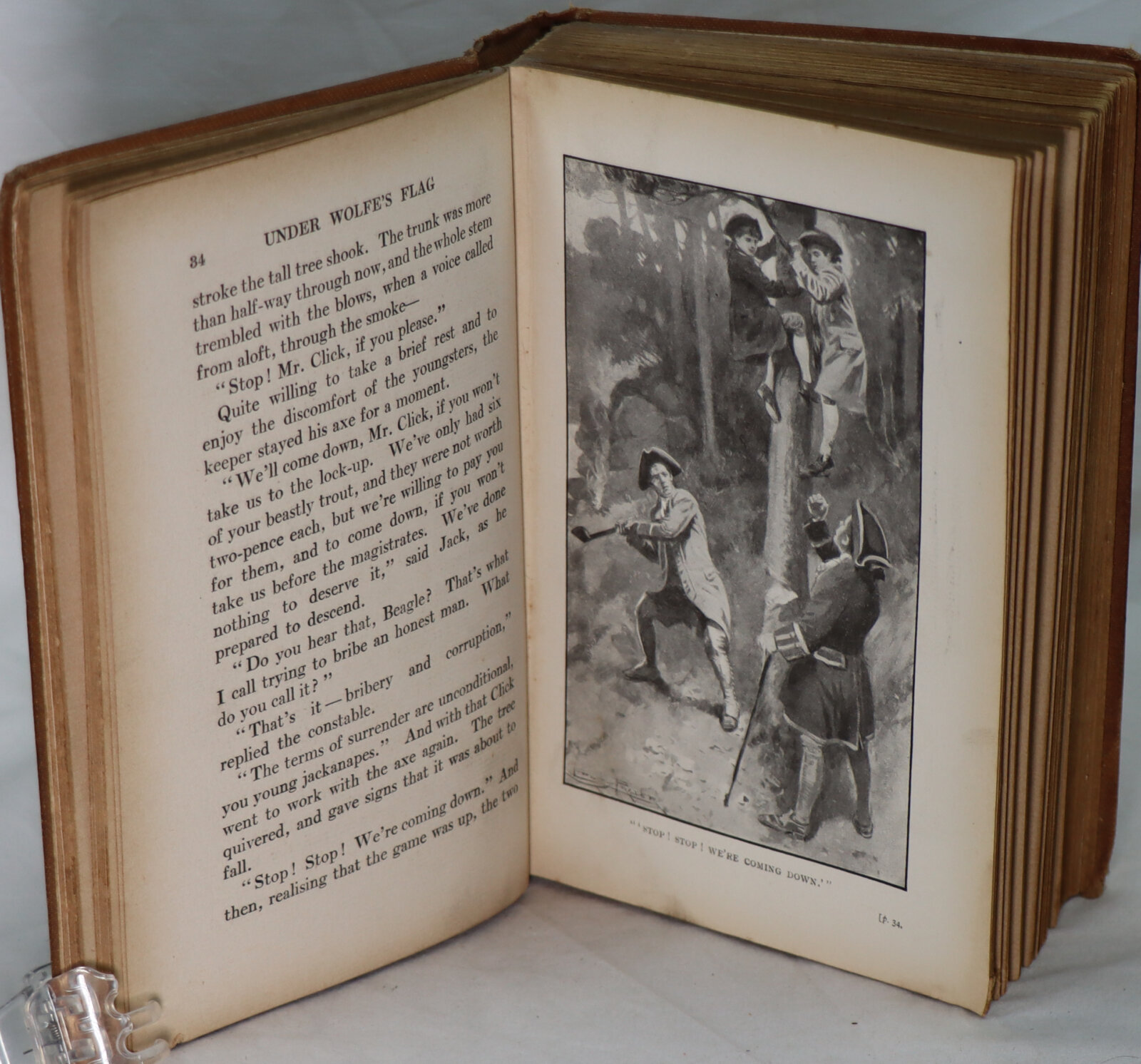
Tan cloth binding with cream title and fighers fighting on the front board.#
-
F.B.A. provides an in-depth photographic presentation of this item to stimulate your feeling and touch. More traditional book descriptions are immediately available.
-
Note: This book carries the £5.00 discount to those that subscribe to the F.B.A. mailing list.
James Wolfe (born Jan. 2, 1727, Westerham, Kent, Eng.—died Sept. 13, 1759, Quebec) commander of the British army at the capture of Quebec from the French in 1759, a victory that led to British supremacy in Canada.

How The Death of General Wolfe mythologized North America
In The Death of General Wolfe, Benjamin West creates an almost legendary vision of North America.
The elder son of Lieutenant General Edward Wolfe, he was commissioned in the Royal Marines in 1741 but transferred almost immediately to the 12th Foot. Wolfe was on active service continuously until the end of the War of the Austrian Succession, fighting against the French at Dettingen (1743) and later at Falkirk and Culloden (1746) during the Jacobite rebellion. He was promoted to lieutenant colonel in 1750 and served as brigadier general under Major General Jeffery Amherst in an expedition against the French at Cape Breton Island (1758). The capture of Louisbourg, a fortress on the island, was largely attributed to Wolfe’s daring and determination.
Wolfe returned to England to restore his failing health, but there he received from William Pitt the rank of major general and command of the expedition to capture the city of Quebec. By late June 1759, Wolfe’s entire convoy had passed up the St. Lawrence River and had reached the island of Orleans, which lay opposite Quebec along the river. The army of the French defender of Quebec, the marquis de Montcalm, was strongly entrenched on the high cliffs along the river frontage. Unable to lure Montcalm out from the safety of his defenses, Wolfe on July 31 ordered an assault on the Beauport shore east of the city, which proved to be a costly failure.
Ill with dysentery and suffering from rheumatism, Wolfe endured great pain and anxiety while the siege dragged on throughout August 1759. At the end of that month, he and his brigadiers agreed on a plan to land troops across the river a short distance upstream and to the west of Quebec. The resulting attack, which involved scaling the cliffs only one mile from the city, was carried out on September 12 and surprised the French on the level fields of the Plains of Abraham. On September 13, after a battle lasting less than an hour, the French fled. Wolfe, wounded twice early in the battle, died of a third wound, but not before he knew Quebec had fallen to his troops. Montcalm survived him by only a few hours. Quebec surrendered on September 18, and a year later in 1760 Amherst received the surrender of Montreal and the rest of Canada.
Rowland Walker (1876-1947) is an almost forgotten author today, yet in his day he was very successful; one of the few authors to tell his stories on radio, and the possibility of turning some of his books into films. Like many authors, including T.C. Bridges, and the Westermans, both father and son, the quality of his work was variable, but always good; at his best he could surpass both W.E. Johns and George E. Rochester in stories of the Royal Flying Corps.Born Herbert Rowland Walker on 5th December, 1876, at Greetland, Yorkshire; youngest son of James William Walker, a Police Sergeant, and Eliza. He was baptised on 13th July, 1877. In his excellent re-telling of the Robin Hood legends, he tells us that as a boy he lived in an old farmhouse among the Yorkshire Dales, not far from Kirklees Abbey.
Want to know more about this item?
We are happy to answer any questions you may have about this item. In addition, it is also possible to request more photographs if there is something specific you want illustrated.
Ask a question
Related products





Share this Page with a friend
