
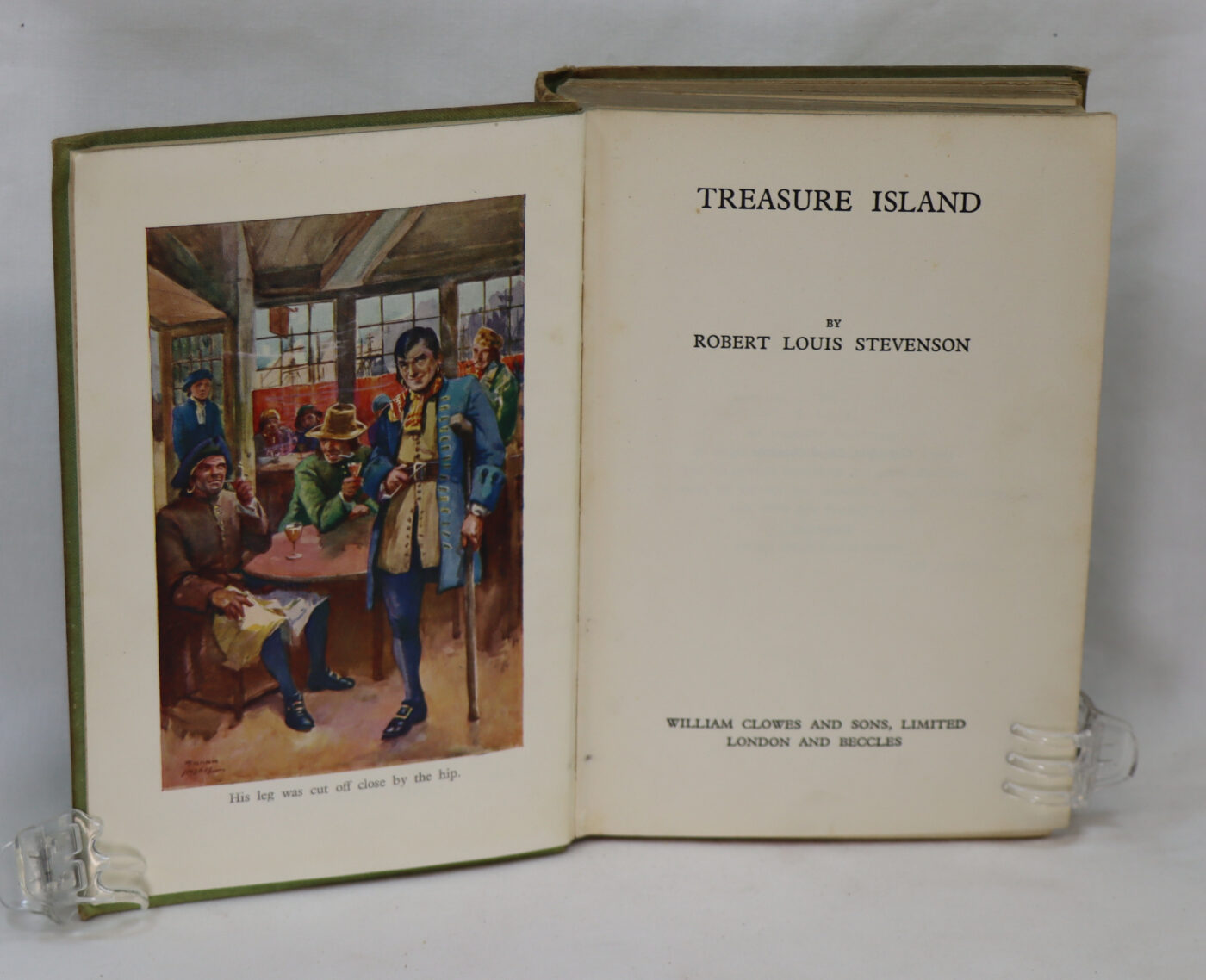
Treasure Island.
By Robert Louis Stevenson
Printed: Circa 1950
Publisher: William Clowes & Sons. London
| Dimensions | 14 × 19 × 3 cm |
|---|---|
| Language |
Language: English
Size (cminches): 14 x 19 x 3
Condition: Good (See explanation of ratings)
£7.00
Buy Now
Item information
Description
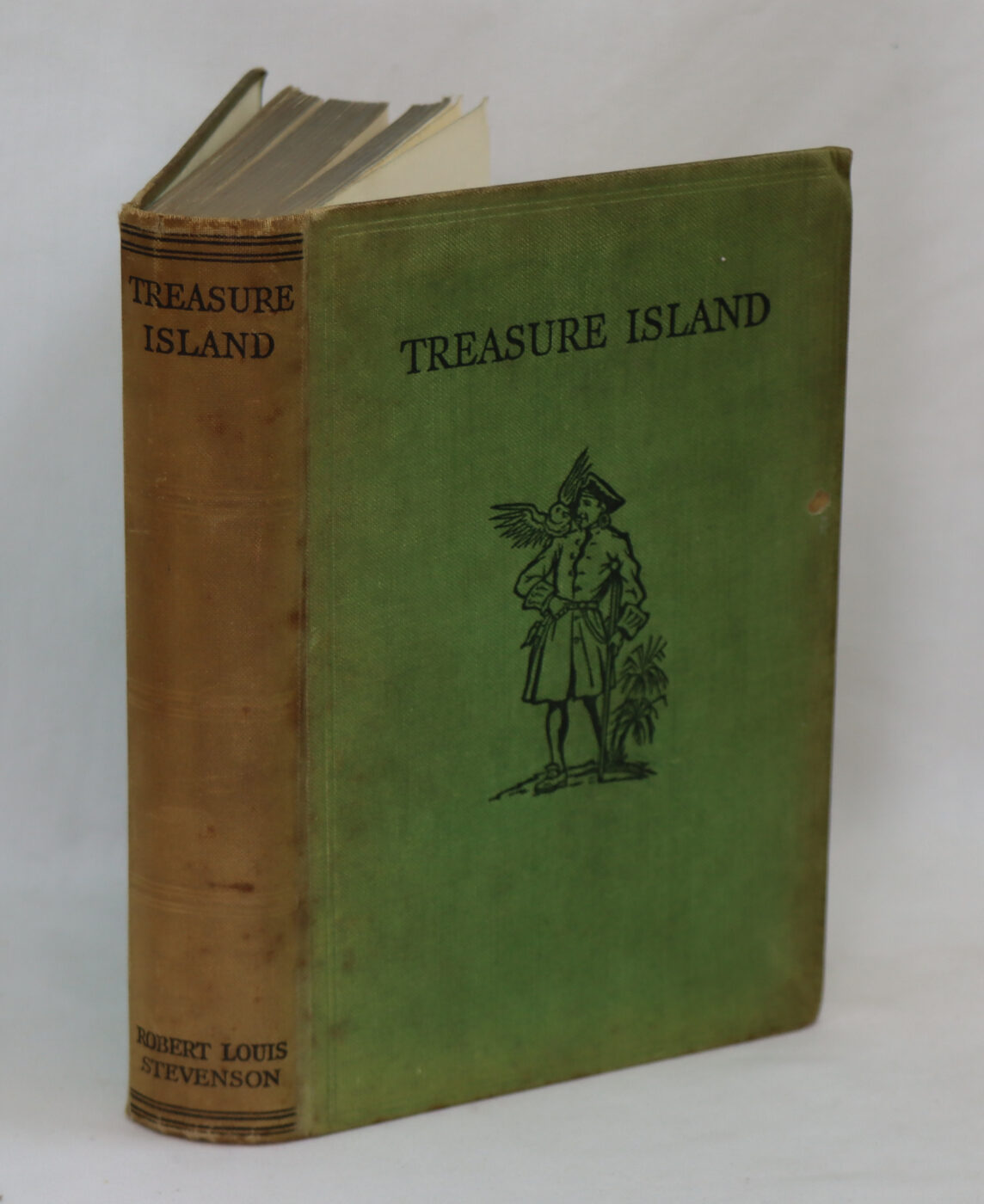
Green cloth binding with black title on the spine and front board.
We provide an in-depth photographic presentation of this item to stimulate your feeling and touch. More traditional book descriptions are immediately available.
- A £2 reduction when collected from FBA shop
A good readable well illustrated copy.
Treasure Island (originally titled The Sea Cook: A Story for Boys) is an adventure and historical novel by Scottish novelist Robert Louis Stevenson. It was published as a book in 1883, but is set in the 18th century, and tells a story of “buccaneers and buried gold”. It is considered a coming-of-age story, and is noted for its atmosphere, characters, and action.
The novel was originally serialised from 1881 to 1882 in the children’s magazine Young Folks under the title Treasure Island or the Mutiny of the Hispaniola, credited to the pseudonym “Captain George North”. It was first published as a book on 14 November 1883 by Cassell & Co. It has since become one of the most-often dramatised and adapted novels.
Since its publication Treasure Island has significantly influenced depictions of pirates in popular culture, including elements such as deserted tropical islands, treasure maps marked with an “X”, and one-legged seamen with parrots perched on their shoulders.
Robert Louis Stevenson (born Robert Lewis Balfour Stevenson; 13 November 1850 – 3 December 1894) was a Scottish novelist, essayist, poet and travel writer. He is best known for the novels Treasure Island (1883), Strange Case of Dr Jekyll and Mr Hyde (1886), and Kidnapped (1886) and for the poetry collection A Child’s Garden of Verses (1885).
Born and educated in Edinburgh, Stevenson suffered from serious bronchial trouble for much of his life but managed to write prolifically and travel widely despite his poor health. As a young man, he mixed in London literary circles, receiving encouragement from Sidney Colvin, Andrew Lang, Edmund Gosse, Leslie Stephen and W. E. Henley, the last of whom may have provided the model for Long John Silver in Treasure Island. In 1890 he settled in Samoa, where, alarmed at increasing European and American influence in the South Sea islands, his writing turned from romance and adventure fiction toward a darker realism. He died of a stroke in his island home in 1894 at age 44.
A celebrity in his lifetime, Stevenson’s critical reputation has fluctuated since his death, although today his works are held in general acclaim. In 2018 he was ranked just behind Charles Dickens as the 26th-most-translated author in the world.
Want to know more about this item?
We are happy to answer any questions you may have about this item. In addition, it is also possible to request more photographs if there is something specific you want illustrated.
Ask a question
Related products


Share this Page with a friend
