
Thomson's Seasons.
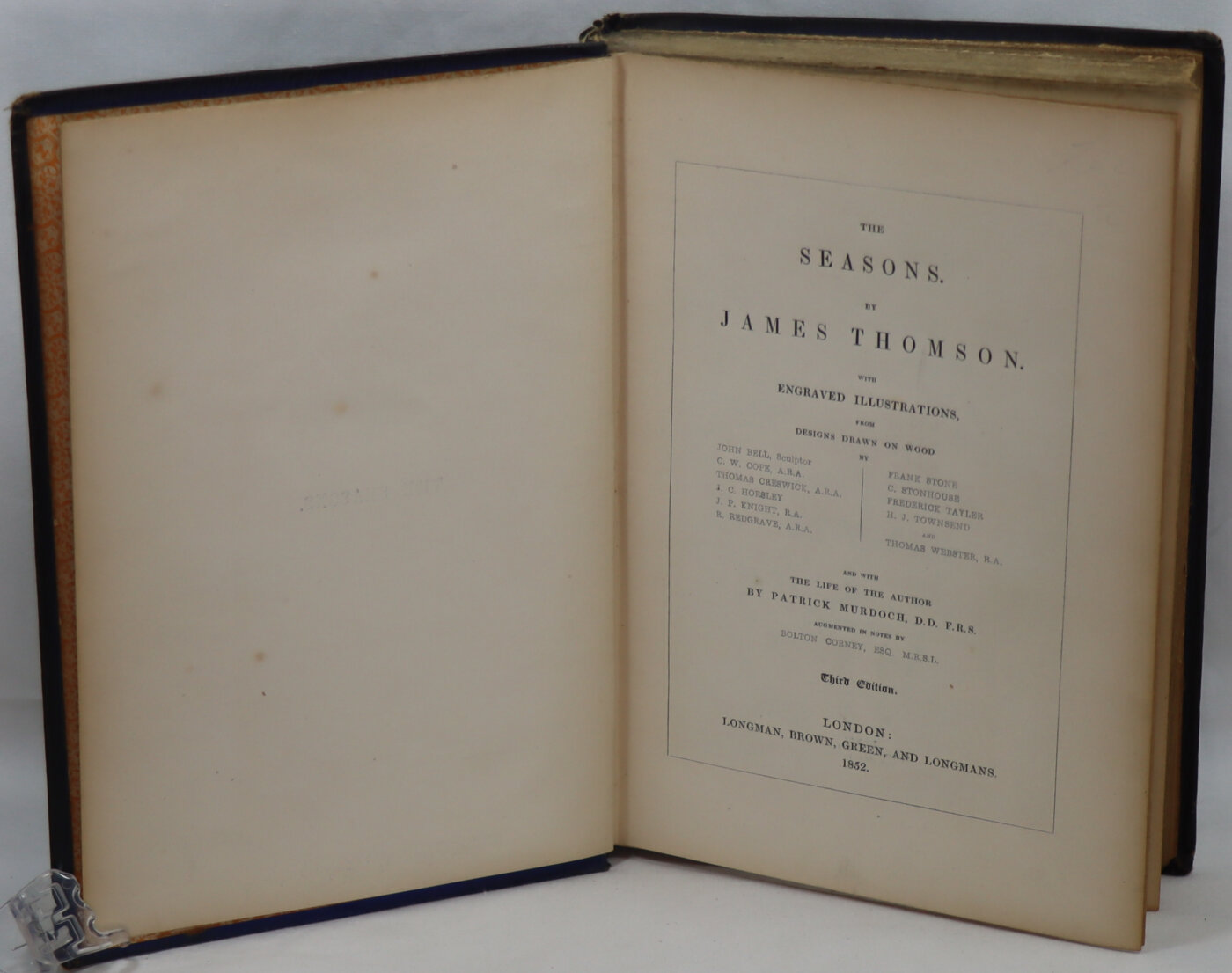
By James Thomson
Printed: 1852
Publisher: Longman Brown Green & Longmans. London
| Dimensions | 17 × 22 × 3 cm |
|---|---|
| Language |
Language: English
Size (cminches): 17 x 22 x 3
Condition: Very good (See explanation of ratings)
£278.00
FREE shipping
Buy Now

Item information
Description
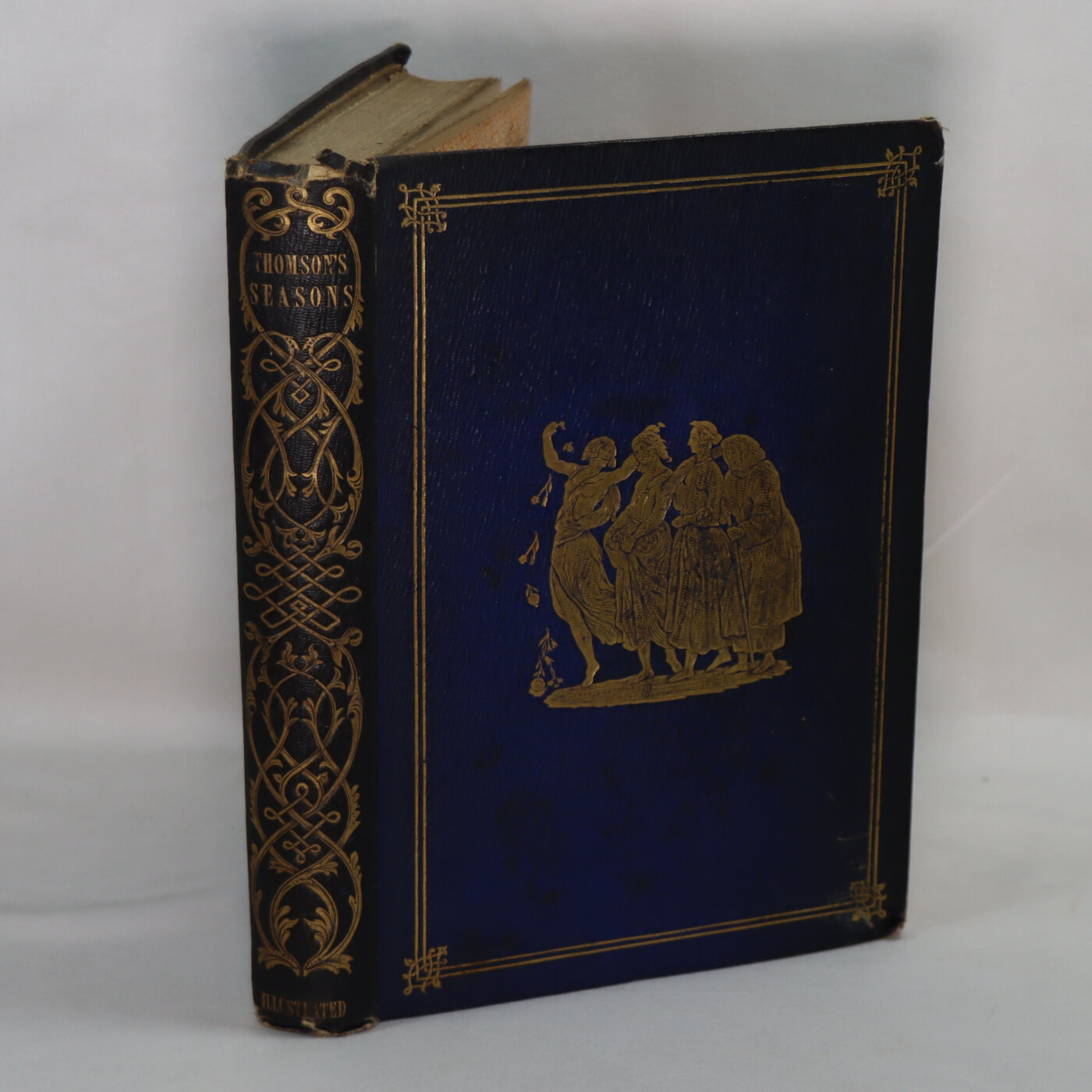
Navy cloth binding with gilt decoration and title on the spine. Four gilt women image on the front board.
-
We provide an in-depth photographic presentation of this item to stimulate your feeling and touch. More traditional book descriptions are immediately available.
-
Note: This book carries the £5.00 discount to those that subscribe to the F.B.A. mailing list.
A very solid edition. The four seasons are represented by four nymphs on the book’s cover. This is a very pleasing book.
The Seasons is a series of four poems written by the Scottish author James Thomson. The first part, Winter, was published in 1726, and the completed poem cycle appeared in 1730. The poem was extremely influential, and stimulated works by Joshua Reynolds, John Christopher Smith, Joseph Haydn, Thomas Gainsborough and J. M. W. Turner.
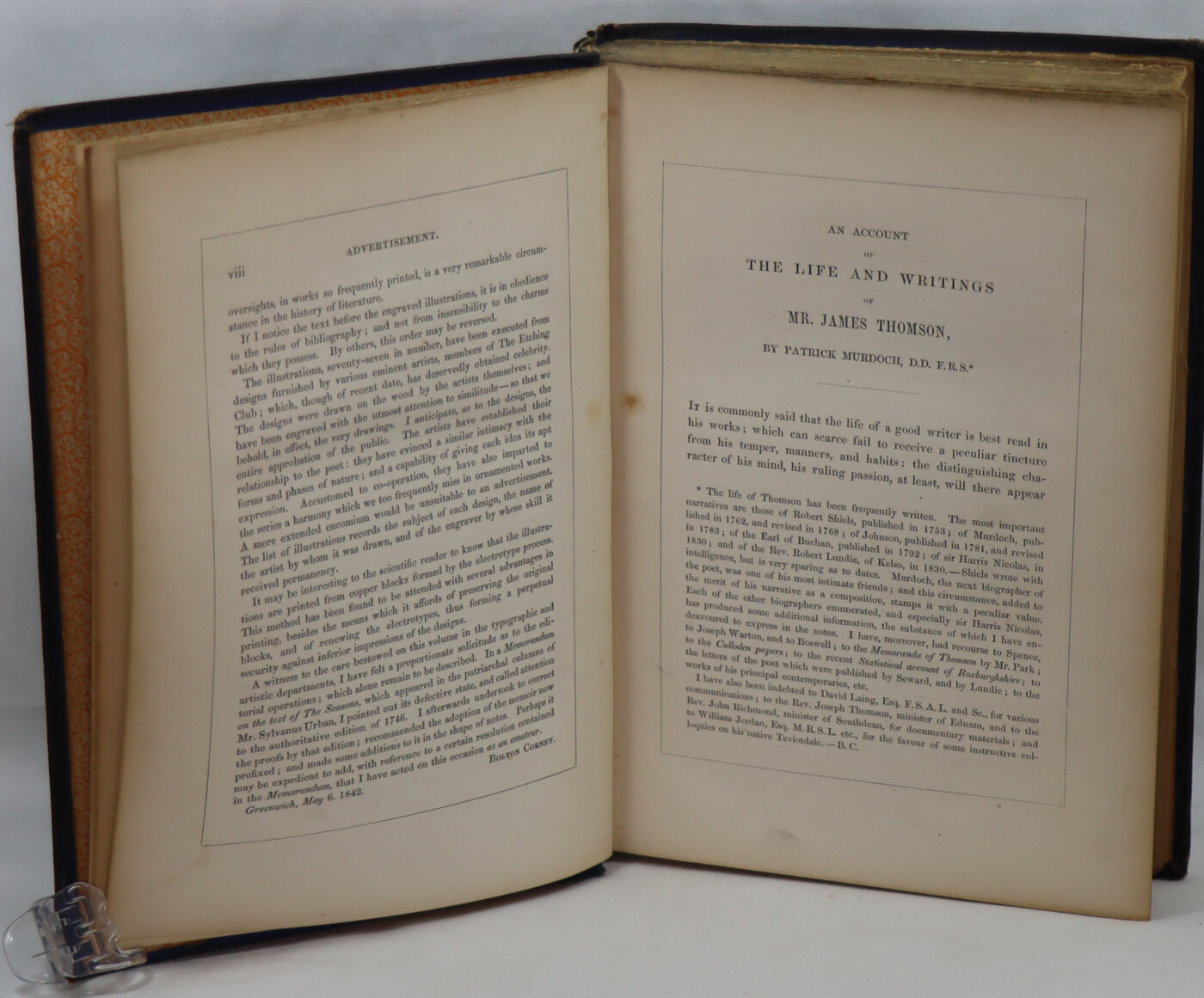
Thomson was educated first at the Parish school of Southdean then at Jedburgh Grammar School and Edinburgh University where he was a member of “The Grotesques” literary club; some of his early poems were published in the Edinburgh Miscellany of 1720. Seeking a larger stage, he went to London in 1725, and became the tutor of Thomas Hamilton (who became the 7th Earl of Haddington) in Barnet. There he was able to begin Winter, the first of his four Seasons.
Blank verse had been considered more of an interesting toy than anything useful to poetry, despite John Milton’s epic-scale Paradise Lost and Paradise Regained half a century earlier.
The poem was published one season at a time, Winter in 1726, Summer in 1727, Spring in 1728 and Autumn only in the complete edition of 1730. Thomson borrowed Milton’s Latin-influenced vocabulary and inverted word order, with phrases like “in convolution swift”. He extended Milton’s narrative use of blank verse to use it for description and to give a meditative feeling. The critic Raymond Dexter Havens called Thomson’s style pompous and contorted, remarking that Thomson seemed to have avoided “calling things by their right names and speaking simply, directly, and naturally”.
James Thomson (c. 11 September 1700 – 27 August 1748) was a Scottish poet and playwright, known for his poems The Seasons and The Castle of Indolence, and for the lyrics of “Rule, Britannia!”
A dispute over the publishing rights to one of his works, The Seasons, gave rise to two important legal decisions (Millar v. Taylor; Donaldson v. Beckett) in the history of copyright.
Want to know more about this item?
We are happy to answer any questions you may have about this item. In addition, it is also possible to request more photographs if there is something specific you want illustrated.
Ask a question
Related products

Share this Page with a friend
