
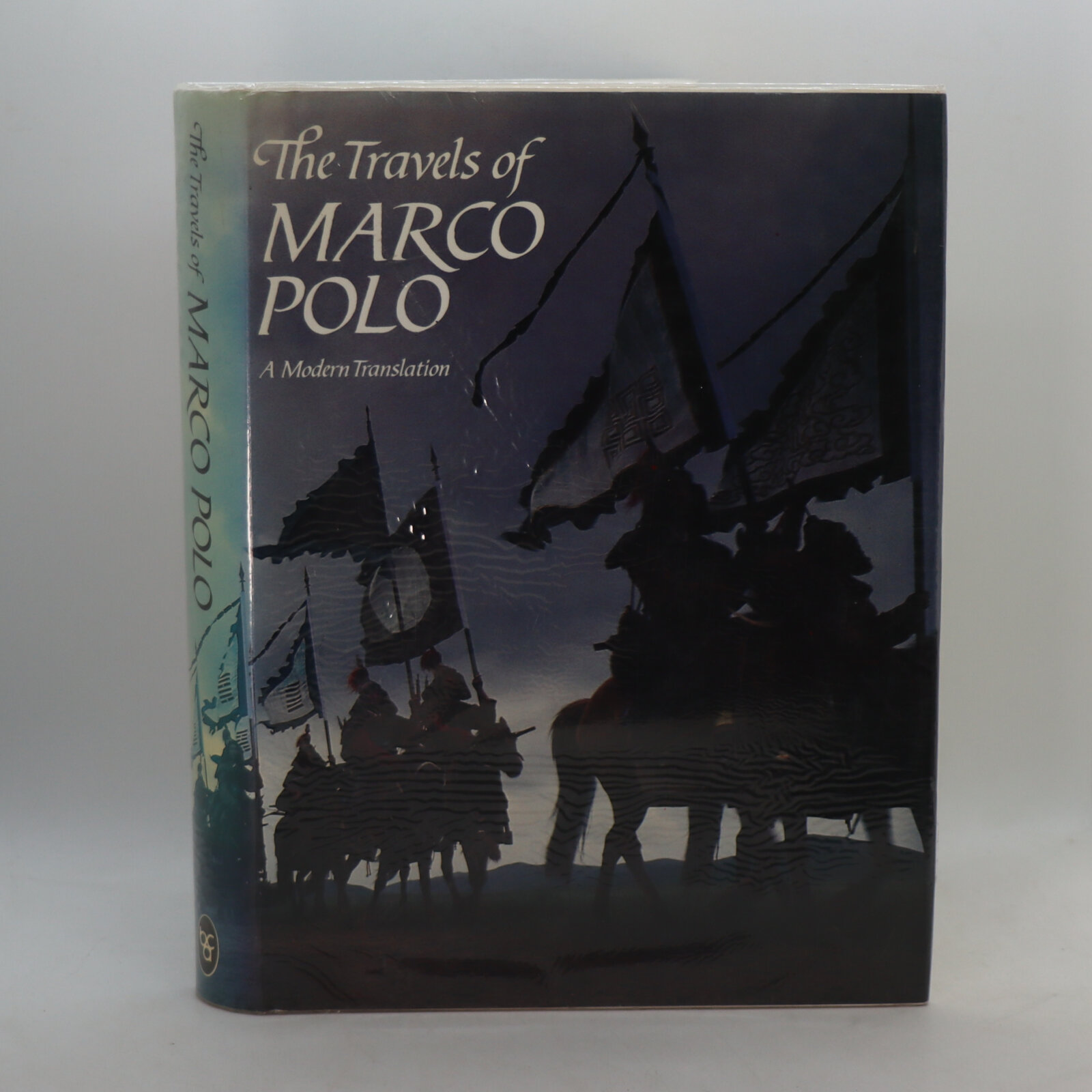
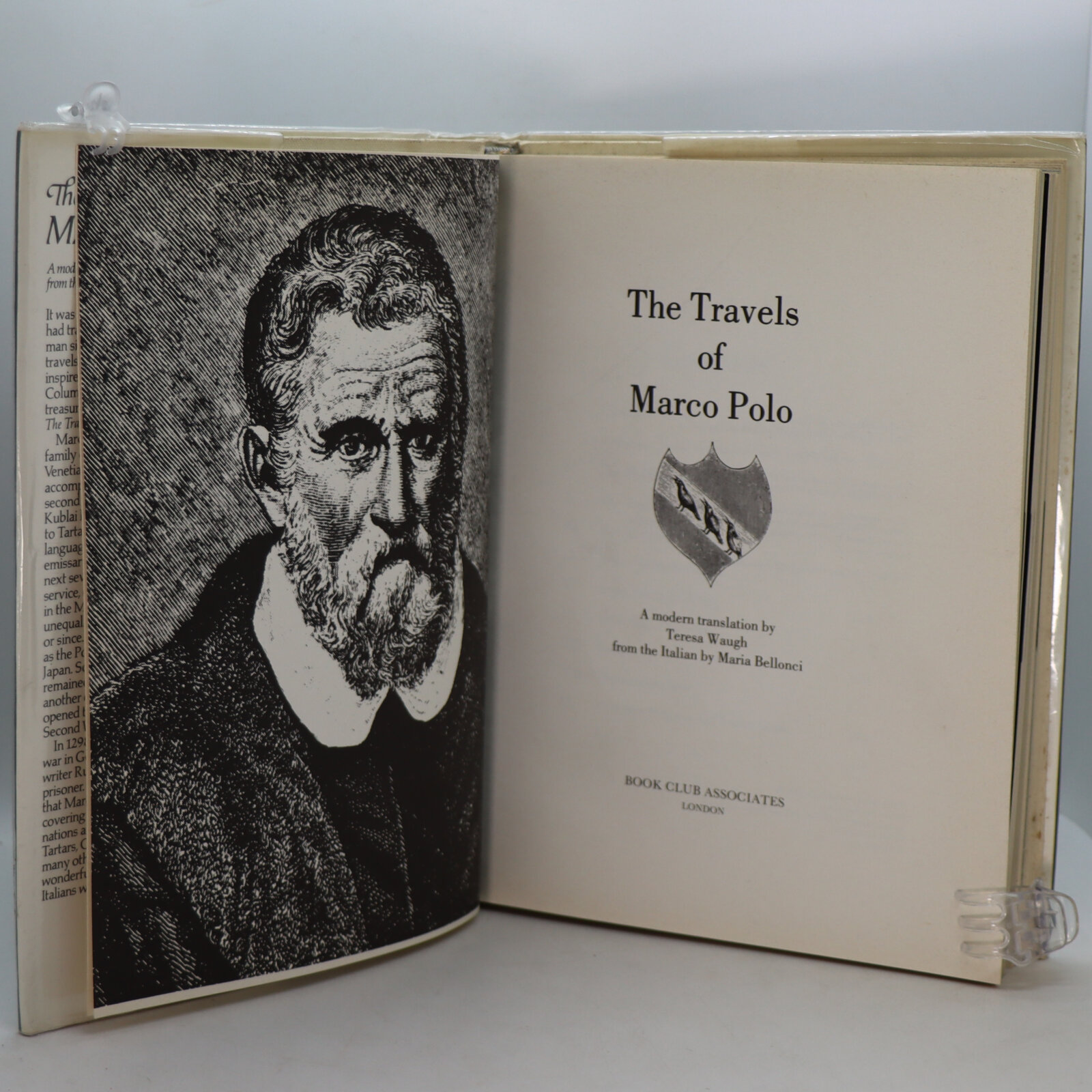
The Travels of Marco Polo.
ISBN: 9781101157657
Printed: 1984
Publisher: Book Club Associates.
| Dimensions | 20 × 26 × 3.5 cm |
|---|---|
| Language |
Language: English
Size (cminches): 20 x 26 x 3.5
Condition: Fine (See explanation of ratings)
£17.00
Buy Now
Your items

Item information
Description
In the original dustsheet. White cloth binding with gilt title on the spine.
F.B.A. provides an in-depth photographic presentation of this item to stimulate your feeling and touch. More traditional book descriptions are immediately available.
A great book for the collector
Marco Polo (1254-1329) has achieved an almost archetypal status as a traveller, and his Travels is one of the first great travel books of Western literature, outside the ancient world. The Travels recounts Polo’s journey to the eastern court of Kublai Khan, the chieftain of the Mongol empire which covered the Asian continent, but which was almost unknown to Polo’s contemporaries. Encompassing a twenty-four year period from 1721, Polo’s account details his travels in the service of the empire, from Beijing to northern India and ends with the remarkable story of Polo’s return voyage from the Chinese port of Amoy to the Persian Gulf. Alternately factual and fantastic, Polo’s prose at once reveals the medieval imagination’s limits, and captures the wonder of subsequent travel writers when faced with the unfamiliar, the exotic or the unknown.
Review: The Travels of Marco Polo may be perhaps the most challenging travelogue ever put together. While Marco Polo was not the first to write about lands distant and alien to one’s own, he wrote of a journey of immense challenge and difficulty. Difficulty that is difficult to appreciate in our modern world. First, the most notable controversy; was Marco Polo a fraud? This reader disagrees. While some regard it as suspect that he travelled to Yuan Dynasty China and did not mention the largely Han practice of foot binding, one needs to remember that he was employed in the court of Kublai Khan, a Mongol Emperor who headed a very multicultural court.
While this reader is not a first-class scholar of medieval China, the narrative through which Marco Polo describes the China of then corresponds somewhat to the cultural mosaic of today. While in the Southwest of China, he describes people of rather relaxed sexual practices, which have an eery similarity to the Naxi of Yunnan Province, he describes a religious mosaic that regularly alternates between either Christian, Muslim or, as he terms it, idolatry, he describes funerary practices, the choice of clothing, and dietary practices. Therefore, this reader rules favourably in the authenticity of Marco Polo’s account.
The book in itself is mainly a travelogue, and describes everywhere from Armenia and the Caspian Sea region, China, India, the Middle East, and in the final chapter, Russia. Toward the end, the book becomes something of a commentary of the then current affairs, describing a conflict in what was then an area close to Russia’s frontier, and earlier parts of the book describe the conflict and intrigue in the court of the Great Khan. However, the book, for the most part, is a travelogue.
The book is an immensely entertaining and readable account. With just simple relaxation and the right approach, one feels themselves there with Marco Polo, exploring unknown lands, and traveling a greater distance travelled by no man since the creation, in the words of the introduction. Marco Polo’s Travels, or to give it it’s actual title, Il Milione, is a timeless classic. A timeless work of inquiry and observation that is both intriguing and fascinating, and a pleasure for the soul.
Want to know more about this item?
We are happy to answer any questions you may have about this item. In addition, it is also possible to request more photographs if there is something specific you want illustrated.
Ask a question


Share this Page with a friend
