
The Time Machine.
By H G Wells
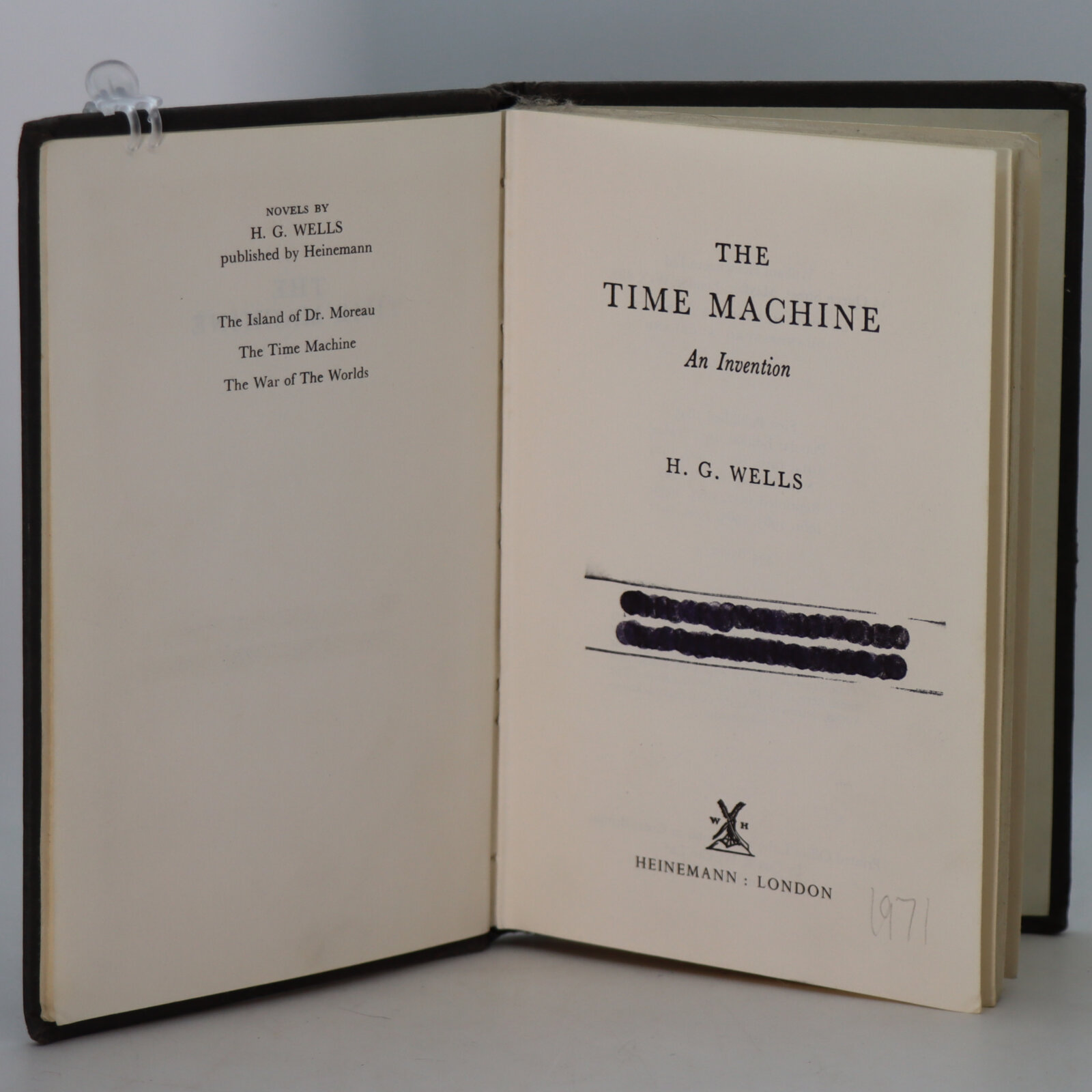
Printed: 1971
Publisher: William Heinemann Ltd, London
| Dimensions | 13 × 19 × 1.5 cm |
|---|---|
| Language |
Language: English
Size (cminches): 13 x 19 x 1.5
Condition: Fine (See explanation of ratings)
SORRY, THIS ITEM HAS SOLD

Item information
Description
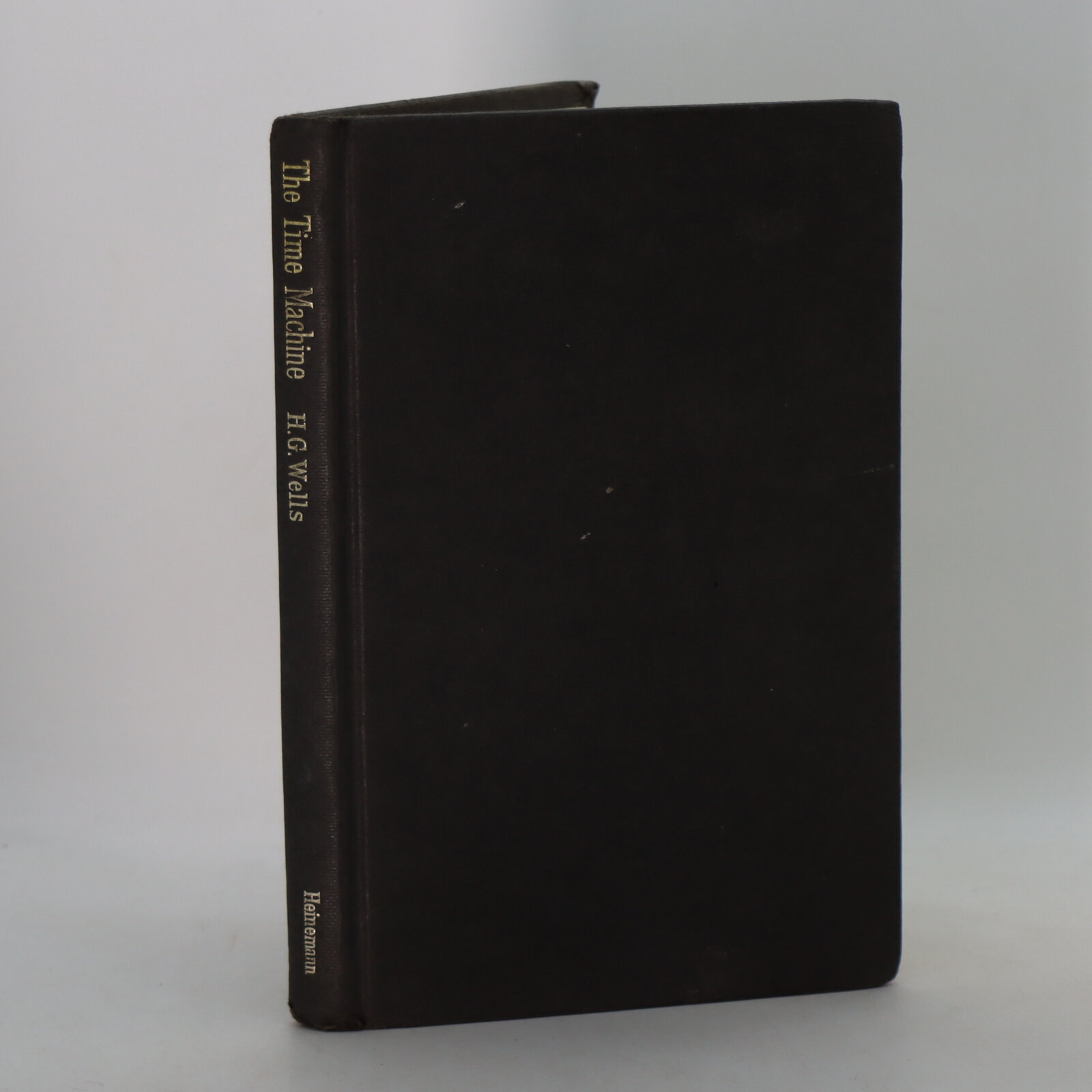
Black cloth binding with gilt title on the spine.
F.B.A. provides an in-depth photographic presentation of this item to stimulate your feeling and touch. More traditional book descriptions are immediately available.
A book, once kept by an H. G. Wells enthusiast
The Time Machine is a post-apocalyptic science fiction novella by H. G. Wells, published in 1895. The work is generally credited with the popularization of the concept of time travel by using a vehicle or device to travel purposely and selectively forward or backward through time. The term “time machine”, coined by Wells, is now almost universally used to refer to such a vehicle or device.
Utilizing a frame story set in then-present Victorian England, Wells’ text focuses on a recount of the otherwise anonymous Time Traveller’s journey into the far future. A work of future history and speculative evolution, Time Machine is interpreted in modern times as a commentary on the increasing inequality and class divisions of Wells’ era, which he projects as giving rise to two separate human species: the fair, childlike Eloi, and the savage, simian Morlocks, distant descendants of the contemporary upper and lower classes respectively. It is believed that Wells’ depiction of the Eloi as a race living in plenitude and abandon was inspired by the utopic romance novel News from Nowhere (1890), though Wells’ universe in the novel is notably more savage and brutal.
In his 1931 preface to the book, Wells wrote that The Time Machine seemed “a very undergraduate performance to its now mature writer, as he looks over it once more”, though he states that “the writer feels no remorse for this youthful effort”. However, critics have praised the novella’s handling of its thematic concerns, with Marina Warner writing that the book was the most significant contribution to understanding fragments of desire before Sigmund Freud‘s The Interpretation of Dreams, with the novel “[conveying] how close he felt to the melancholy seeker after a door that he once opened on to a luminous vision and could never find again”.
The Time Machine has been adapted into two feature films of the same name, as well as two television versions and many comic book adaptations. It has also indirectly inspired many more works of fiction in many media productions.
Herbert George Wells (21 September 1866 – 13 August 1946) was an English writer. Prolific in many genres, he wrote more than fifty novels and dozens of short stories. His non-fiction output included works of social commentary, politics, history, popular science, satire, biography and autobiography. Wells is now best remembered for his science fiction novels and has been called the “father of science fiction.”
In addition to his fame as a writer, he was prominent in his lifetime as a forward-looking, even prophetic social critic who devoted his literary talents to the development of a progressive vision on a global scale. A futurist, he wrote a number of utopian works and foresaw the advent of aircraft, tanks, space travel, nuclear weapons, satellite television and something resembling the World Wide Web. His science fiction imagined time travel, alien invasion, invisibility, and biological engineering before these subjects were common in the genre.
Wells rendered his works convincing by instilling commonplace detail alongside a single extraordinary assumption per work – dubbed “Wells’s law” – leading Joseph Conrad to hail him in 1898 with “O Realist of the Fantastic!”. His most notable science fiction works include The Time Machine (1895), which was his first novel, The Island of Doctor Moreau (1896), The Invisible Man (1897), The War of the Worlds (1898), the military science fiction The War in the Air (1907), and the dystopian When the Sleeper Wakes (1910). Novels of social realism such as Kipps (1905) and The History of Mr Polly (1910), which describe lower-middle-class English life, led to the suggestion that he was a worthy successor to Charles Dickens, but Wells described a range of social strata and even attempted, in Tono-Bungay (1909), a diagnosis of English society as a whole. Wells was nominated for the Nobel Prize in Literature four times.
Wells’s earliest specialised training was in biology, and his thinking on ethical matters took place in a Darwinian context. He was also an outspoken socialist from a young age, often (but not always, as at the beginning of the First World War) sympathising with pacifist views. In his later years, he wrote less fiction and more works expounding his political and social views, sometimes giving his profession as that of journalist. Wells was a diabetic and co-founded the charity The Diabetic Association (known today as Diabetes UK) in 1934.
Want to know more about this item?
We are happy to answer any questions you may have about this item. In addition, it is also possible to request more photographs if there is something specific you want illustrated.
Ask a question


Share this Page with a friend
