
The Shadow Line.
By Joseph Conrad
Printed: 2001
Publisher: The Folio Society. London
| Dimensions | 17 × 24 × 4 cm |
|---|---|
| Language |
Language: English
Size (cminches): 17 x 24 x 4
Condition: Fine (See explanation of ratings)
SORRY, THIS ITEM HAS SOLD
Your items


Item information
Description
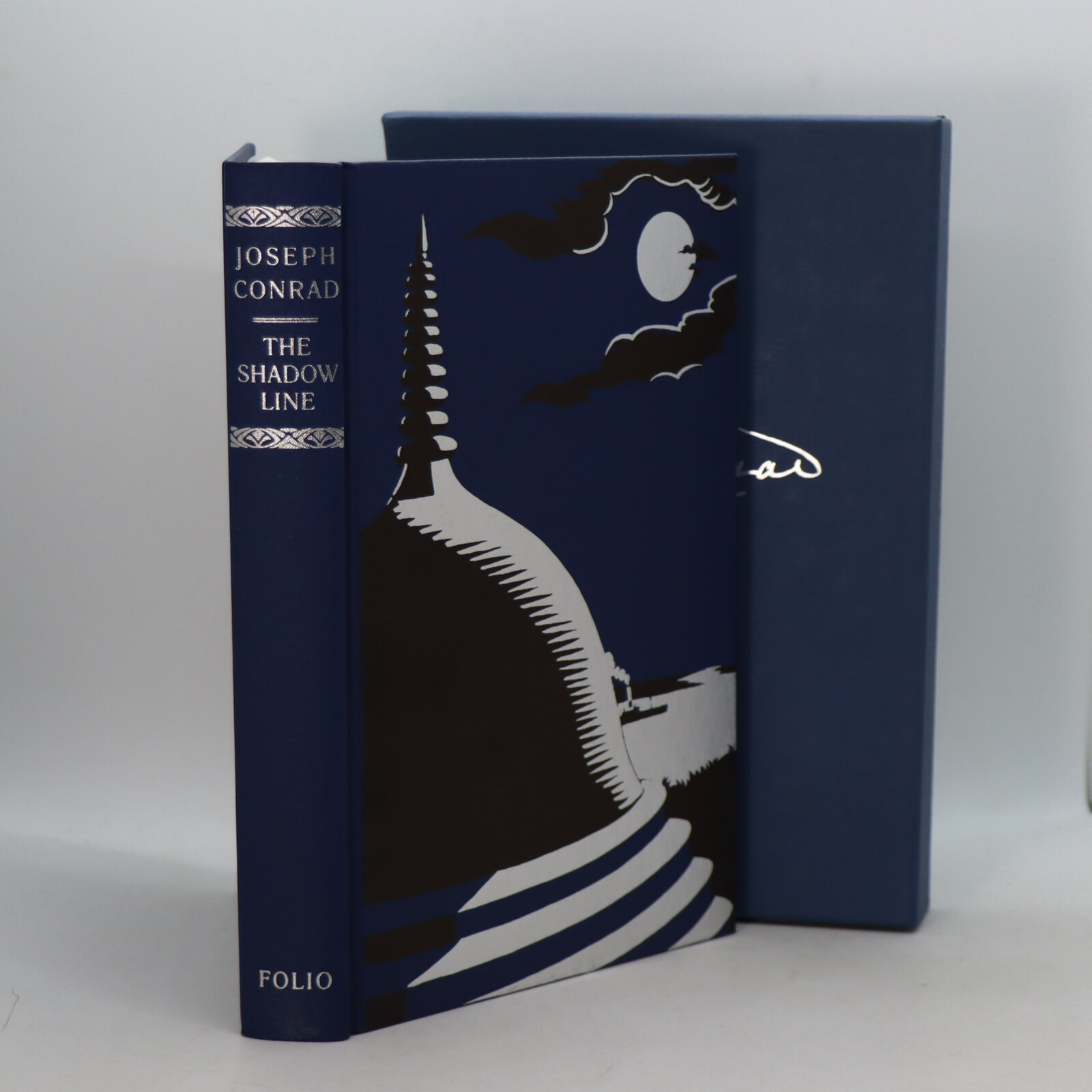
In a fitted box. Navy cloth binding with silver title on the spine. Black and silver design on the front board.
F.B.A. provides an in-depth photographic presentation of this item to stimulate your feeling and touch. More traditional book descriptions are immediately available.
The Shadow-Line is a short novel based at sea by Joseph Conrad; it is one of his later works, being written from February to December 1915. It was first published in 1916 as a serial in New York’s Metropolitan Magazine (September—October) in the English Review (September 1916-March 1917) and published in book form in 1917 in the UK (March) and America (April). The novella depicts the development of a young man upon taking a captaincy in the Orient, with the shadow line of the title representing the threshold of this development.
The novella is notable for its dual narrative structure. The full, subtitled title of the novel is The Shadow-Line, A Confession, which immediately alerts the reader to the retrospective nature of the novella. The ironic constructions following from the conflict between the ‘young’ protagonist (who is never named) and the ‘old’ drive much of the underlying points of the novella, namely the nature of wisdom, experience, and maturity. Conrad also extensively uses irony by comparison in the work, with characters such as Captain Giles and the ship’s ‘factotum’ Ransome used to emphasise strengths and weaknesses of the protagonist.
The novel has often been cited as a metaphor of the First World War, given its timing and references to a long struggle and the importance of camaraderie. This viewpoint may also be reinforced by the knowledge that Conrad’s elder son, Borys, was wounded in the First World War. Others however see the novel as having a strong supernatural influence, referring to various plot-lines in the novella such as the ‘ghost’ of the previous captain potentially cursing the ship, and the madness of first mate Mr Burns. Conrad himself, however, denied this link in his ‘Author’s Note’ (1920), claiming that although critics had attempted to show this link, “The world of the living contains enough marvels and mysteries as it is.”
Georges Franju made a 1973 television film La ligne d’ombre based on the novel. Andrzej Wajda made a 1976 film adaptation of the novel under its Polish title – Smuga cienia. In the 2004 novel (trs 2005) House of Paper by Carlos Maria Dominguez the plot is driven by the narrator’s quest for the person who sent a copy of The Shadow Line to a recently deceased colleague.
Joseph Conrad (born Józef Teodor Konrad Korzeniowski, Polish; 3 December 1857 – 3 August 1924) was a Polish-British novelist and short story writer. He is regarded as one of the greatest writers in the English language; though he did not speak English fluently until his twenties, he came to be regarded a master prose stylist who brought a non-English sensibility into. He wrote novels and stories, many in nautical settings, that depict crises of human individuality in the midst of what he saw as an indifferent, inscrutable and amoral world.
Conrad is considered a literary impressionist by some and an early modernist by others, though his works also contain elements of 19th-century realism. His narrative style and anti-heroic characters, as in Lord Jim, for example, have influenced numerous authors. Many dramatic films have been adapted from and inspired by his works. Numerous writers and critics have commented that his fictional works, written largely in the first two decades of the 20th century, seem to have anticipated later world events.
Writing near the peak of the British Empire, Conrad drew on the national experiences of his native Poland—during nearly all his life, parcelled out among three occupying empires and on his own experiences in the French and British merchant navies, to create short stories and novels that reflect aspects of a European-dominated world—including imperialism and colonialism—and that profoundly explore the human psyche. Postcolonial analysis of Conrad’s work has stimulated substantial debate; in 1975, author Chinua Achebe published an article denouncing Heart of Darkness as racist and dehumanising, whereas other scholars, including Adam Hochschild and Peter Edgerly Firchow, have rebutted Achebe’s view.
Want to know more about this item?
We are happy to answer any questions you may have about this item. In addition, it is also possible to request more photographs if there is something specific you want illustrated.
Ask a question



Share this Page with a friend
