
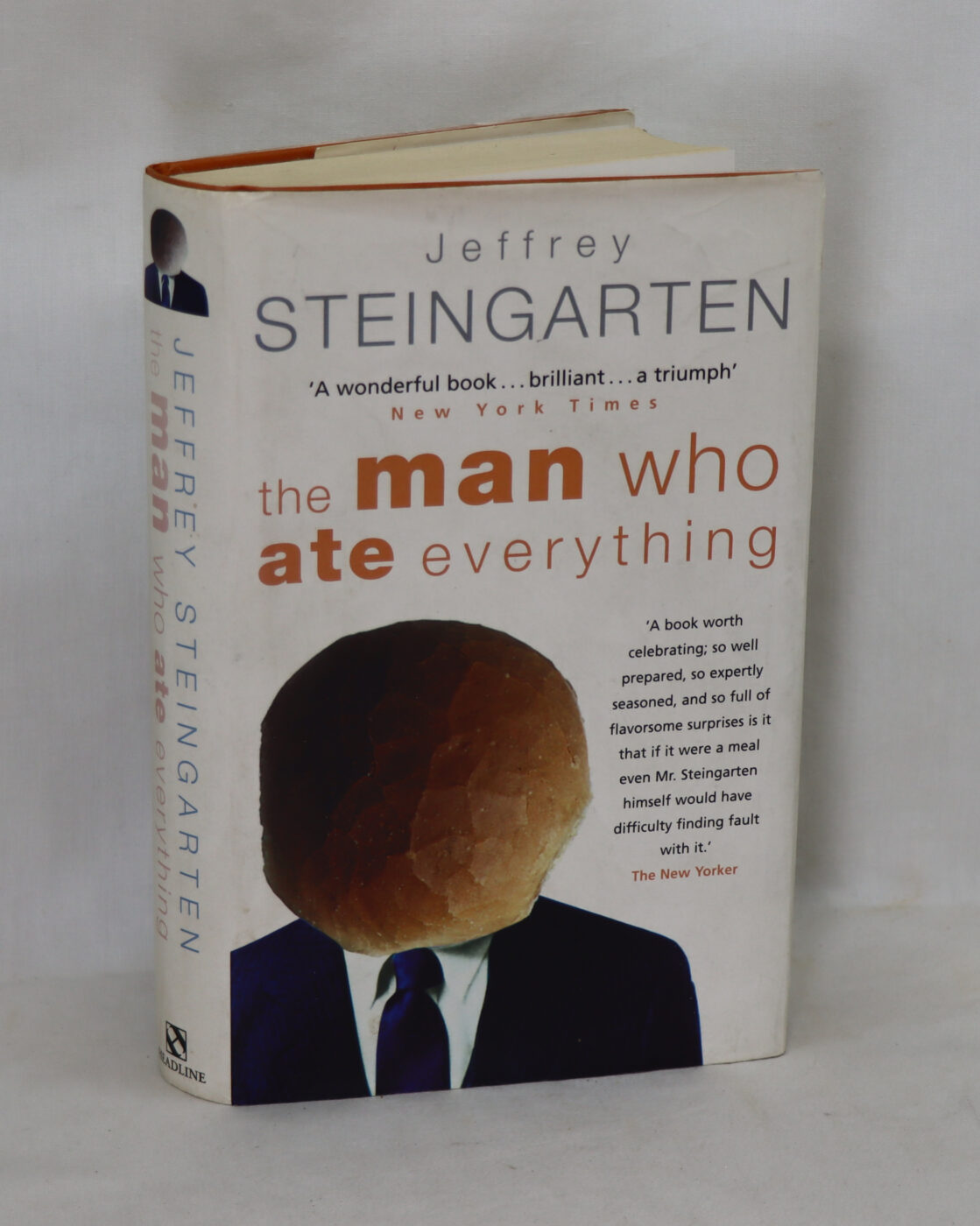
The Man Who Ate Everything.
By Jeffrey Steingarten
ISBN: 9780307797827
Printed: 1977
Publisher: Headline. London
| Dimensions | 15 × 22 × 4 cm |
|---|---|
| Language |
Language: English
Size (cminches): 15 x 22 x 4
Condition: Good (See explanation of ratings)
£10.00
Buy Now
Item information
Description
In the original dust cover. Tan cloth binding with silver title on the spine.
We provide an in-depth photographic presentation of this item to stimulate your feeling and touch. More traditional book descriptions are immediately available
- A £3 reduction when collected from FBA shop
- ‘Absolutely not to be missed’ Spectator
- ‘Like all great food writing, The Man Who Ate Everything celebrates much more than the journey from plate to palate . . . An excellent investment.’ Time Out
- I have yet to meet anyone who hasn’t adored this book’ Nigella Lawson
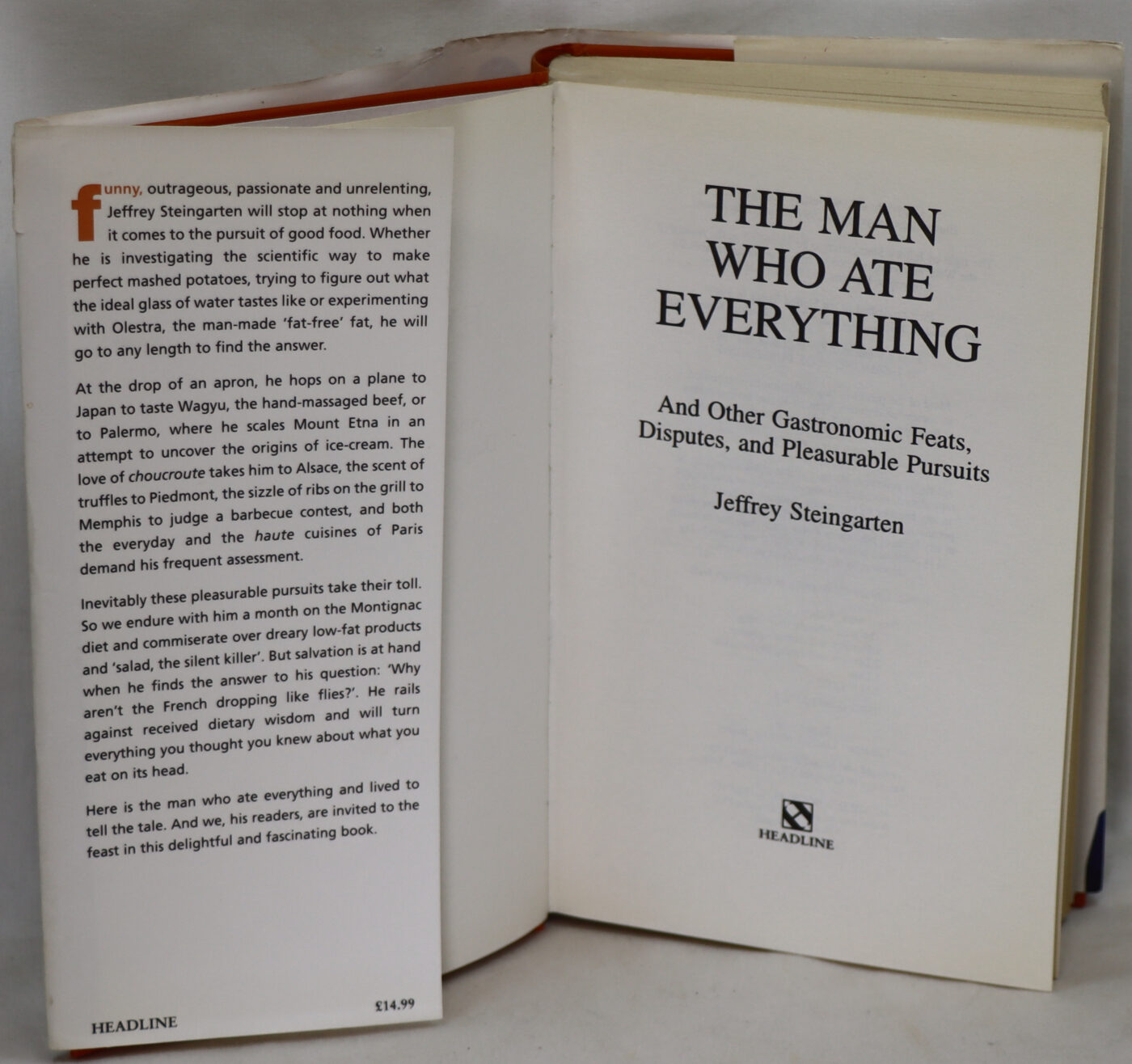
Jeffrey Steingarten’s award-winning collection of essays on food.
Jeffrey Steingarten is to food writing what Bill Bryson is to travel writing. Whether he is hymning the joys of the perfect chip, discussing the taste of beef produced from Japanese cows which are massaged daily and fed on sake, or telling us the scientific reasons why salad is a ‘silent killer’, his humour and his love of good food never fail. The questions he asks will challenge everything you assume you know about what you eat, yet his characteristic wit imparts masses of revelatory information in the most palatable of ways. As well as his outrageously honest and hilarious writing, you’ll find recipes including Perfumed Rice with Lamb and Lentils, Salt-and Pepper Shrimp and Lemon Granita. A must for everyone who’s ever enjoyed a meal – this book contains everything you ever wanted to know about food, but were too hungry to ask . .
Review: Jeffrey Steingarten was a lawyer until 1989, when an invitation to write for American Vogue effected his metamorphosis into a food writer–unquestionably a higher form of life. As the self-styled Man Who Ate Everything, he could allow himself no favourite foods nor irrational dislikes; consequently, the first piece in the book describes his heroic efforts to purge himself of all food phobias in preparation for his new post. The Six-Step Programme he devised was largely successful: as a result, kimchi (Korean pickled cabbage), anchovies, Greek food and clams (“I feel a mild horror about what goes on in the moist darkness between the shells of all bivalves…is the horror deeper than I know?) all assumed a place in his diet. He became the “perfect omnivore”. Now he seems to travel the world, eating. The Man Who Ate Everything deals to a certain extent with food and cooking, but its real subject (aside from Steingarten himself) is our attitude towards what we eat–what our food choices reveal about us. So he discusses the complex issues surrounding choosing the best brand of bottled water; the pros and cons of cooking “French” fries in horse fat; the deadly toxins that infest a virginal salad. He travels to Alsace in pursuit of le Veritable Choucroute Garni, to Piedmont to join white-truffle hunters, to Kyoto to worship at the shrine of kaiseki ryori, formal Japanese haute cuisine. By turns witty, learned, satirical and riotously farcical, The Man Who Ate Everything is never less than passionate about his subject. —Robin Davidson
NOTE: This is an original book from the library gathered by the famous Cambridge Don, computer scientist, food and wine connoisseur, Jack Arnold LANG. Note: Jack founded the Michelin Guide ‘Midsummer House’- Cambridge’s paramount restaurant. This dining experience is hidden amongst the grassy pastures and grazing cattle of Midsummer Common and perched on the banks of the River Cam. The Midsummer House experience is imaginatively curated to delight and amaze, so the surprise set menu changes regularly and is ‘Midsummer’s’ playground to showcase.
In 2008, Jack was one of the co-founders of the Raspberry Pi Foundation, alongside other members of the Department, and acted as the Foundation’s Chair. The project’s original goals were modest: to build and distribute low-cost computers for prospective applicants to our Computer Science degree. Initially the project was a “success disaster”, as Jack would say, as demand far outstripped the low-scale manufacturing plans. Ultimately the Raspberry Pi became the UK’s most successful computer with more than 60 million sold to date. Jack was drawn to the educational possibilities of the Raspberry Pi, its potential uses in emerging economies and the way it could support self-directed learning.
Want to know more about this item?
We are happy to answer any questions you may have about this item. In addition, it is also possible to request more photographs if there is something specific you want illustrated.
Ask a question
Related products
Share this Page with a friend
