
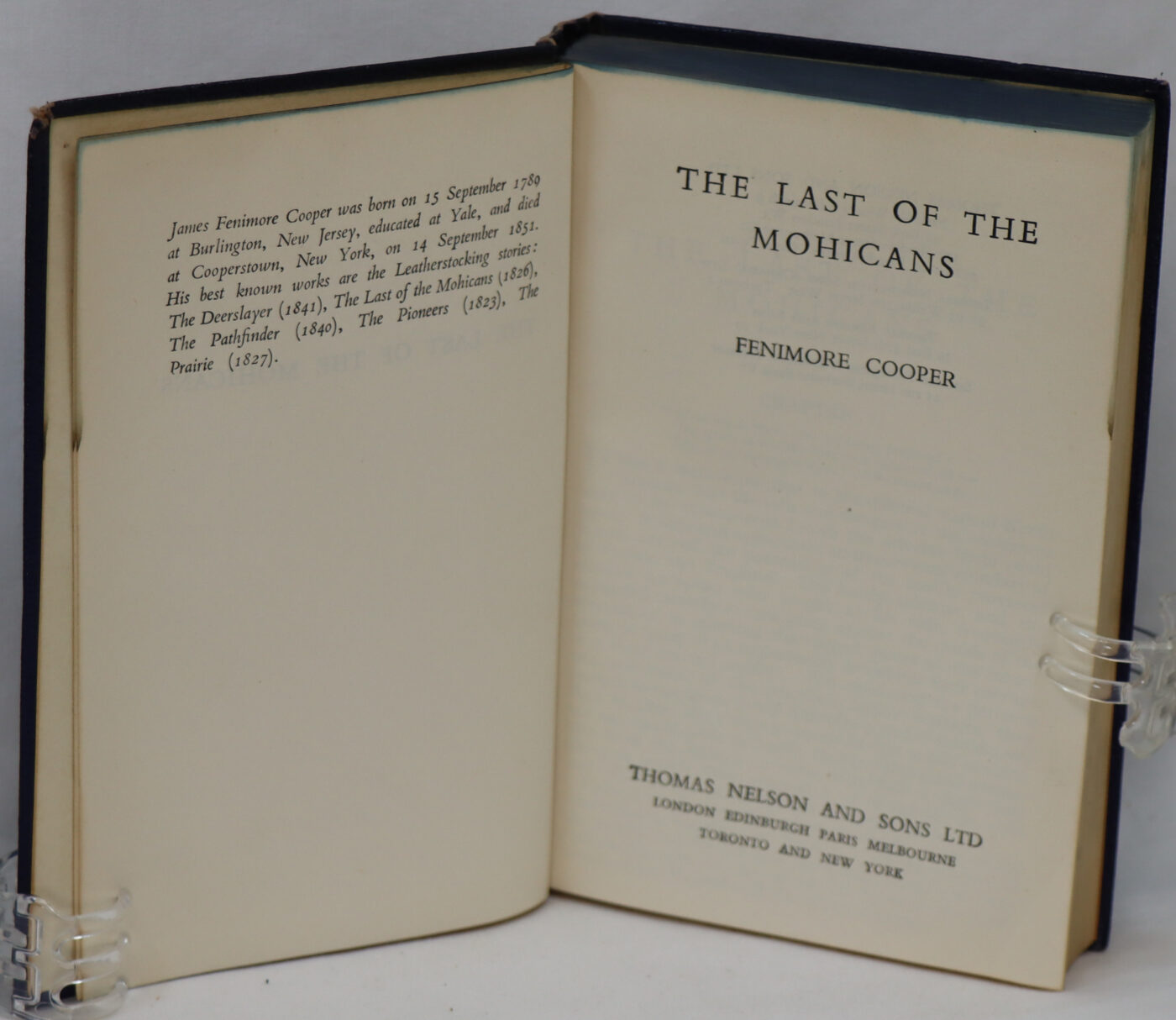
The Last of the Mohicans.
By Fenimore Cooper
Printed: Circa 1940
Publisher: Thomas Nelson & Sons. London
| Dimensions | 13 × 16 × 3 cm |
|---|---|
| Language |
Language: English
Size (cminches): 13 x 16 x 3
Condition: Good (See explanation of ratings)
£18.00
Buy Now

Item information
Description
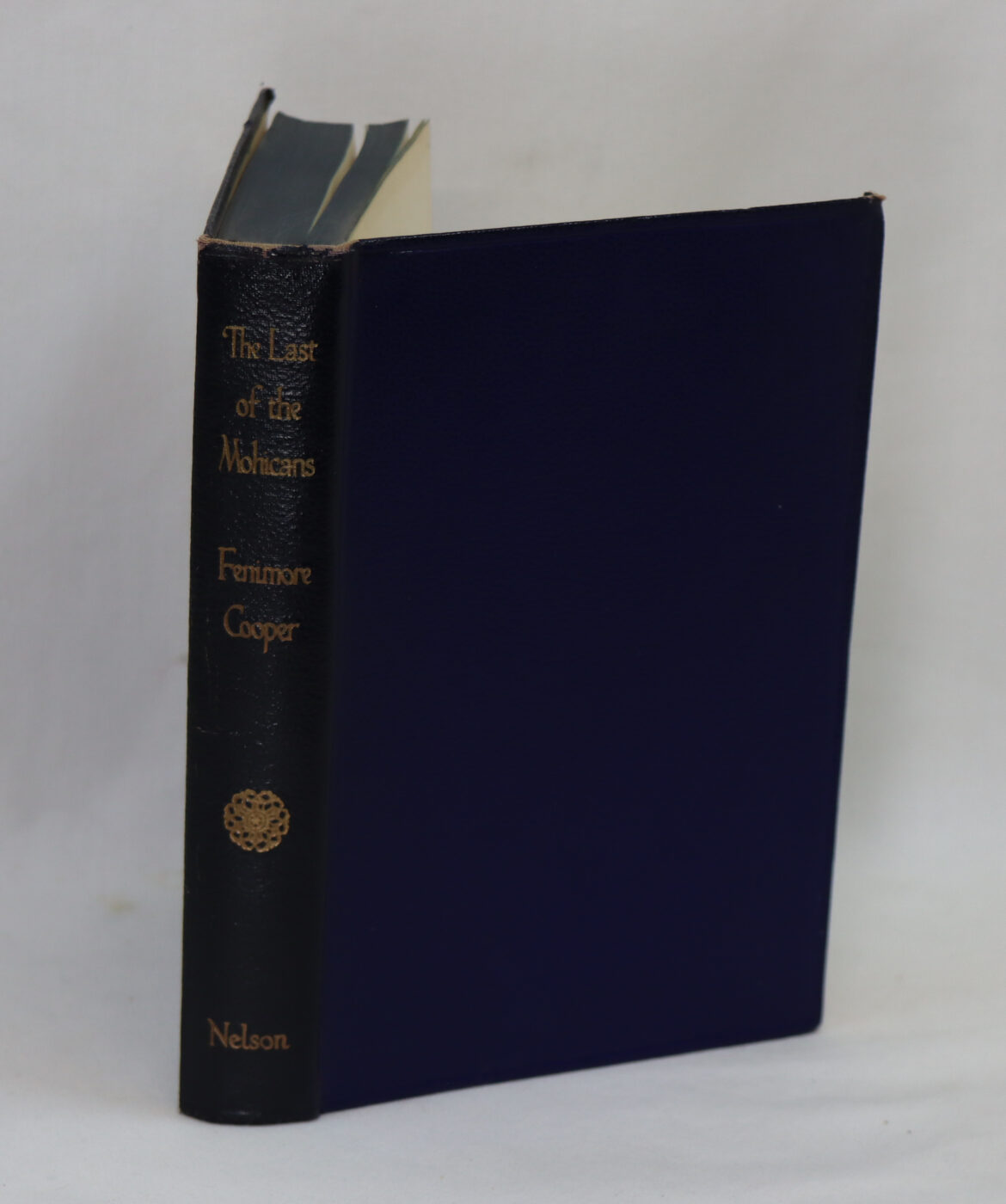
Softback. Navy leatherette cloth binding with gilt title on the spine.
We provide an in-depth photographic presentation of this item to stimulate your feeling and touch. More traditional book descriptions are immediately available.
- Note: This book carries a £5.00 discount to those that subscribe to the F.B.A. mailing list
It is a pleasure to touch and feel this lovely book. A book which has been treasured throughout its life.
The Last of the Mohicans: A Narrative of 1757 is an 1826 historical romance novel by James Fenimore Cooper. It is the second book of the Leatherstocking Tales pentalogy and the best known to contemporary audiences.The Pathfinder, published 14 years later in 1840, is its sequel; its prequel, The Deerslayer, was published a year after The Pathfinder. The Last of the Mohicans is set in 1757, during the French and Indian War (the North American theater of the Seven Years’ War), when France and Great Britain battled for control of North America. During this war, both the French and the British used Native American allies, but the French were particularly dependent on Indigenous forces since they were outnumbered in the Northeast frontier areas by the British. Specifically, the events of the novel are set immediately before, during, and after the Siege of Fort William Henry.
The novel is set primarily in the area of Lake George, New York, detailing the transport of Colonel Munro’s two daughters, Alice and Cora, to a safe destination at Fort William Henry. Among the caravan guarding the women are the frontiersman Natty Bumppo, Major Duncan Heyward, singing teacher David Gamut, and the Indians Chingachgook and Uncas, the latter two being the novel’s title characters. These characters are sometimes seen as a microcosm of the budding American society, particularly with regard to their racial composition.
The novel has been one of the most popular English-language novels since its publication; it is frequently assigned reading in American literature courses. It has been adapted numerous times and in many languages for the stage, films, and cartoons.
This is part of the esteemed Nelson Classics series published by Thomas Nelson & Sons, which was widely distributed in the UK during the 1930s and 1940s.
James Fenimore Cooper (September 15, 1789 – September 14, 1851) was an American writer of the first half of the 19th century, whose historical romances depicting colonial and indigenous characters from the 17th to the 19th centuries brought him fame and fortune. He lived much of his boyhood and his last 15 years in Cooperstown, New York, which was founded by his father William Cooper on property that he owned. Cooper became a member of the Episcopal Church shortly before his death, and contributed generously to it. He attended Yale University for three years, where he was a member of the Linonian Society.
After a stint on a commercial voyage, Cooper served in the U.S. Navy as a midshipman, where he learned the technology of managing sailing vessels, which greatly influenced many of his novels and other writings. The novel that launched his career was The Spy, a tale about espionage set during the American Revolutionary War and published in 1821. He also created American sea stories. His best-known works are five historical novels of the frontier period, written between 1823 and 1841, known as the Leatherstocking Tales, which introduced the iconic American frontier scout, Natty Bumppo. Cooper’s works on the U.S. Navy have been well received among naval historians, but they were sometimes criticized by his contemporaries. Among his more famous works is the Romantic novel The Last of the Mohicans, often regarded as his masterpiece. Throughout his career, he published numerous social, political, and historical works of fiction and nonfiction, with the objective of countering European prejudices and nurturing an original American art and culture.
Want to know more about this item?
We are happy to answer any questions you may have about this item. In addition, it is also possible to request more photographs if there is something specific you want illustrated.
Ask a question
Related products


Share this Page with a friend
