
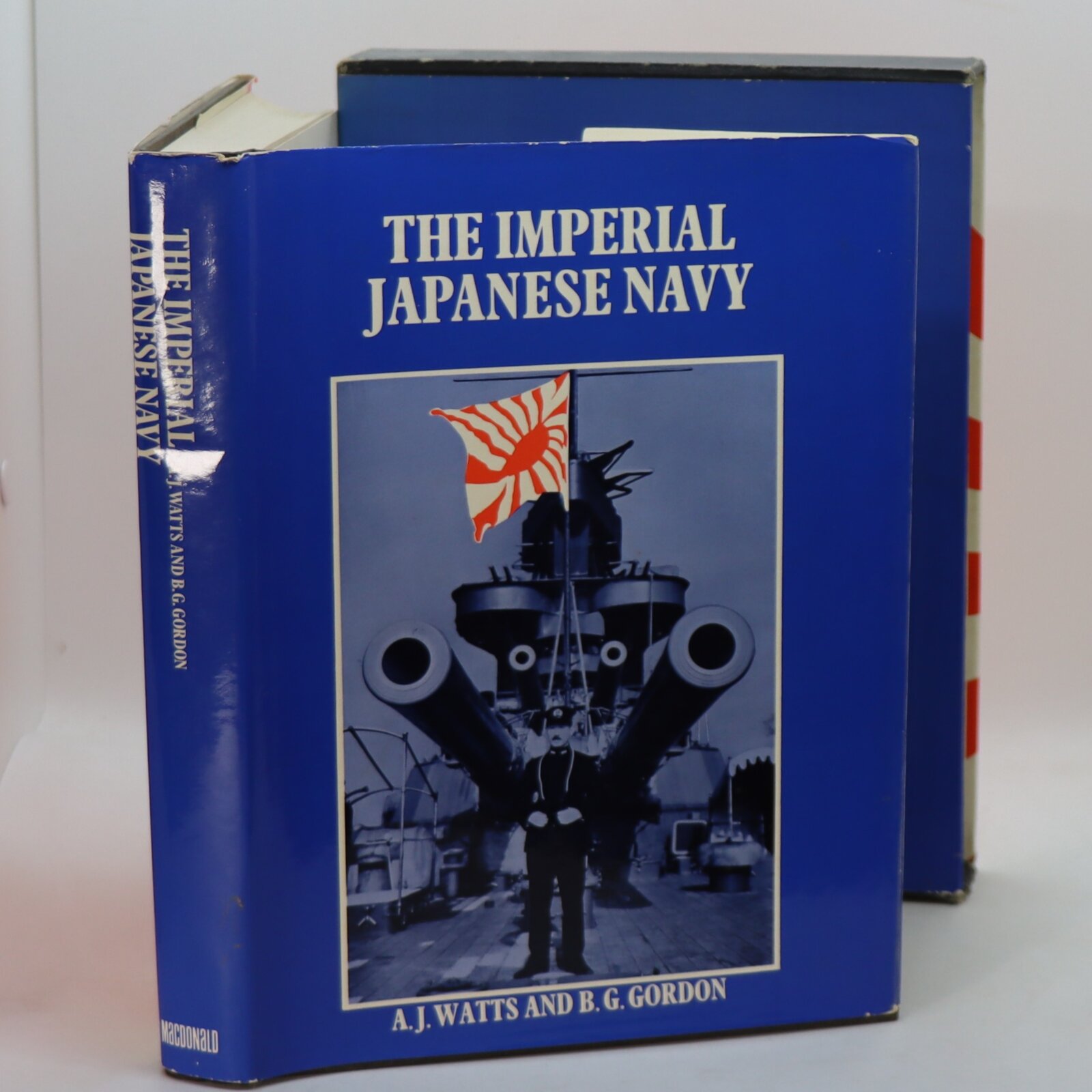
The Imperial Japanese Navy.
By A J Watts & B G Gordon
Printed: 1971
Publisher: MacDonald. London
Edition: First edition
| Dimensions | 20 × 27 × 3.5 cm |
|---|---|
| Language |
Language: English
Size (cminches): 20 x 27 x 3.5
Condition: Fine (See explanation of ratings)
£25.00
Buy Now

Item information
Description
In the original dust sheet and matching fitted box. Black textured binding with silver title on the spine.
F.B.A. provides an in-depth photographic presentation of this item to stimulate your feel and touch. More traditional book descriptions are immediately available.
A well-researched book worthy of the book’s weight
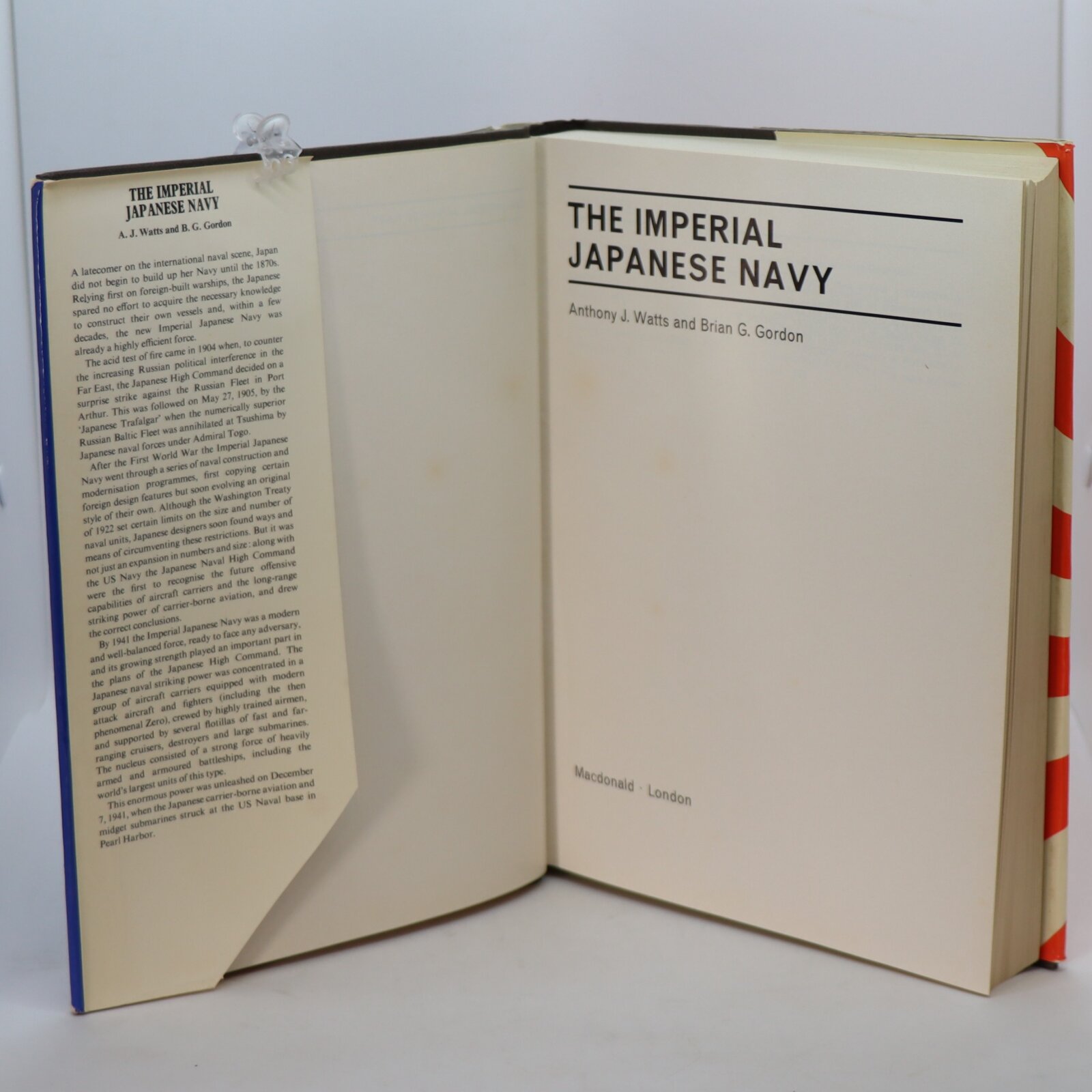
The Imperial Japanese Navy ( ‘Navy of the Greater Japanese Empire’, or ‘Japanese Navy’) was the navy of the Empire of Japan from 1868 to 1945, when it was dissolved following Japan’s surrender in World War II. The Japan Maritime Self-Defense Force (JMSDF) was formed between 1952–1954 after the dissolution of the IJN.
The Imperial Japanese Navy was the third largest navy in the world by 1920, behind the Royal Navy and the United States Navy (USN). It was supported by the Imperial Japanese Navy Air Service for aircraft and airstrike operation from the fleet. It was the primary opponent of the Western Allies in the Pacific War.
The origins of the Imperial Japanese Navy go back to early interactions with nations on the Asian continent, beginning in the early medieval period and reaching a peak of activity during the 16th and 17th centuries at a time of cultural exchange with European powers during the Age of Discovery. After two centuries of stagnation during the country’s ensuing seclusion policy under the shōgun of the Edo period, Japan’s navy was comparatively backward when the country was forced open to trade by American intervention in 1854. This eventually led to the Meiji Restoration. Accompanying the re-ascendance of the Emperor came a period of frantic modernization and industrialization. The navy had several successes, sometimes against much more powerful enemies such as in the Sino-Japanese War and the Russo-Japanese War, before being largely destroyed in World War II.
Want to know more about this item?
We are happy to answer any questions you may have about this item. In addition, it is also possible to request more photographs if there is something specific you want illustrated.
Ask a question
Related products



Share this Page with a friend
