
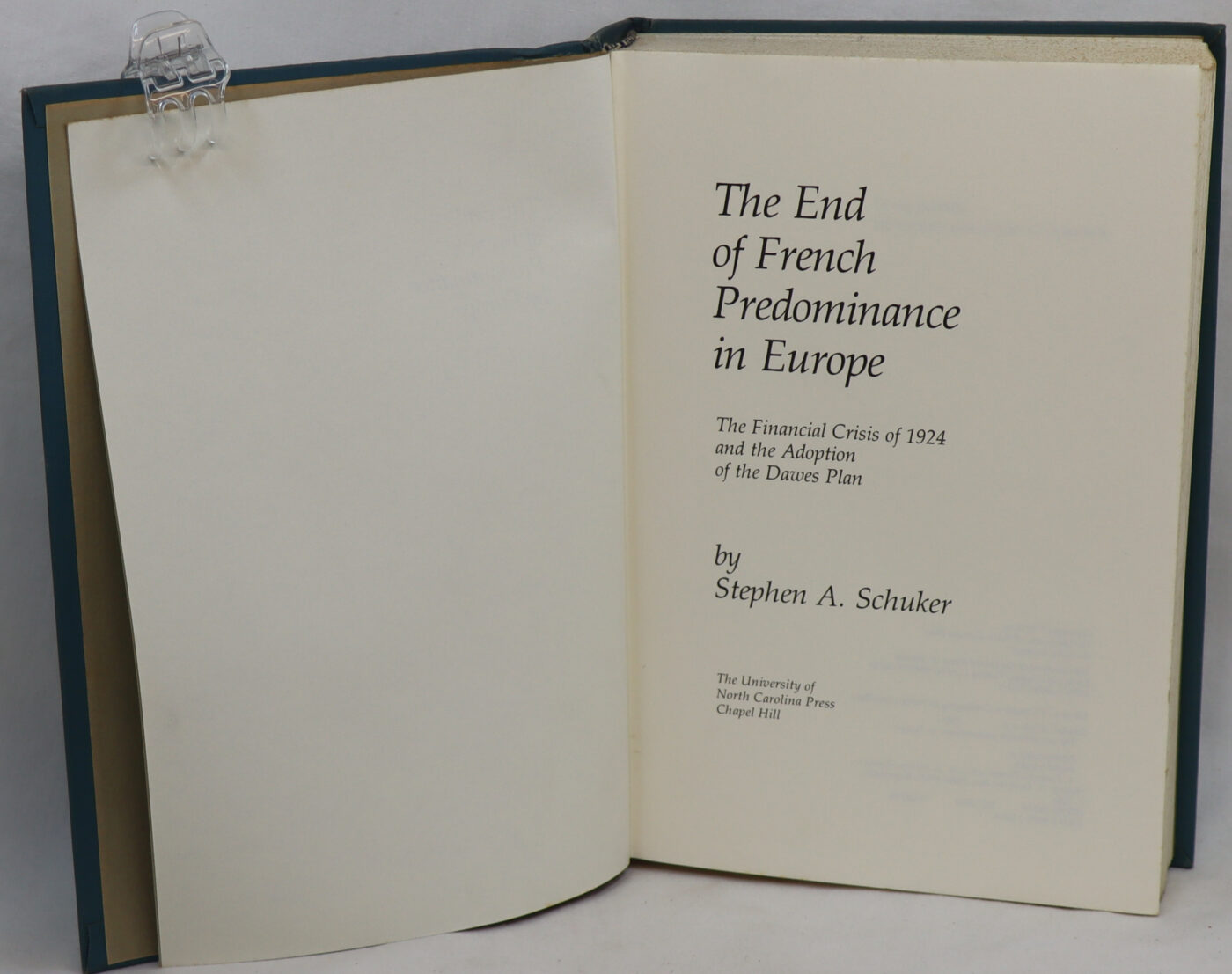
The End of French Predominance in Europe.
By Stephen A Schuker
ISBN: 0807812536
Printed: 1976
Publisher: University of North Carolina Press. Chapel Hill
Edition: 1st edition
| Dimensions | 12 × 24 × 4 cm |
|---|---|
| Language |
Language: English
Size (cminches): 12 x 24 x 4
Condition: Very good (See explanation of ratings)
£27.00
Buy Now

Item information
Description
Blue cloth binding with gilt title on the spine. The financial crisis of 1924 and the adoption of the Dawes Plan.
We provide an in-depth photographic presentation of this item to stimulate your feeling and touch. More traditional book descriptions are immediately available.
- Note: This book carries a £5.00 discount to those that subscribe to the F.B.A. mailing list
Please view our photographs. The end of French predominance in Europe : the financial crisis of 1924 and the adoption of the Dawes plan A very balanced book which provides a solid explanation of inter-war years. While the plan temporarily stabilized Europe, this value structure built a fragile financial house of cards. When the US stock market crashed in 1929, American loans abruptly dried up, causing the German economy to collapse and triggering a global depression.
The Dawes Plan was a 1924 agreement that restructured Germany’s World War I reparation payments to ease its economic crisis and end the French and Belgian occupation of the Ruhr.
Key Features
- Reduced Payments: Annual payment amounts were lowered and scaled based on Germany’s economic health, starting at 1 billion gold marks and rising to 2.5 billion marks by 1928.
- Foreign Loans: The United States provided an initial loan of 800 million gold marks to help stabilize the German currency (the Reichsmark) and revive industry.
- End of Occupation: Allied forces agreed to withdraw from the industrial Ruhr valley.
- Financial Reorganization: The German central bank (Reichsbank) was reorganized under Allied supervision.
Impact and Aftermath
- Sparked a brief period of economic stabilization and cultural revival in Germany known as the “Golden Twenties”.
- Made the German economy heavily dependent on foreign loans and capital.
- Was ultimately replaced in 1929 by the Young Plan, which further reduced and fixed the final debt total
Want to know more about this item?
We are happy to answer any questions you may have about this item. In addition, it is also possible to request more photographs if there is something specific you want illustrated.
Ask a question
Related products







Share this Page with a friend
