
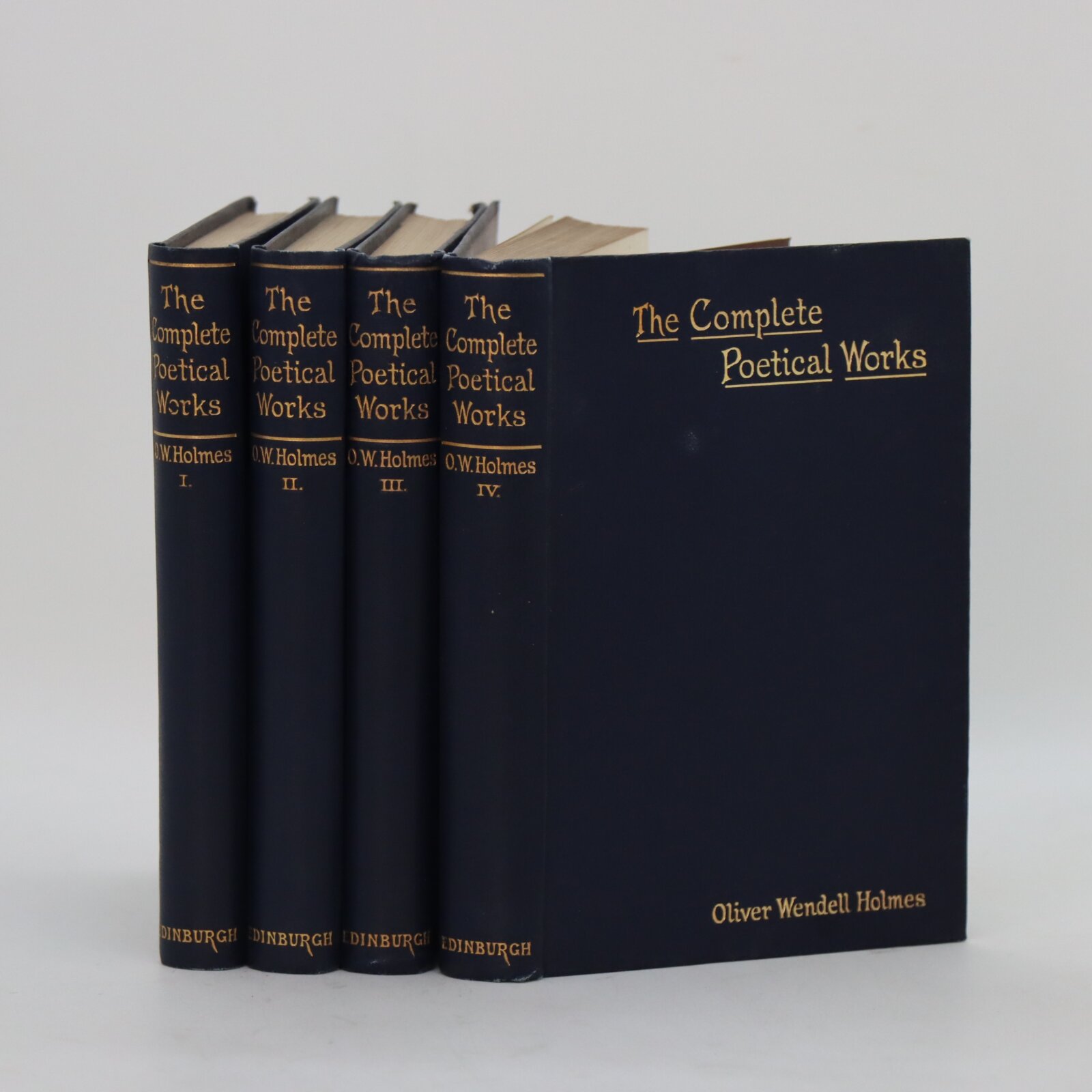
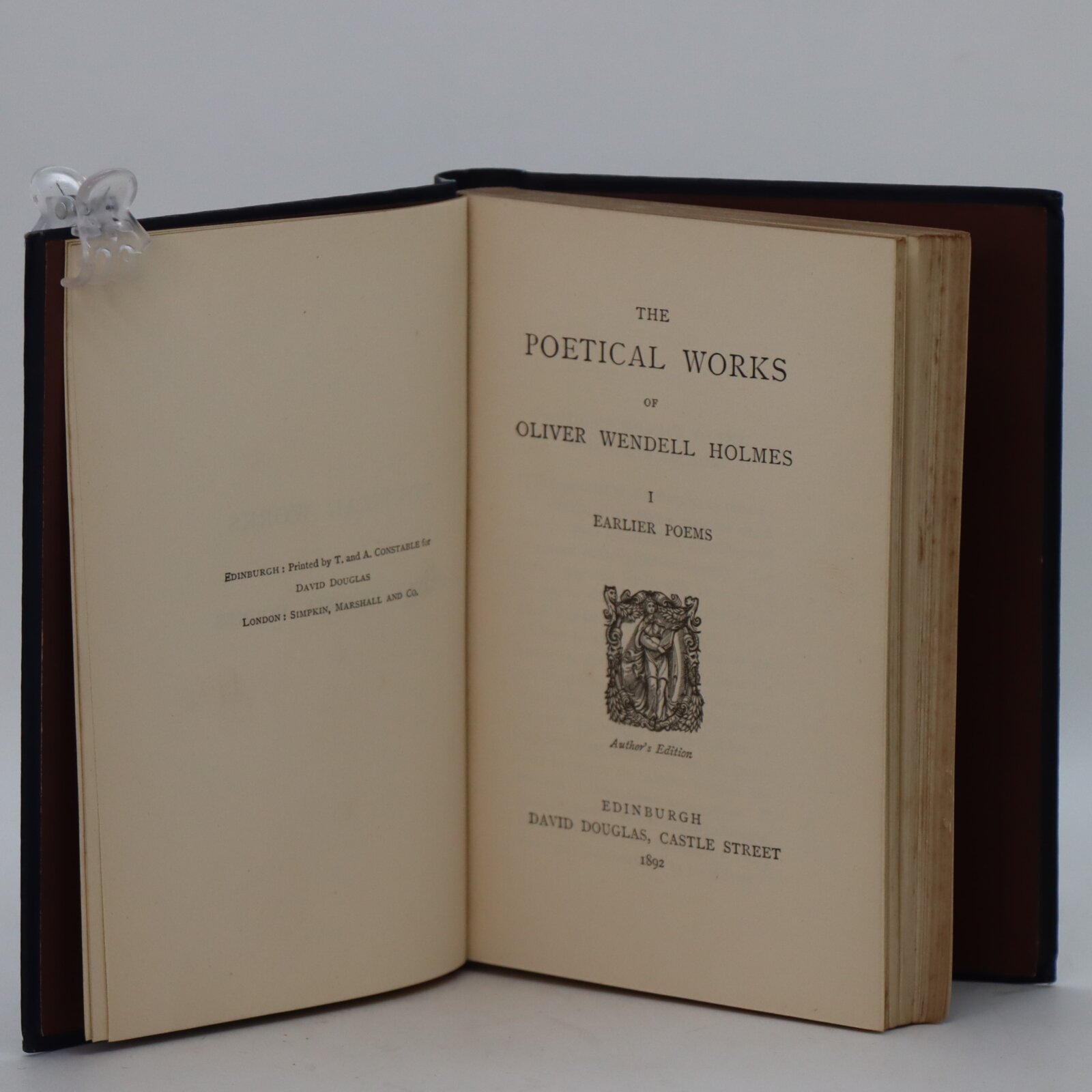
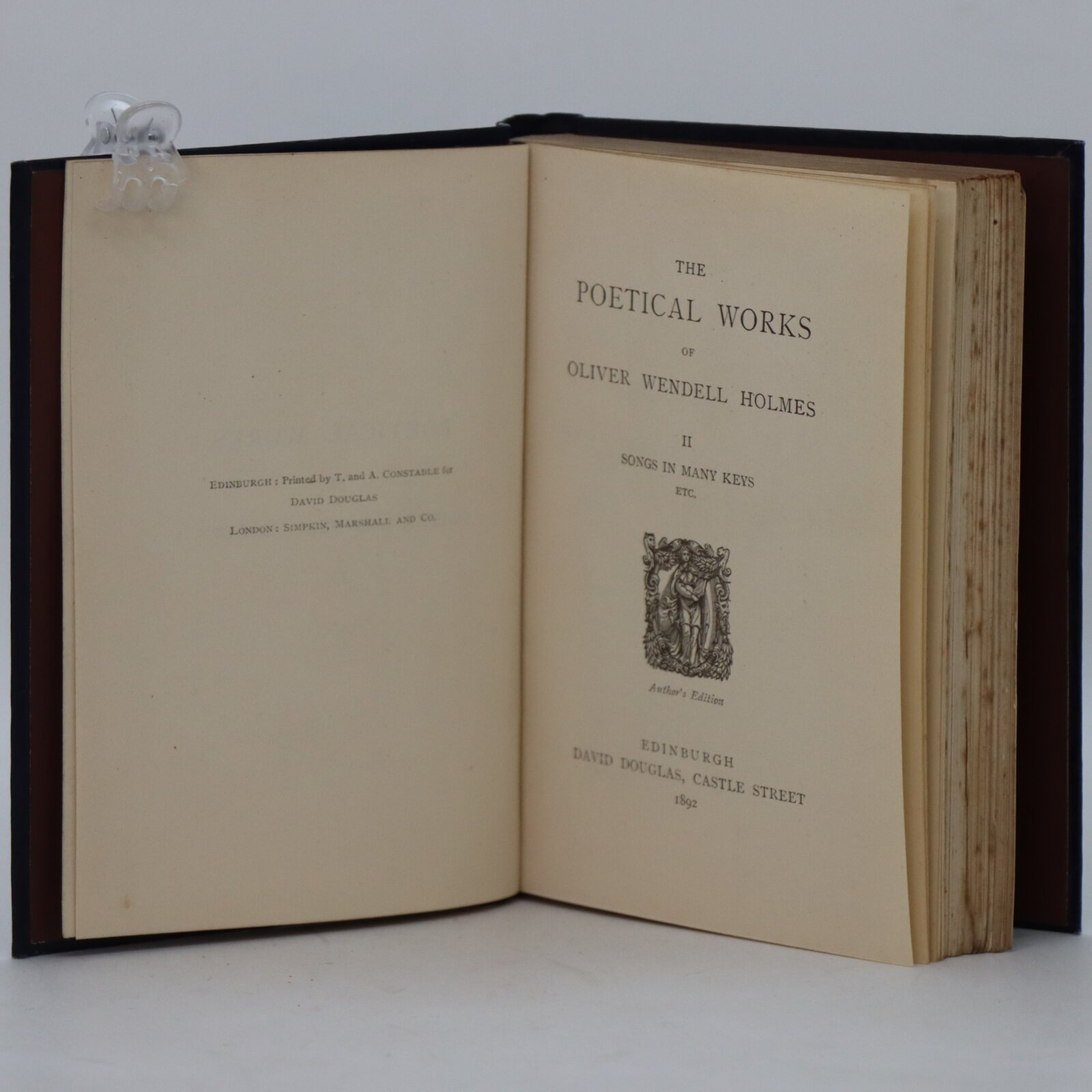
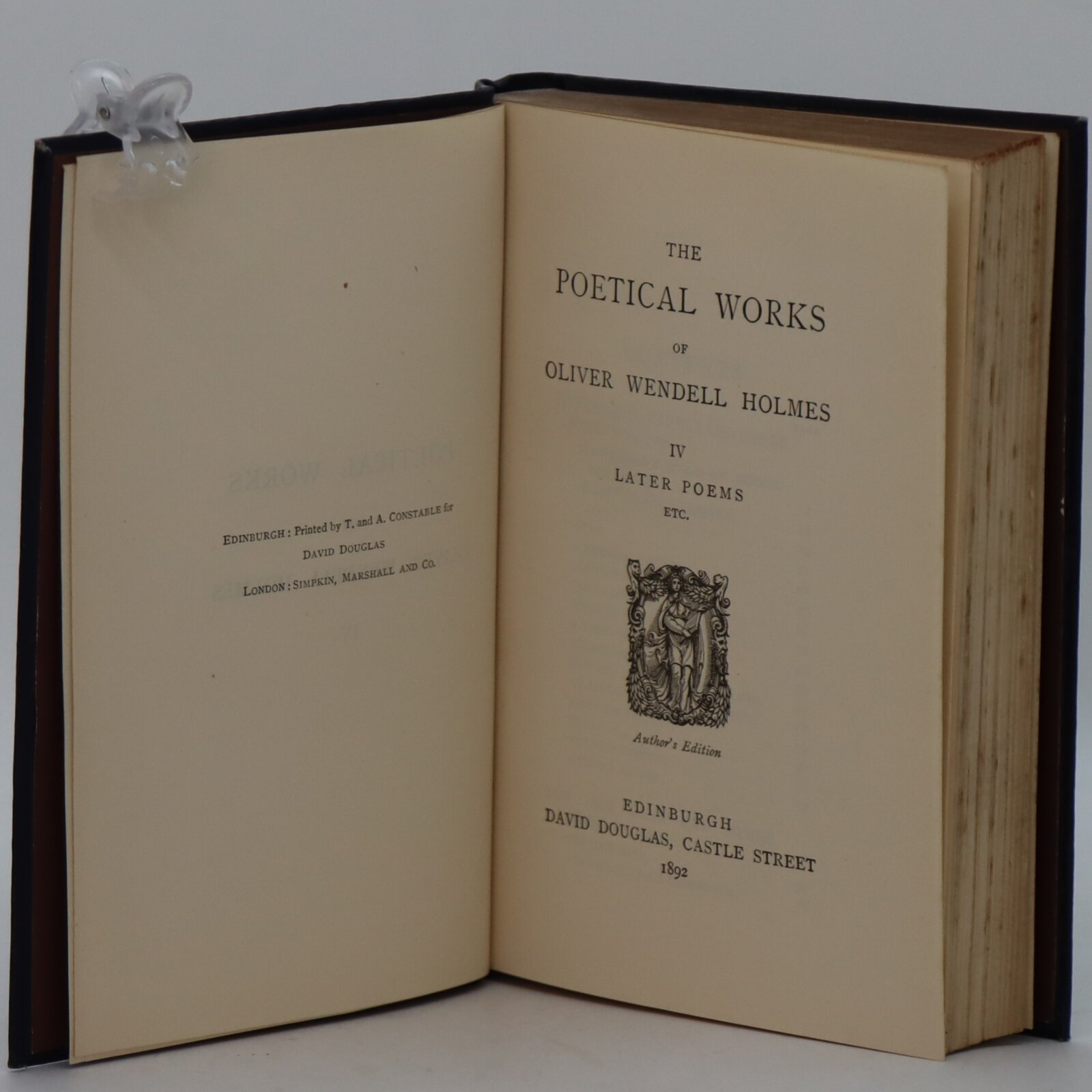
The Complete Poetical Works of Oliver Wendell Holmes. 4 Volumes.
By Oliver Wendell Holmes
Printed: 1892
Publisher: David Douglas. Edinburgh
Edition: Edinburgh edition
| Dimensions | 11 × 14 × 1.5 cm |
|---|---|
| Language |
Language: English
Size (cminches): 11 x 14 x 1.5
Condition: Fine (See explanation of ratings)
£67.00
Buy Now
Your items

Item information
Description
Navy cloth binding with gilt title on the spine and front board. Dimensions are for one volume.
F.B.A. provides an in-depth photographic presentation of this item to stimulate your feel and touch. More traditional book descriptions are immediately available.
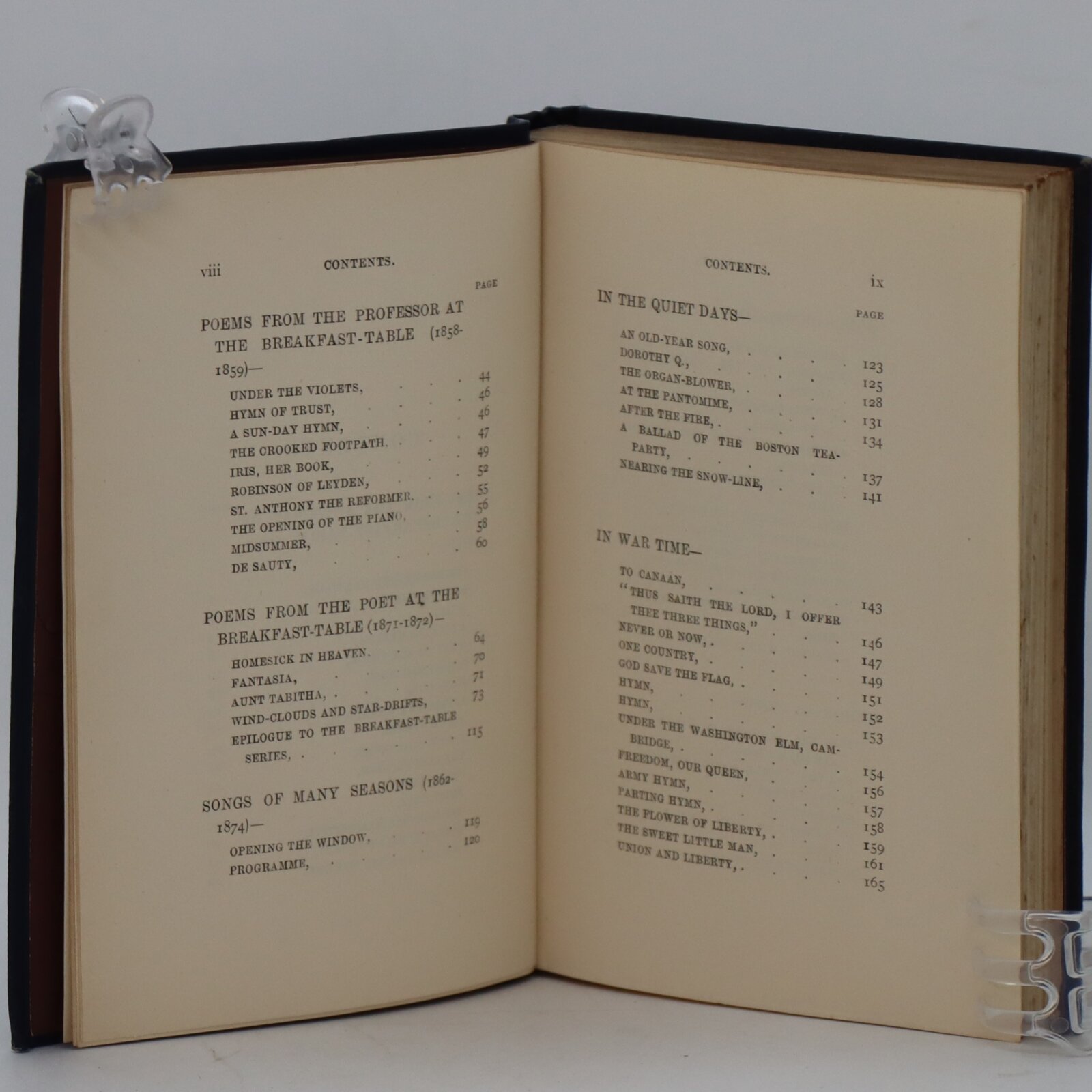
Four near fine copies in the original gilt-blocked cloth. All remain particularly and surprisingly well-preserved overall; tight, bright, clean and strong. ; 4 pages; Description: 4 vol. ; 15 cm. Contents: v. 1. Earlier poems — v. 2. Songs in many keys, etc. — v. 3. Poems from the breakfast-table series, etc — v. 4. Later poems, etc. Subjects: English Poetry. American Poetry.
Oliver Wendell Holmes August 29, 1809 – October 7, 1894, was an American physician, poet, and polymath based in Boston. Grouped among the fireside poets, he was acclaimed by his peers as one of the best writers of the day. His most famous prose works are the “Breakfast-Table” series, which began with The Autocrat of the Breakfast-Table (1858). He was also an important medical reformer. In addition to his work as an author and poet, Holmes also served as a physician, professor, lecturer and inventor and, although he never practiced it, he received formal training in law.
Born in Cambridge, Massachusetts, Holmes was educated at Phillips Academy and Harvard College. After graduating from Harvard in 1829, he briefly studied law before turning to the medical profession. He began writing poetry at an early age; one of his most famous works, “Old Ironsides”, was published in 1830 and was influential in the eventual preservation of the USS Constitution. Following training at the prestigious medical schools of Paris, Holmes was granted his Doctor of Medicine degree from Harvard Medical School in 1836. He taught at Dartmouth Medical School before returning to teach at Harvard and, for a time, served as dean there. During his long professorship, he became an advocate for various medical reforms and notably posited the controversial idea that doctors could carry puerperal fever from patient to patient. Holmes retired from Harvard in 1882 and continued writing poetry, novels, and essays until his death in 1894.
Surrounded by Boston’s literary elite—which included friends such as Ralph Waldo Emerson, Henry Wadsworth Longfellow, and James Russell Lowell—Holmes made an indelible imprint on the literary world of the 19th century. Many of his works were published in The Atlantic Monthly, a magazine that he named. For his literary achievements and other accomplishments, he was awarded numerous honorary degrees from universities around the world. Holmes’s writing often commemorated his native Boston area, and much of it was meant to be humorous or conversational. Some of his medical writings, notably his 1843 essay regarding the contagiousness of puerperal fever, were considered innovative for their time. He was often called upon to issue occasional poetry, or poems written specifically for an event, including many occasions at Harvard. Holmes also popularized several terms, including Boston Brahmin and anaesthesia. He was the father of Justice Oliver Wendell Holmes Jr. of the Supreme Court of the United States.
Want to know more about this item?
We are happy to answer any questions you may have about this item. In addition, it is also possible to request more photographs if there is something specific you want illustrated.
Ask a question
Related products

Share this Page with a friend
