
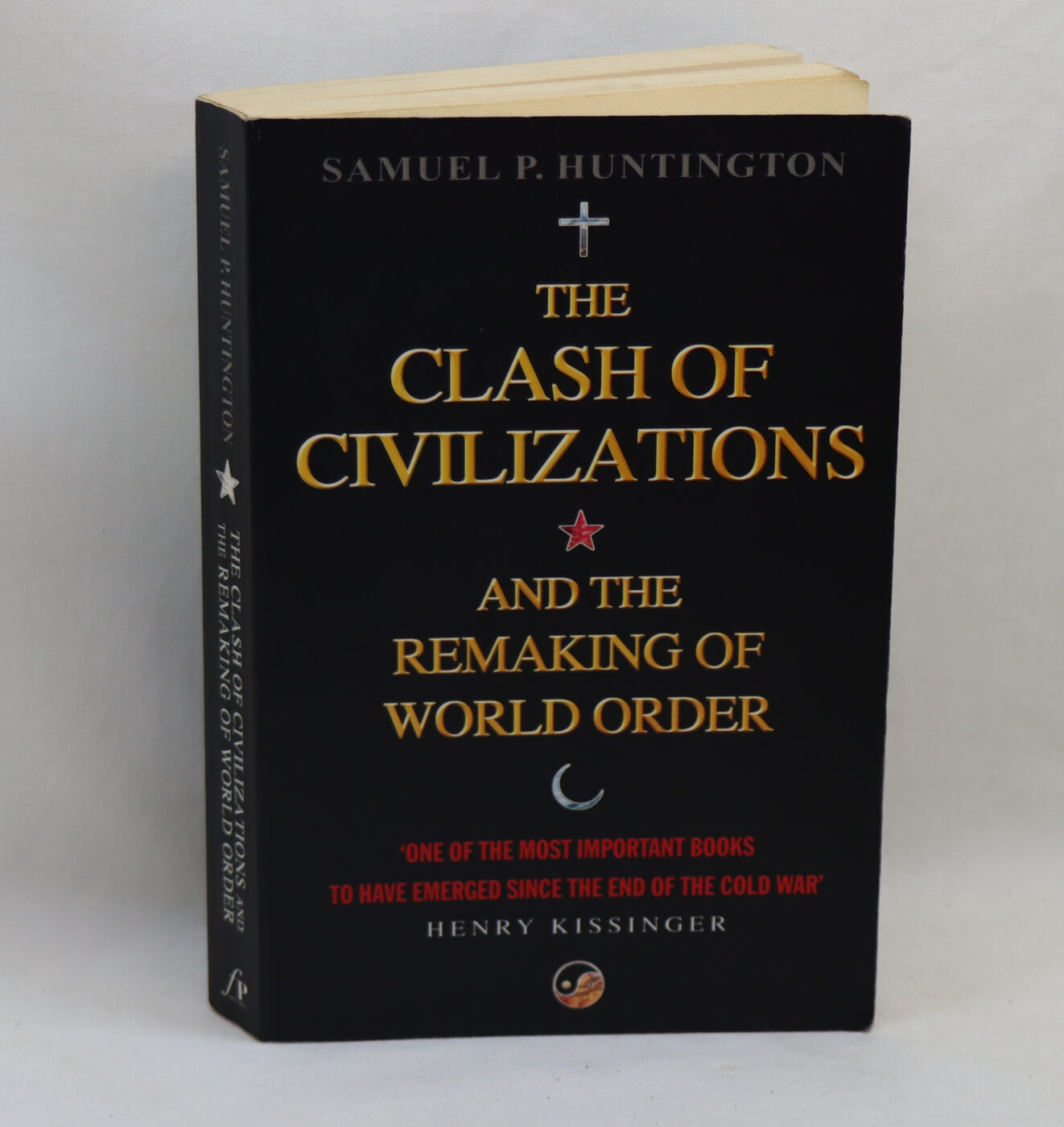
The Clash of Civilisations.
By Samuel P Huntington
ISBN: 9780140267310
Printed: 2002
Publisher: The Free Press. London
| Dimensions | 13 × 20 × 2 cm |
|---|---|
| Language |
Language: English
Size (cminches): 13 x 20 x 2
Condition: Very good (See explanation of ratings)
£15.00
Buy Now

Item information
Description
Paperback. Black cover and white title.
We provide an in-depth photographic presentation of this item to stimulate your feeling and touch. More traditional book descriptions are immediately available.
- Note: This book carries a £5.00 discount to those that subscribe to the F.B.A. mailing list
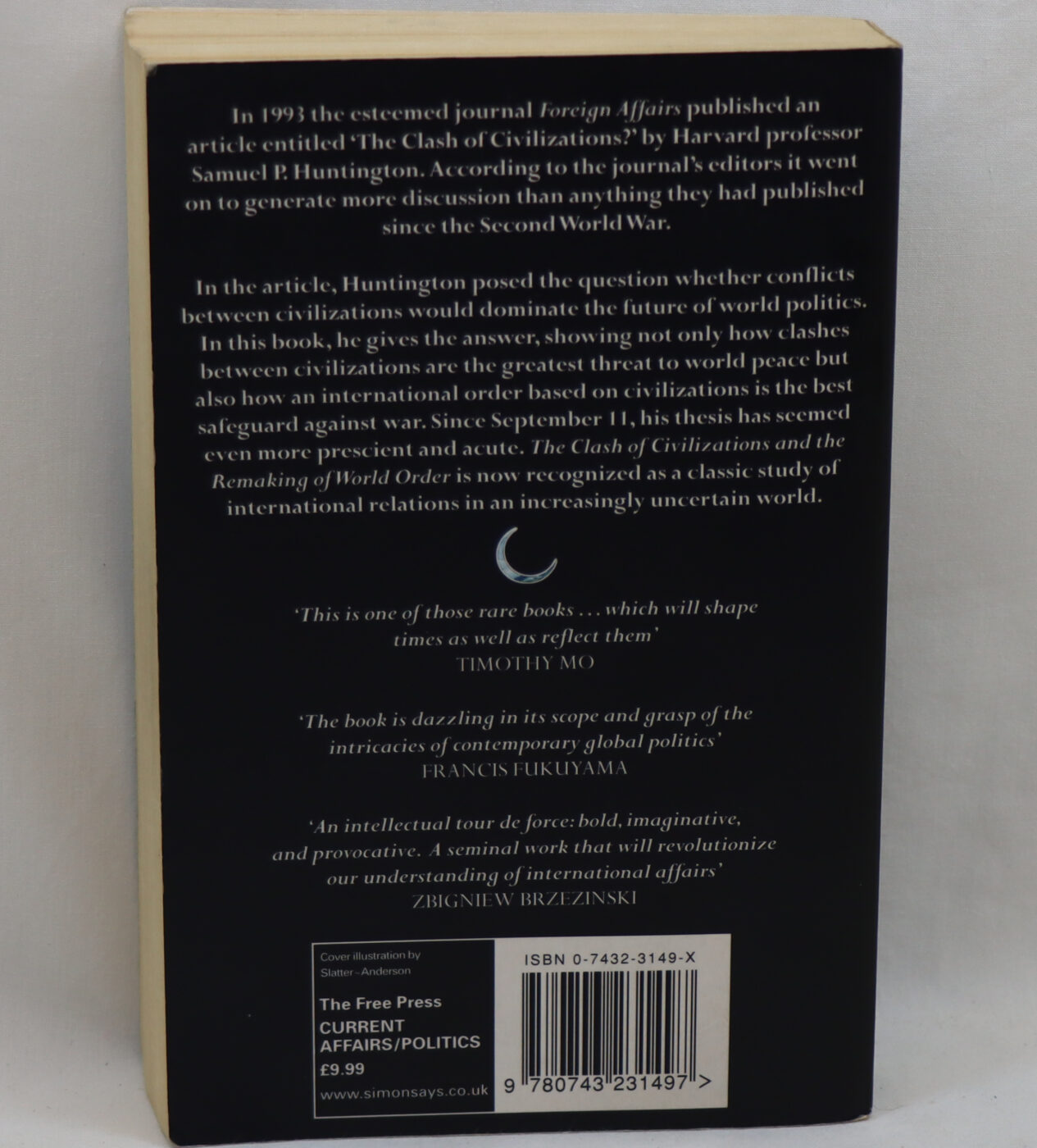
The Clash of Civilizations is a thesis that people’s cultural and religious identities will be the primary source of conflict in the post–Cold War world.The American political scientist Samuel P. Huntington argued that future wars would be fought not between countries, but between cultures. It was proposed in a 1992 lecture at the American Enterprise Institute, which was then developed in a 1993 Foreign Affairs article titled The Clash of Civilizations?, in response to his former student Francis Fukuyama’s 1992 book The End of History and the Last Man. Huntington later expanded his thesis in a 1996 book The Clash of Civilizations and the Remaking of World Order.
The phrase itself was earlier used by Albert Camus in 1946, by Girilal Jain in his analysis of the Ayodhya dispute in 1988, by Bernard Lewis in an article in the September 1990 issue of The Atlantic Monthly titled The Roots of Muslim Rage and by Mahdi El Mandjra in his book La première guerre civilisationnelle published in 1992. Even earlier, the phrase appears in a 1926 book regarding the Middle East by Basil Mathews: Young Islam on Trek: A Study in the Clash of Civilizations. This expression derives from clash of cultures, already used during the colonial period and the Belle Époque.
Huntington began his thinking by surveying the diverse theories about the nature of global politics in the post–Cold War period. Some theorists and writers argued that human rights, liberal democracy, and the capitalist free market economy had become the only remaining ideological alternative for nations in the post–Cold War world. Specifically, Francis Fukuyama argued that the world had reached the end of history in a Hegelian sense.
Huntington believed that while the age of ideology had ended, the world had only reverted to a normal state of affairs characterized by cultural conflict. In his thesis, he argued that the primary axis of conflict in the future will be along cultural lines. As an extension, he posits that the concept of different civilizations, as the highest category of cultural identity, will become increasingly useful in analyzing the potential for conflict. At the end of his 1993 Foreign Affairs article, The Clash of Civilizations?, Huntington writes, “This is not to advocate the desirability of conflicts between civilizations. It is to set forth descriptive hypothesis as to what the future may be like.”
In addition, the clash of civilizations, for Huntington, represents a development of history. In the past, world history was mainly about the struggles between monarchs, nations and ideologies, such as that seen within the Western civilization. However, after the end of the Cold War, world politics moved into a new phase, in which non-Western civilizations are no longer the exploited recipients of Western civilization but have become additional important actors joining the West to shape and move world history
Review: For those of us who are interested in world politics and how civilizations play a critical role in redefining international borders, this book is a must read. Sharing with you some of the thoughts in this book I particularly like :
1) We know who we ARE only when we know who we are NOT and often only when we know who we are AGAINST.
2) Civilizations are the biggest WE within which we feel culturally at home, as distinguished from all other THEMS.
3) In fundamental ways, the world is becoming more Modern and less Western.
4) The revival of non-western religions is not a rejection of modernity, rather it is a westoxification of non-western societies.
5) Friedburg suggests, Europe’s past is Asia’s future. More precisely, Asia’s past is Asia’s future.
Rating – immaterial when the author is a reputed Harvard professor.
Samuel Phillips Huntington (April 18, 1927 – December 24, 2008) was an American political scientist, adviser, and academic. He was the Albert J. Weatherhead III University Professor at Harvard University, where he directed the Weatherhead Center for International Affairs. During the presidency of Jimmy Carter, Huntington was the White House coordinator of security planning for the National Security Council. Huntington is known best for his 1993 theory, the “Clash of Civilizations” otherwise known as COC, of a post–Cold War new world order. He argued that future wars would be fought not between countries, but between cultures, and that Islamic civilization would become the greatest threat to Western domination of the world. Huntington is credited with helping to shape American opinions on civilian-military relations, political development, and comparative government. According to the Open Syllabus Project, Huntington is the second most frequently cited author on college syllabi for political science courses in the USA.
Want to know more about this item?
We are happy to answer any questions you may have about this item. In addition, it is also possible to request more photographs if there is something specific you want illustrated.
Ask a question
Related products

Share this Page with a friend
