
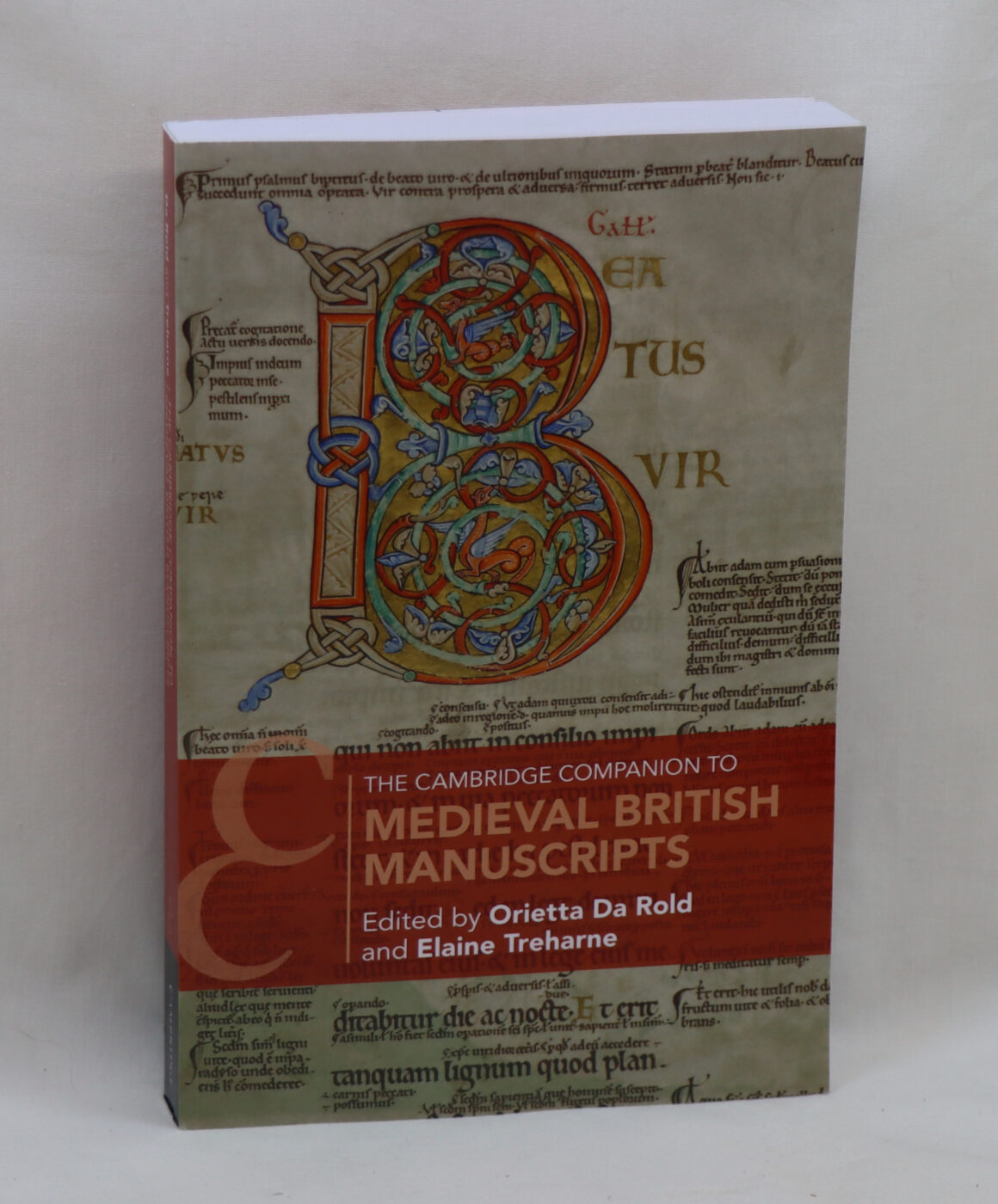
The Cambridge Companion Medieval British Manuscripts.
ISBN: 9781108916103
Printed: 2020
Publisher: Cambridge University Press.
| Dimensions | 15 × 23 × 2 cm |
|---|---|
| Language |
Language: English
Size (cminches): 15 x 23 x 2
Condition: As new (See explanation of ratings)
£23.00
Buy Now


Item information
Description
Paperback. Red cover with white title and illuminated manuscript on the front board.
We provide an in-depth photographic presentation of this item to stimulate your feeling and touch. More traditional book descriptions are immediately available.
-
Note: This book carries a £5.00 discount to those that subscribe to the F.B.A. mailing list
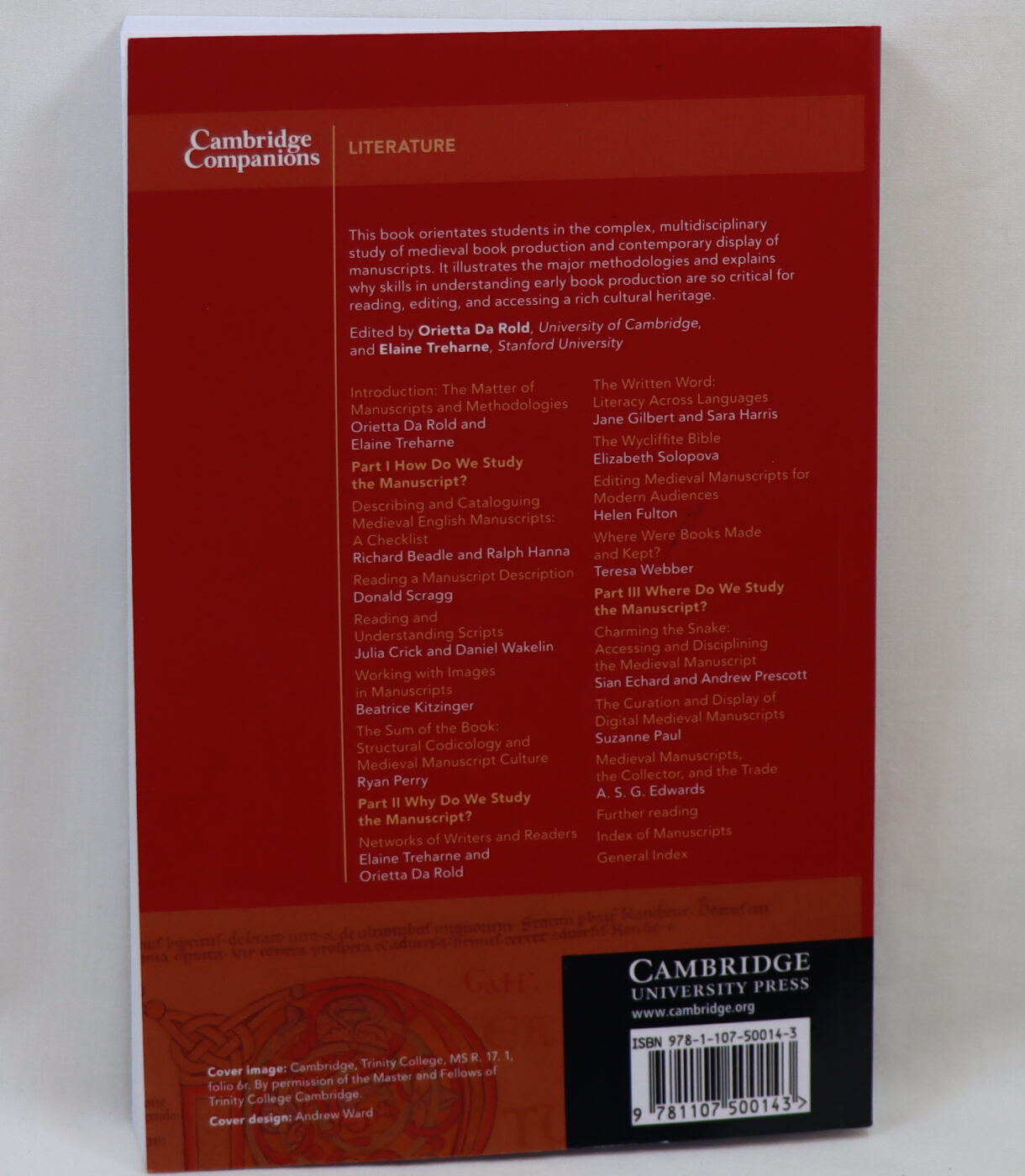
The scholarship and teaching of manuscript studies has been transformed by digitisation, rendering previously rarefied documents accessible for study on a vast scale. The Cambridge Companion to Medieval British Manuscripts orientates students in the complex, multidisciplinary study of medieval book production and contemporary display of manuscripts from c.600–1500. Accessible explanations draw on key case studies to illustrate the major methodologies and explain why skills in understanding early book production are so critical for reading, editing, and accessing a rich cultural heritage. Chapters by leading specialists in manuscript studies range from explaining how manuscripts were stored, to revealing the complex networks of readers and writers which can be understood through manuscripts, to an in depth discussion on the Wycliffite Bible.
Elaine Treharne is Roberta Bowman Denning Professor of Humanities, Professor of English, and Robert K. Packard University Fellow in Undergraduate Education at Stanford University, California, and a Fellow of the Society of Antiquaries, the Royal Historical Society, and the English Association. A qualified archivist, she has published more than thirty books, and sixty articles in early medieval literature and the history of text technologies.
Elaine Treharne: I’m a Welsh medievalist with specializations in manuscript studies, archives, information technologies, and early British literature. I teach core courses in British Literary History, on Text Technologies, and Palaeography and Archival Studies. I supervise honors students and graduate students working in early literature, Book History, and Digital Humanities and I am committed to providing a supportive and ethical environment in all my work. My current projects focus on death and trauma, on manuscripts and on the history of writing systems. I’m currently working on a new book that focuses on contemporary European Manuscript Studies, its debt to Neil Ripley Ker, and his methods and impact as a scholar. I recently published Disrupting Categories, 1050 to 1250: Rethinking the Humanities through Premodern Texts (ARC Humanities Press, 2024); Perceptions of Medieval Manuscripts: The Phenomenal Book with OUP in 2021; A Very Short Introduction to Medieval Literature (OUP, 2015); Living Through Conquest: The Politics of Early English (OUP, 2012). Also recently published is the two-part issue 13 (2024) of Digital Philology on “Fragmentology” (with Ben Albritton and Shiva Mihan); and the Cambridge Companion to British Medieval Manuscripts, co-edited with Dr Orietta Da Rold for CambridgeUP in 2020.
Since 2013, I have been the Director of Stanford Text Technologies, and, with Claude Willan, published Text Technologies: A History in 2019 (StanfordUP). A new initiative is HANDMADE (Handwriting Analysis through New Directions in Manuscript Studies with AI and Digital Environments). This will be hosted by CESTA at Stanford and seeks to describe, evaluate, and refine handwriting recognition tools for textual objects of all periods. Other projects include Digital Ker—an online digitization and updating of Neil R. Ker’s 1957 Catalogue of Manuscripts containing Anglo-Saxon, together with newly published archival materials of Ker’s; and, with Stanford undergraduate RAs, Stanford Ordinary People Extraordinary Stories (SOPES), which investigates the complex subject of personal and community archives. With Mateusz Fafinski, Medieval Networks of Memory analyzes two thirteenth-century mortuary rolls, upon which I am writing a short book tracing the footsteps of the roll-carriers around Britain. With Benjamin Albritton, I run Stanford Manuscript Studies, where we highlight Stanford University Libraries’ world-class manuscript collections for students and community members. I am also the Co-PI of the NEH-Funded ‘Stanford Global Currents’ and of the AHRC-funded research project and ebook, The Production and Use of English Manuscripts, 1060 to 1220 (Leicester, 2010; version 2.0).
I work a great deal with, and for, the Stanford Alumni Association, leading Study Tours and seminars; and in 2023, I was delighted to win the Lyman Award for this. I’m the current President of the Teachers of Old English in Britain and Ireland (TOEBI); I’ve been an American Philosophical Society Franklin Fellow, a Princeton Procter Fellow, a Fellow of the Stanford Clayman Institute for Gender Studies, and a Stanford Impact Labs Fellow. I’m a Fellow of the Society of Antiquaries; a Fellow of the Royal Historical Society; an Honorary Lifetime Fellow of the English Association (and former Chair and President); and a Fellow of the Learned Society of Wales.
Orietta Da Rold is University Lecturer in the University of Cambridge and Fellow of St John’s College. Her publications include The Dd Manuscript: A Digital Edition of Cambridge University Library, MS Dd.4.24 of Chaucer’s Canterbury Tales (2013) and she has just completed a project entitled From Pulp to Fictions: Paper in Medieval England.
Want to know more about this item?
We are happy to answer any questions you may have about this item. In addition, it is also possible to request more photographs if there is something specific you want illustrated.
Ask a question

Share this Page with a friend
