
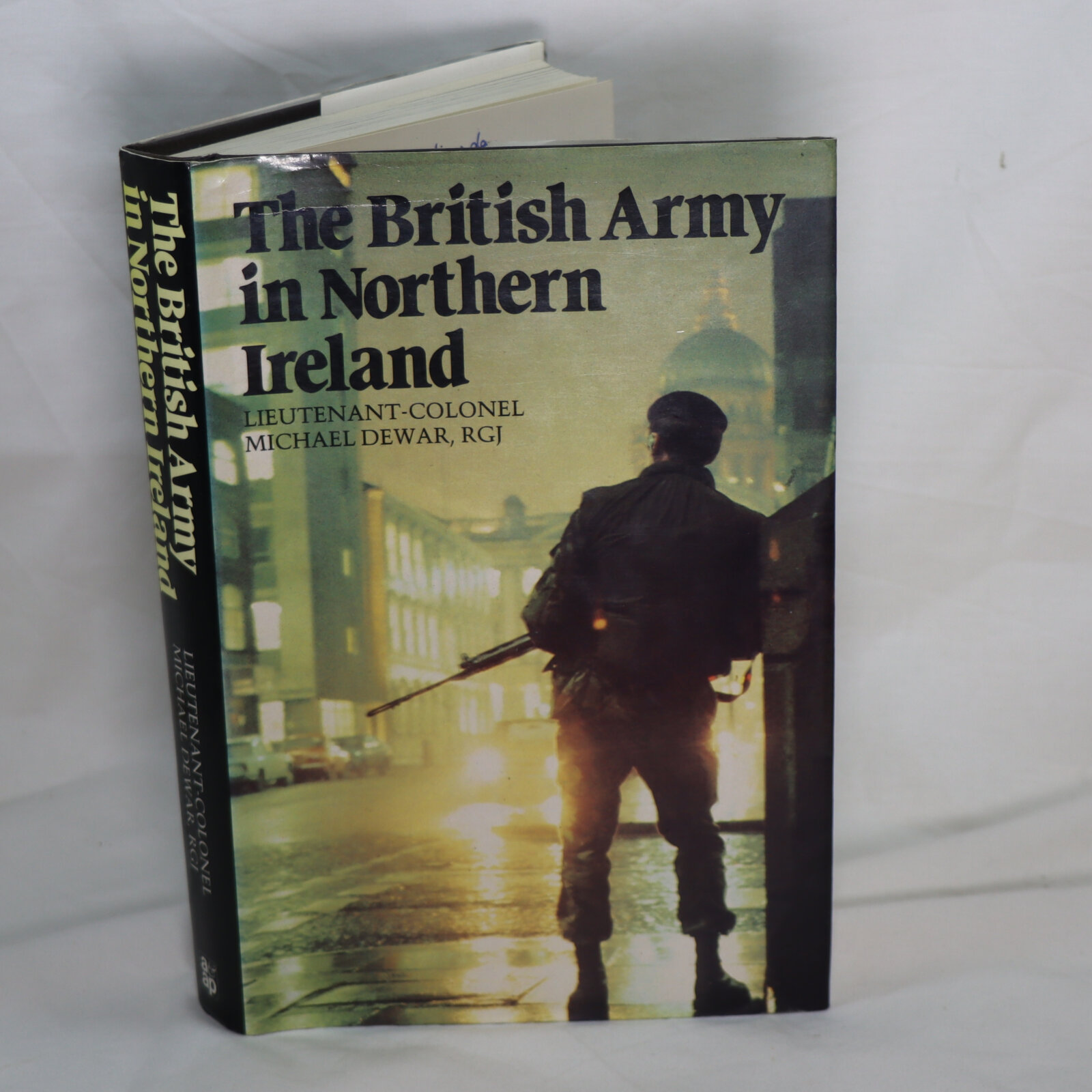
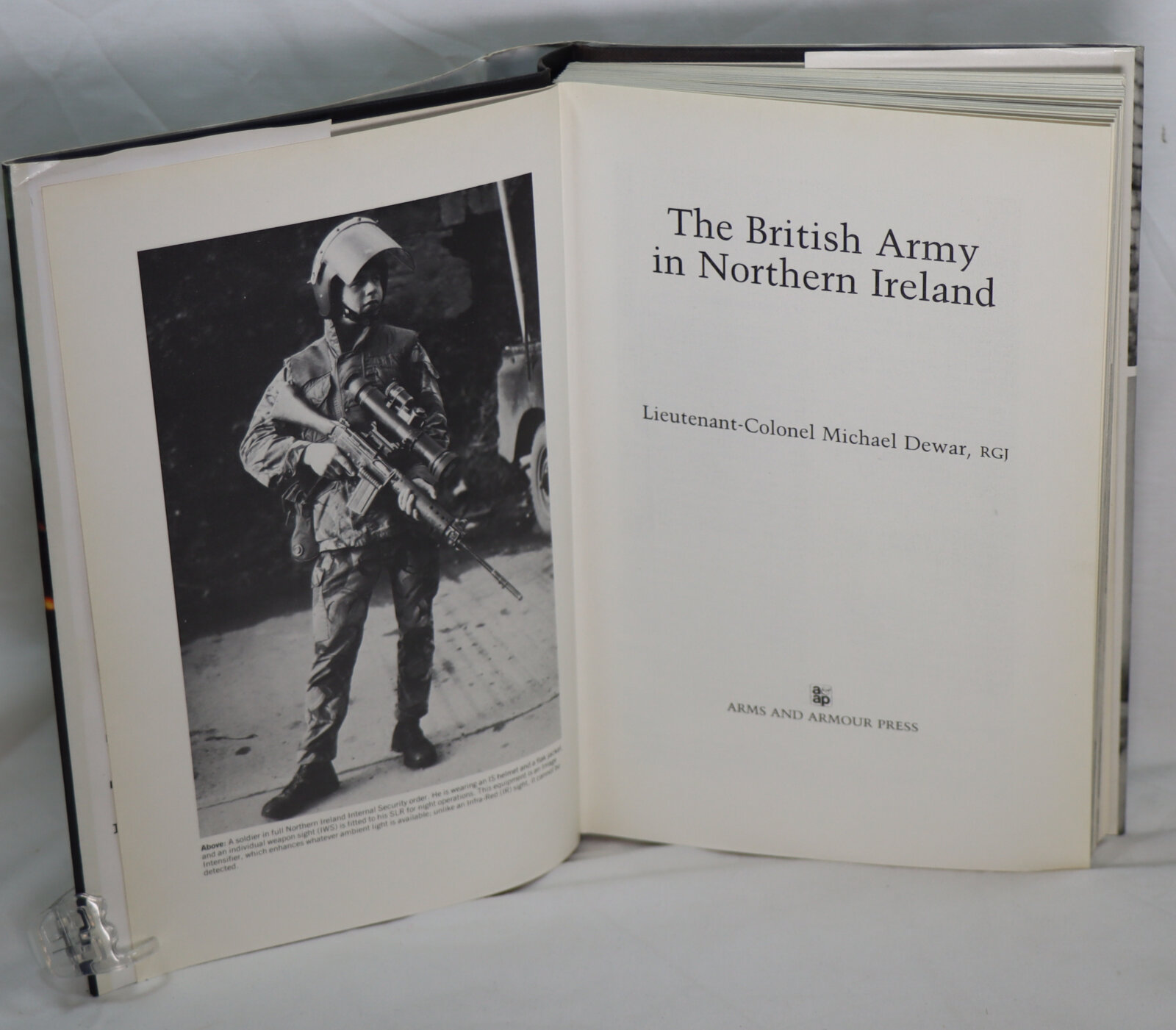
The British Army in Northern Ireland.
By Michael Dewar
ISBN: 9780853687160
Printed: 1985
Publisher: Arms & Armour Press. London
| Dimensions | 17 × 24 × 3 cm |
|---|---|
| Language |
Language: English
Size (cminches): 17 x 24 x 3
Condition: Fine (See explanation of ratings)
£18.00
Buy Now

Item information
Description
In the original dustsheet. Black cloth binding with gilt title on the spine.
-
F.B.A. provides an in-depth photographic presentation of this item to stimulate your feeling and touch. More traditional book descriptions are immediately available.
Having served in Northern Ireland on both Op Motorman and Banner, I found the book a great read, and not distorted by those who wish to “re-write” history. This is how it was – a very worthwhile read.

Two British Army soldiers at a checkpoint near Newry, Northern Ireland, 1988
Operation Banner was the operational name for the British Armed Forces’ operation in Northern Ireland from 1969 to 2007, as part of the Troubles. It was the longest continuous deployment in British military history. The British Army was initially deployed, at the request of the unionist government of Northern Ireland, in response to the August 1969 riots. Its role was to support the Royal Ulster Constabulary (RUC) and to assert the authority of the British government in Northern Ireland. This involved counter-insurgency and supporting the police in carrying out internal security duties such as guarding key points, mounting checkpoints and patrols, carrying out raids and searches, riot control and bomb disposal. More than 300,000 soldiers served in Operation Banner. At the peak of the operation in the 1970s, about 21,000 British troops were deployed, most of them from Great Britain. As part of the operation, a new locally-recruited regiment was also formed: the Ulster Defence Regiment (UDR).
The Provisional Irish Republican Army (IRA) waged a guerrilla campaign against the British military from 1970 to 1997. Catholics welcomed the troops when they first arrived, because they saw the RUC as sectarian, but Catholic hostility to the British military’s deployment grew after incidents such as the Falls Curfew (1970), Operation Demetrius (1971) and Bloody Sunday (1972). In their efforts to defeat the IRA, there were incidents of collusion between British soldiers and Ulster loyalist paramilitaries. From the late 1970s the British government adopted a policy of “Ulsterisation”, which meant giving a greater role to local forces: the UDR and RUC. After the Good Friday Agreement in 1998, the operation was gradually scaled down, most military facilities were removed and the vast majority of British troops were withdrawn.
According to the Ministry of Defence, 1,441 serving British military personnel died in Operation Banner; 722 of whom were killed in paramilitary attacks, and 719 of whom died as a result of other causes. It suffered its greatest loss of life in the Warrenpoint ambush of 1979.
Want to know more about this item?
We are happy to answer any questions you may have about this item. In addition, it is also possible to request more photographs if there is something specific you want illustrated.
Ask a question
Related products
Share this Page with a friend
