
The Book of Rustem.
By E M Wilmot-Buxton
Printed: 1907
Publisher: George Harrap & Co. London
| Dimensions | 15 × 19 × 3 cm |
|---|---|
| Language |
Language: English
Size (cminches): 15 x 19 x 3
Condition: Very good (See explanation of ratings)
£109.00
Buy Now
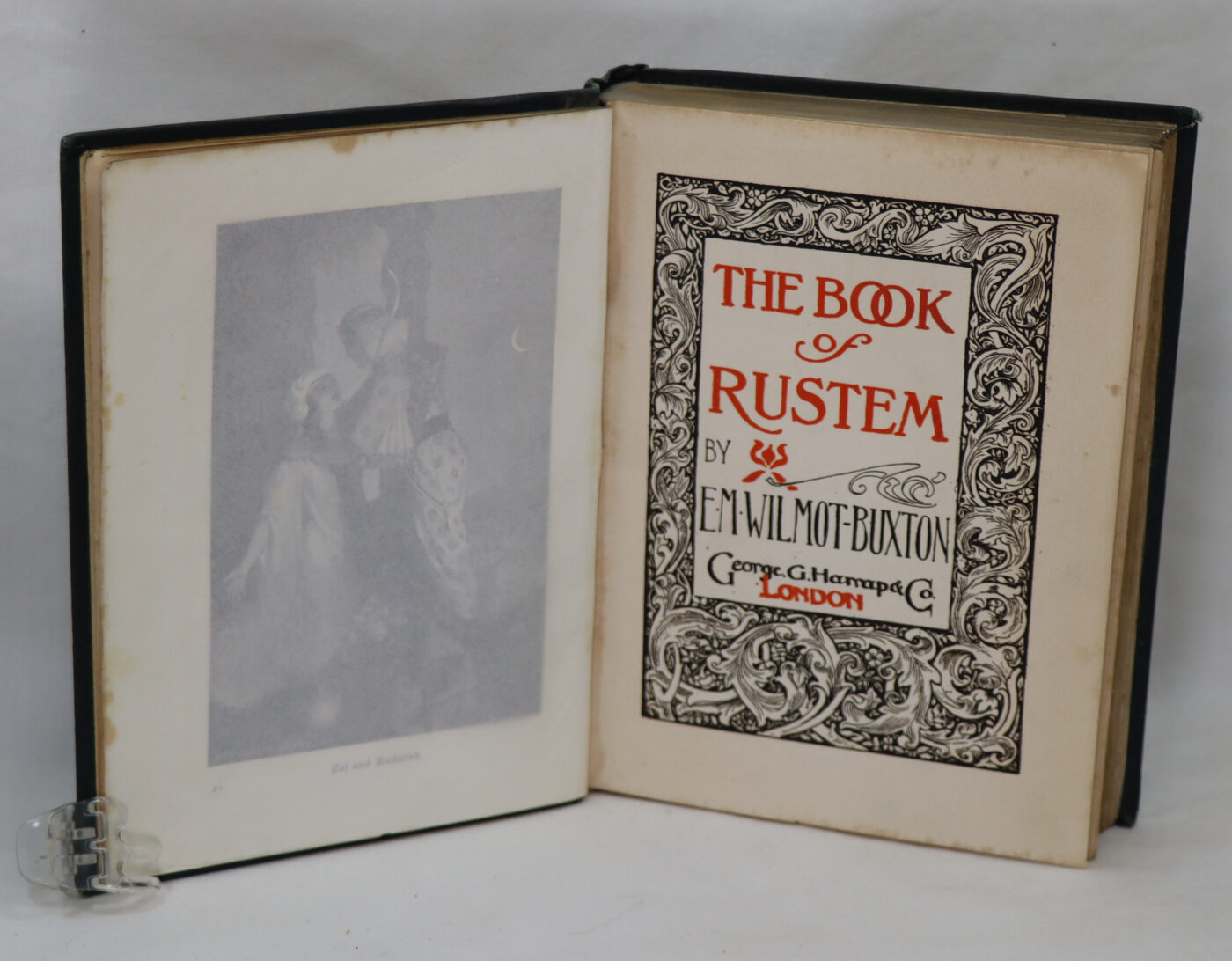

Item information
Description
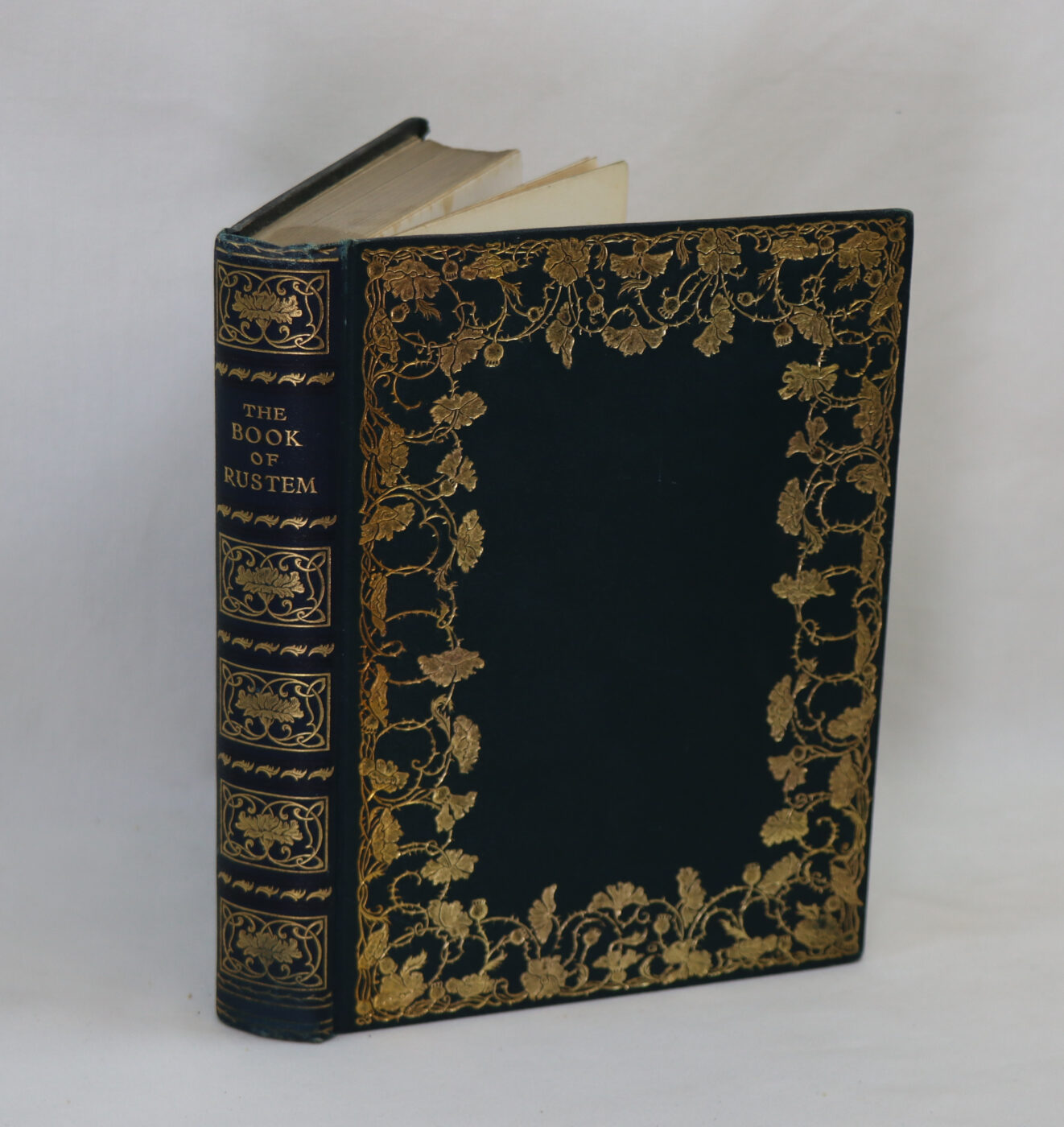
Dark green/navy cloth binding with gilt title and decoration on the spine. Gilt decoration on the front board.
We provide an in-depth photographic presentation of this item to stimulate your feeling and touch. More traditional book descriptions are immediately available.
- Note: This book carries a £5.00 discount to those that subscribe to the F.B.A. mailing list
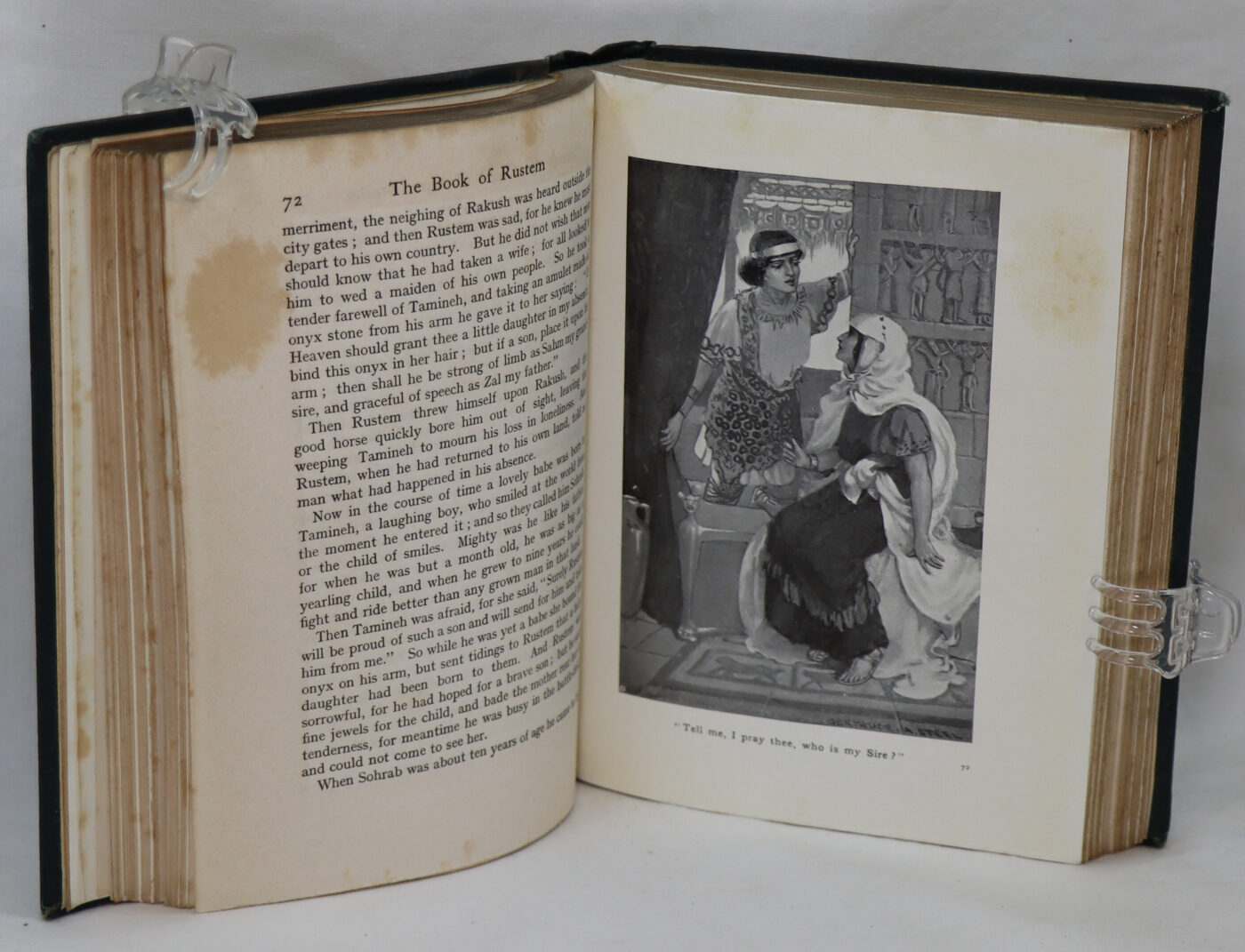
- Early Rare Edition. 233 pages. No dust jacket. Part of Gold Through The Ages series. Green cloth with gilt decorations and gilt lettering to spine. Contains black and white plates. A truly lovely book.
The nations of the world each have their respective culture, national heroes and in most cases, almost mythological epic stories. Just as the British have the King Arthurian legends, how Greece has its ancient Odyssey, and how the Americas have their pre-Columbus history; other countries have similar tales and legendary figures which have shaped their past. Most of these stories have many things in common. In particular, all of the heroes performed daring or glorious deeds to make their country an admirable place. This book of Persian tales is no different. It takes the reader on a fantastic journey to a distant figment of the custom and culture of ancient Persian storytelling.
In its original Persian form, written by a man named Firdausi in the 11th century, this book was first known as the “Epic of Kings.” And like the legends of King Arthur, Hercules and Beowulf, it is a collection of the legends of various kings of Persia, their escape from peril, and the battles they fought and won. Rustem is the real hero of this book. He has an inclination of appearing at precisely the right time with his keen wit and gigantic strength, to save the king from some disgrace or unfortunate situation just as things seem most ominous. Many of these stories are associated with Rustem’s remarkable steed Rakush, and in this respect resemble the stories of Alexander and his horse Bucephalus. Since Alexander had conquered Persia previously, some of his fame and glory may have made their way into these interesting tales.
These stories also have many things in common with the tales of Hercules. For example, one of the stories in this book is “The Seven Labors of Rustem,” while one of Hercules adventures was The Twelve Labors, where he performs work for his cousin Eurysteus, in order to gain immortality. The similarities are so great that people have thought the legend of Rustem had made its way from ancient Greece. However, others claim that every nation has its own idealistic hero that can not be stopped by any earthly power. In any case, this book provides a meaningful history to one of the most important legendary figures in Middle Eastern mythology.
- M. Wilmot-Buxton (Ethel Mary Wilmot-Buxton) (1870–1923) was an author, translator and school teacher. Wilmot-Buxton studied at Hughes Hall, Cambridge. While there she founded the Marsh Marigold Tramp Club in 1894. The aim was to undertake an annual walking tour in the English countryside. In Easter 1894 she led a 3 week trip by some students to the Alps. She later became a teacher at Brighton High School for Girls. She also became an author of historical factual books for children, as well as contributing to some collections of short stories and translations. She was a fellow of the Royal Historical Society. Wilmot-Buxton was a prolific author of well over 30 books. They were mainly factual works about history or religion aimed at children and schools, but she also re-wrote stories from some classic literature such as Norse sagas and the Mabinogion. Her first published work was in collections of short stories. She was also the author of at least one translation from French. She also wrote at least one original historical novel, The Red Queen, set during the reign of Elizabeth I.
George G. Harrap, Ltd (officially: George G. Harrap and Company Limited, London,Bombay) was a publisher of speciality books, many of them educational, such as the memoirs of Winston Churchill, or highly illustrated with line drawings, engravings or etchings, such as the much republished classic educational children’s book The Cave Boy of the Age of Stone from at least 1901 into the 1980s. Publishers of English classics for the educational trade, Harrap was also known for publishing finely illustrated books by Rackham, Gooden, and others, and as the publisher of Winston Churchill.
— Antiquarian Booksellers’ Association of America listing, about catalog listing of book: HARRAP, George G. Some Memories, 1901 – 1935
(subtitled: “A Publisher’s Contribution to the History of Publishing”).
In 1992, George G. Harrap and Co. was acquired and became part of Chambers Harrap of Scotland, a subsidiary of the French publisher CEP. Havas acquired CEP in 1997; Havas was then acquired by Vivendi in 1998. Vivendi sold its European book publishing to Lagardère Group in 2002.
In September 2009 the Edinburgh offices of Harrap, as part of Chambers Harrap, were closed. The Harrap’s section has been moved to Paris, where, according to a press release] by the owners, the plan is for Hachette Larousse publishers to manage it directly.
Want to know more about this item?
We are happy to answer any questions you may have about this item. In addition, it is also possible to request more photographs if there is something specific you want illustrated.
Ask a question
Share this Page with a friend
