
The Black Tulip.
By Alexander Dumas
Printed: Circa 1940
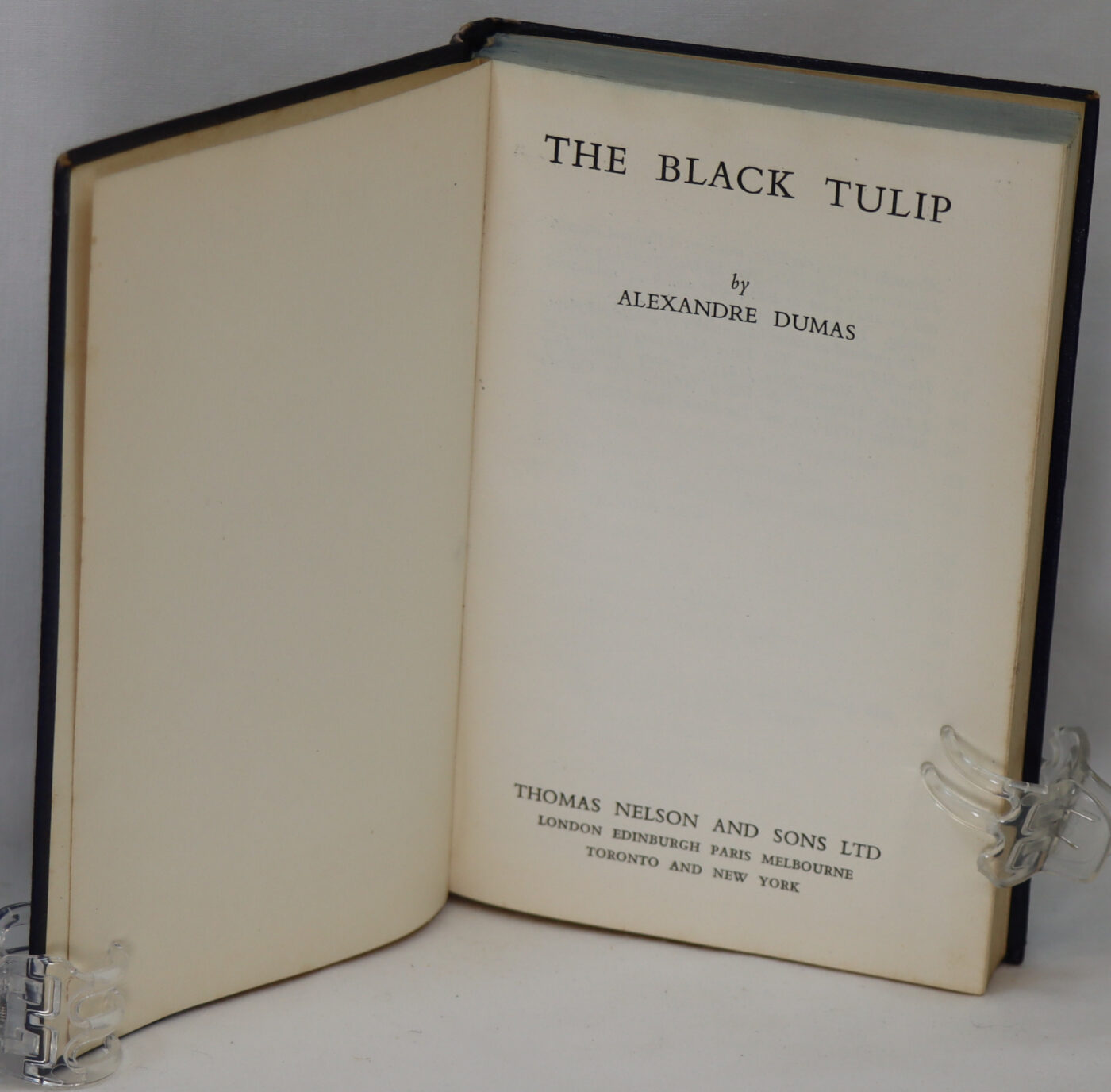
Publisher: Thomas Nelson & Sons. London
| Dimensions | 13 × 16 × 2 cm |
|---|---|
| Language |
Language: English
Size (cminches): 13 x 16 x 2
Condition: Good (See explanation of ratings)
£17.00
Buy Now

Item information
Description
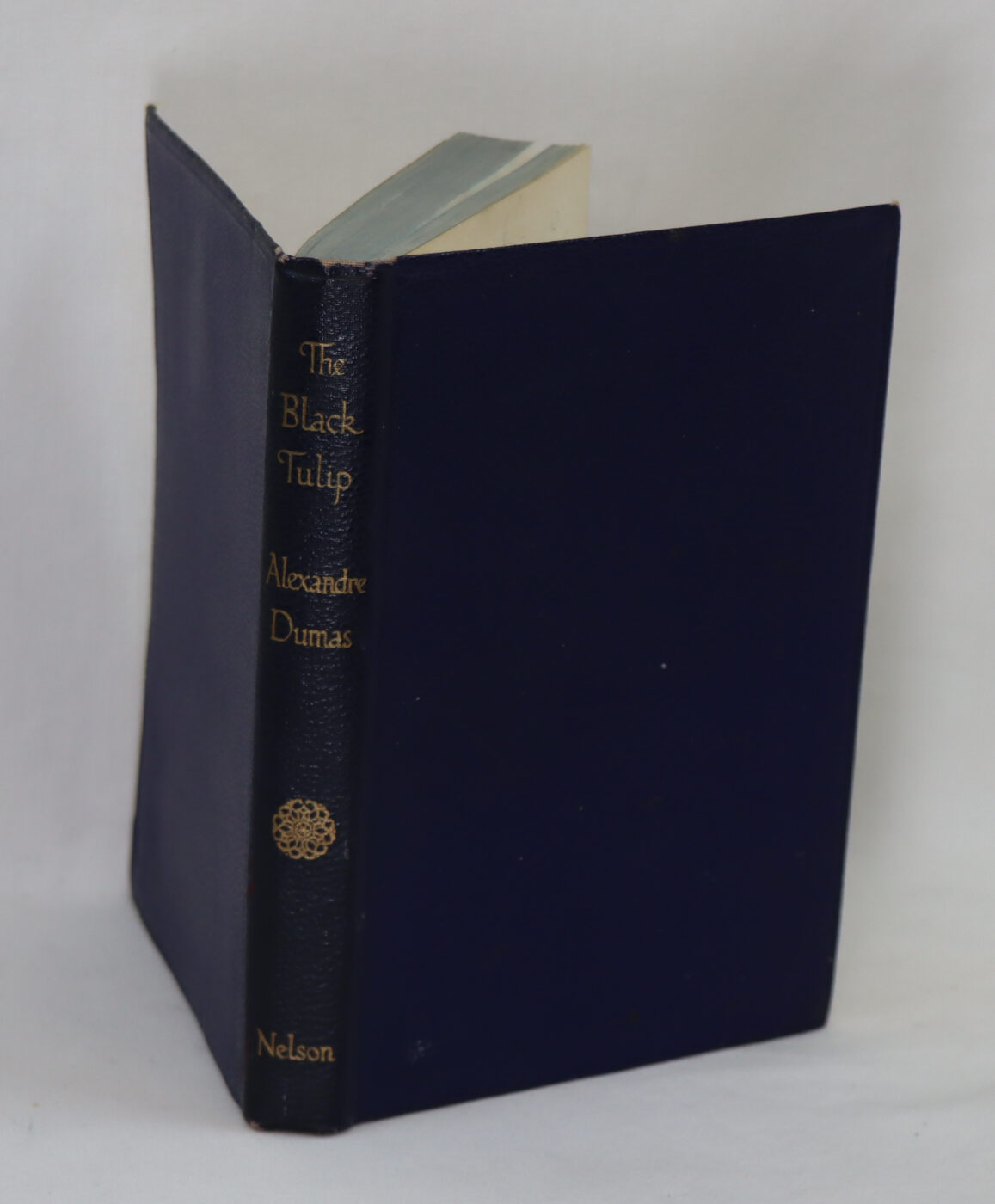
Softback. Navy leatherette cloth binding with gilt title on the spine.
We provide an in-depth photographic presentation of this item to stimulate your feeling and touch. More traditional book descriptions are immediately available.
- Note: This book carries a £5.00 discount to those that subscribe to the F.B.A. mailing list
It is a pleasure to touch and feel this lovely book. A book which has been treasured throughout its life.
The Black Tulip is a historical novel and a work of Romantic poetry written by Alexandre Dumas, père, and first published in 1850. The story begins in 1672, with a historic event: the lynching of the Dutch Grand Pensionary Johan de Witt and his brother Cornelis, considered rebels against the upcoming stadtholder and the Prince of Orange, William III. The plot takes place while tulip mania grips the Netherlands. The main fictional character, Cornelius Van Baerle, belongs to the natural school whose motto was: “To despise flowers is to offend God”, and thus followed the syllogism:
“To despise flowers is to offend God,
The more beautiful the flower is, the more does one offend God in despising it,
The tulip is the most beautiful of all flowers,
Therefore, he who despises the tulip offends God beyond measure”.
The city of Haarlem has offered a prize of 100,000 francs to whoever can grow a black tulip. At stake was not only the prize, but fame and honour; the winner would also have his name included in that given to the tulip itself.
The prosperous Cornelius Van Baerle, godson of Cornelius de Witt, is known in his locale for the growing of tulips and he takes up the challenge to grow a black tulip. His neighbour, Isaac Boxtel who is also a gardener, watches his every move and fearing Cornelius’ success, starts plotting. Boxtel, motivated by envy, denounces Van Baerle because of his relation to the brothers De Witt who are both now considered traitors.
Van Baerle is arrested and condemned to a life sentence in prison. Religious beliefs are used in the narrative for dramatic effect and also words such as “Fate”, “Providence” and “Misfortune”. Misfortune plays a major influence throughout the events of Van Baerle’s life, but at the end turns out to be a major act of Providence, showing that God is always in control, both in sadness as in happiness.
In prison, Van Baerle meets the beautiful daughter of the jailer, Rosa Gryphus. Cornelius lost everything but had kept the bulbs of the tulips, which were expected to have black flowers. In the midst of loss and sorrow, Rosa helps him to grow the flower in the jail. His affection for Rosa (who is depicted as brave and virtuous) gives him courage to not give up his dreams.
The philosophy of the book is summed up in the quote “Sometimes one has suffered so much that he has the right never to be able to say, ‘I am too happy.’” (p. 204 The Black Tulip).
The novel was originally published in three volumes in 1850 as La Tulipe Noire by Baudry (Paris). The Count of Monte Cristo, also by Dumas, has similar themes of love, revenge and faith.
This is part of the esteemed Nelson Classics series published by Thomas Nelson & Sons, which was widely distributed in the UK during the 1930s and 1940s.
Alexandre Dumas (born Alexandre Dumas Davy de la Pailleterie; 24 July 1802 – 5 December 1870), also known as Alexandre Dumas père, was a French novelist and playwright.
His works have been translated into many languages and he is one of the most widely read French authors. Many of his historical novels of adventure were originally published as serials, including The Count of Monte Cristo, The Three Musketeers, Twenty Years After and The Vicomte of Bragelonne: Ten Years Later. Since the early 20th century, his novels have been adapted into nearly 200 films. Prolific in several genres, Dumas began his career by writing plays, which were successfully produced from the first. He wrote numerous magazine articles and travel books; his published works totalled 100,000 pages. In the 1840s, Dumas founded the Théâtre Historique in Paris.
His father, General Thomas-Alexandre Dumas Davy de la Pailleterie, was born in the French colony of Saint-Domingue (present-day Haiti) to Alexandre Antoine Davy de la Pailleterie, a French nobleman, and Marie-Cessette Dumas, an African slave. At age 14, Thomas-Alexandre was taken by his father to France, where he was given his freedom, educated in a military academy, and entered the military for what became an illustrious career.
Alexandre acquired work with Louis-Philippe, Duke of Orléans, then as a writer, a career that led to his early success. Decades later, after the election of Louis-Napoléon Bonaparte in 1851, Dumas fell from favour and left France for Belgium, where he stayed for several years. He moved to Russia for a few years and then to Italy. In 1861, he founded and published the newspaper L’Indépendant, which supported Italian unification. He returned to Paris in 1864.
English playwright Watts Phillips, who knew Dumas in his later life, described him as “the most generous, large-hearted being in the world. He also was the most delightfully amusing and egotistical creature on the face of the earth. His tongue was like a windmill – once set in motion, you would never know when he would stop, especially if the theme was himself.”
Want to know more about this item?
We are happy to answer any questions you may have about this item. In addition, it is also possible to request more photographs if there is something specific you want illustrated.
Ask a question
Related products






Share this Page with a friend
