
The Anatomy of Melancholy.
By Robert Burton
Printed: 1948
Publisher: Tudor Publishing Co. New York
| Dimensions | 17 × 25 × 6 cm |
|---|---|
| Language |
Language: English
Size (cminches): 17 x 25 x 6
Condition: Good (See explanation of ratings)
£70.00
Buy Now

Item information
Description
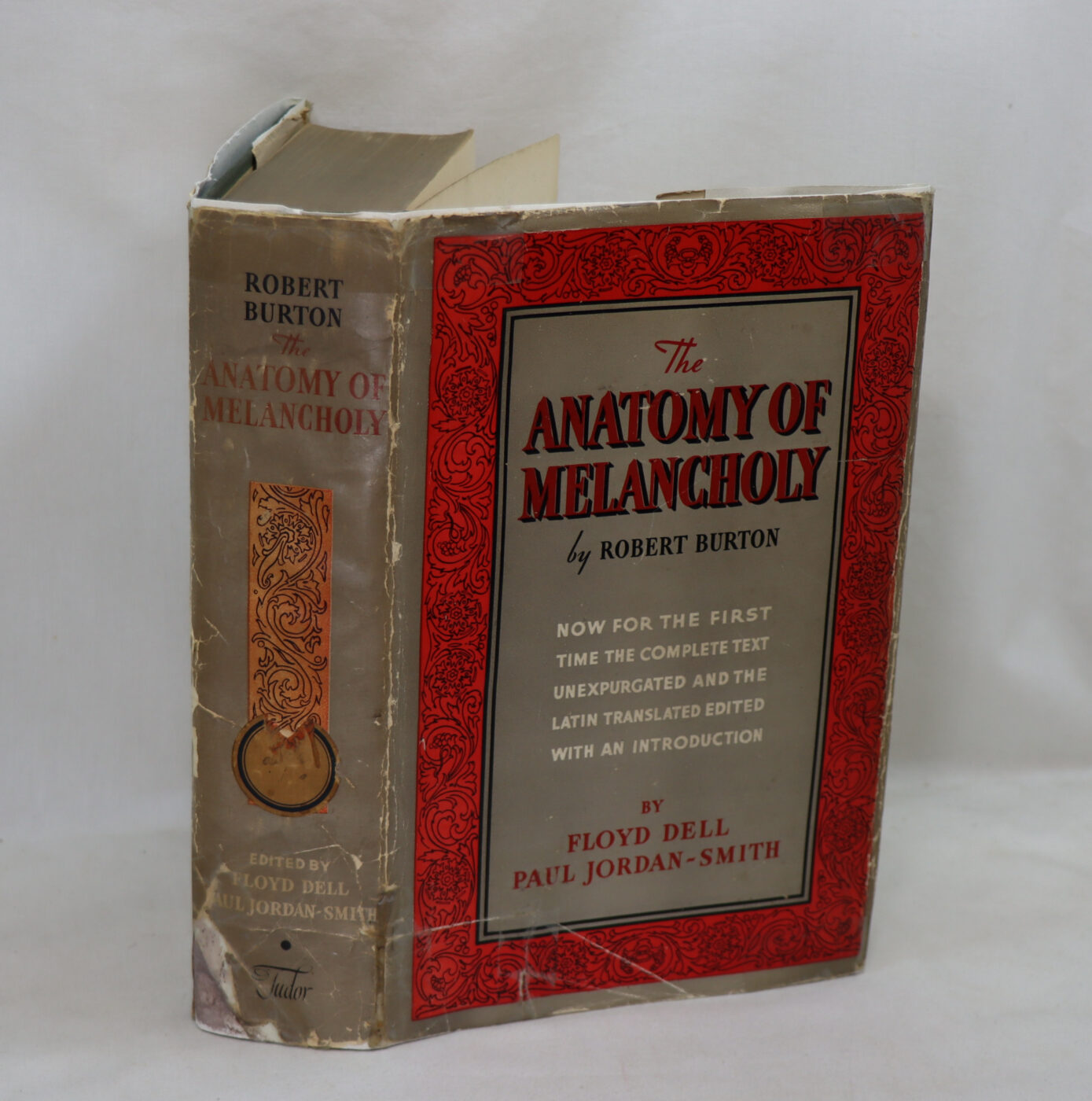
In the original (repaired) dust cover. Green cloth binding with gilt title on the spine.
We provide an in-depth photographic presentation of this item to stimulate your feeling and touch. More traditional book descriptions are immediately available
- Note: This book carries a £5.00 discount to those that subscribe to the F.B.A. mailing list
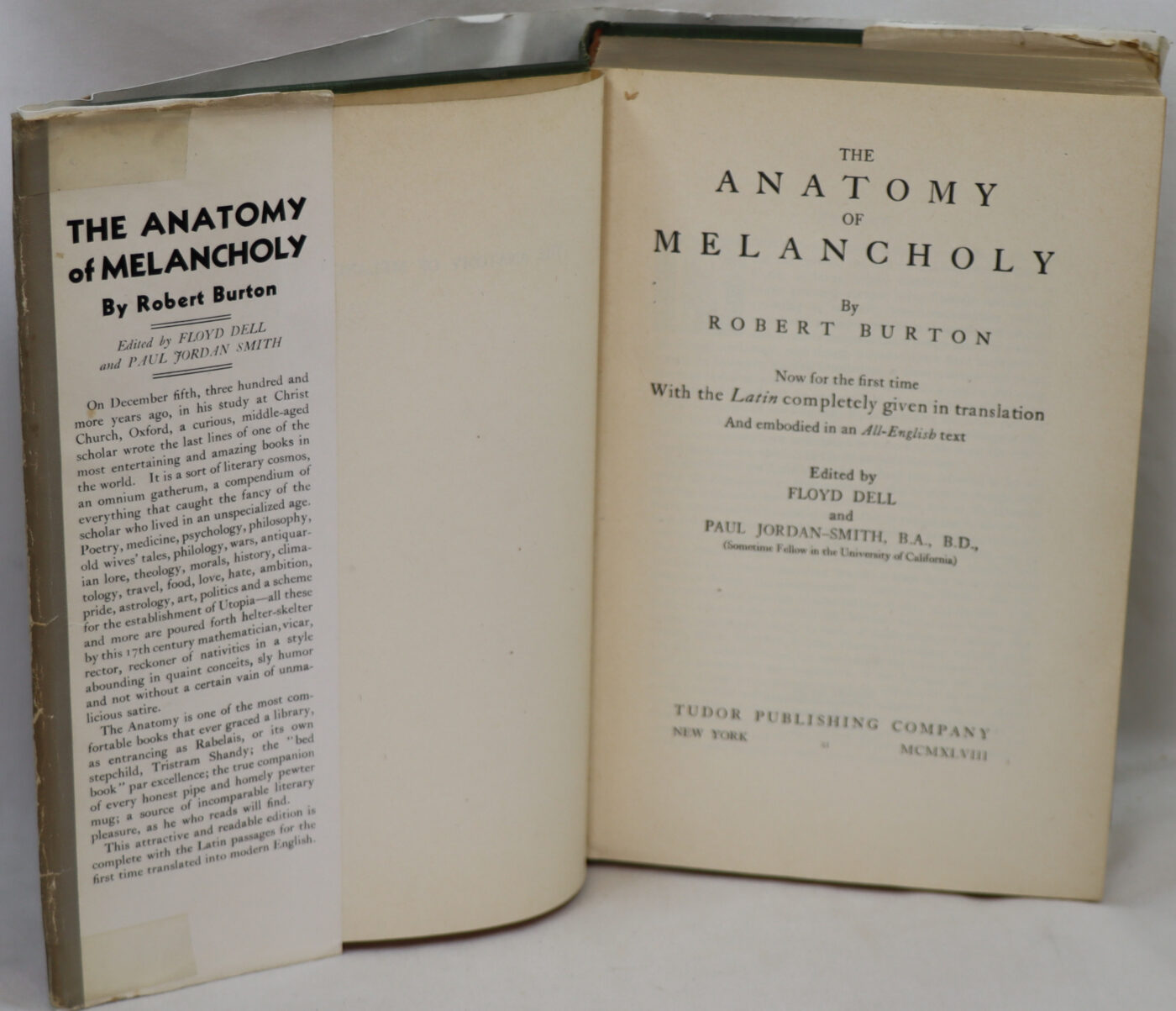
The 1948 Tudor Publishing Co. edition of The Anatomy of Melancholy by Robert Burton is a recognized one-volume reprint of this classic 17th-century psychological work. It typically features an editor’s note by Floyd Dell and Paul Jordan-Smith.
- Availability & Condition: Commonly found as a sturdy hardcover, often in blue or green cloth binding.
- Value: Generally considered a reading copy rather than a high-value collector’s item. Prices for used copies in good condition often fall in the range of £20-£50, though higher prices may be listed based on condition, particularly with a dust jacket.
- Content: This edition preserves the extensive 17th-century exploration of melancholy (depression), including causes, symptoms, and cures, often with the original spelling and typography maintained.
If your copy has its original dust jacket in good condition, it will have a higher value than a copy without one.
The Anatomy of Melancholy (full title: The Anatomy of Melancholy, What it is: With all the Kinds, Causes, Symptomes, Prognostickes, and Several Cures of it. In Three Maine Partitions with their several Sections, Members, and Subsections. Philosophically, Medicinally, Historically, Opened and Cut Up) is a book by Robert Burton, first published in 1621 but republished five more times over the next seventeen years with massive alterations and expansions.
The book is a medical treatise about melancholy (depression). Over 500,000 words long, it discusses a wide range of topics besides depression – including history, astronomy, geography, and various aspects of literature and science – and frequently uses humour to make points or explain topics. Burton wrote it under the pseudonym Democritus Junior as a reference to the Ancient Greek “laughing philosopher” Democritus.
The Anatomy of Melancholy inspired several writers of the following centuries, such as Enlightenment figures like Samuel Johnson and modern authors like Philip Pullman. Romantic poet John Keats claimed Anatomy was his favorite book. Portions of Burton’s writing were plagiarized by Laurence Sterne in Tristram Shandy during the 1750s and 1760s.
Robert Burton (8 February 1577 – 25 January 1640; sometimes writing under the pen name Democritus Junior) was an English author and fellow of Oxford University, known for his encyclopedic The Anatomy of Melancholy.
Born in 1577 to a comfortably well-off family of the landed gentry, Burton attended two grammar schools and matriculated at Brasenose College, Oxford in 1593, age 15. Burton’s education at Oxford was unusually lengthy, possibly drawn out by an affliction of melancholy, and saw an early transfer to Christ Church. Burton received an MA and BD, and by 1607 was qualified as a tutor. As early as 1603, Burton indulged in some early literary creations at Oxford, including Latin poems, a now-lost play performed before and panned by King James I himself, and his only surviving play: an academic satire called Philosophaster. This work, though less well regarded than Burton’s masterpiece, has “received more attention than most of the other surviving examples of university drama”.
Sometime after obtaining his MA in 1605, Burton made some attempts to leave the university. Though he never fully succeeded, he managed to obtain the living of St Thomas the Martyr’s Church, Oxford through the university, and external patronage for the benefice of Walesby and the rectorship of Seagrave. As a fellow of Oxford, he served in many minor administrative roles and as the librarian of Christ Church Library from 1624 until his death. Over time he came to accept his “sequestered” existence in the libraries of Oxford, speaking highly of his alma mater throughout the Anatomy.
Burton’s most famous work and greatest achievement was The Anatomy of Melancholy. First published in 1621, it was reprinted with additions from Burton no fewer than five times. A digressive and labyrinthine work, Burton wrote as much to alleviate his own melancholy as to help others. The final edition totalled more than 500,000 words. The book is permeated by quotations from and paraphrases of many authorities, both classical and contemporary, the culmination of a lifetime of erudition.
Burton died in 1640. Within the university, his death was (probably falsely) rumoured to have been a suicide. His large personal library was divided between the Bodleian and Christ Church. The Anatomy was perused and plagiarised by many authors during his lifetime and after his death, but entered a lull in popularity through the 18th century. It was only the revelation of Laurence Sterne’s plagiarism that revived interest in Burton’s work into the 19th century, especially among the Romantics. The Anatomy received more academic attention in the 20th and 21st centuries. Whatever his popularity, Burton has always attracted distinguished readers, including Samuel Johnson, Benjamin Franklin, John Keats, William Osler, and Samuel Beckett.
NOTE: This is an original book from the library gathered by the famous Cambridge Don, computer scientist, food and wine connoisseur, Jack Arnold LANG. Note: Jack founded the Michelin Guide ‘Midsummer House’- Cambridge’s paramount restaurant. This dining experience is hidden amongst the grassy pastures and grazing cattle of Midsummer Common and perched on the banks of the River Cam.
In 2008, Jack was one of the co-founders of the Raspberry Pi Foundation, alongside other members of the Department, and acted as the Foundation’s Chair. The project’s original goals were modest: to build and distribute low-cost computers for prospective applicants to our Computer Science degree. Initially the project was a “success disaster”, as Jack would say, as demand far outstripped the low-scale manufacturing plans. Ultimately the Raspberry Pi became the UK’s most successful computer with more than 60 million sold to date. Jack was drawn to the educational possibilities of the Raspberry Pi, its potential uses in emerging economies and the way it could support self-directed learning.
Condition notes
Dust jacket repaired
Want to know more about this item?
We are happy to answer any questions you may have about this item. In addition, it is also possible to request more photographs if there is something specific you want illustrated.
Ask a question
Related products







Share this Page with a friend
