
Stories of Old Renown.
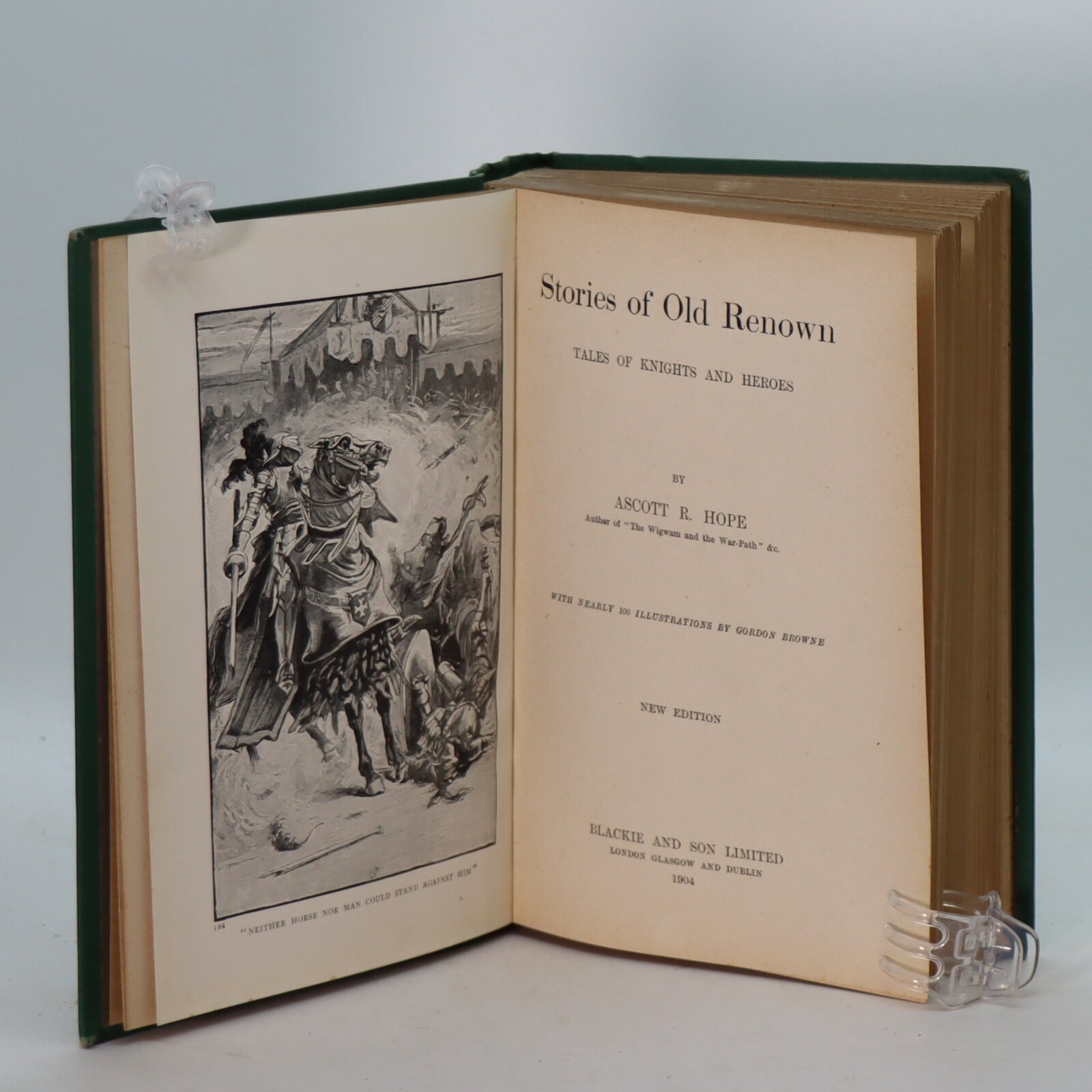
By Ascott R Hope
Printed: 1904
Publisher: Blackie & Son. London
| Dimensions | 14 × 19 × 3 cm |
|---|---|
| Language |
Language: English
Size (cminches): 14 x 19 x 3
Condition: Very good (See explanation of ratings)
SORRY, THIS ITEM HAS SOLD

Item information
Description
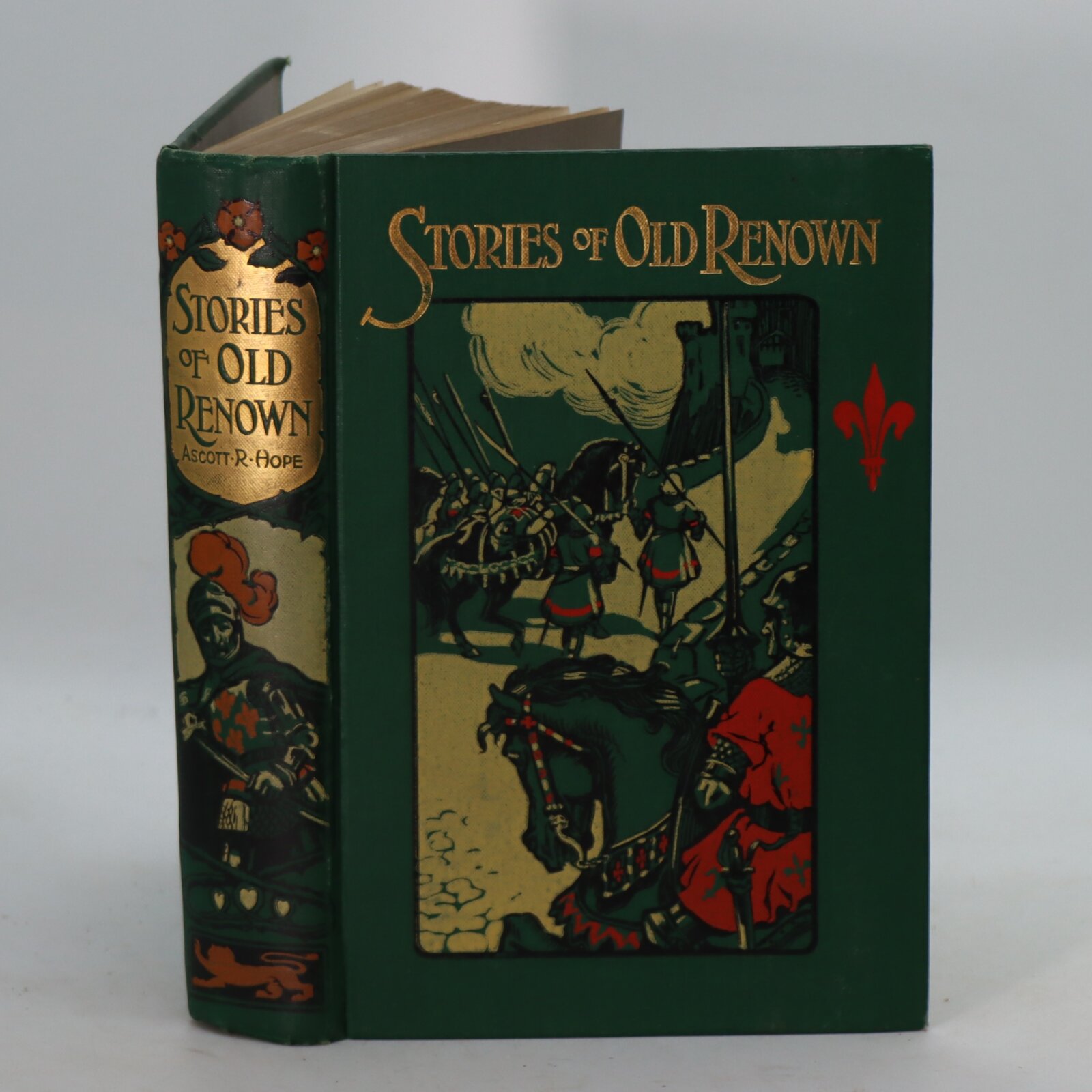
Green cloth binding Gilt title and knights picture on the front board. Similar on the spine.
F.B.A. provides an in-depth photographic presentation of this item to stimulate your feel and touch. More traditional book descriptions are immediately available.
An excellent children’s story
Robert Hope Moncrief (1846 – 1927) was a prolific Scottish author of children’s fiction and of Black’s Guides.
Before he was out of his teens, Moncrieff had written and made money by a real book. While he attended the University of Edinburgh he wrote A book about Dominies (1867), Dominies being a term used for schoolmasters in Scotland. This was taken by a publisher, who published it at his own expense with a promise of profit to the author, which proved rather a mirage in the cold light of publishing accounts. It was published anonymously with no author’s name given. The book was well reviewed and went into several editions. Moncrieff followed this up with A Book About Boys, (1868) adopting his pseudonym Ascott R. Hope for the first time. Moncrieff was ashamed of some of his early books and went to some expense to withdraw them from circulation.
Moncrieff says that he had have made awkward attempts at more than one handicraft, with the view of gathering straw for literary bricks. He was said to have taken up teaching briefly more with the purpose of studying schoolboys and their ways than to making it a profession.
Moncrieff travelled extensively. Even his census returns in the UK show how much he bounced around:
- 1851 – Living with his widowed father and two siblings in Perth. 5 years old.
- 1861 – At the Circus Place School in Edinburgh with his brother John.
- 1871 – An assistant master at Christ College, Brecon in Wales.
- 1881 – Boarding at 8, Victoria Grove, in Kensington, London. Profession now is Author.
- 1891 – Boarding at Hillside Boarding Lodge in Ventnor on the Isle of Wight. Profession is Author. The 13th edition of Black’s Guide to the Isle of Wight, edited by Moncrieff, was published in 1895.
- 1901 – Now 55 years old. Moncrieff was no longer boarding, but was at the head of his own establishment at 85 Munster Road in Fulham, London. No relatives in the house, but the house also holds his 60-year-old housekeeper and her adult daughter. The electoral register show that he was still there in 1907.
- 1911 – Only occupant of 5 Chandos Road, Cricklewood, London, apart from a 52-year-old housekeeper.
- 1927 – On his death at 81 years-of-age he was living at 16a Addison Gardens, Kensington, London.
Moncrieff not only travelled the whole of Great Britain, but he also travelled internationally. He wrote: It has been by lot to be a good deal about the world from an early age. After a boyish visit to Paris, my travels began with a cruise in the Mediterranean and a stay in Italy, still heaving from Garibaldi’s exploits. Moncrieff travelled, and visited four continents. He even tried his hand at farming in Canada, but soon abandoned it. All of his travels contributed not only to the background for his books, but also supported his books on geography and history. Moncrieff suffered from short-sightedness and this led him to favour occupations such as walking and riding. And these leisurely pursuits allowed him to make observations that he made use of when writing on topographical topics.
His study of the geography of the world, The world of to-day : a survey of the lands and peoples of the globe as seen in travel and commerce (1905) took him five years, and was updated every two years or so. Moncrieff wrote ever word of the six volumes, bar a single page.
Moncrieff was a member of first the Savile and later of the Athenaeum. He was of a kindly nature and always ready to do good to others, but in a discreet way. He wrote that his work seldom brought him into contact with fellow authors, and that still less had he cultivated what is called smart society. His view of the world’s affairs was mainly that of a looker-on. He wrote: I have lived my life in my own way, and that his writing was the sum of his accomplishments.
Want to know more about this item?
We are happy to answer any questions you may have about this item. In addition, it is also possible to request more photographs if there is something specific you want illustrated.
Ask a question
Related products
Share this Page with a friend
