
South with Scott.
By Vice-Admiral E R G Evans
Printed: Circa 1925
Publisher: Collins Clear Type Press. London
| Dimensions | 13 × 19 × 4 cm |
|---|---|
| Language |
Language: English
Size (cminches): 13 x 19 x 4
Condition: Poor (See explanation of ratings)
£20.00
Buy Now

Item information
Description
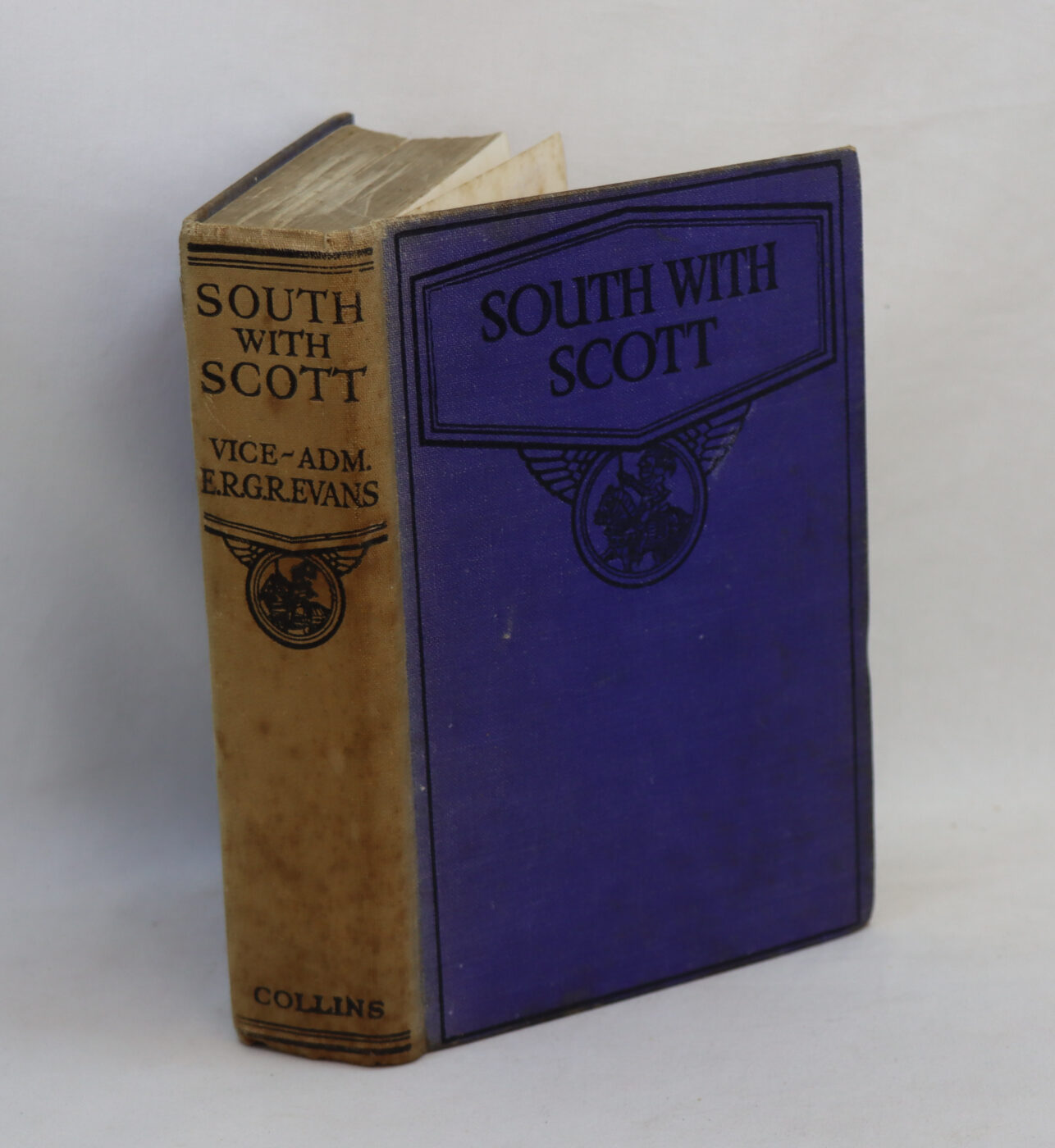
Purple cloth binding with black title on the spine and front board.
We provide an in-depth photographic presentation of this item to stimulate your feeling and touch. More traditional book descriptions are immediately available.
- Note: This book carries a £5.00 discount to those that subscribe to the F.B.A. mailing list
Please view our photographs: The technical and physical specifications for a vintage edition of South with Scott by Vice-Admiral E.R.G.R. Evans, published by Collins Clear Type Press.
About the Book & Author
- The Historical Context: First published in 1921, South with Scott is a highly popular and enduring account of Captain Robert Falcon Scott’s tragic Terra Nova Expedition (1910–1913) to the South Pole.
- The Author: Edward “Teddy” Evans (later Lord Mountevans) was Scott’s second-in-command. He accompanied Scott to within 150 miles of the Pole before being ordered to turn back. Evans narrowly survived the return trek after contracting a severe case of scurvy.
Edition Identification
Collins Clear Type Press frequently issued this book in multiple formats during the 1920s and 1930s, often as part of their “Library of Classics” or pocket series.
- The Binding: These 1920s editions were commonly bound either in a vivid cobalt blue cloth featuring pictorial stamping of Captain Scott or an ice scene, or as a soft faux-leather/leather pocket edition.
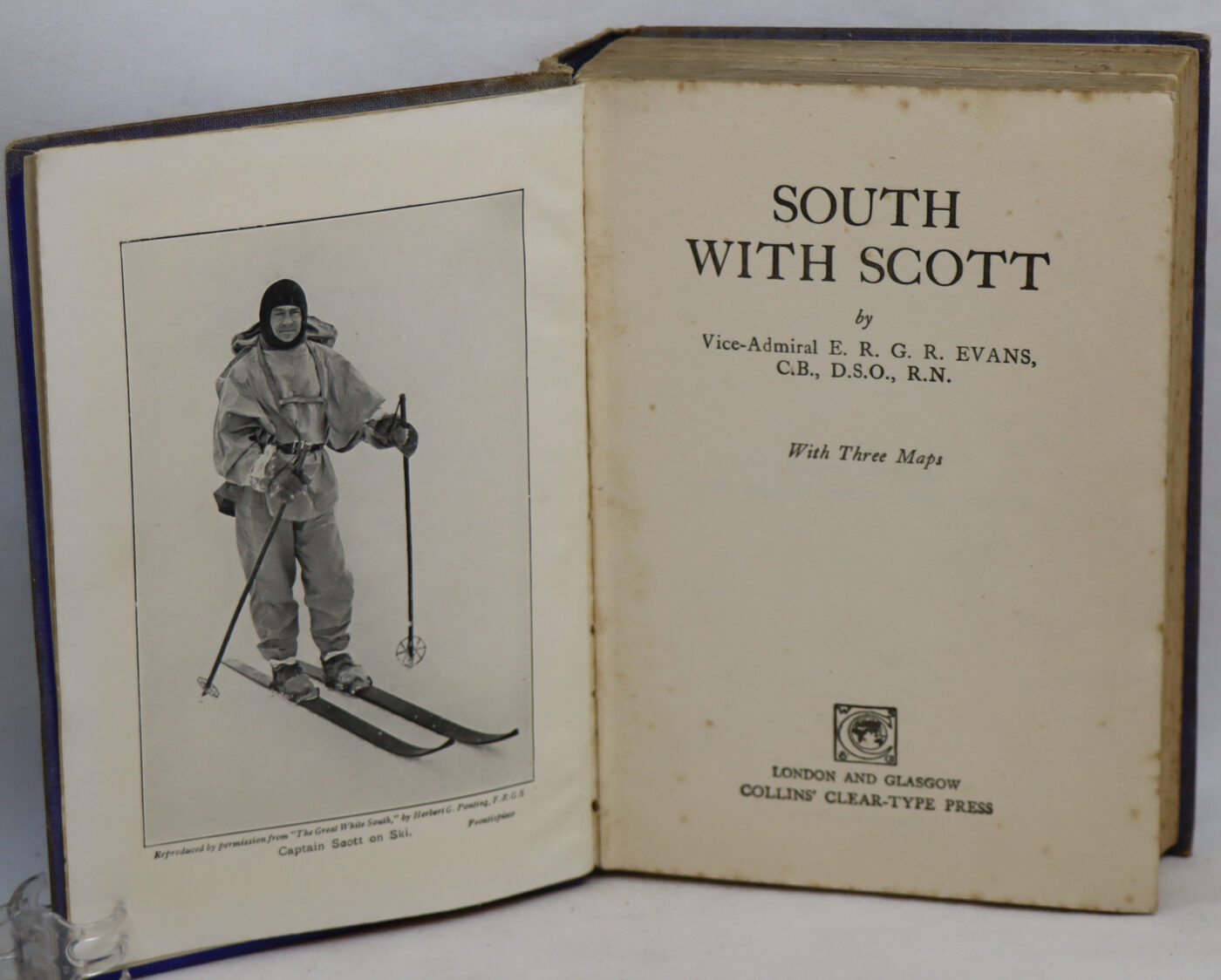
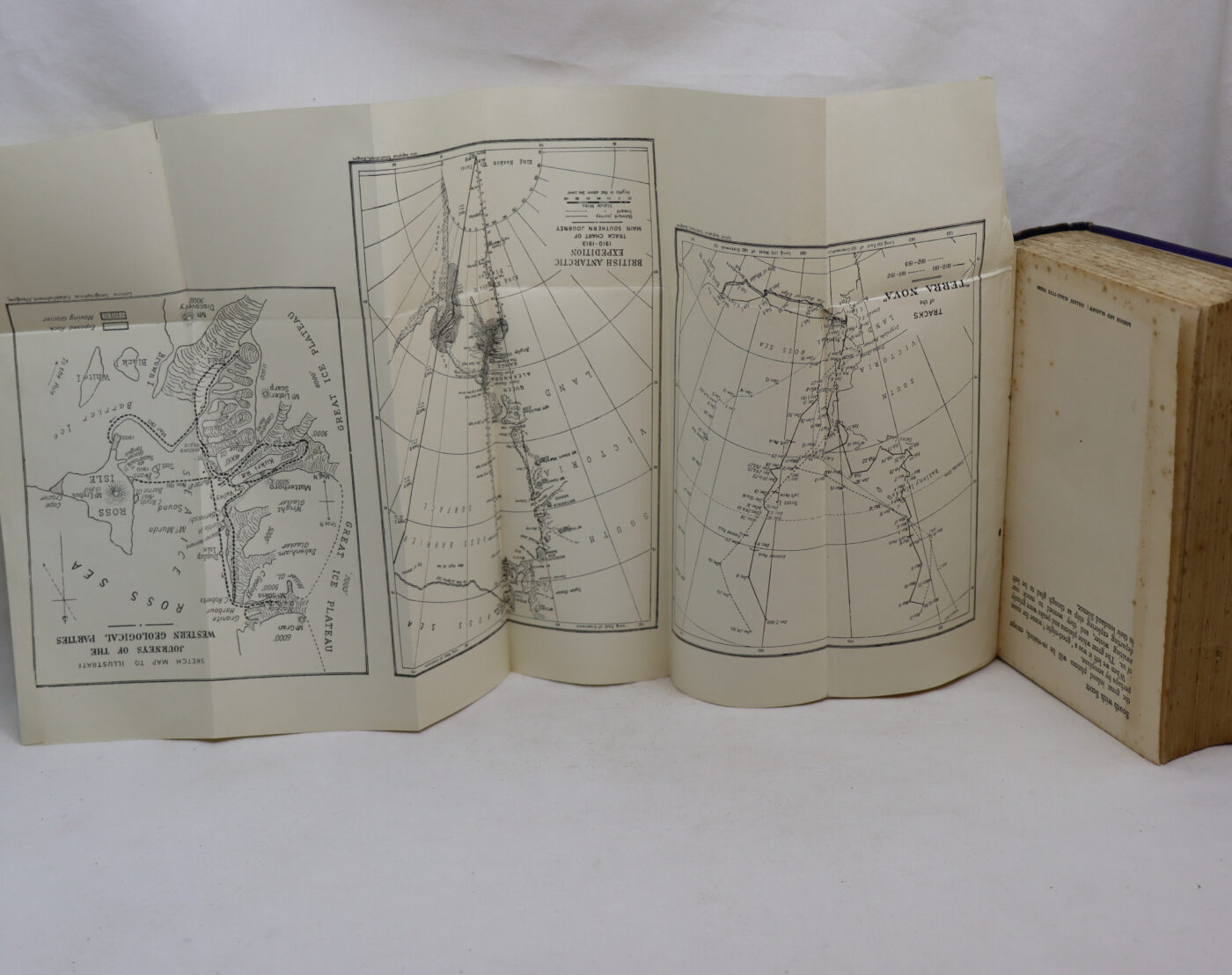
- Interior Features: Copies from this era typically feature a photographic frontispiece of Captain Scott, a few black-and-white plates, and a fold-out map tucked inside the back cover.
Value & Collectability
Because Collins reprinted this book extensively to satisfy public demand for Antarctic adventure stories, regular 1920s reprints are widely available.
- Standard trade or pocket copies from circa 1925 in good condition generally hold a modest market value of £15 to £25.
- Pristine copies with highly decorative boards or those that still possess their original dust jackets command higher premiums. (Note: True 1921 first editions from the original publisher, W. Collins Sons & Co., carry significantly higher valuation).
NOTE 1: Admiral Edward Ratcliffe Garth Russell Evans, 1st Baron Mountevans, KCB, DSO, SGM (28 October 1880 – 20 August 1957) was a Royal Navy officer and Antarctic explorer
Evans was seconded from the navy to the Discovery expedition to Antarctica in 1901–1904, when he served on the crew of the relief ship, and afterwards began planning his own Antarctic expedition. However, he suspended this plan when offered the post of second-in-command on Robert Falcon Scott’s ill-fated Terra Nova expedition to the South Pole in 1910–1913, as captain of the expedition ship Terra Nova. He accompanied Scott to within 150 miles of the Pole, but was sent back in command of the last supporting party. On the return he became seriously ill with scurvy and only narrowly survived.
After the expedition Evans toured the country giving lectures, and returned to his naval duties as a commander in the summer of 1914. He spent the First World War as a destroyer captain, becoming famous as “Evans of the Broke” after the battle of Dover Strait in 1917. He commanded a cruiser at Hong Kong in 1921–1922, where he was awarded a medal for his role in rescuing passengers from the wrecked vessel Hong Moh, and then spent several years commanding the Home Fisheries Protection Squadron before being given command of the modern battlecruiser HMS Repulse. He later commanded the Australian Squadron and the Africa Station before becoming Commander-in-Chief, The Nore, one of the Navy’s senior Home Commands; during this time, unusually for a serving officer, he was also Rector of the University of Aberdeen.
After four years at the Nore, Evans handed over command in early 1939, and was appointed Civil Defence Commissioner for London during the preparations for the Second World War; after the German invasion of Norway he travelled there to liaise with King Haakon VII, a personal acquaintance. He remained in a civil defence role throughout the War, though he had officially retired from the Navy in 1941, and was raised to the peerage in 1945, sitting in the House of Lords as a Labour member.
Edward Ratcliffe Garth Russell Evans, known to his family and friends as “Teddy”, was born in London on 28 October 1880, at a mews near Berkeley Square. He was the second of three sons born to Frank Evans and his wife Eliza, née McNulty. Frank Evans, a young barrister at Lincoln’s Inn, hailed from a large Lancashire family of Welsh descent; his father had been a provision merchant in Oldham. Eliza McNulty’s family were of Irish origin and lived at Deptford. The family were respectably middle-class, but the three Evans children did not behave as respectably as might be expected; when Edward was nine, he and his brothers frequently roamed far into the East End, on one occasion being detained by the police after a theft. Edward and his older brother Joe were admitted to the Merchant Taylors’ School in 1890, when he was ten, and were expelled for fighting and truancy a year later. He was then sent to a relatively modern school in the countryside near Croydon, which aimed to educate “troublesome boys”; despite being the youngest boy and often victimised and homesick, he enjoyed the rural environment and responded well to the teaching. He later attended a school in Maida Vale where he obtained high marks but slipped back into his old misbehaviour; the headmaster responded by making him a prefect, which shocked Evans into self-discipline. He became one of the school’s star performers, with a string of prizes, before leaving at 14.
Evans sought a career at sea, and while at school had tried, but failed, to obtain a cadetship with the Royal Navy training ship HMS Britannia. The alternatives open to him were to be “crammed” by an expensive tutor and resit the Britannia examination, or to attend the cheaper privately run training ship HMS Worcester, which mainly trained officers for the Merchant Navy. His father chose the latter, and Evans joined the Worcester in January 1895. He was heavily bullied, but by the middle of his second year had found his place, and gained a reputation as an able and diligent – if still troublesome – cadet. He won several prizes, culminating in a coveted Navy cadetship in his final year.
As a Midshipman Evans was posted to the cruiser HMS Hawke in the Mediterranean in 1897, a ship noted for her immaculate presentation and strict conduct, which was not entirely to Evans’ taste. In August he became seriously ill with brucellosis, after drinking contaminated milk, and was sent home to recover for three months. During this time, he gained a lasting fanaticism for physical fitness, walking forty or fifty miles in a day and swimming for hours in the sea; he would maintain this state of fitness for decades to come. After returning to duty, he was posted to the battleship HMS Repulse and then the sloop HMS Dolphin, following which he was examined and passed as a sub-lieutenant. He then studied at the Royal Naval College, Greenwich, interrupted with a posting to HMS Majestic, where he first encountered then-Lieutenant Robert Falcon Scott.
Condition notes
Hinge broken
Want to know more about this item?
We are happy to answer any questions you may have about this item. In addition, it is also possible to request more photographs if there is something specific you want illustrated.
Ask a question
Related products




Share this Page with a friend
