
Essays on Chivalry, Romance and the Drama. Sir Walter Scott's Prose Works.
By Sir Walter Scott
Printed: 1834
Publisher: Robert Caddell. Edinburgh
| Dimensions | 12 × 18 × 3 cm |
|---|---|
| Language |
Language: English
Size (cminches): 12 x 18 x 3
Condition: Good (See explanation of ratings)
£74.00
Buy Now


Item information
Description
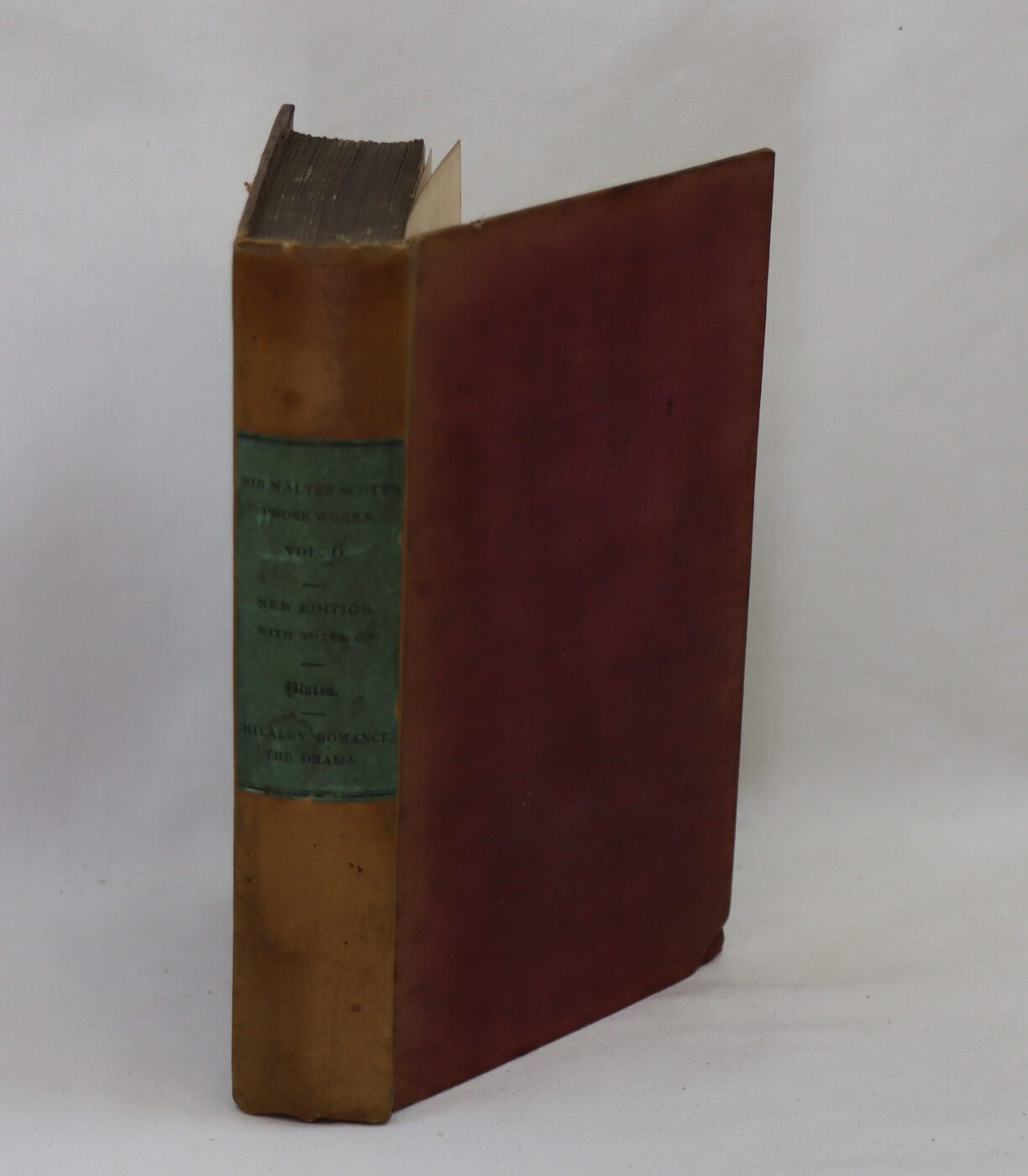
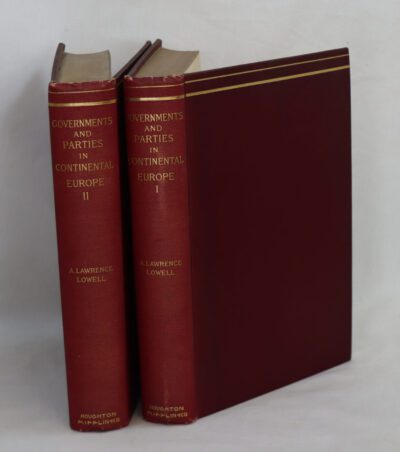
Maroon cloth binding with blue title plate and black title on the spine.
We provide an in-depth photographic presentation of this item to stimulate your feeling and touch. More traditional book descriptions are immediately available.
- Note: This book carries a £5.00 discount to those that subscribe to the F.B.A. mailing list
This is a collector’s work which will greatly interest all fans of Sir Walter Scott along with the evolution of 19th century printing and publishing. For conditions please view our extensive photographs.
To fully appreciate this work you should read the thesis: ‘The Posthumous British Editions of Sir Walter Scott‟s Waverley Novels, 1832-1871, And the Evolution of his Literary Legacy’ by Ruth M. McAdam. Find: ‘RM McAdamsMPhil thesis on Walter Scott (733K)’
Ruth M. McAdam’s thesis argues for the importance of the posthumous editions of Sir Walter Scott‟s Waverley Novels in shaping his literary reputation between 1832 and 1871. In the series of editions published by Robert Cadell and later A. & C. Black between Scott‟s death and the centenary of his birth, changes were made to the paratextual presentation of the novels, particularly through illustrations and notes. By tracing these changes, I will show how Scott‟s literary legacy evolves over this crucial period. Furthermore, by demonstrating that these posthumous editions reached a far wider audience than ever before, I will suggest that these editions, rather than any published during Scott‟s lifetime, most powerfully shaped his status as a cultural icon in the nineteenth century. These editions are, thus, still important to the way that Sir Walter Scott‟s place in the literary canon is understood.
Valuation and Preservation
- Market Value: Partial or multi-volume editions of Scott’s prose works or Napoleon biography generally hold modest antiquarian value. Single volumes or partial broken sets from this 1835 edition typically sell in the range of £60 to £80 each, while complete original multi-volume sets (if in exceptionally good condition, leather-bound) are worth several hundred pounds.
- Verifying Your Copy: To understand the exact value of your three-volume set, you can research the publisher using antiquarian aggregator tools.
- Historical Significance: You can read more about the origins of this monumental biography.
Robert Cadell (16 December 1788 – 20 January 1849) was a bookseller and publisher closely associated with Sir Walter Scott. He was born at Cockenzie, East Lothian, Scotland, the fifth son of John Cadell, a Laird of Cockenzie, and Marie Buchan, his wife. Cadell’s career began as a clerk at Archibald Constable & Co., Sir Walter Scott’s publisher, where he acquired an interest in the firm from 1809, became a joint partner in 1811 after Mr Hunter of Blackness dropped out, and from 1812 was sole partner with Constable. The connection to Constable was also personal: Cadell married his daughter Elizabeth in October 1817. She died less than nine months later. Cadell married again (to Anne Fletcher Mylne) in 1821, adding to the friction which had developed between Constable and Cadell since the death of Elizabeth. The two men were very different characters: Cadell was cautious and lived plainly, while Constable’s lifestyle was lavish and he took risks in business. When Constable’s London agents Hurst Robinson went bankrupt and Archibald Constable & Co. itself fell into receivership in January 1826 through the effects of Scott’s own bankruptcy, the partnership between Cadell and Constable dissolved. Scott chose to remain with Cadell, respecting Cadell’s prudence in business affairs. Scott and Cadell purchased the copyright to Scott’s novels and produced a new edition of the Waverley novels including new material penned by Scott. The work to create this ‘author’s edition’ commenced in 1827 and was highly successful, in part perhaps because of the illustrations executed for it by J. M. W. Turner.
Cadell took care of Scott in the writer’s last years, profiting handsomely from arrangements made with Scott’s family after his death such that they were absolved from debt in return for Cadell’s exclusive right to republish Scott’s novels and biographical material. On Scott’s death, Cadell paid £30,000 for Scott’s share of the copyright on Scott’s work, thereafter owning it outright. Cadell’s wealth enabled him to acquire considerable land and personal property, including Ratho House, in Midlothian. Cadell died at Ratho on 20 January 1849 and is buried in Greyfriars Kirkyard in central Edinburgh. The grave stands at the head of one of the western lines in the western extension.
Want to know more about this item?
We are happy to answer any questions you may have about this item. In addition, it is also possible to request more photographs if there is something specific you want illustrated.
Ask a question
Related products
Share this Page with a friend
