
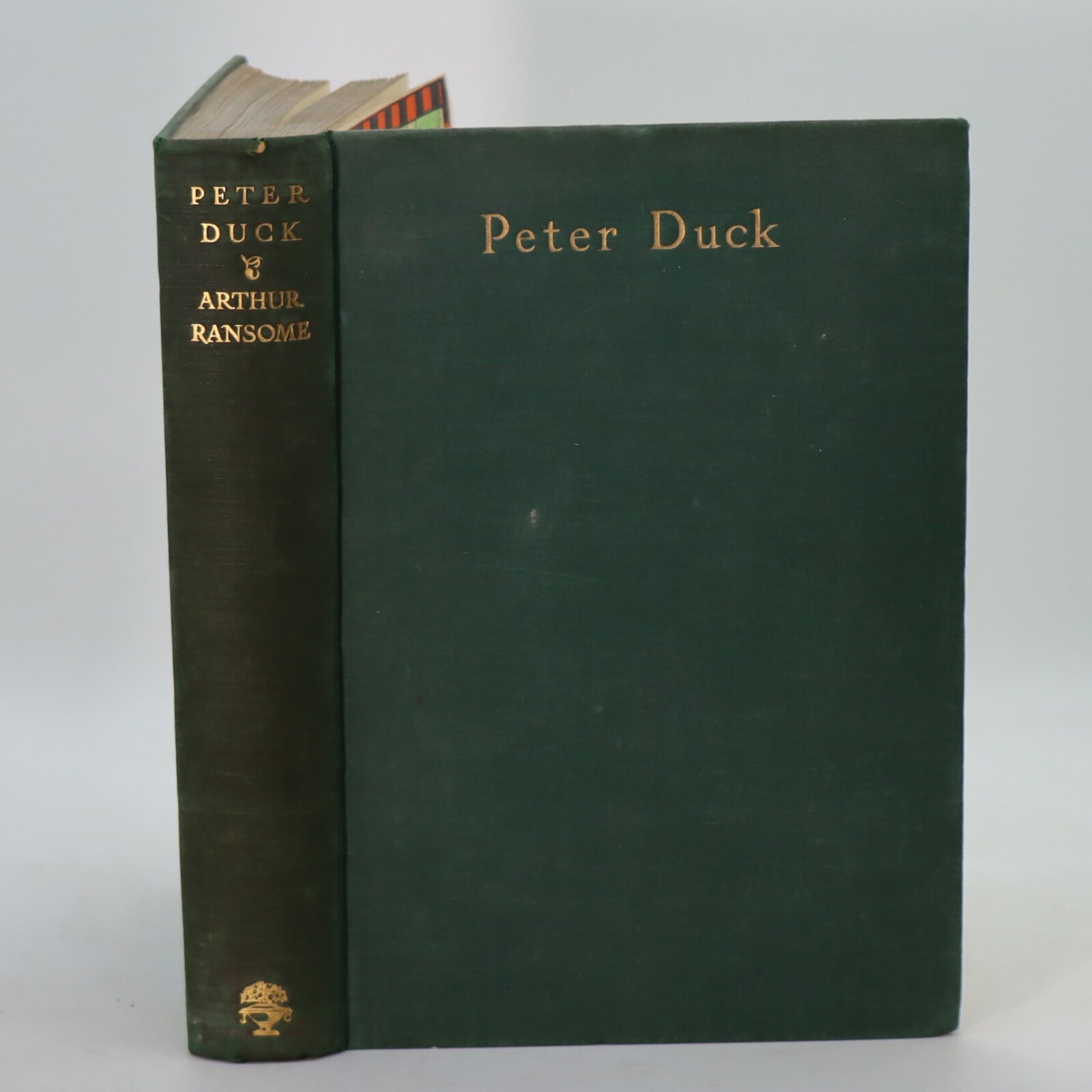
Peter Duck.
By Arthur Ransome
Printed: Circa 1938
Publisher: Jonathan Cape. London
| Dimensions | 15 × 21 × 4 cm |
|---|---|
| Language |
Language: English
Size (cminches): 15 x 21 x 4
Condition: Very good (See explanation of ratings)
£38.00
Buy Now

Item information
Description
Green cloth binding with gilt title on the front board and spine.
F.B.A. provides an in-depth photographic presentation of this item to stimulate your feel and touch. More traditional book descriptions are immediately available.
No dustjacket: by the 1932 formatting. the impression date is likely to be earlier than 1938, but without contra evidence this book is priced as produced in 1938
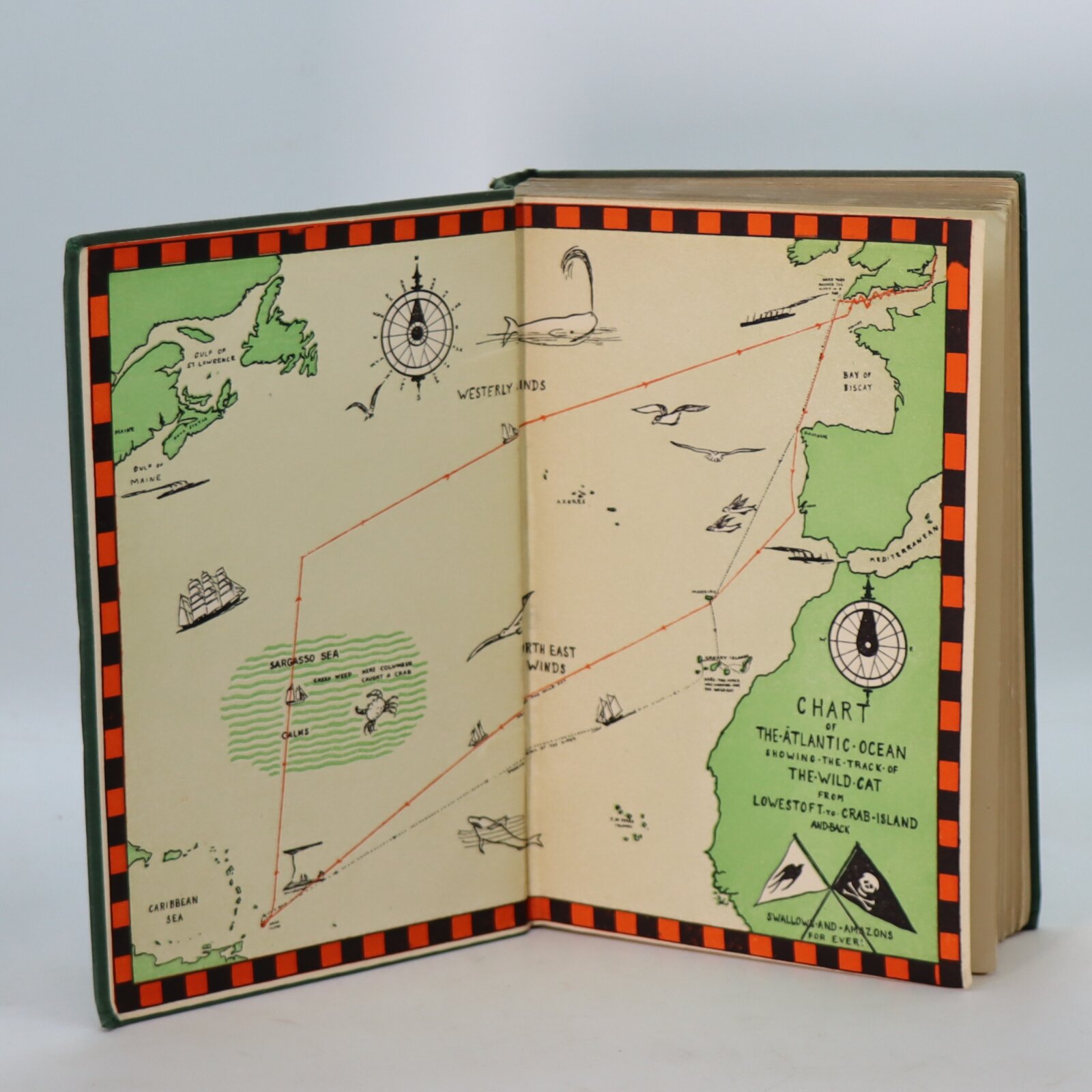
Peter Duck is the third book in the Swallows and Amazons series by Arthur Ransome. The Swallows and Amazons sail to Crab Island with Captain Flint and Peter Duck, an old sailor, to recover buried treasure. During the voyage the Wildcat (Captain Flint’s ship) is chased by another vessel, the Viper, whose piratical crew are also intending to recover the treasure.
The book, first published in 1932, is considered to be one of the metafictional books in the series, along with Missee Lee and perhaps Great Northern?. Most of the book was written in Aleppo where Ransome was staying with the Altounyans.
The appearance, sailing background and many of the characteristics of Peter Duck are based on Captain Sehmel, a Latvian sailor who accompanied Ransome on a cruise aboard his yacht Racundra in the Baltic Sea, as documented in Ransome’s sailing book, Racundra’s First Cruise.
Ransome used as a major resource for Peter Duck a book by one of his favourite sailing authors, E. F. Knight, The Cruise of the Alerte. This describes a treasure-seeking expedition on the volcanic island of Trindade, off Brazil (sometimes known as “Trinidad” but not to be confused with the larger Caribbean island of that name). Trindade has many features in common with Peter Duck’s Crab Island, including mountains, landslides, jungles and loathsome land crabs.
By publication date, Peter Duck is the third book in the series, but the story is supposed to be one created by the Swallows and Amazons while staying on a Norfolk wherry with Captain Flint in the winter between the first two books. Two early chapters describing this creation process were written by Arthur Ransome before he started Swallowdale. This opening was discarded from the final version of the book when it was published after Swallowdale. However, Peter Duck is mentioned in Swallowdale as Titty’s imaginary friend from a story made up by the Swallows and Amazons.
THE PLOT SUMMARY
The Swallows and Amazons are in Lowestoft, preparing for a cruise aboard a schooner, the Wild Cat, with Captain Flint, the Blacketts’ uncle Jim Turner. Unfortunately, the other adult (Sam Bideford) cannot come and so the cruise is threatened until Peter Duck, an elderly seaman, offers to come along to help. In the harbour a larger black schooner, the Viper, is fitting out for a voyage and Peter Duck’s presence aboard the Wild Cat interests Black Jake, the Viper’s captain. Peter Duck spins a yarn about a treasure that he saw being buried long ago, when marooned on a desert island in the Caribbean Sea, and which Black Jake wants to find. When the Wild Cat sails, the Viper is quick to follow and trails her down the English Channel, at one point threatening to board her in the night.
In a fog off Land’s End, the crew of the Wild Cat give the Viper the slip but pick up the Viper’s cabin boy, Bill, who has been set adrift to try and fool the Wild Cat’s crew with false signals. They continue across the Atlantic Ocean to Crab Island where they spend several days searching in vain for Peter Duck’s treasure.
When a hurricane blows up, Peter Duck and Captain Flint take the Wild Cat out to sea to ride out the storm, leaving the Swallows and Amazons ashore. There is an earthquake during the storm, and when the schooner returns all the paths to the treasure-hunters’ camp are blocked by landslides and fallen trees. However, a fallen palm tree exposes a small box, Peter Duck’s treasure, which the children recover. They decide to sail round to the anchorage as the land route is blocked.
While Captain Flint attempts to cross the island to rescue the Swallows and Amazons, the Viper arrives and Peter Duck and Bill are captured. The crew of the Viper also go ashore to look for the treasure. The children rescue Peter Duck and Bill, and then the Wild Cat sails back to the other side and they pick up Captain Flint just before Black Jake arrives. They attempt to sail away from the island but the wind dies and the Viper looks like catching them, but they are saved by a waterspout which destroys the Viper. They return home safely without further incident. The treasure proves to be a collection of pearls.
Arthur Michell Ransome CBE (18 January 1884 – 3 June 1967) was an English author and journalist. He is best known for writing and illustrating the Swallows and Amazons series of children’s books about the school-holiday adventures of children, mostly in the Lake District and the Norfolk Broads. The books remain popular and Swallows and Amazons is the basis for a tourist industry around Windermere and Coniston Water, the two lakes Ransome adapted as his fictional North Country lake.
He also wrote about the literary life of London, and about Russia before, during, and after the revolutions of 1917. His connection with the leaders of the Revolution led to him providing information to the Secret Intelligence Service, while he was also suspected of being a Soviet spy by MI5.
By the late 1920s, Ransome had settled in the Lake District because he had decided not to accept a position as a full-time foreign correspondent with The Guardian newspaper. Instead he wrote Swallows and Amazons in 1929—the first of the series that made his reputation as one of the best English writers of children’s books.
Ransome apparently based the Walker children (the “Swallows”) in the book partly on the Altounyan family. He had a long-standing friendship with the mother of the Altounyans, and their Collingwood grandparents. Later, he denied the connection, claiming he simply gave the Altounyans’ names to his own characters; it appears to have upset him that people did not regard the characters as original creations. Letters also indicate that conflict arose between Ransome and the family.
Ransome’s writing is noted for his detailed descriptions of activities. Although he used many actual features from the Lake District landscape, he invented his own geography, mixing descriptions of different places to create his own juxtapositions. His move to East Anglia brought a change of location for four of the books, and Ransome started using the real landscape and geography of East Anglia, so that one can use the maps printed in the books as a guide to the real area. Ransome’s own interest in sailing and his need to provide an accurate description caused him to undertake a voyage across the North Sea to Flushing. His book We Didn’t Mean To Go To Sea reflects that, and he based the fictional Goblin on his own boat Nancy Blackett (which in turn took its name from a character in the series).
Two or three of the Swallows and Amazons books have less realistic plots. The original concept of Peter Duck was a story made up by the children themselves, and Peter Duck had appeared in the preceding volume, Swallowdale, as a character whom the children created, but Ransome dropped the foreword of explanation from Peter Duck before it was published. Although relatively straightforward, the story, together with its equally unrealistic ostensible sequel Missee Lee, is much more fantastic than the rest of the series. A trip to China as a foreign correspondent provided Ransome with the imaginative springboard for Missee Lee, in which readers find the Swallows and the Amazons sailing around the world in the schooner Wild Cat from Peter Duck. Together with Captain Flint (the Amazons’ uncle Jim Turner), they become the captives of Chinese pirates.
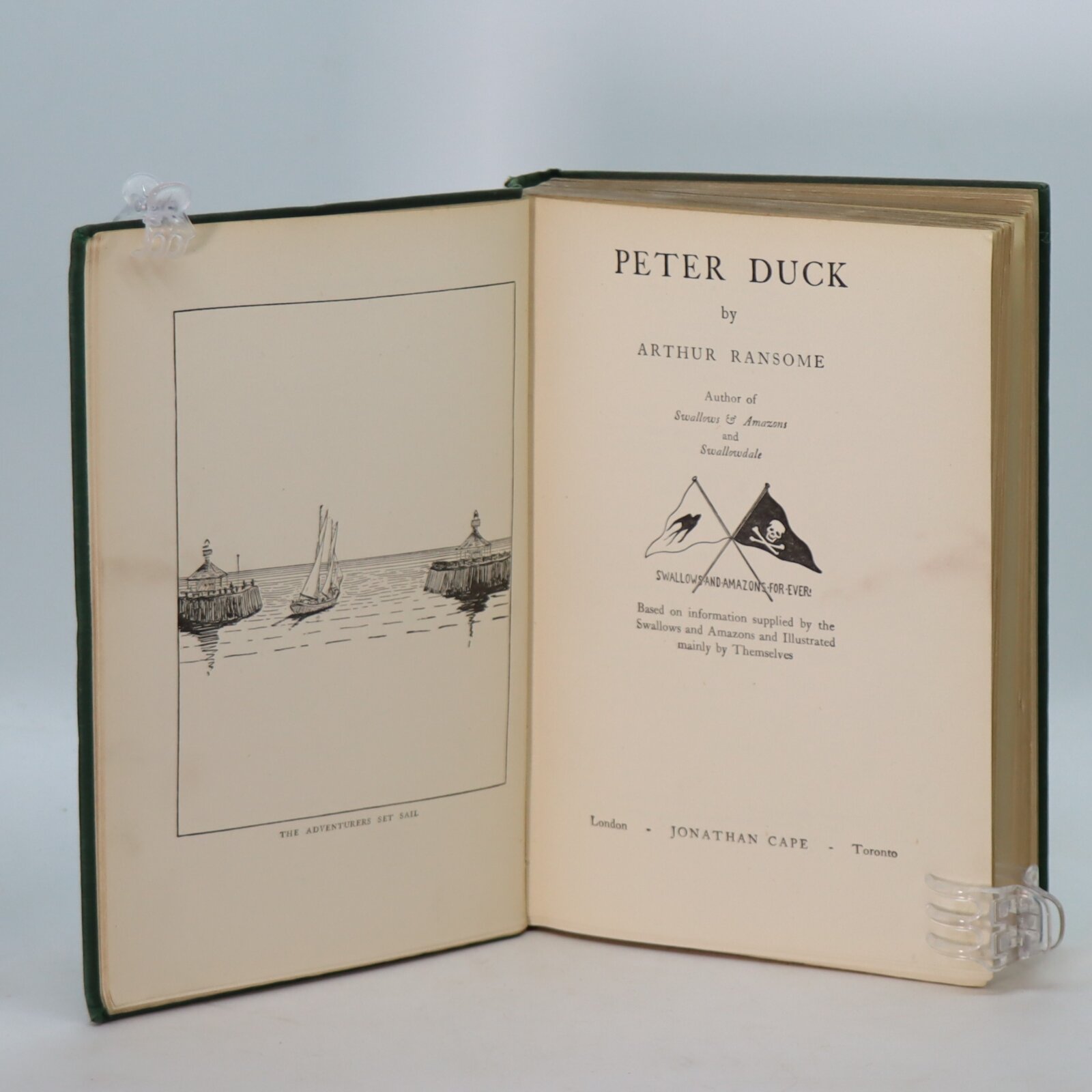
Peter Duck was illustrated by Ransome himself using pen and ink, although the frontispiece claims that the book is “Based on information supplied by the Swallows and Amazons and illustrated mainly by Themselves.” Ransome then continued to illustrate the stories, and provided illustrations for new editions of the first two books of the series as of 1938, replacing images by Clifford Webb (whose illustrations for Swallows and Amazons had themselves replaced Steven Spurrier’s first edition drawings. Ransome had disliked Spurrier’s images and only the maps drawn by Spurrier were retained for the end paper and dust jacket).
The final book of the series, Great Northern? (1947) was set in Scotland, and while the plot and action appear realistic, the internal chronology does not fit the usual run of school holiday adventures. Myles North, an admirer of Ransome, provided much of the basic plot of the book.
Swallows and Amazons was so popular that it inspired a number of other authors to write in a similar vein. Most notably, two schoolchildren, Pamela Whitlock and Katharine Hull, wrote The Far-Distant Oxus, an adventure story set on Exmoor. Whitlock sent the manuscript to Ransome in March 1937, and he persuaded his publisher, Jonathan Cape, to produce it, characterising it as “the best children’s book of 1937”
Want to know more about this item?
We are happy to answer any questions you may have about this item. In addition, it is also possible to request more photographs if there is something specific you want illustrated.
Ask a question
Related products
Share this Page with a friend
