
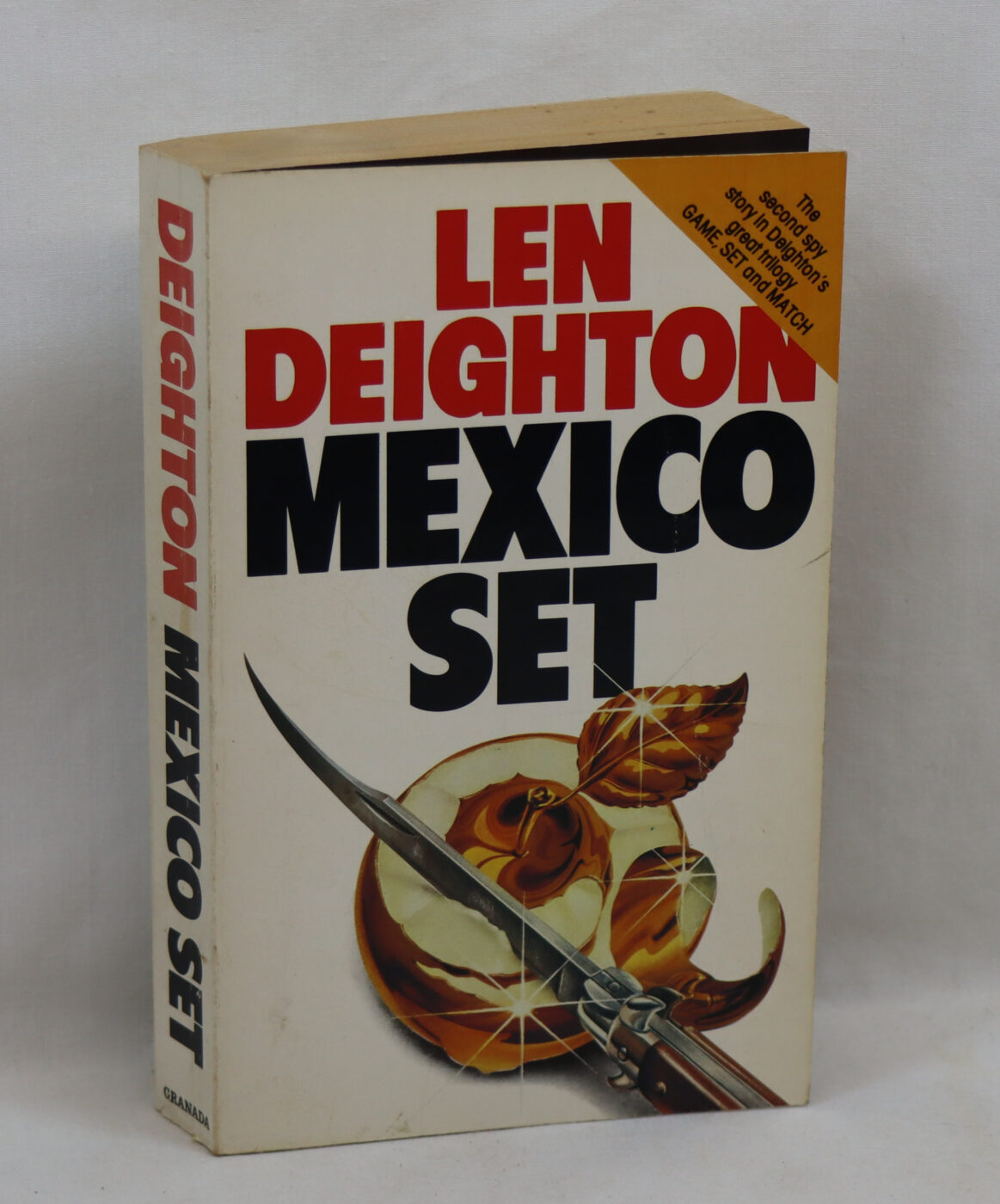
Mexico Set.
By Len Deighton.
ISBN: 9780394535258
Printed: 1985
Publisher: Panther Books. London
| Dimensions | 11 × 18 × 3 cm |
|---|---|
| Language |
Language: English
Size (cminches): 11 x 18 x 3
Condition: Fair (See explanation of ratings)
£6.00
Buy Now
Item information
Description
Paperback. White cover with black title.
Please view the photographs.
A great British spy story.
Mexico Set is a 1984 spy novel by Len Deighton. It is the second novel in the first of three trilogies about Bernard Samson, a middle-aged and somewhat jaded intelligence officer working for the British Secret Intelligence Service (MI6). Mexico Set is part of the Game, Set and Match trilogy, being preceded by the Berlin Game and followed by the London Match. This trilogy is followed by the Hook, Line and Sinker trilogy and the final Faith, Hope and Charity trilogy. Deighton’s novel Winter (1987) is a prequel to the nine novels, covering the years 1900-1945 and providing the backstory to some of the characters. Mexico Set continues the story that began with the Berlin Game, where Bernard Samson’s wife Fiona was unmasked as a KGB double agent.
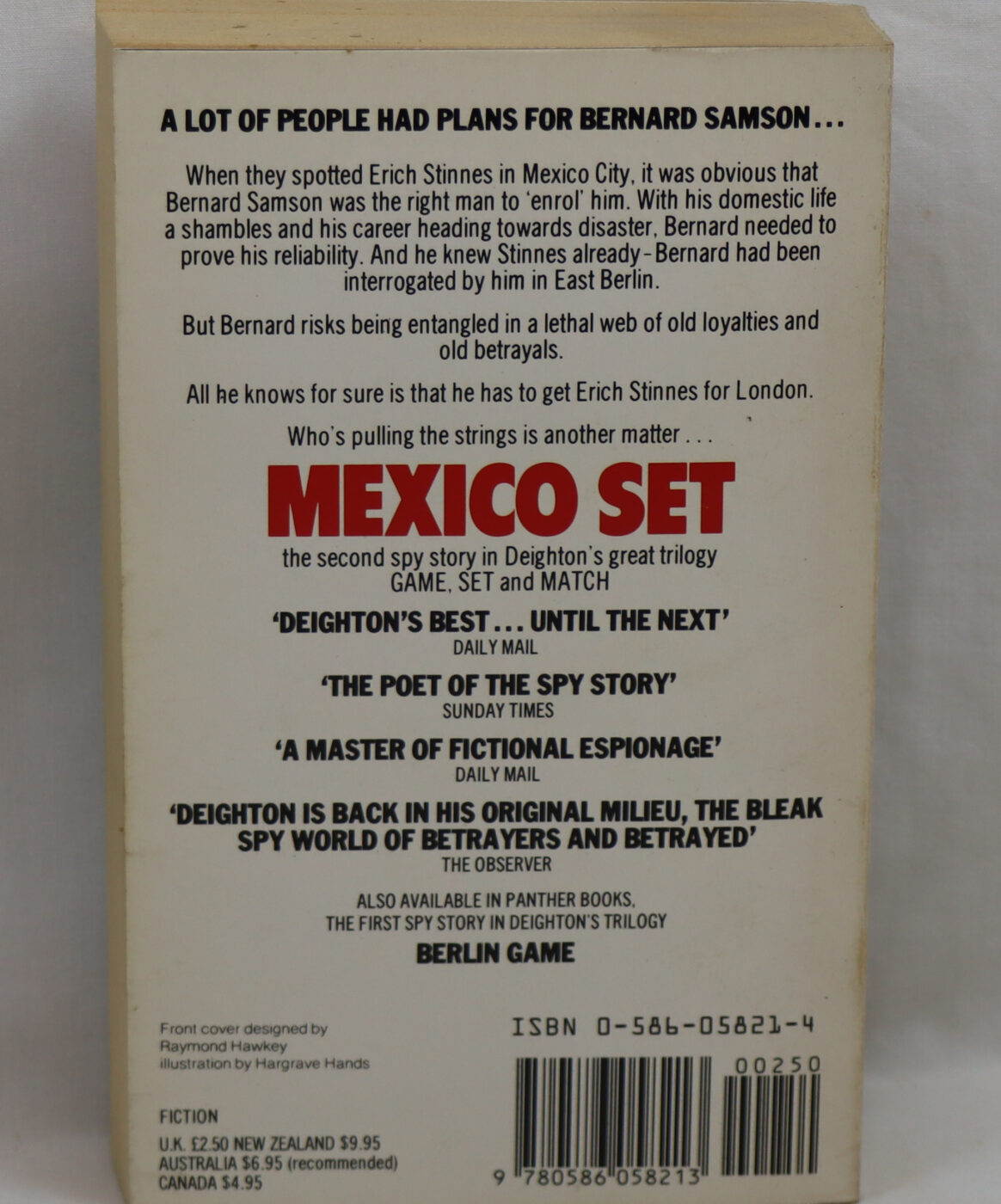
Long-awaited reissue of the second part of the classic spy trilogy, GAME, SET and MATCH, when the Berlin Wall divided not just a city but a world. A lot of people had plans for Bernard Samson… When they spotted Erich Stinnes in Mexico City, it was obvious that Bernard Samson was the right man to ‘enrol’ him. With his domestic life a shambles and his career heading towards disaster, Bernard needed to prove his reliability. and he knew Stinnes already – Bernard had been interrogated by him in East Berlin. But Bernard risks being entangled in a lethal web of old loyalties and old betrayals. All he knows for sure is that he has to get Erich Stinnes for London. Who’s pulling the strings is another matter…
A £3 reduction when collected from the FBA shop. An original book from the library gathered by the famous Cambridge Don, computer scientist, food and wine connoisseur, Jack Arnold LANG. In 2008, Jack was one of the co-founders of the Raspberry Pi Foundation, alongside other members of the Department, and acted as the Foundation’s Chair. The project’s original goals were modest: to build and distribute low-cost computers for prospective applicants to our Computer Science degree. Initially the project was a “success disaster”, as Jack would say, as demand far outstripped the low-scale manufacturing plans. Ultimately the Raspberry Pi became the UK’s most successful computer with more than 60 million sold to date. Jack was drawn to the educational possibilities of the Raspberry Pi, its potential uses in emerging economies and the way it could support self-directed learning.
Want to know more about this item?
We are happy to answer any questions you may have about this item. In addition, it is also possible to request more photographs if there is something specific you want illustrated.
Ask a question
Related products






Share this Page with a friend
