
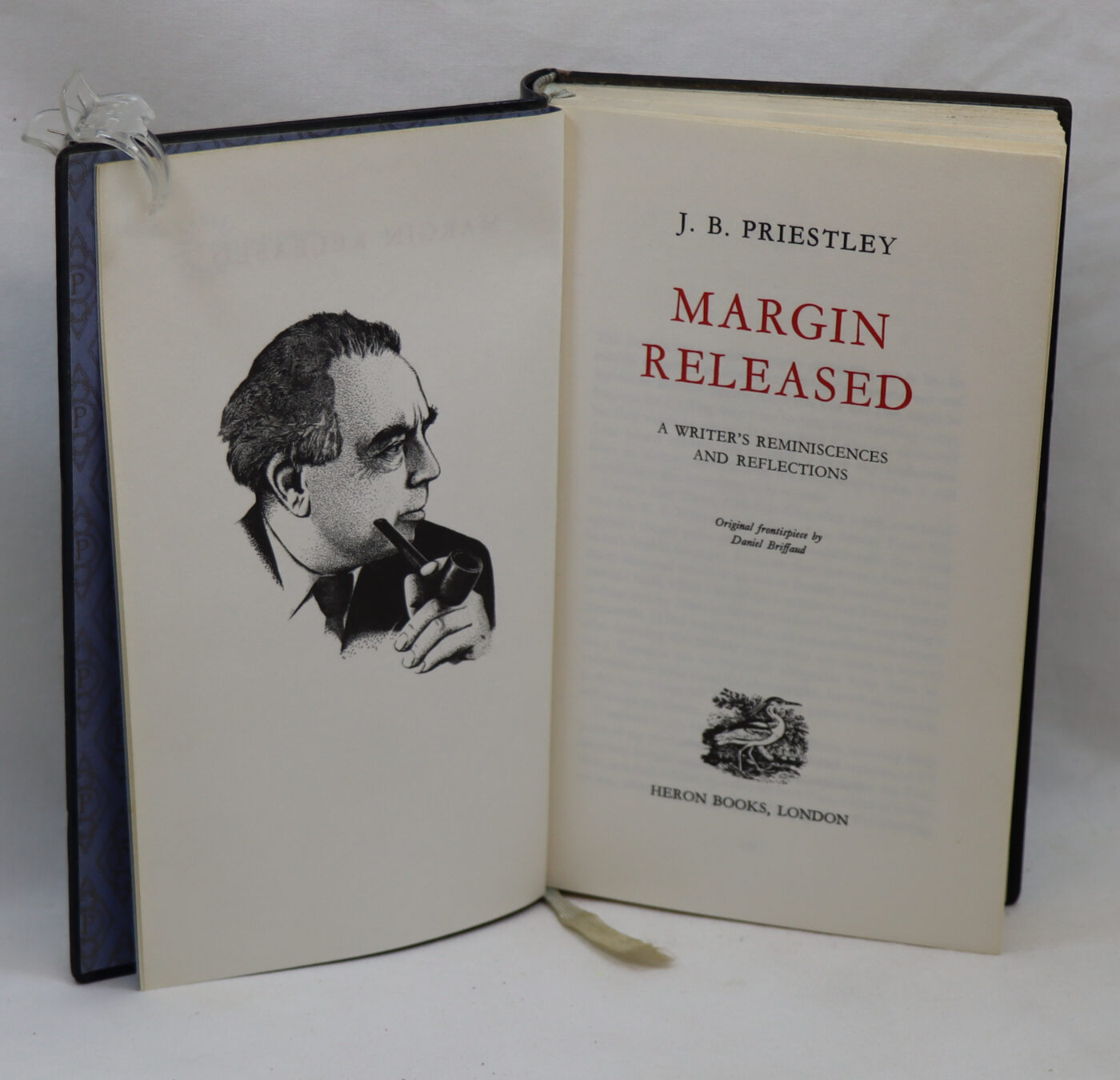
Margin Released.
By J B Preastley
Printed: Circa 1990
Publisher: Heron Books. London
| Dimensions | 13 × 21 × 3 cm |
|---|---|
| Language |
Language: English
Size (cminches): 13 x 21 x 3
Condition: Good (See explanation of ratings)
£31.00
Buy Now

Item information
Description
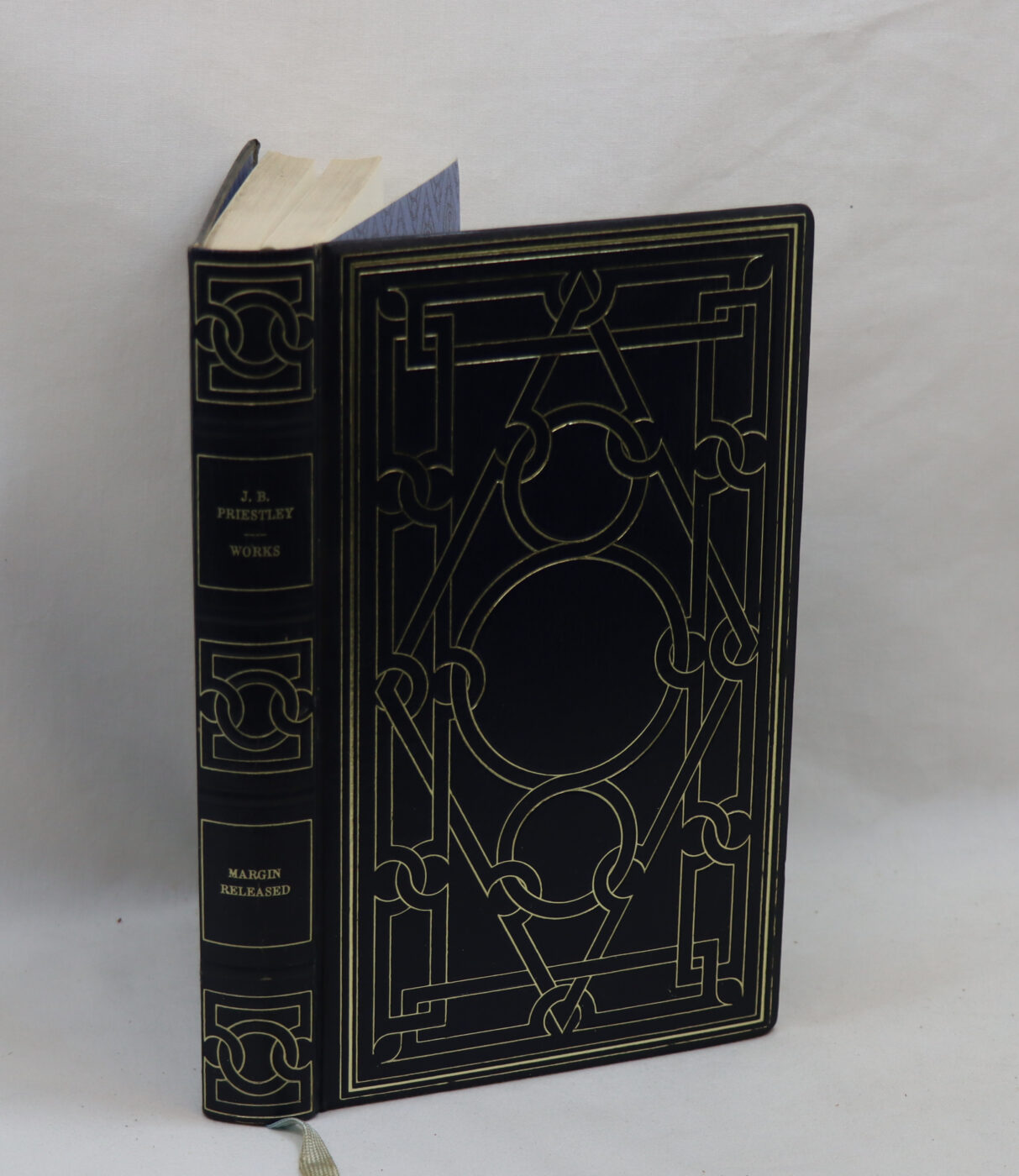
Navy cloth binding with gilt title and decoration.
We provide an in-depth photographic presentation of this item to stimulate your feeling and touch. More traditional book descriptions are immediately available.
- Note: This book carries a £5.00 discount to those that subscribe to the F.B.A. mailing list
Late last year I read two of Priestley’s early novels, LOST EMPIRES and THE GOOD COMPANIONS, for the first time and fell in love with Priestley’s gifts for character and, especially, his ability to create drama without having to resort to villains. Priestley began to write seriously after an appalling set of experiences in the trenches of World War I, and it seemed, in those books, as though he wanted to create a world in which good feeling and companionship were the important things, and forbearance toward others a primary virtue. So I looked forward to this book with real pleasure, only to discover that Priestley aged into a remarkable grumpy older man who came to resent deeply the amazing success of THE GOOD COMPANIONS, to the extent that when he was called upon to speak somewhere he would get furious if the person who was introducing him referred to him as “a good companion.” (Few reactions are more complicated than that of a writer being told his early work is his best.) There are some good stories here, especially about his somewhat late-in-life career as a writer of hit plays, but he lost me when he devoted a whole paragraph, about a third of the way in, to taking potshots as P.G. Wodehouse. Probably better to read Priestley’s books and skip his reminiscences.
Review: Parts of this book deserve five stars or more, but others didn’t hold my attention. Books about Priestley that I have read say that he never liked to talk about his experiences during the First World War and in this autobiographical memoir he says that he only included a section on the way because he had to bridge what happened before and after. But it is in fact by far the most gripping section of the book and occupies fifty closely written pages. His experiences draw from him here very frankly written accounts of experiences in the trenches and his feelings about the organisation of the military and especially the British military. His anger is palpable, not so much at the overall political and military objectives but at the arrogance, stupidity and actually cruelty of the officer class which he seems to think indicative of the puffed-upness which he feels is peculiar to the British character. He experienced as he says the tragedy of the trenches and the comedy of the military organisation. His reluctance to write about it at all perhaps stems partly from the fact that his wartime experiences were you might think bizarrely different from any other experiences in his life. He is respectful of other accounts of the war, especially by Graves and Sassoon but regrets that they didn’t see the comic side of what was going on. Of course Priestley’s account was written forty years on.nAlso very interesting is the early account of his youth in Bradford, an account which is evocative of many scenes in his novels. Much of the rest of the book is about his experience as a writer and of other writers. His writing is always to the point and goodhearted and balanced but reflects a very particular point of view and didn’t always hold my attention but nevertheless reveals the man, a man I admire very much.
John Boynton Priestley (13 September 1894 – 14 August 1984) was an English novelist, playwright, screenwriter, broadcaster and social commentator. His Yorkshire background is reflected in much of his fiction, notably in The Good Companions (1929), which first brought him to wide public notice. Many of his plays are structured around a time slip, and he went on to develop a new theory of time, with different dimensions that link past, present and future. In 1940, he broadcast a series of short propaganda radio talks, which were credited with strengthening civilian morale during the Battle of Britain. In the following years his left-wing beliefs brought him into conflict with the government and influenced the development of the welfare state. He wrote a number of plays during this period, including An Inspector Calls (1945).
Want to know more about this item?
We are happy to answer any questions you may have about this item. In addition, it is also possible to request more photographs if there is something specific you want illustrated.
Ask a question
Related products
Share this Page with a friend
