
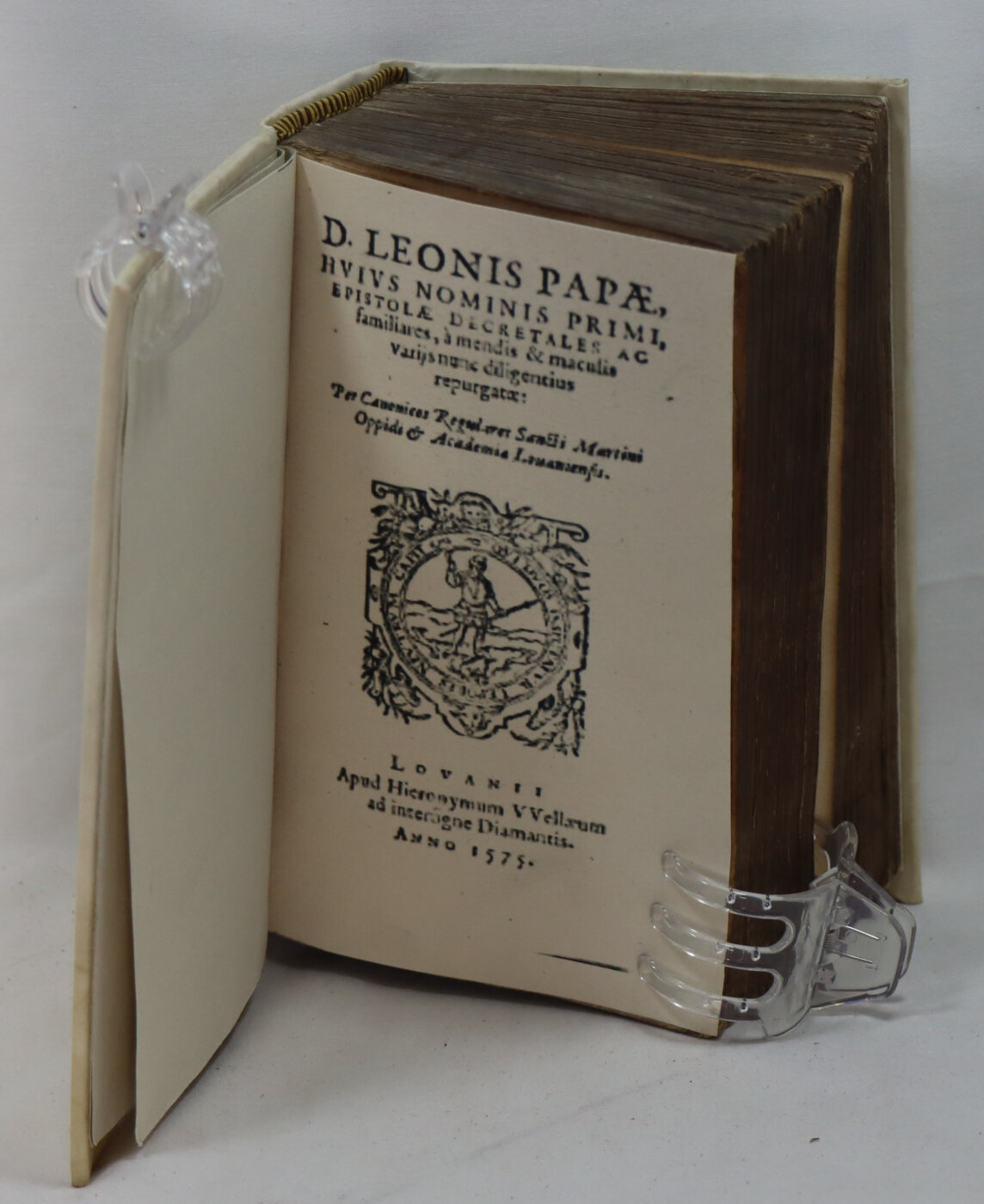
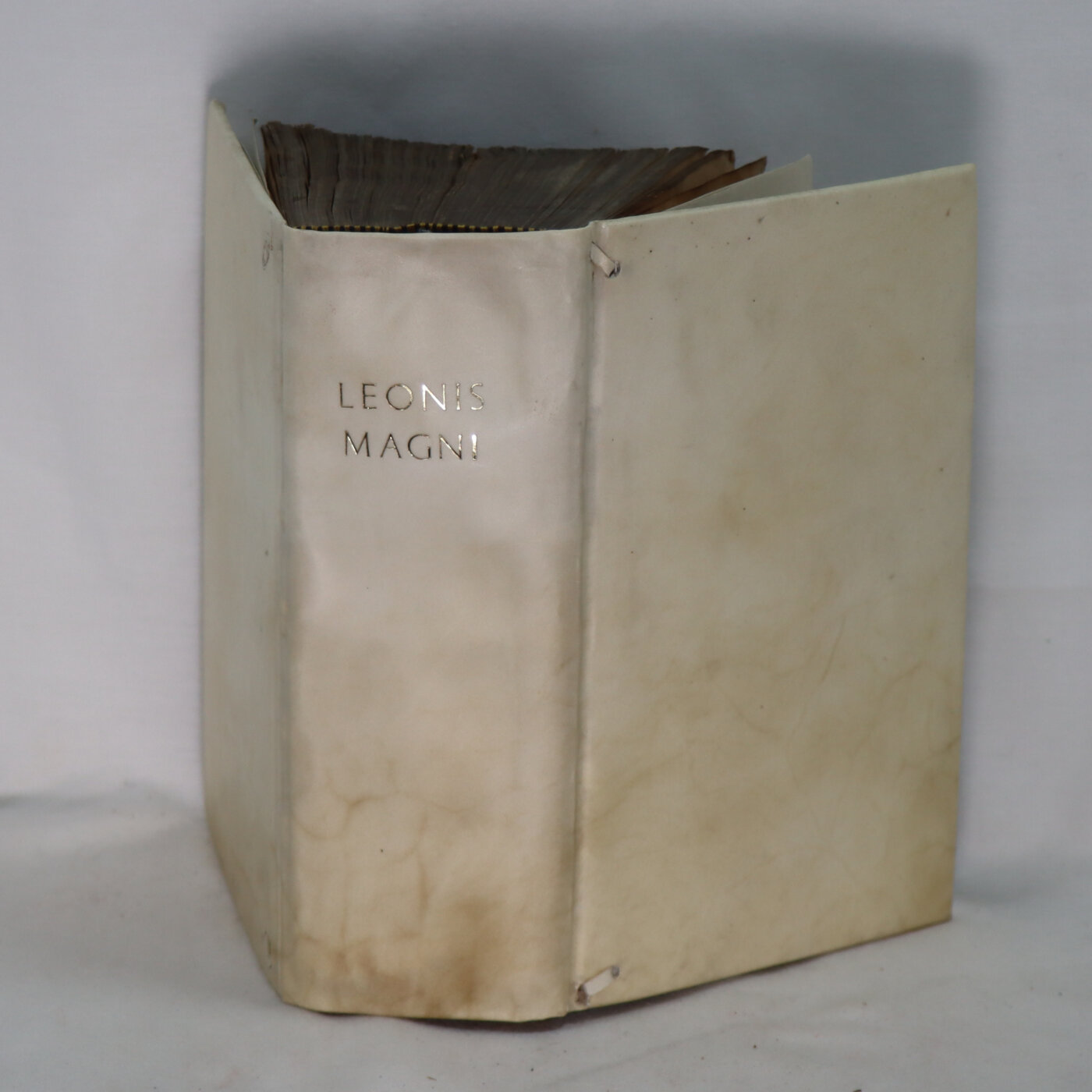
Leonis Magni.
By Leonis.
Printed: 1575
Publisher: V Vellxum. Lovanii
| Dimensions | 13 × 18 × 7 cm |
|---|---|
| Language |
Language: Latin
Size (cminches): 13 x 18 x 7
Condition: Fine (See explanation of ratings)
£844.00
FREE shipping
Buy Now


Item information
Description
Newly rebound and restored in cream vellum binding with gilt title on the spine. Presented in a protective box.
- We provide an in-depth photographic presentation of this item to stimulate your feeling and touch. More traditional book descriptions are immediately available.Note:
- These books carry the £5.00 discount to those that subscribe to the F.B.A. mailing list.
This is an exceptional book printed in 1575 and published in vellum. F.B.A. has some concern about its very, early provenance in that the French appear to have once stolen this book. Hence, the massive price reduction. That said, in a historic perspective when holding this book you really do feel that you are touching history.
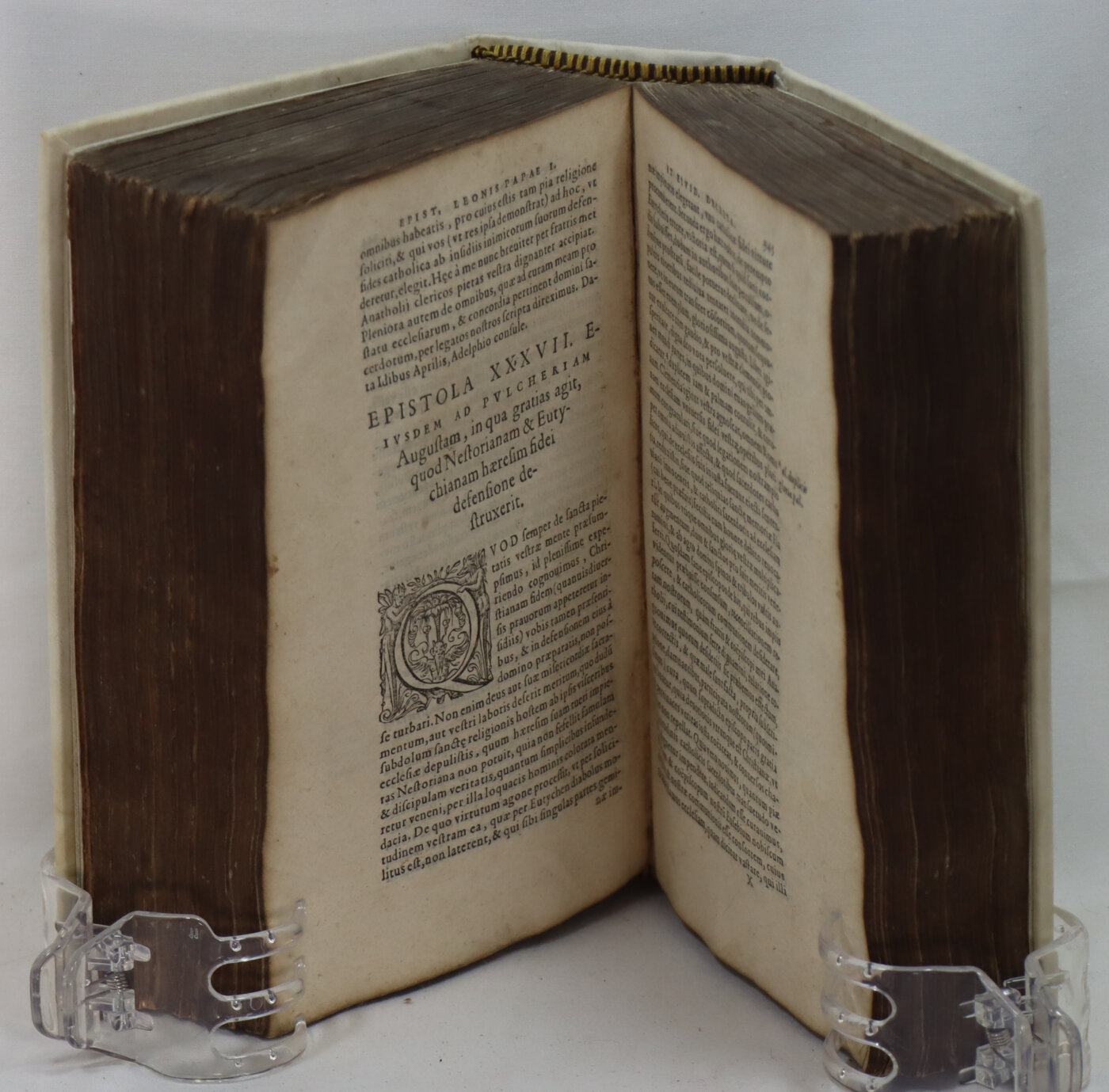
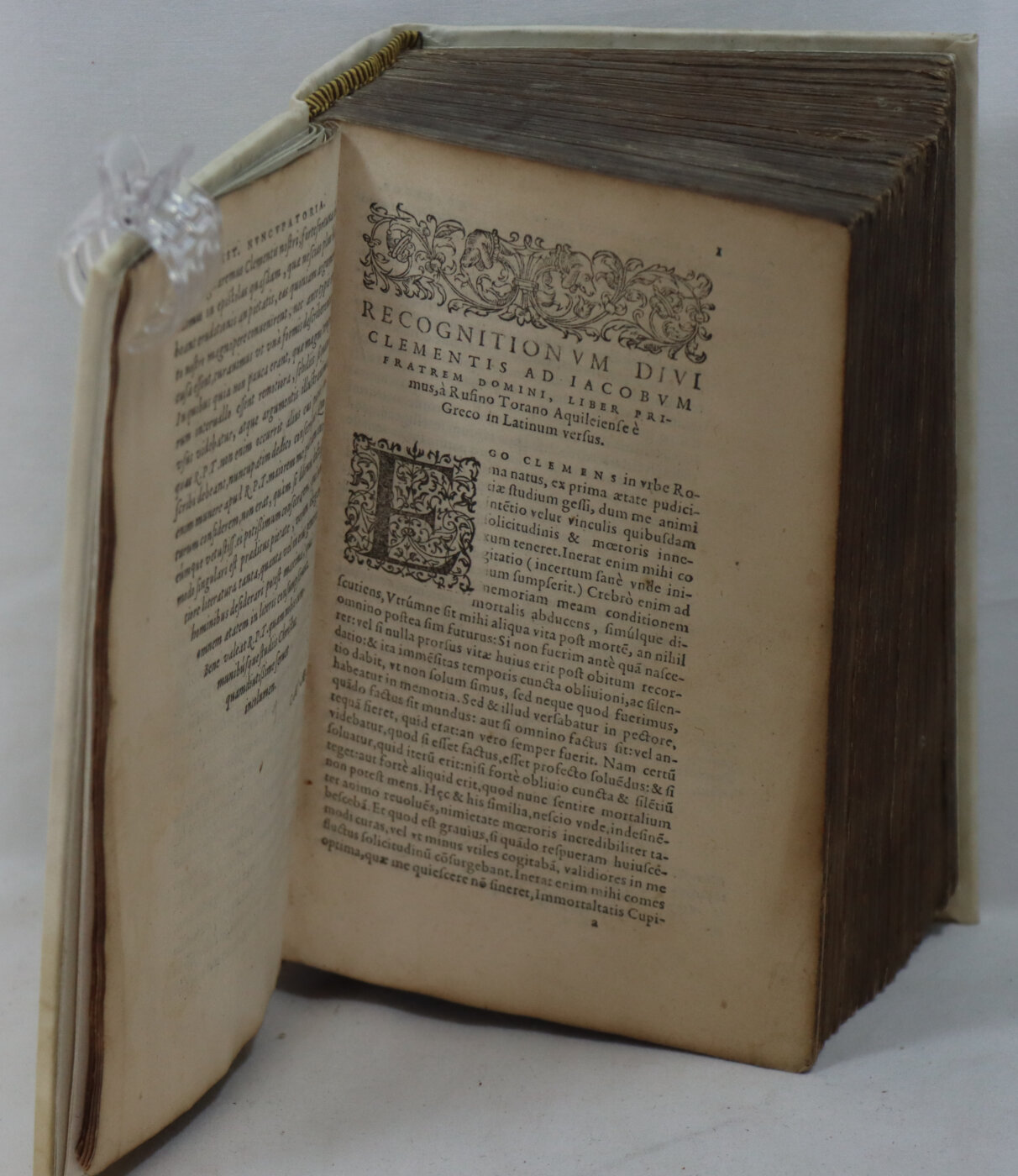
First Edition rebound in Vellum. Condition: Good. A scarce collection of sixteenth century religious texts Leonis Magnis Romani Pontificis Eius Nominis Primi, Maximi Tavrinensis Episcopi, Petri Chrysologi Ravennatis Episcopi, Fulgentii Episcopi Ruspensis & Valeriani Epsicopi Cemeliensis, Opera Omnia Qu In Latin. Three volumes bound in one. This volume is 99+% original with less than 1% being the insertion of facsimile pages to give 100% representation of the original print.
An edition, with authoritative additions of further observation and enlightenment on topics of scripture. With a scriptural index to front and further index to rear. Rebound in full vellum. Externally sound. Bright and generally clean. A Good book of the collected works of Sancti Leonis Magni (Saint Leo the Great or Saint Leo Magnus). Pope Leo I (ca. 400-461) was pope from September 29, 440 to his death in 461. He was an Italian aristocrat, and is the first pope of the Catholic Church to have been called “the Great”. He is perhaps best known for having met Attila the Hun in 452, persuading him to turn back from his invasion of Italy. The significance of Leo’s pontificate lies in his assertion of the universal jurisdiction of the Roman bishop, as expressed in his letters, and still more in his ninety-six extant orations. This assertion is commonly referred to as the doctrine of Petrine supremacy.
Pope Leo I (c. 400 – 10 November 461), also known as Leo the Great, was Bishop of Rome from 29 September 440 until his death. Leo was a Roman aristocrat, and was the first pope to have been called “the Great”. He is perhaps best known for having met Attila the Hun in 452 and persuading him to turn back from his invasion of Italy. He is also a Doctor of the Church, most remembered theologically for issuing the Tome of Leo, a document which was a major foundation to the debates of the Council of Chalcedon, the fourth ecumenical council. That meeting dealt primarily with Christology and elucidated the orthodox definition of Christ’s being as the hypostatic union of two natures, divine and human, united in one person, “with neither confusion nor division”. It was followed by a major schism associated with Monophysitism, Miaphysitism and Dyophysitism. He also contributed significantly to developing ideas of papal authority.
Early life Pope Leo I (c. 400 – 10 November 461), also known as Leo the Great,[1] was Bishop of Rome[2] from 29 September 440 until his death.
According to the Liber Pontificalis, he was a native of Tuscany. By 431, as a deacon, he was sufficiently well known outside of Rome that John Cassian dedicated to him the treatise against Nestorius written at Leo’s suggestion. About this time Cyril of Alexandria appealed to Rome regarding a jurisdictional dispute with the Juvenal of Jerusalem, but it is not entirely clear whether the letter was intended for Leo in his capacity as archdeacon, or for Pope Celestine I directly. Near the end of the reign of Pope Sixtus III, Leo was dispatched at the request of Emperor Valentinian III to settle a dispute between Aëtius, one of Gaul’s chief military commanders, and the chief magistrate Albinus. Johann Peter Kirsch sees this commission as a proof of the confidence placed in the able deacon by the Imperial Court. During Leo’s absence in Gaul, Pope Sixtus III died on 11 August 440, and on 29 September Leo was unanimously elected by the people to succeed him. Soon after assuming the papal throne, Leo learned that in Aquileia, Pelagians were received into church communion without formal repudiation of their heresy; he censured this practice and directed that a provincial synod be held where such former Pelagians be required to make an unequivocal abjuration. Leo claimed that Manichaeans, possibly fleeing Vandal Africa, had come to Rome and secretly organized there. In late 443, Leo preached a series of sermons condemning the Manichaeans and calling for Romans to denounce suspected heretics to their priests. Eventually, suspected heretics were brought to court, and likely under torture, they confessed to various crimes. By early 444, Leo announced to the bishops of Italy that the Manichaeans had been eradicated from Rome. According to his contemporary Prosper of Aquitaine, Leo exposed the Manichaeans and burned their books. He was equally firm against the Priscillianist sect. Bishop Turibius of Astorga, astonished at the spread of the sect in Spain, had addressed the other Spanish bishops on the subject, sending a copy of his letter to Leo, who took the opportunity to write an extended treatise (21 July 447) against the sect, examining its false teaching in detail and calling for a Spanish general council to investigate whether it had any adherents in the episcopate. From a pastoral perspective, he energized charitable works in a Rome beset by famines, an influx of refugees, and poverty. He further associated the practice of fasting with charity and almsgiving, particularly on the occasion of the Quattro tempora, (the quarterly Ember days).It was during Leo’s papacy that the term “Pope”, which previously meant any bishop, came to exclusively mean the Bishop of Rome.
Papal authority: Leo drew many learned men about him and chose Prosper of Aquitaine to act in some secretarial or notarial capacity. Leo was a significant contributor to the centralisation of spiritual authority within the Church and in reaffirming papal authority. In 450, the Byzantine Emperor Theodosius II, in a letter to Pope Leo I, was the first to call the Bishop of Rome the Patriarch of the West, a title that would continue to be used by the popes until the present days (only interrupted by a brief period between 2006 and 2024). By 447, he declared that heretics deserved the most severe punishments. The Pope justified the death penalty declaring that if the followers of a heresy were allowed to live, that would be the end of human and Divine law. According to the Liber Pontificalis, he was a native of Tuscany. By 431, as a deacon, he was sufficiently well known outside of Rome that John Cassian dedicated to him the treatise against Nestorius written at Leo’s suggestion. About this time Cyril of Alexandria appealed to Rome regarding a jurisdictional dispute with Juvenal of Jerusalem, but it is not entirely clear whether the letter was intended for Leo in his capacity as archdeacon, or for Pope Celestine I directly. Near the end of the reign of Pope Sixtus III, Leo was dispatched at the request of Emperor Valentinian III to settle a dispute between Aëtius, one of Gaul’s chief military commanders, and the chief magistrate Albinus. Johann Peter Kirsch sees this commission as a proof of the confidence placed in the able deacon by the Imperial Court.
Papacy: During Leo’s absence in Gaul, Pope Sixtus III died on 11 August 440, and on 29 September Leo was unanimously elected by the people to succeed him. Soon after assuming the papal throne, Leo learned that in Aquileia, Pelagians were received into church communion without formal repudiation of their heresy; he censured this practice and directed that a provincial synod be held where such former Pelagians be required to make an unequivocal abjuration.
Leo claimed that Manichaeans, possibly fleeing Vandal Africa, had come to Rome and secretly organized there. In late 443, Leo preached a series of sermons condemning the Manichaeans and calling for Romans to denounce suspected heretics to their priests. Eventually, suspected heretics were brought to court, and likely under torture, they confessed to various crimes. By early 444, Leo announced to the bishops of Italy that the Manichaeans had been eradicated from Rome. According to his contemporary Prosper of Aquitaine, Leo exposed the Manichaeans and burned their books. He was equally firm against the Priscillianist sect. Bishop Turibius of Astorga, astonished at the spread of the sect in Spain, had addressed the other Spanish bishops on the subject, sending a copy of his letter to Leo, who took the opportunity to write an extended treatise (21 July 447) against the sect, examining its false teaching in detail and calling for a Spanish general council to investigate whether it had any adherents in the episcopate.
From a pastoral perspective, he energized charitable works in a Rome beset by famines, an influx of refugees, and poverty. He further associated the practice of fasting with charity and almsgiving, particularly on the occasion of the Quattro tempora, (the quarterly Ember days).It was during Leo’s papacy that the term “Pope”, which previously meant any bishop, came to exclusively mean the Bishop of Rome.
Leonis Magni. By Leonis. Printed: 1575 Publisher: V Vellxum. Lovanii Language: Latin Size (inches): 5.2 x 7.2 x 2.8 Condition: Very good
These details identify a 16th-century printed edition of the collected works of Pope Leo I (Leo the Great), formally titled Opera D. Leonis Magni, Romani Pontificis, eius nominis Primi.
Bibliographical Identification
- Author. Pope Leo I (c. 400–461 AD), known in Latin as Leo Magnus.
- Title. Opera D. Leonis Magni, Romani Pontificis, eius nominis Primi (typically bound with his letters, Epistolae decretales ac familiares).
- Publisher and Printer. The imprint “V Vellxum. Lovanii” is a transcription or misreading of the Latin imprint apud Hieronymum Wellaeum, Lovanii (published by Jerome Wellens in Leuven, Belgium). The colophon notes it was printed by Joannes Masius in 1575.
- Editors. Edited from manuscripts by the Canons Regular of St. Martin’s Priory in Leuven (per canonicos regulares Sancti Martini oppidi & Universitatis Lovaniensis).
- Format and Dimensions. An octavo edition measuring approximately 5.2 x 7.2 inches, usually comprising two parts bound together into a single thick volume (2.8 inches).
Market & Collector Context
- Comparable Listings. Antiquarian copies of this 1575 Leuven edition are listed on rare book platforms such as AbeBooks for around £850 to £900 (approximately $1,150 USD), depending on completeness and binding.
- Key Value Factors. For 16th-century theology and patristics, value depends heavily on whether both volumes are present, whether the title page and colophon are intact, and the age and state of the binding (e.g., contemporary blind-stamped pigskin or vellum versus a later rebinding).
Chapter headings and price
This 1575 Leuven edition is divided into two distinct parts (sermons and letters) rather than modern numbered chapters, and complete copies typically retail between £800 and £900 (approx. 1,100–1,150 USD) in the antiquarian book trade.
Structure & Contents
In 16th-century editions of Pope Leo I (Opera D. Leonis Magni), the text is organized by liturgical sermons and papal letters rather than standard book chapters. Your thick 2.8-inch volume likely binds both main parts together:
- Part I: Sermones (Sermons). Covers 96 liturgical homilies arranged around the Christian calendar. Major groupings include sermons on his anniversary (In natali ordinationis suae), Christmas (De Nativitate Domini), Epiphany, Lent (De Quadragesima), the Passion (De Passione Domini), Easter, Pentecost, and the Ember Days (De Ieiunio).
- Part II: Epistolae Decretales ac Familiares (Letters). A separate section (often bearing its own title page) containing over 140 papal letters. Key sections include the famous Tome of Leo (Epistola ad Flavianum on the Incarnation), correspondence with emperors Theodosius II and Marcian, and letters concerning the Council of Chalcedon.
- Front & Back Matter. Begins with a dedicatory preface by the editors (the Canons Regular of St. Martin’s in Leuven) and a biographical life of Pope Leo (Vita D. Leonis). It concludes with an alphabetical subject index (Index rerum et verborum) at the end of each part.
Market Price & Valuation
- Retail Asking Price. Comparable 1575 Leuven octavo copies containing both parts bound together in 17th-century calf or contemporary vellum are listed by rare book dealers on AbeBooks for around £850 to £900.
- Auction vs. Private Sale. If sold at a specialist book auction or directly to an antiquarian dealer rather than at retail, expect a hammer or trade offer closer to £300–£550 (roughly 40–60% of retail).
- Key Value Drivers. A “Very Good” copy holds maximum value only if both the Sermones (193 leaves / ~432 pages) and Epistolae (316–371 pages) are present and complete. Missing title pages, heavy dampstaining, wormholes, or a modern library rebinding can reduce the value by 30–50%.
Pope Leo I (c. 400–461 AD
Pope Leo I (c. 400–461 AD), widely known as Saint Leo the Great, was the 45th Bishop of Rome from 440 until his death in 461. He is remembered as a pivotal figure who solidified papal authority, defended orthodox Christian doctrine, and famously negotiated with Attila the Hun to spare Rome from destruction.
Early Life and Rise to the Papacy
- Background and Education. Born into a Roman aristocratic family in Tuscany around 400 AD, Leo received a classical education that sharpened his administrative and rhetorical skills.
- Deacon and Diplomat. By the late 420s, he served as a prominent archdeacon and advisor in Rome under Popes Celestine I and Sixtus III. Emperor Valentinian III even dispatched him to Gaul in 440 to mediate a political dispute, and Leo was unanimously elected pope while still away on this mission.
Key Achievements and Legacy
- The Tome of Leo and Chalcedon. In 449, Leo wrote his famous Tome to Flavian, defining Jesus Christ as one divine person possessing two distinct natures—fully human and fully divine. The Council of Chalcedon adopted this teaching as orthodox doctrine in 451, with attending bishops famously declaring that “Peter has spoken through Leo”.
- Meeting Attila the Hun. As the Western Roman Empire crumbled, Leo stepped into a civil leadership vacuum. In 452, he traveled to northern Italy and personally persuaded Attila the Hun to halt his invasion and turn back from Rome.
- Negotiating with the Vandals. Three years later, in 455, Leo confronted the Vandal king Genseric at the gates of Rome. Although he could not prevent the city from being looted, he secured Genseric’s promise to spare the inhabitants from slaughter and protect major basilicas housing refugees.
- Papal Primacy. Leo vigorously promoted the doctrine of Petrine Primacy, arguing that the authority Christ gave to Saint Peter passed directly to every subsequent Bishop of Rome. He secured an imperial edict from Emperor Valentinian III recognizing the universal jurisdiction of the Roman papacy over the Western Church.
- Doctor of the Church. Nearly 100 of his sermons and over 140 letters survive today, noted for their clear, concise Latin prose. In 1754, Pope Benedict XIV proclaimed him a Doctor of the Church—one of only two popes (alongside Gregory I) to hold both that title and the epithet “the Great”
The Council of Chalcedon (held from 8 October to 1 November 451 AD) was the fourth ecumenical council of the Christian Church, convened by the Eastern Roman Emperor Marcian in Chalcedon (modern-day Kadıköy, Istanbul). Attended by roughly 500 to 600 bishops, it was convened to resolve fierce theological disputes over how Jesus Christ’s divine and human natures relate to one another.
Background: Why It Was Called
- The Monophysite Controversy. A monk named Eutyches taught that Christ’s human nature was absorbed into his divine nature, leaving him with effectively one single nature (monophysis).
- The “Robber Synod” of 449. An earlier assembly at Ephesus backed Eutyches, deposed orthodox leaders like Patriarch Flavian of Constantinople, and ignored Pope Leo I’s doctrinal letter. Following the death of Emperor Theodosius II, the new rulers—Marcian and Empress Pulcheria—called the Council of Chalcedon to overturn the 449 synod and restore church unity.
Key Decisions and Outcomes
- The Chalcedonian Definition. Drawing heavily on Pope Leo I’s Tome, the council declared that Jesus Christ is one person in two distinct natures—fully divine and fully human. According to the Definition of Chalcedon, these two natures exist together “without confusion, without change, without division, without separation”.
- Condemnation of Extremes. The council simultaneously rejected Nestorianism (which divided Christ too sharply into two separate persons) and Eutychianism / Monophysitism (which blended his two natures into one).
- Canon 28 and Church Governance. Alongside doctrinal rulings, the council issued disciplinary canons regulating clergy and monastic life. Most controversially, Canon 28 elevated the Patriarchate of Constantinople to second in rank after Rome, granting it equal privileges as “New Rome”—a decision Pope Leo I firmly rejected.
Lasting Historical Impact
- Foundation of Mainstream Christology. The Chalcedonian Definition became the standard orthodox doctrine on the person of Christ for the Roman Catholic, Eastern Orthodox, Anglican, and most Protestant traditions.
- The Oriental Orthodox Schism. Churches primarily in Egypt, Syria, and Armenia rejected the council’s two-nature formula, fearing it leaned too close to Nestorianism. This split gave rise to the Oriental Orthodox Churches (such as the Coptic, Syriac, and Armenian Apostolic churches), creating a division that persists today.
Condition notes
Rebound, replaced title page
Want to know more about this item?
We are happy to answer any questions you may have about this item. In addition, it is also possible to request more photographs if there is something specific you want illustrated.
Ask a question

Share this Page with a friend
