
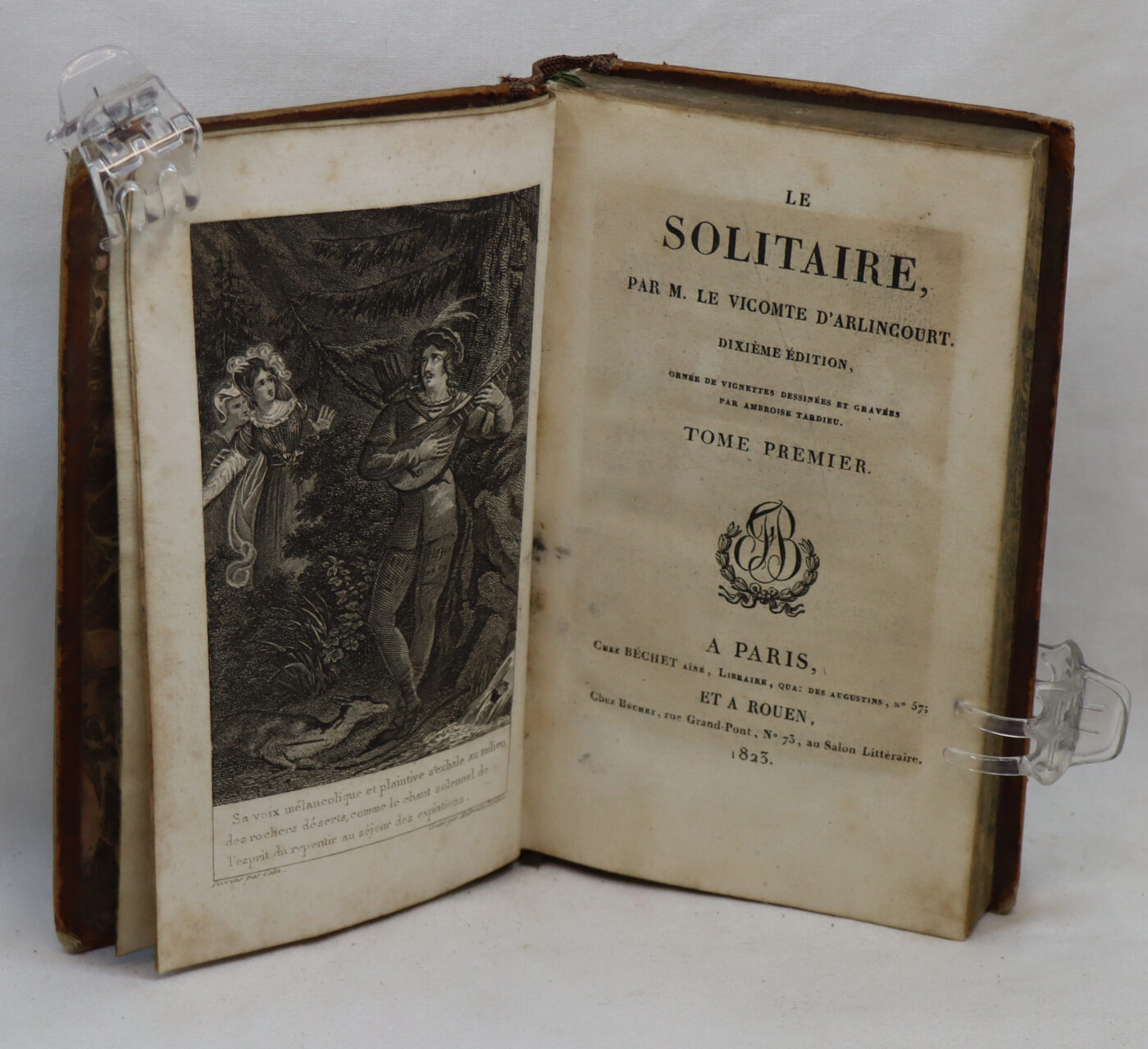
Le Solataire.Tome Premier.
By M Le Vicomte D'Arlingcourt
Printed: 1823
Publisher: Chez Bechet aine. Paris
| Dimensions | 11 × 17 × 2 cm |
|---|---|
| Language |
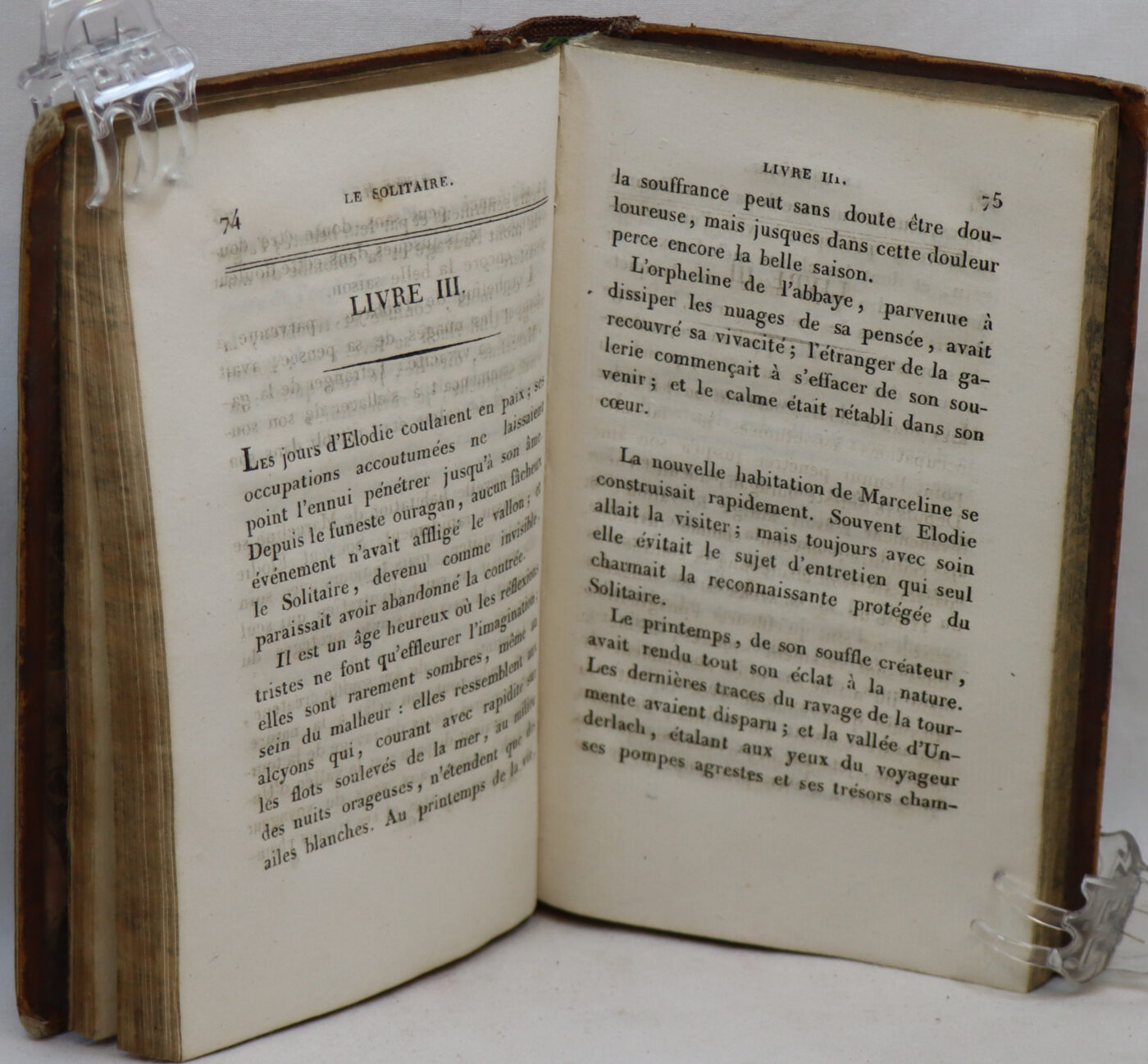
Language: French
Size (cminches): 11 x 17 x 2
Condition: Fair (See explanation of ratings)
£132.00
Buy Now

Item information
Description
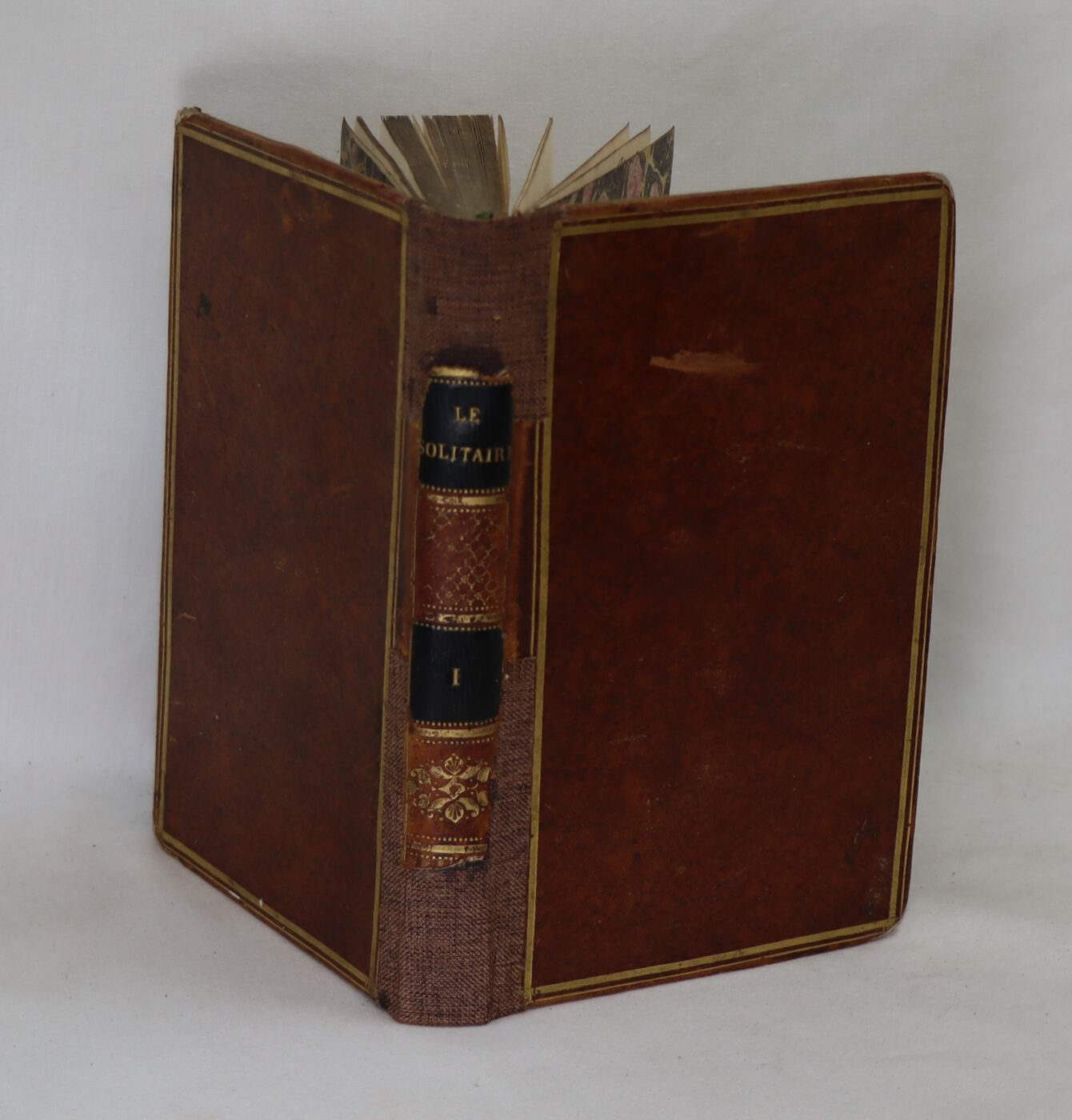
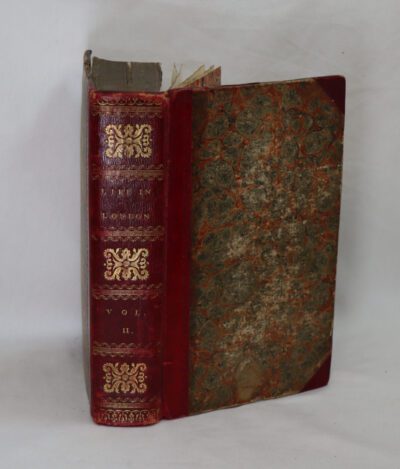
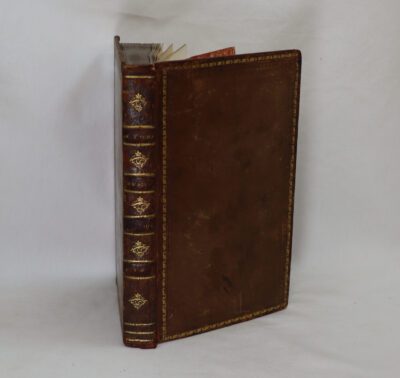
Tan calf binding with black title plates and gilt title on the repaired spine.
We provide an in-depth photographic presentation of this item to stimulate your feeling and touch. More traditional book descriptions are immediately available.
- Note: This book carries a £5.00 discount to those that subscribe to the F.B.A. mailing list
Refurbished rare edition which due to its content would likely be banned today. Please view our photographs.
Rare 10th printing of the first edition. The Viscount d’Arlincourt (1788-1856), poet, novelist and playwright. At the age of 22, Napoleon appointed him auditor at the Council of State. He was nicknamed “the Prince of the Romantics” at the beginning of his career, and later “the Inverted Viscount”, due to his pronounced taste for convoluted style. Balzac would also make fun of him in *Lost Illusions*. The Viscount d’Arlincourt became famous thanks to his novel entitled *Le Solitaire*, published in 1821. In it, he combines the Gothic novel with a historical plot. Hardcover/bound cover.
The Solitary Man. Volume 1 / , by Viscount d’Arlincourt. Tenth edition, revised, corrected, augmented, and adorned with vignettes drawn by M. Chasselat. Date of the original edition: 1821. This work is part of a heritage preservation policy for works of French literature implemented with the National Library of France (BnF). Some of these works reflect currents of thought characteristic of their time, but which would be considered reprehensible today. Nevertheless, they belong to the history of ideas in France and may be of scientific or historical interest. The purpose of our editorial approach is therefore to allow access to these works without in any way endorsing their content.
Charles-Victor Prévost d’Arlincourt, known as the Viscount d’Arlincourt , was born in Magny-les-Hameaux , at the Château de Mérantais, onSeptember 26, 1788 and died in ParisonJanuary 22, 1856, is a novelist,poet and playwright. Knight of the Legion of Honour, Grand Cross of Francesco Victor of Naples and of Constantine of Parma, Commander of the Order of St Gregory of Rome, Knight of St Louis, of Malta, of the Polar Star etc.
The popularity of this writer, nicknamed ” the Prince of Romantics ” before gradually falling into oblivion, rivaled that of Victor Hugo in the early 1820s .
His mother was Marie-Jeanne Gourgon de Precy (1749-1813). His father, Louis-Adrien Prévost d’Arlincourt , born in 1744, was guillotined on May 8, 1794 at the same time as Antoine Lavoisier and twenty-six other tax farmers . His grandfather , Charles-Adrien Prévost d’Arlincourt , born in 1718, also a former tax farmer, was guillotined on May 14, 1794.
He married, as his first wife,February 2, 1808, Marie Thérèse Joséphine Laure Cholet (1788-1847), daughter of the Imperial senator, Count François-Armand Cholet (1747-1826) and in second marriage theDecember 18, 1851, Albérie Elisabeth Contenot de Laneuville (1797-1864). They had no children.
At the beginning of the Empire , his mother pleaded his case with Napoleon , who appointed him equerry to Madame Mère . At the age of nineteen, he composed a tragedy, Charlemagne , which was rejected by the Comédie-Française . In 1811 , Napoleon appointed him auditor to the Council of State , then intendant of the army in Spain . He participated in the Spanish campaign and witnessed the capture of Tarragona .
After the emperor’s downfall, he managed to ingratiate himself with Louis XVIII , who appointed him Master of Requests . He then bought a château and proclaimed himself Viscount . In 1818 , he orchestrated, with considerable fanfare, the publication of an epic poem, Charlemagne ou La Caroléide , and presented himself to the French Academy , where his candidacy received only one vote. Disappointed, but by no means discouraged, he began writing a novel which he hoped would make him the equal of Chateaubriand .
The Solitary Man appeared in 1821 and immediately enjoyed ” an extraordinary, colossal popularity.” Within a few months, the book was reprinted a dozen times ; it was translated into ten languages; no fewer than seven operas and twice as many plays were based on it; it inspired countless songs, parodies, paintings, and lithographs . The success of the three novels that followed, The Renegade in 1822 , Ipsiboe in 1823 , and The Stranger in 1825 , was almost as great.
Adored first and foremost by female readers, who saw him as ” the new Ossian “, he was savaged by critics. His plots were deemed implausible, his characters false, his imagery grotesque. His penchant for inversions, which he peppered in his prose, earned him the nickname ” the inverted viscount “, and while Balzac made a memorable parody of this mania in Lost Illusions , he was nevertheless greatly influenced, in his early days, by the Gothic style of Arlincourt. The academician Charles-Marie de Feletz wrote: ” The Solitary Man has been translated into every language except French “. Later judgments drove the point home : ” Style belongs solely to the author ; never before had the French language been written in such an extraordinary manner”. The Viscount’s novels are likened to Gothic novels , which were then called ” frenetic” “: ” Always a mysterious plot centered on some illustrious and guilty unfortunate who drags himself through a thousand violent adventures towards a bloody catastrophe .”
Decline: The Viscount, who in the meantime posed for Robert Lefèvre and Jean-Baptiste Isabey , defended himself. What mattered to him, he wrote about the ” novel-poem ” that followed The Stranger , was to ” spiritualize all the impressions of existence.” Eager to reinvent himself, he had an early work, The Siege of Paris , performed at the Théâtre-Français in 1826 , but the play was quickly torn to shreds by the critics. Sometimes unjustly: the most ridiculous lines reproduced in all the anthologies were not, in fact, his.
During the July Revolution , he embarked on writing historical novels, which were perceived as more or less disguised attacks against the government. Weary of the criticism that continued to rain down upon him, he undertook two long journeys across Europe, in 1841 and 1844 , finding solace with exiled princes. Upon his return to France, he staged a new play, * La Peste noire * (The Black Death ), which was received just as coldly as the first. In 1848 , outraged by the June Days uprising , he published *Dieu le veut ! * (God Wills It! ), a pamphlet that led to his prosecution in court while simultaneously bringing him renewed popularity. In 1850 , he returned from a trip to Italy with an account, * L’Italie rouge* (Red Italy ), in which he depicted what he perceived as the horrors of the Risorgimento.During the last years of his life, still ” insatiable for publicity”, he became the ornament of the salons. Charles-Victor Prévost d’Arlincourt is buried in the Montmartre cemetery.
Condition notes
Repaired spine
Want to know more about this item?
We are happy to answer any questions you may have about this item. In addition, it is also possible to request more photographs if there is something specific you want illustrated.
Ask a question
Related products

Share this Page with a friend
