
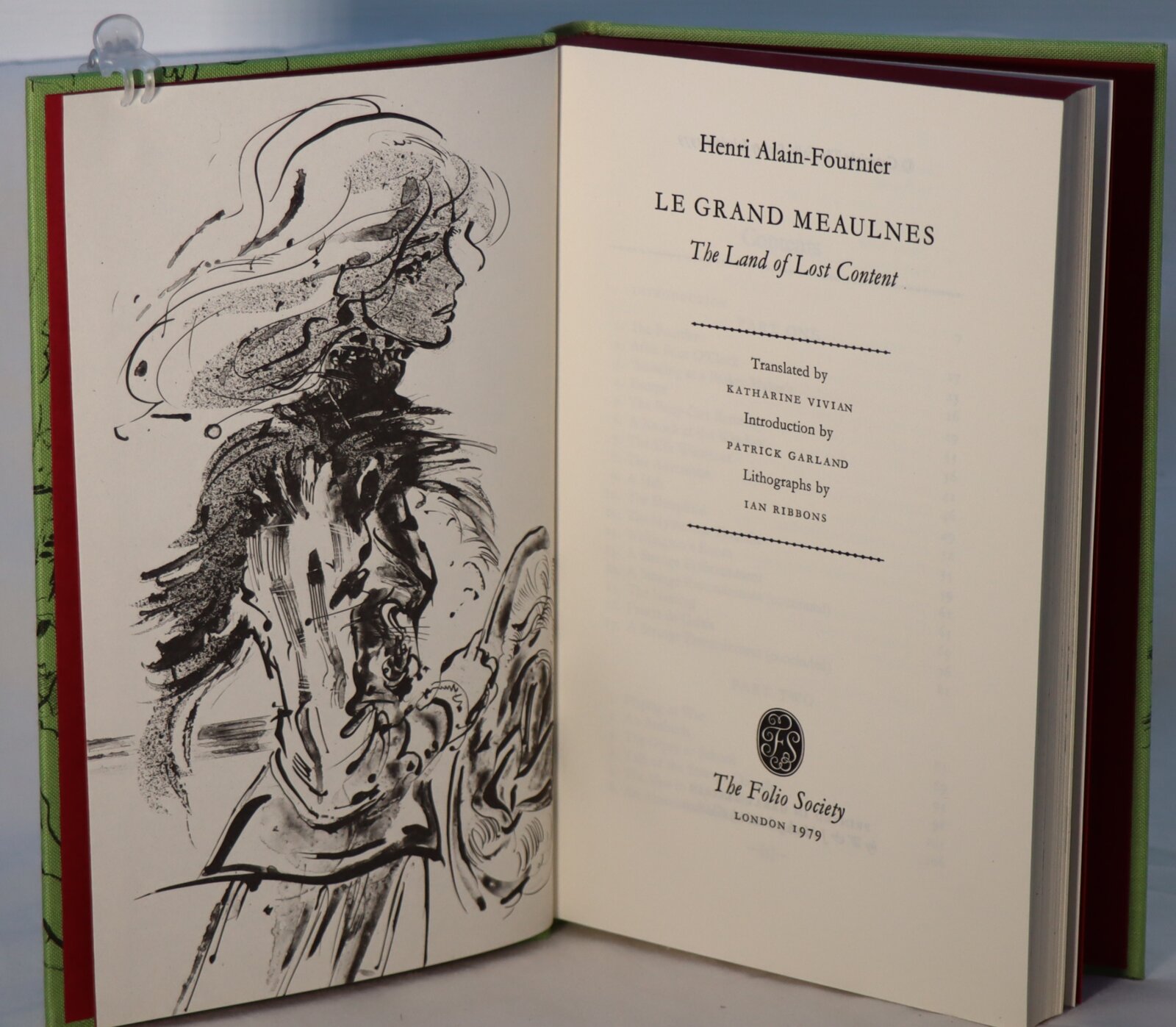
Le Grand Meaulnes.
By Henri Alain-Founier
ISBN: 9780828890113
Printed: 1979
Publisher: The Folio Society. London
| Dimensions | 15 × 24 × 3 cm |
|---|---|
| Language |
Language: English
Size (cminches): 15 x 24 x 3
Condition: Fine (See explanation of ratings)
£23.00
Buy Now

Item information
Description
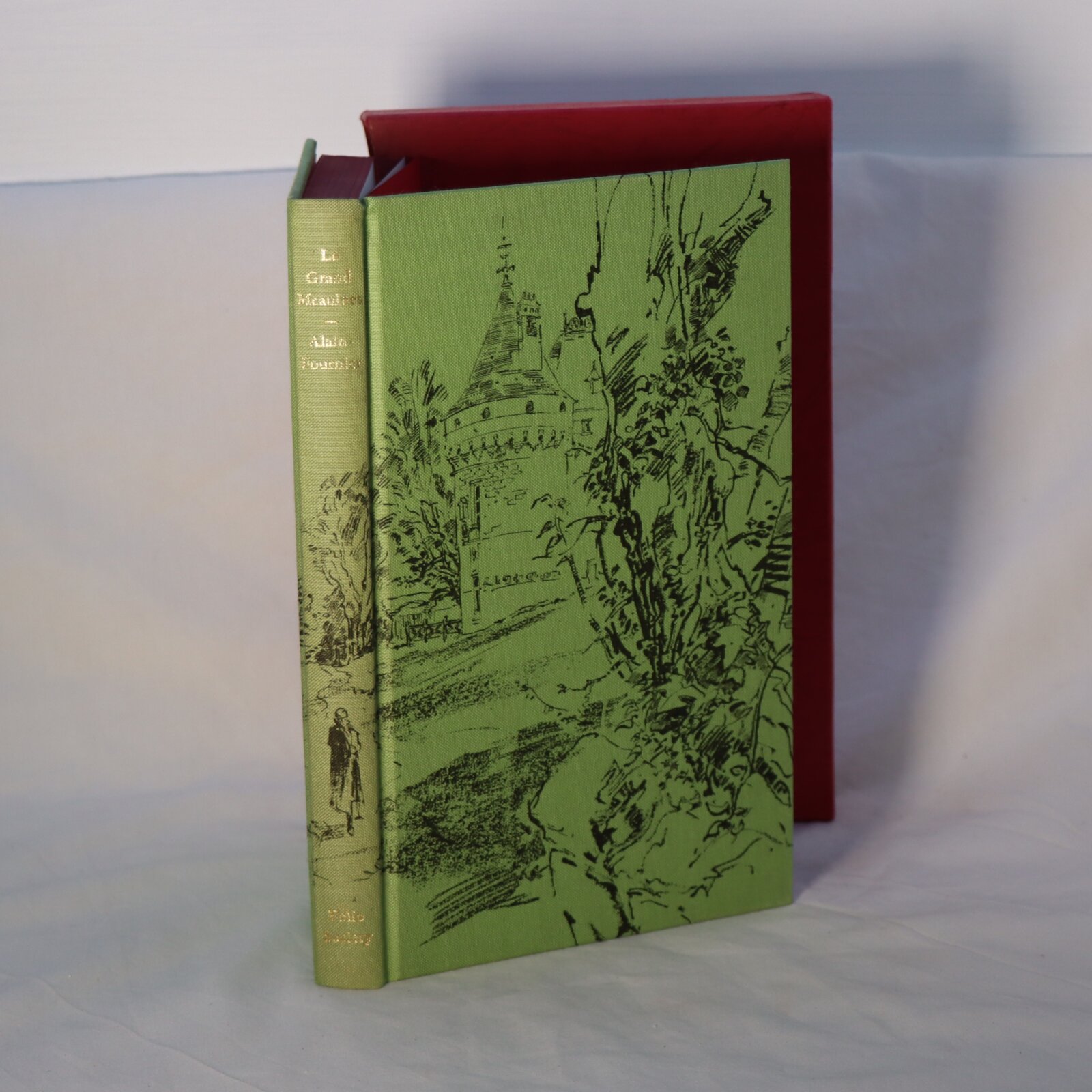
In a fitted box. Great cloth binding with black turret etching. Gilt title on the spine.
-
F.B.A. provides an in-depth photographic presentation of this item to stimulate your feeling and touch. More traditional book descriptions are immediately available.
-
A Folio First Edition
The Land of Lost Content. There is no doubting the classic status of Alain-Fournier’s Le Grand Meaulnes. A poll of French readers a dozen years ago placed it sixth of all 20th-century books, just behind Proust and Camus, most French people read it at school. Fifteen-year-old François Seurel narrates the story of his relationship with seventeen-year-old Augustin Meaulnes as Meaulnes searches for his lost love. Impulsive, reckless and heroic, Meaulnes embodies the romantic ideal, the search for the unobtainable, and the mysterious world between childhood and adulthood.
Alain-Fournier was the pseudonym of Henri-Alban Fournier (3 October 1886 – 22 September 1914), a French author and soldier. He was the author of a single novel, Le Grand Meaulnes (1913), which has been filmed twice and is considered a classic of French literature. The book is based partly on his childhood.
Alain-Fournier was born in La Chapelle-d’Angillon, in the Cher département, in central France, the son of a school teacher. He studied at the Lycée Lakanal in Sceaux, Hauts-de-Seine, near Paris, where he prepared for the entrance examination to the École Normale Supérieure, but without success. He then studied at the merchant navy school in Brest. At the Lycée Lakanal, he met Jacques Rivière, and the two became close friends. In 1909, Rivière married Alain-Fournier’s younger sister Isabelle. He interrupted his studies in 1907, and from 1908 to 1909, he performed his military service. At this time, he published some essays, poems and stories, which were later collected and re-published by the name Miracles. Throughout this period, he was contemplating what would become his celebrated novel, Le Grand Meaulnes. On the first of June 1905, Ascension Day, while he was taking a stroll along the banks of the Seine, he met and spoke with Yvonne Marie Elise Toussaint de Quiévrecourt. He became enamored, but it was not reciprocated. The next year on the same day, he waited for her at the same place, but she did not appear. That night he told Rivière, “She did not come. And even if she had, she would not have been the same”. They did not meet again until eight years later, when she was married with two children. Yvonne de Quiévrecourt would become Yvonne de Galais in his novel. Alain-Fournier returned to Paris in 1910, and became a literary critic, writing for the Paris-Journal. There he met André Gide and Paul Claudel. In 1912, he quit his job to become the personal assistant of the politician Casimir Perrier. Le Grand Meaulnes was finished in early 1913, and was published first in the Nouvelle Revue Française (from July to October 1913) and then as a book, which was nominated for, but did not win, the Prix Goncourt. It is available in English in a widely admired 1959 translation by Frank Davison for Oxford University Press with the title The Lost Domain.
Condition notes
Box worn
Want to know more about this item?
We are happy to answer any questions you may have about this item. In addition, it is also possible to request more photographs if there is something specific you want illustrated.
Ask a question
Related products

Share this Page with a friend
