
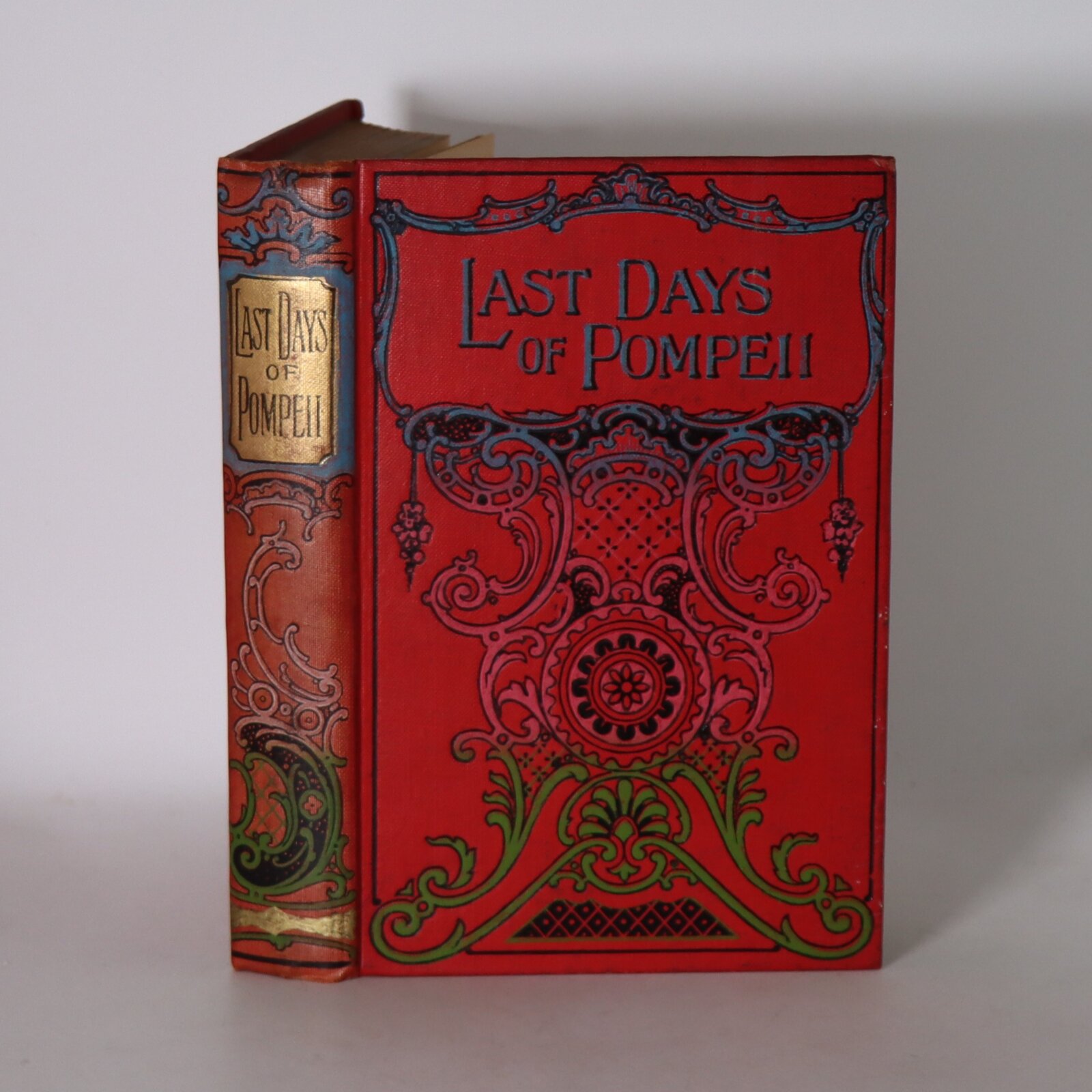
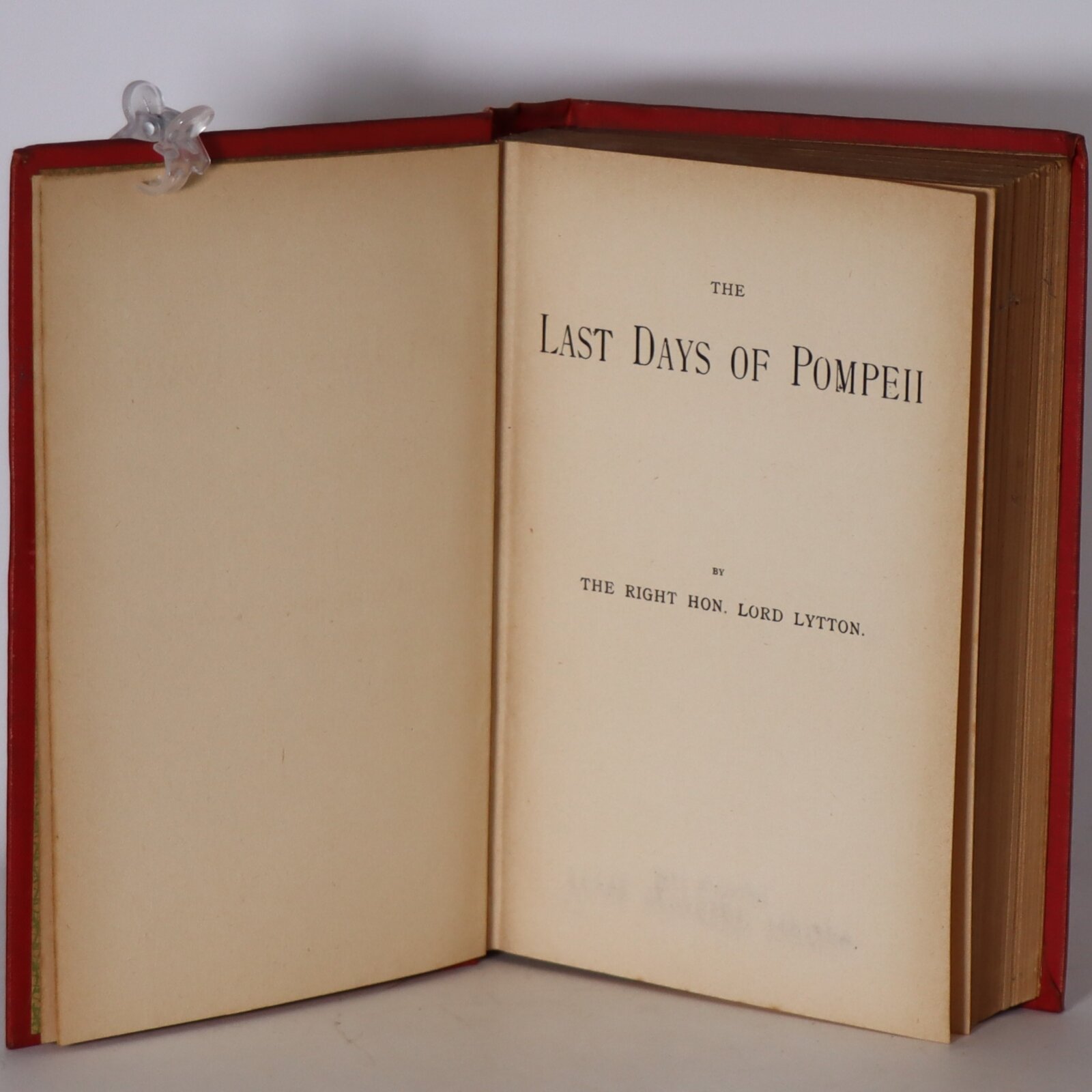
Last Days of Pompeii.
By The Right Honorable Lord Lytton
Printed: Circa 1880
Publisher: Unknown
| Dimensions | 13 × 18 × 2.5 cm |
|---|---|
| Language |
Language: English
Size (cminches): 13 x 18 x 2.5
Condition: Very good (See explanation of ratings)
£65.00
Buy Now

Item information
Description
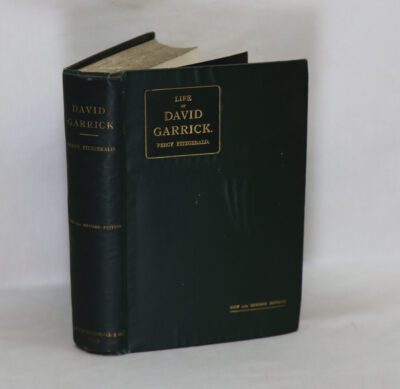
Red cloth binding with gilt title plate on the spine. Blue and green design on the front board.
F.B.A. provides an in-depth photographic presentation of this item to stimulate your feel and touch. More traditional book descriptions are immediately available.
Published around the 1880s
I like this book; it is ahead of its time.
Edward George Earle Lytton Bulwer-Lytton, 1st Baron Lytton, PC (25 May 1803 – 18 January 1873) was an English writer and politician. He served as a Whig member of Parliament from 1831 to 1841 and a Conservative from 1851 to 1866. He was Secretary of State for the Colonies from June 1858 to June 1859, choosing Richard Clement Moody as founder of British Columbia. He declined the Crown of Greece in 1862 after King Otto abdicated, He was created Baron Lytton of Knebworth in 1866.
Bulwer-Lytton’s works sold and paid him well. He coined famous phrases like “the great unwashed”, “pursuit of the almighty dollar”, “the pen is mightier than the sword”, “dweller on the threshold”, and the opening phrase “It was a dark and stormy night.” The sardonic Bulwer-Lytton Fiction Contest, held annually since 1982, claims to seek the “opening sentence of the worst of all possible novels”.
Bulwer-Lytton’s literary career began in 1820 with the publication of a book of poems and spanned much of the 19th century. He wrote in a variety of genres, including historical fiction, mystery, romance, the occult and science fiction. He financed his extravagant way of life with a varied and prolific literary output, sometimes publishing anonymously.
Bulwer-Lytton published Falkland in 1827, a novel which was only a moderate success. But Pelham brought him public acclaim in 1828 and established his reputation as a wit and dandy. Its intricate plot and humorous, intimate portrayal of pre-Victorian dandyism kept gossips busy trying to associate public figures with characters in the book. Pelham resembled Benjamin Disraeli’s first novel Vivian Grey (1827). The character of the villainous Richard Crawford in The Disowned, also published in 1828, borrowed much from that of banker and forger Henry Fauntleroy, who was hanged in London in 1824 before a crowd of some 100,000.
Bulwer-Lytton admired Disraeli’s father Isaac D’Israeli, himself a noted author. They began corresponding in the late 1820s and met for the first time in March 1830, when Isaac D’Israeli dined at Bulwer-Lytton’s house. Also present that evening were Charles Pelham Villiers and Alexander Cockburn. The young Villiers had a long parliamentary career, while Cockburn became Lord Chief Justice of England in 1859.
Bulwer-Lytton reached his height of popularity with the publication of England and the English, and Godolphin (1833). This was followed by The Pilgrims of the Rhine (1834), The Last Days of Pompeii (1834), Rienzi, Last of the Roman Tribunes about Cola di Rienzo (1835), Ernest Maltravers; or, The Eleusinia (1837), Alice; or, The Mysteries (1838), Leila; or, The Siege of Granada (1838), and Harold, the Last of the Saxons (1848). The Last Days of Pompeii was inspired by Karl Briullov’s painting The Last Day of Pompeii, which Bulwer-Lytton saw in Milan.
His New Timon lampooned Tennyson, who responded in kind. Bulwer-Lytton also wrote the horror story The Haunted and the Haunters; or, The House and the Brain (1859). Another novel with a supernatural theme was A Strange Story (1862), which was an influence on Bram Stoker’s Dracula.
Bulwer-Lytton wrote many other works, including Vril: The Power of the Coming Race (1871) which drew heavily on his interest in the occult and contributed to the early growth of the science fiction genre. Its story of a subterranean race waiting to reclaim the surface of the Earth is an early science fiction theme. The book popularised the Hollow Earth theory and may have inspired Nazi mysticism. His term “vril” lent its name to Bovril meat extract. The book was also the theme of a fundraising event held at the Royal Albert Hall in 1891, the Vril-Ya Bazaar and Fete. “Vril” has been adopted by theosophists and occultists since the 1870s and became closely associated with the ideas of an esoteric neo-Nazism after 1945.
His play Money (1840) was first produced at the Theatre Royal, Haymarket, London, on 8 December 1840. The first American production was at the Old Park Theater in New York on 1 February 1841. Subsequent productions include the Prince of Wales’s Theatre’s in 1872 and as the inaugural play at the new California Theatre (San Francisco) in 1869.
Among Bulwer-Lytton’s lesser-known contributions to literature was that he convinced Charles Dickens to revise the ending of Great Expectations to make it more palatable to the reading public, as in the original version of the novel, Pip and Estella do not get together.
Want to know more about this item?
We are happy to answer any questions you may have about this item. In addition, it is also possible to request more photographs if there is something specific you want illustrated.
Ask a question
Related products

Share this Page with a friend
