
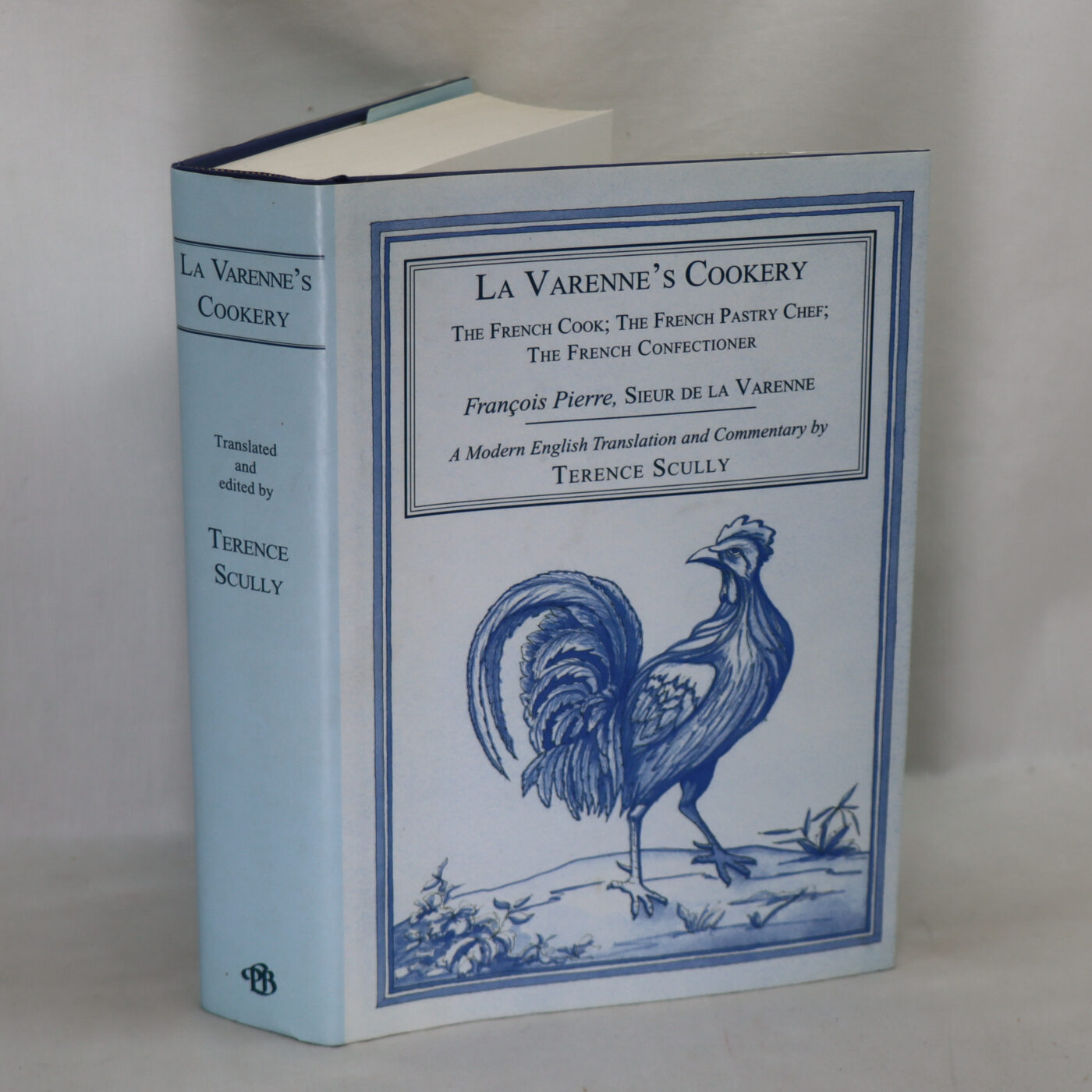
La Varenne's Cookery.
By Terence Skully
ISBN: 9780851154305
Printed: 2006
Publisher: Prospect Books. London
| Dimensions | 19 × 25 × 5 cm |
|---|---|
| Language |
Language: English
Size (cminches): 19 x 25 x 5
Condition: Very good (See explanation of ratings)
£54.00
Buy Now

Item information
Description
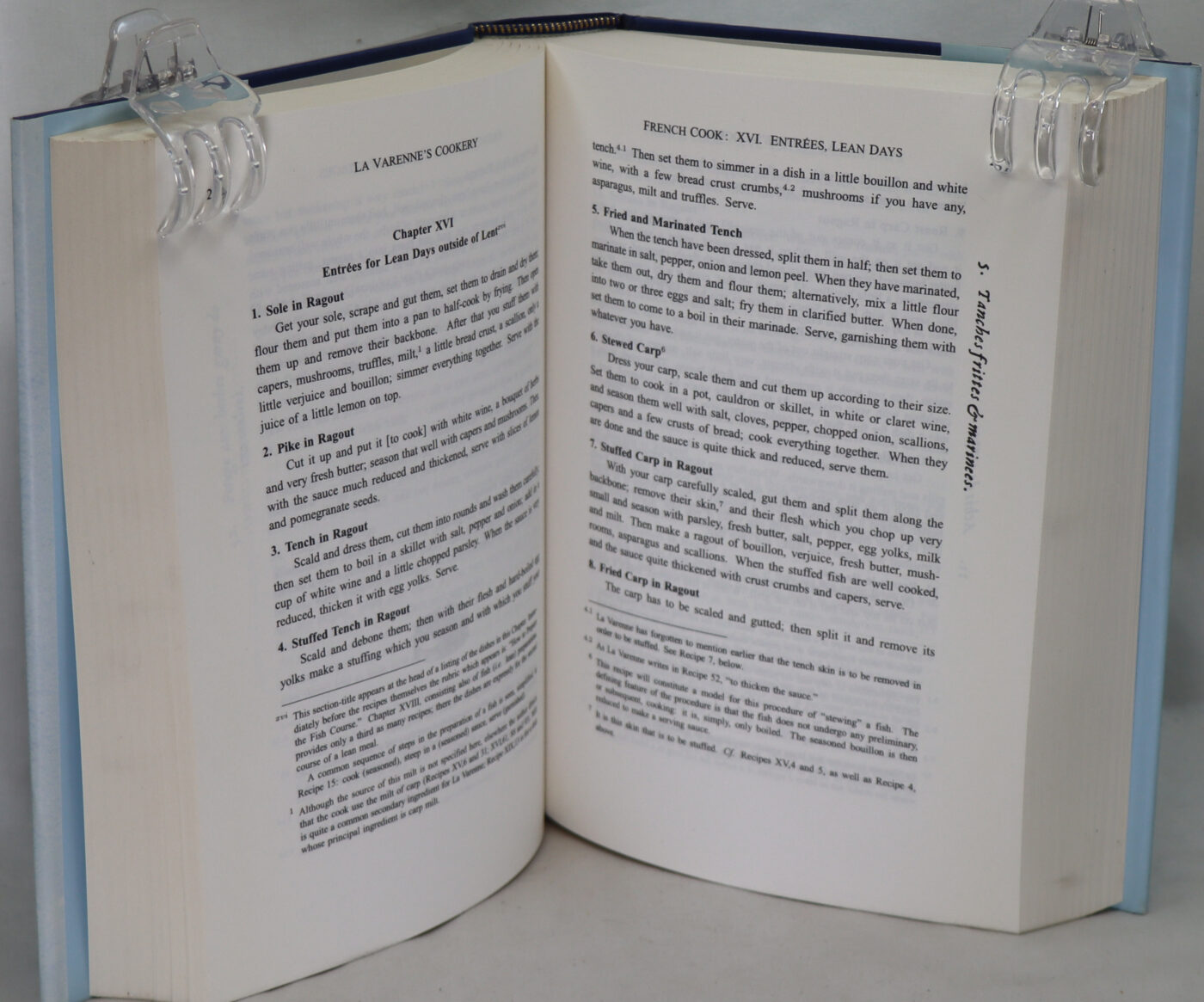
In the original dust jacket. Blue cloth binding with gilt title on the spine.
We provide an in-depth photographic presentation of this item to stimulate your feeling and touch. More traditional book descriptions are immediately available
- Note: This book carries a £5.00 discount to those that subscribe to the F.B.A. mailing list
For conditions, please view our photographs. A nice clean rare copy from the library gathered by the famous Cambridge Don, computer scientist, food and wine connoisseur, Jack Arnold LANG. Jack founded the Midsummer House, Cambridge’s paramount restaurant. This dining experience is hidden amongst the grassy pastures and grazing cattle of Midsummer Common and perched on the banks of the River Cam.
Francois’s cookbook is the first book written on French haute cuisine and is therefore essential to understanding the modern methodology using today’s equipment and techniques
Modern translation of La Varenne”s The French cook, The French pastry chef, and The French confectioner, published in Paris between 1651 and 1660, essential reading for anyone seeking to understand French cookery of the seventeenth century. Includes a detailed commentary covering the life of La Varenne, the nature of his three works, and period French cooking. La Varenne (1618-1678) was chef to the Marquis d”Uxelles and the first to produce a French cookery book of any substance since Le Viandier almost 300 years earlier, and therefore the first to record the advances in French cooking since the fifteenth century.
A MODERN ENGLISH TRANSLATION AND COMMENTARY BY TERENCE SCULLY
These books, first published in Paris between 1651 and 1660, are essential reading for anyone seeking to understand French cookery of the 17th century. Not only were they printed and reprinted in France itself for many decades, but they were soon translated and merrily pillaged throughout Europe (the first English translation of The French Cook was in 1653). La Varenne (c. 1615 1678) was chef to the Marquis d Uxelles. His was the first French cookery book of any substance since Le Viandier almost 300 years earlier. It was, therefore, the first to record and embody the immense advances which French cooking had made, largely under the influence of Italy, since the 15th century. Some medieval characteristics are still visible, but many have disappeared. New World ingredients make their entrance; and a surprising number of recipes are for dishes still made in modern times (omelettes, beignets, even pumpkin pie). The watershed from medieval to modern times is being crossed under our eyes in La Varenne’s pages. Earlier translations, as indeed the original itself, are not easy for modern readers to understand: there are difficult words, omissions, mistranslations and other opacities. Terence Scully has solved our problems by undertaking a modern translation with a detailed commentary. His work takes cognisance of contemporary works for purposes of comparison and contrast so that even French people will profit from what he tells us of the workings of the classical French kitchen.
François Pierre de la Varenne (1615–1678 in Dijon), Burgundian by birth, was the author of Le Cuisinier françois (1651), one of the most influential cookbooks in early modern French cuisine. La Varenne’s book expressed the culinary innovations that had revolutionised medieval and Renaissance French cookery in the 16th century and early 17th century.
Historical context: La Varenne was the foremost member of a group of French chefs, writing for a professional audience, who codified French cuisine in the age of King Louis XIV. The others were Nicolas de Bonnefons, Le Jardinier françois (1651) and Les Délices de la campagne (1654), and François Massialot, Le Cuisinier royal et bourgeois (1691), which was still being edited and modernised in the mid-18th century. The cookbook was still used in France until the French Revolution.
The seventeenth century saw a culinary revolution which transported French gastronomy into the modern era. The heavily spiced flavours inherited from the cuisine of the Middle Ages (as documented, notably, in Le Viandier by Taillevent) were abandoned in favour of the natural flavours of foods. Exotic and costly spices (saffron, cinnamon, cumin, ginger, nutmeg, cardamom, nigella, seeds of paradise) were, with the exception of pepper, replaced by local herbs (parsley, thyme, bayleaf, chervil, sage, tarragon). New vegetables like cauliflower, asparagus, peas, cucumber and artichoke were introduced.
Special care was given to the cooking of meat in order to conserve maximum flavour. Vegetables had to be fresh and tender. Fish, with the improvement of transportation, had to be impeccably fresh. Preparation had to respect the gustatory and visual integrity of the ingredients instead of masking them as had been the practice previously. Finally, a rigorous separation between salted and sweet dishes was introduced, the former served before the latter, banishing the Renaissance taste for mixing sweet and salted ingredients in the same dish or in the same part of the meal.
Want to know more about this item?
We are happy to answer any questions you may have about this item. In addition, it is also possible to request more photographs if there is something specific you want illustrated.
Ask a question
Related products
Share this Page with a friend
