
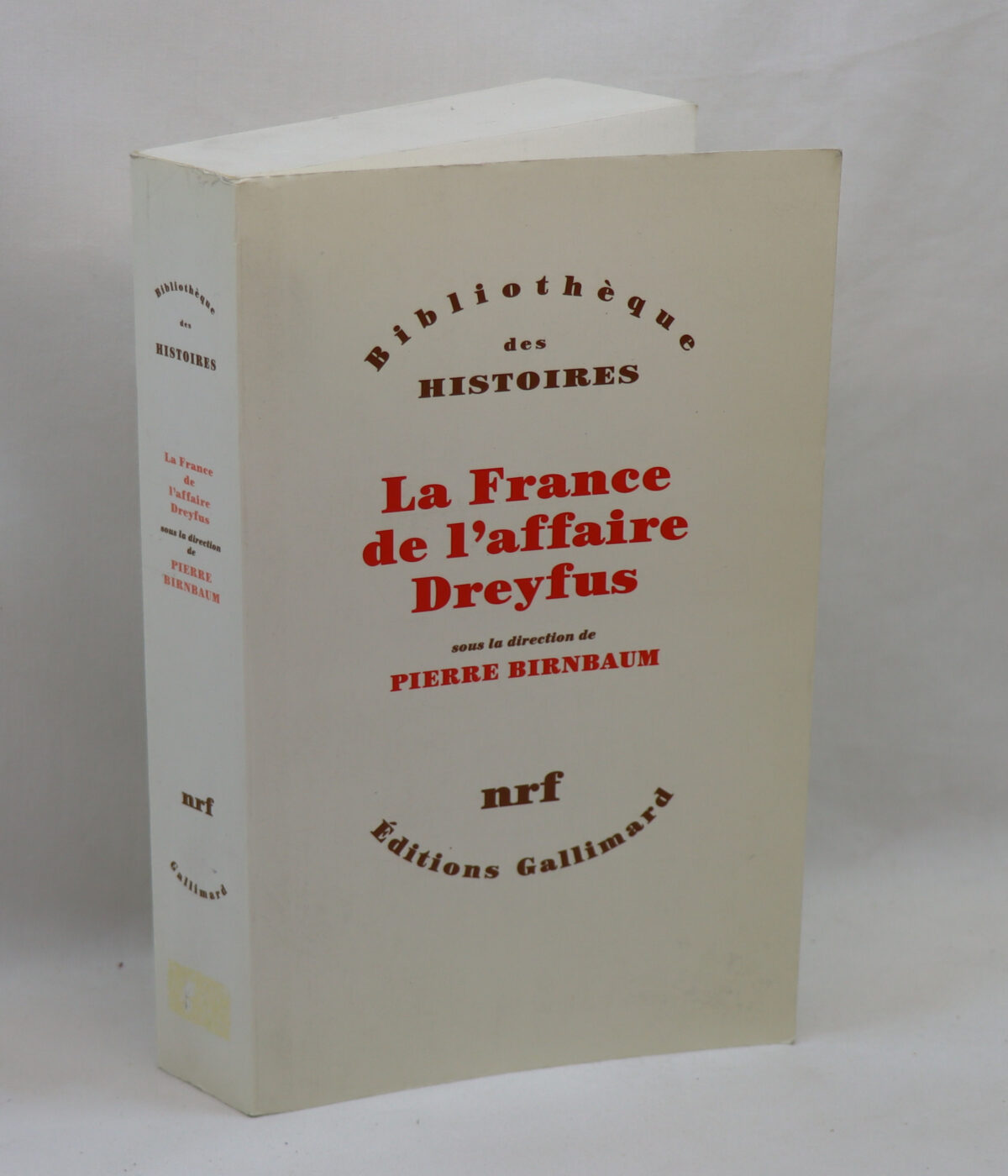
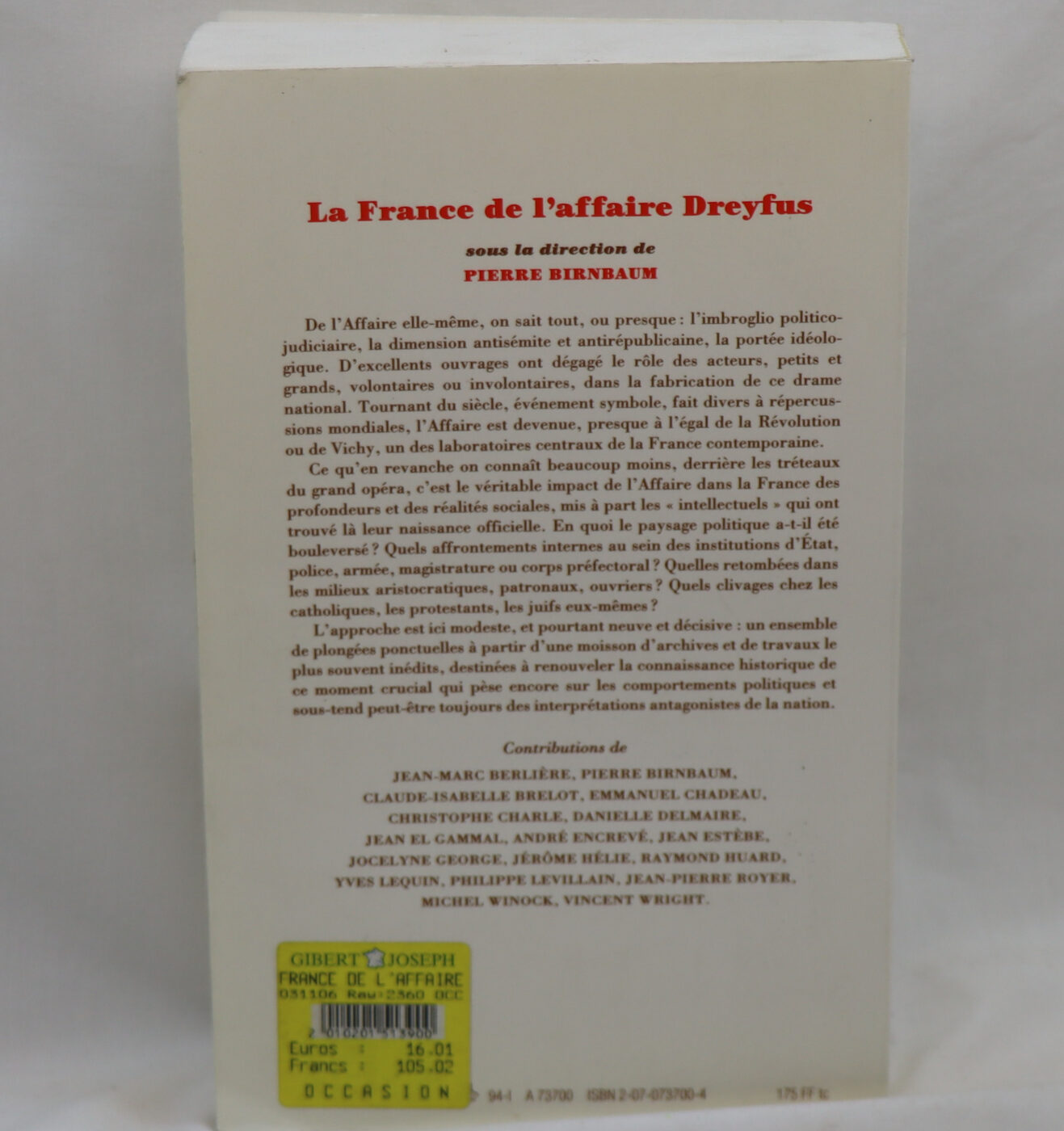
La France de L'affaire Dreyfus.
By Pierre Birnbaum
Printed: 1994
Publisher: Gallimard.
| Dimensions | 14 × 23 × 4 cm |
|---|---|
| Language |
Language: French
Size (cminches): 14 x 23 x 4
Condition: Very good (See explanation of ratings)
£10.00
Buy Now
Your items
Item information
Description
Paperback. Cream cover and red title.
We provide an in-depth photographic presentation of this item to stimulate your feeling and touch. More traditional book descriptions are immediately available.
- Note: This book carries a £5.00 discount to those that subscribe to the F.B.A. mailing list
Décembre 1894. Alfred Dreyfus, un jeune officier juif, est jugé pour haute trahison. Il est condamné à la déportation perpétuelle et à la dégradation militaire. Quatre ans plus tard, Emile Zola clame l’innocence du condamné. C’est le célèbre ” J’accuse “. La France s’enflamme. Pour le droit ou pour l’armée ? Les passions se déchaînent. Ce qui s’annonçait comme un fait divers a débouché sur un furieux affrontement dreyfusards contre anti-dreyfusards, combattants de la justice contre partisans de l’armée, adeptes des Lumières contre nationalistes et antisémites. En retraçant les épisodes marquants de l’Affaire, Pierre Birnbaum suggère un combat d’une autre ampleur : celui que la République dut livrer contre elle-même.
The Dreyfus affair (French: affaire Dreyfus, was a political scandal that divided the Third French Republic from 1894 until its resolution in 1906. The scandal began in December 1894 when Captain Alfred Dreyfus, a 35-year-old Alsatian French artillery officer of Jewish descent, was wrongfully convicted of treason for communicating French military secrets to the German Embassy in Paris. He was sentenced to life imprisonment and sent overseas to the penal colony on Devil’s Island in French Guiana, where he spent the following five years imprisoned in very harsh conditions.
In 1896, evidence came to light—primarily through the investigations of Lieutenant Colonel Georges Picquart, head of counter-espionage—that identified the real culprit as a French Army major named Ferdinand Walsin Esterhazy. High-ranking military officials suppressed the new evidence, and a military court unanimously acquitted Esterhazy after a trial lasting only two days. The Army laid additional charges against Dreyfus, based on forged documents. Subsequently, writer Émile Zola’s open letter “J’Accuse…!” in the newspaper L’Aurore stoked a growing movement of political support for Dreyfus, putting pressure on the government to reopen the case.
In 1899, Dreyfus was returned to France for another trial. The intense political and judicial scandal that ensued divided French society between those who supported Dreyfus, the “Dreyfusards” such as Sarah Bernhardt, Anatole France, Charles Péguy, Henri Poincaré, Georges Méliès, and Georges Clemenceau; and those who condemned him, the “anti-Dreyfusards” such as Édouard Drumont, the director and publisher of the antisemitic newspaper La Libre Parole. The new trial resulted in another conviction and a 10-year sentence, but Dreyfus was pardoned and released. In 1906, Dreyfus was exonerated. After being reinstated as a major in the French Army, he served during the whole of World War I, ending his service with the rank of lieutenant colonel. He died in 1935.
The Dreyfus affair came to symbolise modern injustice in the Francophone world;it remains one of the most notable examples of a miscarriage of justice and of antisemitism. The affair divided France into pro-republican, anticlerical Dreyfusards and pro-army, mostly Catholic anti-Dreyfusards, embittering French politics and encouraging radicalisation. The press played a crucial role in exposing information and in shaping and expressing public opinion on both sides of the conflict.
Want to know more about this item?
We are happy to answer any questions you may have about this item. In addition, it is also possible to request more photographs if there is something specific you want illustrated.
Ask a question
Related products
Share this Page with a friend
